Start-up rivals Nestlé with coffee capsules; Ex-City duo make CaféPod a player in the market
December 2, 2013 Leave a comment
Start-up rivals Nestlé with coffee capsules
Ex-City duo make CaféPod a player in the market
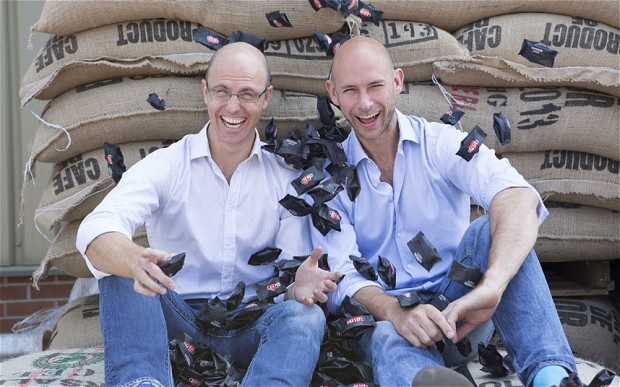
When Nestle’s coffee capsule patents expired in 2011, South African-born Peter Grainger and Brent Hadfield were ready to enter the market.
By Anna White
9:00PM GMT 30 Nov 2013
Two hedge fund executives-turned-baristas behind CaféPod have stirred up the UK coffee market and shown how a battle against a larger incumbent – even a corporate giant – can be won if you follow the right strategy.Since the introduction of the Nespresso machine in 1986, the multinational food and beverage maker Nestlé held patents preventing competitors from producing coffee capsules compatible with their machines.
When those patents expired in 2011, South African-born Peter Grainger and Brent Hadfield were ready to enter the market. CaféPod is now a player in the lucrative coffee capsule market. Its range of products is available in every Waitrose and in 300 Morrisons stores.
“The winner is the consumer,” says Grainger. “There’s more choice and more flavour. We’ve taken the froth off the premium coffee market by making the pods more accessible.”
He and Hadfield have seen growth of 350pc over the past quarter and the company is forecast to hit £1m of revenues in 2014.
The two men, formerly of fund manager GLG Partners, judged that the fast-growing consumer appetite for espressos, lattes and cappuccinos in the home could accommodate another player in the capsule market.
According to a Keynote report published in February, coffee sales are up 36.6pc over the past four years in comparison with tea which saw growth of 14.6pc.
“UK coffee tastes have changed,” says Grainger, 35. “The nation of tea drinkers is now a nation of coffee drinkers, and the Brits like their coffee strong.”
CaféPod’s latest product in a range of five boasts a coffee of the highest possible intensity and is already their best seller after three weeks on the shelves.
“The psychology of coffee is complex,” Grainger says. “We are catering for the occasional drinker, to the addict, to the gym-goer who has a hit of coffee before working out,”
CaféPod also sells to small businesses, typically with fewer than 100 employees in one premises, such as estate agents, and is stocked in the bedrooms of some boutique hotels such as the Accor-owned Jupiter chain.
With no experience in coffee, operations or marketing, Grainger and Hadfield realised they needed to recruit sector-specific expertise.
Kate Peers, an American marketer who helped take the Seattle Coffee Company from just one store in Covent Garden to a 50-strong operation acquired by Starbucks, was the first to arrive. Commercial director, Philip Banfield, of Allied British Foods, followed. He had experience selling to supermarkets.
CaféPod also hired an in-house roaster from heritage coffee and tea maker Taylors of Harrogate and sourced beans from coffee growers around the world.
The one ingredient missing was funding. The directors decided to seek investment from an angel network rather than institutional lenders.
“There is a lot of talk from Government and the banks about lending initiatives for small businesses and start-ups but on the streets of business this doesn’t exist,” says Grainger.
Equipped with investment and a small overdraft CaféPod was confronted with its first sizeable problem – how to make the pods.
Excluding Nestlé, the only other two producers were US pudding company Sara Lee and French capsule brand Ethical Coffee Company but both produced exclusively for their own use.
Undeterred, Grainger and Hadfield built their own equipment. The 10ft sq piece of machinery is now housed in a factory in Lincolnshire, next to the coffee roasting plant.
“Efficiency is the name of the game in manufacturing,” says Hadfield, 30.
“By working with small suppliers we can manage and guarantee quality and consistency of product. For big suppliers we are just a tiny little fish and they don’t care, yet supply and consistency of product is the be all and end all to us.
“A typical manufacturer has 3pc to 5pc wastage. We now run at about 1.5pc.”
In marketing terms, the team faced two distinct challenges.
First, to tackle the assumption by Nespresso machine owners that they could only buy the capsules online or in Nepresso stores.
Second, to take on a Goliath of the brand world with Hollywood stars such as George Clooney and Matt Damon fronting its advertising campaign.
“Small companies have small marketing budgets,” says Grainger. “So we had to spend smartly.”
With a strategy to target professionals aged between 25 and 55, CaféPod started offering tasters outside Waitrose stores in the business districts of London.
Although time consuming and labour intensive, informing Nespresso owners that capsules could be bought instore always led to a spike in sales.
The CaféPod team decided it was better to favour sampling in stores and product promotions over social media.
“However many followers you have on Twitter does not put more money in the bank,” says Grainger. “It’s the quality of those followers.
“It’s easy to get caught up with cool new marketing fads but we’re sticking to the basics.”
Grainger and Hadfield’s expansion ambitions are anything but basic with their sights fixed firmly on the growth opportunities presented by Western Europe – Spain, for example, has 55 Nespresso stores in comparison with five in the UK.
“The Middle East is also a target as consumer trends in that region are driven by those in the West,” Hadfield says. “We’re currently looking to Dubai.”
From their headquarters in Putney, south west London, Hadfield and Grainger also have big ideas about entering the Japanese market, where there is a strong appetite for high quality consumer goods.
“Taking on the crown jewel of Nestlé was not to be taken lightly but we knew it was an opportunity that couldn’t just be ignored,” says Grainger.
 About bambooinnovator
 Bamboo Innovator