Borders Raise Hurdles For Baltic High-Speed Rail Link; Snags to Fast-Train Project Underscore Challenges to EU Rail Push to Boost Growth
December 10, 2013 Leave a comment
Borders Raise Hurdles For Baltic High-Speed Rail Link
Snags to Fast-Train Project Underscore Challenges to EU Rail Push to Boost Growth
FRANCES ROBINSON And LIIS KÄNGSEPP
Dec. 8, 2013 7:39 p.m. ET
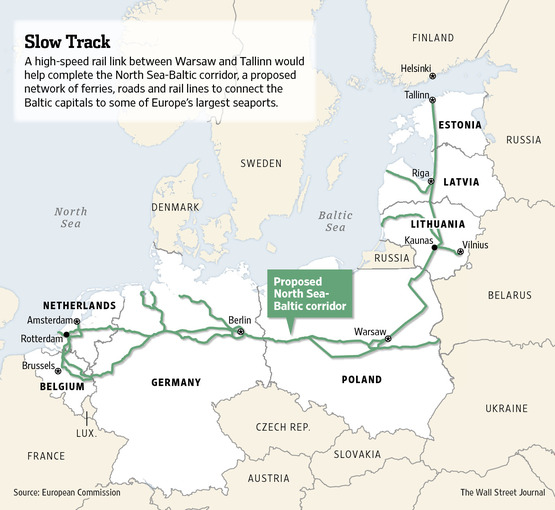
TALLINN, Estonia—A high-speed rail project linking the three Baltic states embodies the economic hopes the European Union has placed on the fast-train technology. It also exemplifies one of high-speed’s biggest hurdles: national borders.Europe’s Transport Ambitions
The North Sea-Baltic corridor would connect the Baltic capitals to some of Europe’s largest seaports in The Netherlands and Belgium.
Unlike the U.S., where politics and costs have been a drag on high-speed rail, Western Europe already has an extensive network that began with the launch of France’s Train à Grande Vitesse, or TGV, in 1981. But a new EU push aims to expand it across multiple countries, upgrading more than 9,000 miles of railways to create nine transport corridors—including some high-speed rail—that link ports and significant trade routes across Europe.
EU officials hope the grand transport plan—part of a €26 billion ($34.9 billion) infrastructure initiative over the next seven years—will create tens of thousands of jobs, boost trade and promote growth in the recession-weary bloc. But they say that can only happen if member states contribute and prioritize building the transnational links over domestic rail projects—a challenge particularly in newer EU countries to the east, where the high-speed lines have to be built from scratch.
The many joint decisions Lithuania, Latvia and Estonia face over Rail Baltic—part of a proposed corridor that would join North Sea ports such as Rotterdam and Hamburg with the Baltic Sea by 2024—underscore the long road ahead.
“Of course there are some disagreements, also at a political level,” said Ilze Aleksandrovica, deputy state secretary of Latvia’s transport ministry. “But we need to discuss how to find compromises on each countries’ interests.”
The latest problem: the route. Lithuania is insisting the high-speed link include its capital, Vilnius, which isn’t part of the current plans—although the route includes the other Baltic states’ capitals. The stop would create a detour, though, and high-speed trains work best on fairly straight routes with infrequent stops.
Ms. Aleksandrovica of Latvia said she is happy for the route to go through Vilnius but “Lithuania should finance this on its own.”
As recently as October, the countries were sticking to plans to set up a joint venture company to manage the project and to apply for EU funds by the end of this year. This now seems unlikely to be completed before March 2014, she said.
“We are working so that we have the shareholders agreement ready by January 2014, solving the formalities may take up to March,” she said in an interview, adding more delays are possible.
One factor could be the resignation of Latvia’s government in late November after the collapse of a Lithuanian-owned supermarket killed more than 50 people. Ms. Aleksandrovica, who is working on the project, doesn’t know if she will remain in her role.
In Brussels, EU officials say they are worried about the delays. Pavel Telicka, the EU coordinator for the Rail Baltic project, said in an annual report presented in November that the pace of building new sections of track “is a cause for concern” and that countries must cooperate. “A unified, collective effort is required from all the partner countries in the next five years if the project is to be successfully achieved,” he wrote.
Governments also face intense pressure by domestic companies and industry groups to focus on improving rail links to Russia instead, transporting oil and minerals to the Baltic Sea. The EU money is earmarked for European standard-gauge railways only and can’t be spent on wider, Russian-gauge lines that currently make up the Baltic states’ rail network.
“In all the Baltic countries you’ll find people who are very much against Rail Baltic and who still believe that it would be a major economic advantage to rather develop railway connections between the Baltic countries and Russia,” said EU Transport Commissioner Siim Kallas, Estonia’s former prime minister. “Some people in the Baltics still believe that transit to Russia is a ‘golden fleece,’ a miracle that will make you rich.”
EU and Baltic state officials have been discussing the Rail Baltic project for years. A 2007 commission report originally envisioned the project being completed by 2016, eight years before the current target.
The EU is providing funds to cover as much as 85% of the estimated €3.6 billion Baltic link, whose construction is expected to create roughly 12,000 jobs.
The remainder will likely come from loans from the European Investment Bank and the Nordic Investment Bank. EU officials say that by building the nine trans-European corridors, they hope to bolster European companies’ competitiveness, given that transport costs in Europe make up between 2% and 10% of businesses’ total costs, according to the European Commission.
But to pull off the high-speed rail project, the national governments have to dedicate the funds to the new lines instead of improving existing domestic lines. “Rail Baltic creates a new infrastructure and cooperation questions have to be solved,” said Juhan Parts, Estonia’s transport minister.
The countries already have run into disagreements over how EU funds have so far been applied. On the “Rail Baltic Express” in October, a special train aimed at showcasing the Baltic states’ rail cooperation, EU and national transport officials rode along 370 miles of winding track spanning the three countries’ capitals.
On board, a video on giant flat screens informed passengers that Lithuania had already embarked on the high-speed project, investing EU and national funds in improving links from the country’s second largest city, Kaunas, to the Polish border. Estonian and Latvian officials on the train disputed the assertion, saying the upgrades were to a track that won’t contribute to the trans-Baltic project.
If the countries don’t bid for EU funds or complete phases of the high-speed link by certain dates, they risk the money being reclaimed or transferred to other projects in Europe.
Mr. Kallas notes the commission in recent years has reclaimed about €400 million from countries that didn’t completed previous EU-subsidized transport projects or meet established criteria.
Even with compromises, national officials in the Baltic states say they’re convinced of the value of building the high-speed link. Estonia’s Mr. Parts cites the cooperation between Helsinki and Tallinn, two cities that are divided by 50 miles of sea. Getting from one capital to the other takes less than two hours on a ferry, and there are several connections a day.
“In the early 1990s there were maybe nine people traveling between Helsinki and Tallinn a day as there were no connections,” Mr. Parts said. “Today we have nine million passengers going back and forth annually between the two cities.”
 About bambooinnovator
 Bamboo Innovator