In Bankruptcy, Detroit Curses the Darkness
December 10, 2013 Leave a comment
In Bankruptcy, Detroit Curses the Darkness
Nearly Half City’s 88,000 Lights Are Broken; New Authority Plans to Borrow Funds to Revamp System
MATTHEW DOLAN
Dec. 8, 2013 6:50 p.m. ET
Almost half of the 88,000 streetlights in Detroit are out. And the bankrpt city is desperate to raise funds to repair them. WSJ’s Matthew Dolan reports.
DETROIT—On Harper Avenue, along a busy but dimly lighted commercial strip of shops and corner bars, James Jennings checked one street lamp after another, searching for one he could fix.“If I can get it burning, I’ll get it burning,” Mr. Jennings said. But the night-shift worker for the Detroit Public Lighting Department wasn’t having much luck. Most of the poles here are stripped of copper or the underground wiring is fried—trouble that no new bulb will correct.
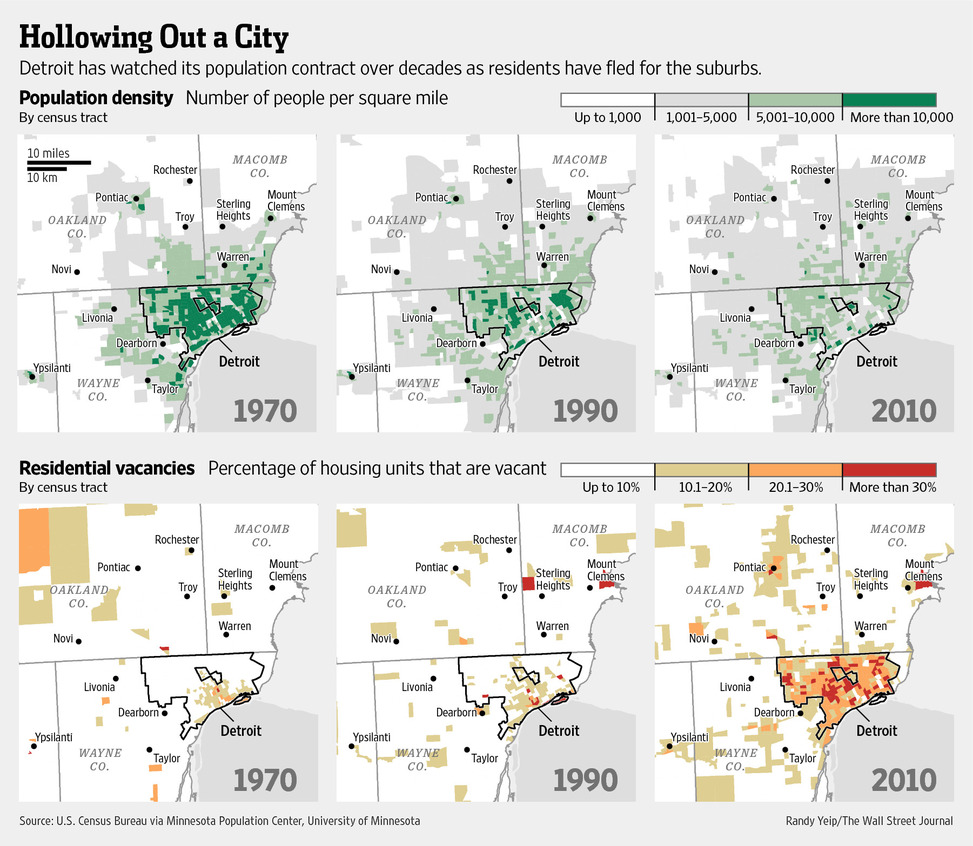
Problems in this bankrupt city run deep. Police on average take nearly an hour to respond to some of the most serious calls. Firefighters must contend with blazes that erupt among the roughly 78,000 abandoned and vacant structures. The population has shrunk to 700,000 from a high of 1.8 million decades ago.
But when federal bankruptcy Judge Steven Rhodes last week affirmed the city’s eligibility for Chapter 9 bankruptcy, he cited streetlights as a prime example of Detroit’s decline. Nearly half of the city’s 88,000 street lamps are dark, according to city estimates.
“The city does not have enough money to take care of its residents, let alone pay its debts,” the judge said in the Dec. 3 ruling that cleared the way for Detroit to cut future payments to unsecured creditors, including pension funds.
As part of its bankruptcy filed in July, Detroit is seeking to restructure roughly $18 billion in long-term obligations. The city’s initial plan, unveiled over the summer, called for repaying unsecured creditors less than 20 cents on the dollar and using $1.25 billion in one-time savings to reduce crime and blight with improved police and fire services, as well as continued demolition of abandoned structures.
Detroit’s Emergency Manager Kevyn Orr also wants a new state-approved lighting authority to replace the city’s lighting department and borrow $210 million to replace 46,000 streetlights in the city’s most populous neighborhoods.
“The lighting question is one of the foremost questions in the city,” Mr. Orr said in an interview, because of its impact on public safety.
But bankruptcy makes city repairs a challenge. “We don’t oppose the idea of providing light to the citizens of the city,” said Ryan Bennett, an attorney with Kirkland & Ellis who represents Syncora, a bond insurer that opposed the borrowing plan. Syncora, which is backing part of the city’s debt, questioned how Detroit can raise new funds before a judge makes final a plan to repay its existing creditors.
When Syncora claimed in court last month that Detroit had kept them in the dark over terms of the proposed lighting deal, Judge Rhodes said, “The dark you’re in doesn’t compare to the dark the citizens of Detroit suffer day in, day out and the crime that results from that.”
On Friday, Judge Rhodes approved the plan by the Detroit Public Lighting Authority.
As the street-lighting repair crew struggled on a recent night to find a fixable street lamp on Harper Avenue, business owners complained of their shortened work days.
“You don’t feel safe because of the lighting,” said James Lawrence, who co-owns City Sweets, a penny-candy store. “When it starts to get dark, we just pack up and go home.”
Control of the city’s century-old lighting department now rests in the hands of Beau Taylor, age 35, who said he was surprised to learn that streetlights must often be illuminated by manually flipping switches in substations across Detroit.
“This department has slowly, slowly fallen into the abyss,” said Mr. Taylor, the acting director, during a tour of the nearly vacant headquarters. “My job is to stabilize this department until we get out of this business.”
Mr. Taylor said he has no idea from day to day which streetlights are working unless someone calls to complain or if crews report outages. The only map of the system is a decades-old wall-hanging with colored pushpins. Officials estimated in 2011 that 21,500 lights were out. Today, they estimate twice that.
Five private companies were hired this fall to help the city lighting department’s 85 workers—down from more than 500 at its peak.
It is tough going. Spare parts for 15,500 lights are almost impossible to find because they are no longer manufactured.
And thousands of streetlights are configured like a string of old-fashioned Christmas lights: When one lamp blows out, the whole block goes dark.
The public and private crews have managed to restore thousands of street lamps, city leaders said, giving priority to places where more people live, drive and do business after dark. New LED lights increase illumination with fewer lamps.
“Everybody wants their light fixed, and people who are naysayers say we’re picking winners and losers,” Mr. Taylor said of his limited resources. “But, no, we’re applying logic.”
That hasn’t helped residents like Norman Morgan. The 73-year-old retired auto worker has lived for 26 years on East Outer Drive, a once-grand boulevard where about 70% of the lights are out, according to city officials. The lights in front of Mr. Morgan’s house have been off for six years, he said.
“We have had traffic accidents,” Mr. Morgan said. “Houses around here have been vandalized like mad.”
Odis Jones, a former official in Cincinnati, is head of the new lighting authority.
He said he has $12.5 million from the city to revamp roughly 5,000 streetlamps in two areas. He hopes to leverage the utility taxes paid by Detroit residents to back the $210 million in new lending.
Mr. Jones said the total bill to revamp lighting over the city’s 139 square miles is closer to $400 million, far beyond the authority’s borrowing capacity.
Under the current plan, the total number of streetlights will be cut by around 45%.
Alley lights will be removed and the most underused blocks will get streetlights only at intersections.
“We’re not trying to build a Cadillac here,” Mr. Jones said, “just a reliable Chevy.”
 About bambooinnovator
 Bamboo Innovator