Sky-High Stocks: A Split Decision?
December 10, 2013 Leave a comment
Dec 6, 2013
Sky-High Stocks: A Split Decision?
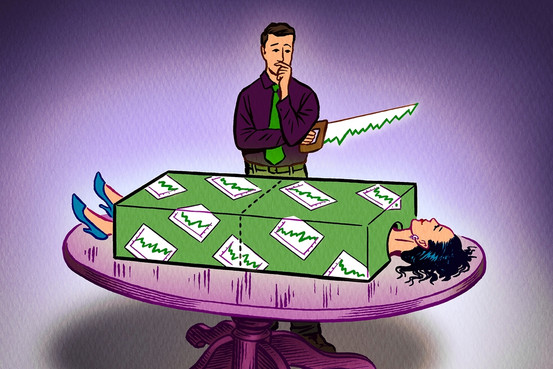
Stock splits have gone Splitsville.
So far this year, only 11 companies in the S&P 500 index have “split” their shares—the fourth-lowest number on record and down from an average of nearly 65 a year in the 1990s, according to Howard Silverblatt, a senior analyst at S&P Dow Jones Indices. In a stock split, a company increases the number of shares you hold while lowering the price accordingly. A 2-for-1 split, for instance, would turn one share of a $100 stock into two shares worth $50 apiece.If you are thinking that two nickels wouldn’t make you any richer than one dime, you are right. But investors don’t always think so clearly, and the decline of splits could be a sign that the markets haven’t gone as gaga as some skeptics fear.
Years ago, near the peak of the Internet bubble, just the announcement of a split could send a stock into orbit. On Jan. 25, 1999, XeroxXRX +2.17% shot up 10.4% when the company said it would split 2-for-1. The next day, eBay went one better with a 3-for-1 announcement that sent its stock up 37.4%.
Back then, active retail traders paid up to $1,000 a year for pager services that would beep them with news of upcoming splits. In 2000, one investor emailed me: “I own IntelINTC +2.31% and need two more splits after the one in July to retire.” (I never heard from him again; Intel hasn’t split since.) Some research has showed stocks that split have better long-term returns than those that don’t, perhaps because investors believe splits signal corporate health. But those findings have been contested, and investors who think that splits are a reliable way to beat the market are asking for heartbreak.
Traditionally, companies appear to have targeted their share prices to a level they believed would appeal to the individual investors who then dominated the markets. Cornell University finance professor Roni Michaely and his colleagues have found that between 1933 and 2007 the average share price of major U.S. stocks remained remarkably constant, rarely straying far from $25 to $35. Anytime a stock went much higher, the company chopped it back down with a stock split. (Warren Buffett’s Berkshire Hathaway, whose A shares have never split and trade above $174,000, was long the glaring exception.)
A few companies, including Cabot Oil & Gas, Colgate-Palmolive and Lorillard, have split this year. But NetflixNFLX -1.01%, which last split in February 2004 when it passed $70, has stayed whole, lately soaring above $355 a share.
Amazon.comAMZN +0.64%
split twice in 1999—but never since, even with the shares nearing $400. Netflix didn’t respond to a request for comment; Amazon.com declined to comment.
Mr. Silverblatt of S&P Dow Jones Indices calculates that the average stock price in the S&P 500 is up 29% this year, to an all-time high of $75.83. At the end of 2011 only 33 companies in the S&P 500 had share prices over $100. This week, 78 did. Six are over $500 a share; two (Priceline.com and Google) top $1,000. At the end of 2011, Google was the only S&P 500 stock trading above $500.
Why have splits dwindled?
Splitting a stock costs a company at least a few hundred thousand dollars, say industry experts. And “as long as we’re in this economic malaise, a lot of [companies] are going to hold their cards and just wait,” says David DeSonier, head of investor relations at Leggett & Platt, a manufacturer based in Carthage, Mo., whose stock hasn’t split since 1998.
The high-frequency trading firms that hold shares for less than one day at a time earn tiny profits per share, making it more profitable for them to trade stocks with lower prices, trading experts say. “A lot of companies do think they become high-frequency prey at a lower share price,” says Ana Avramovic, a trading strategist at Credit Suisse in New York. Therefore, they may be avoiding splits in an attempt to shelter their stock from churning and volatility.
John Linehan, head of U.S. equity at T. Rowe Price in Baltimore, says that the success of companies like Google, Apple and Priceline has made it “a badge of honor to be able to say that your stock is at $500 or $600 a share or more.”
On balance, the decline of splits is probably healthy.
Individual investors can trade shares priced at hundreds of dollars apiece—or even a few thousand dollars—just as economically as those priced at $10 or $20, says Joe Saluzzi, partner at Themis Trading, an institutional brokerage firm in Chatham, N.J.
Companies appear to care less today about catering to the delusion that anyone can get rich quick off stock splits. Now if only investors would learn that the value of a business matters more than the price of its stock, we could all split and go home.
 About bambooinnovator
 Bamboo Innovator