Google Adds to Its Menagerie of Robots; Boston Dynamics’ four-legged robot named WildCat can gallop at high speeds.
December 15, 2013 Leave a comment
December 14, 2013
Google Adds to Its Menagerie of Robots
By JOHN MARKOFF
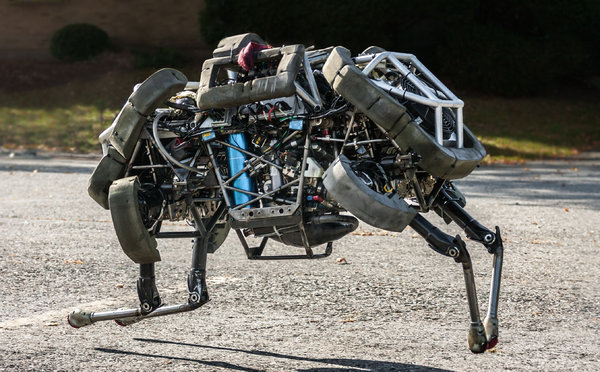
Boston Dynamics’ four-legged robot named WildCat can gallop at high speeds.
SAN FRANCISCO — BigDog, Cheetah, WildCat and Atlas have joined Google’s growing robot menagerie. Google confirmed on Friday that it had completed the acquisition of Boston Dynamics, an engineering company that has designed mobile research robots for the Pentagon. The company, based in Waltham, Mass., has gained an international reputation for machines that walk with an uncanny sense of balance and even — cheetahlike — run faster than the fastest humans.It is the eighth robotics company that Google has acquired in the last half-year. Executives at the Internet giant are circumspect about what exactly they plan to do with their robot collection. But Boston Dynamics and its animal kingdom-themed machines bring significant cachet to Google’s robotic efforts, which are being led by Andy Rubin, the Google executive who spearheaded the development of Android, the world’s most widely used smartphone software.
The deal is also the clearest indication yet that Google is intent on building a new class of autonomous systems that might do anything from warehouse work to package delivery and even elder care.
Boston Dynamics was founded in 1992 by Marc Raibert, a former professor at the Massachusetts Institute of Technology. It has not sold robots commercially, but has pushed the limits of mobile and off-road robotics technology, mostly for Pentagon clients like the Defense Advanced Research Projects Agency, or Darpa. Early on, the company also did consulting work for Sony on consumer robots like the Aibo robotic dog.
Boston Dynamics’ walking robots have a reputation for being extraordinarily agile, able to walk over rough terrain and handle surfaces that in some cases are challenging even for humans.
A video of one of its robots named BigDog shows a noisy, gas-powered, four-legged, walking robot that climbs hills, travels through snow, skitters precariously on ice and even manages to stay upright in response to a well-placed human kick. BigDog development started in 2003 in partnership with the British robot maker Foster-Miller, NASA’s Jet Propulsion Laboratory and Harvard.
The video has been viewed more than 15 million times since it was posted on YouTube in 2008.
More recently, Boston Dynamics distributed a video of a four-legged robot named WildCat, galloping in high-speed circles in a parking lot.
Although the videos frequently inspire comments that the robots will evolve into scary killing machines straight out of the “Terminator” movies, Dr. Raibert has said in the past that he does not consider his company to be a military contractor — it is merely trying to advance robotics technology. Google executives said the company would honor existing military contracts, but that it did not plan to move toward becoming a military contractor on its own.
Under a $10.8 million contract, Boston Dynamics is currently supplying Darpa with a set of humanoid robots named Atlas to participate in the Darpa Robotics Challenge, a two-year contest with a $2 million prize. The contest’s goal is creating a class of robots that can operate in natural disasters and catastrophes like the nuclear power plant meltdown in Fukushima, Japan.
“Competitions like the Darpa Robotics Challenge stretch participants to try to solve problems that matter and we hope to learn from the teams’ insights around disaster relief,” Mr. Rubin said in a statement released by Google.
Boston Dynamics has also designed robots that can climb walls and trees as well as other two- and four-legged walking robots, a neat match to Mr. Rubin’s notion that “computers are starting to sprout legs and move around in the environment.”
A recent video shows a robot named Cheetah running on a treadmill. This year, the robot was clocked running 29 miles per hour, surpassing the previous legged robot land speed record of 13.1 m.p.h., set in 1999. That’s about one mile per hour faster than Jamaica’s Usain Bolt, the two-time Olympic gold medalist in the 100-meter dash. But it’s far short of a real cheetah, which can hit 65 m.p.h.
Google’s other robotics acquisitions include companies in the United States and Japan that have pioneered a range of technologies including software for advanced robot arms, grasping technology and computer vision. Mr. Rubin has also said that he is interested in advancing sensor technology.
Mr. Rubin has called his robotics effort a “moonshot,” but has declined to describe specific products that might come from the project. He has, however, also said that he does not expect initial product development to go on for years, indicating that Google commercial robots of some nature could be available in the next several years.
Google declined to say how much it paid for its newest robotics acquisition and said that it did not plan to release financial information on any of the other companies it has recently bought.
Dr. Raibert is known as the father of walking robots in the United States. He originally created the Leg Lab, a research laboratory to explore walking machines at Carnegie Mellon University in 1980. He then moved the laboratory to M.I.T. before leaving academia to build engineering systems for the military and Sony.
His research in walking robots began with a pogo-stick project called “the hopper,” which he used to test basic concepts.
“I am excited by Andy and Google’s ability to think very, very big,” Dr. Raibert said, “with the resources to make it happen.”
 About bambooinnovator
 Bamboo Innovator