Investors Who Keep Trading—and Trading; Why do so many high-end investors struggle with making trades?
December 15, 2013 Leave a comment
Investors Who Keep Trading—and Trading
Why do so many high-end investors struggle with making trades?
JASON ZWEIG
Dec. 13, 2013 11:26 a.m. ET
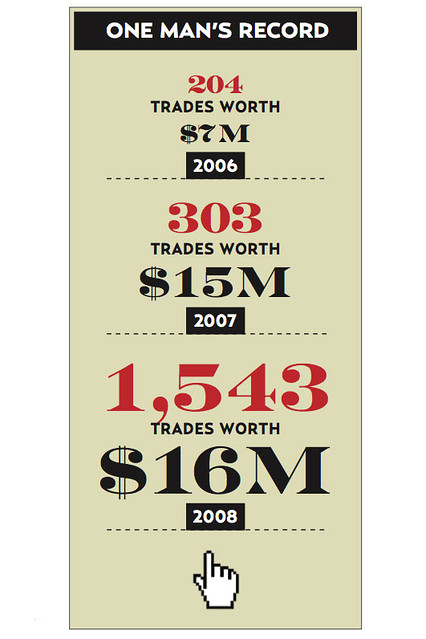
“THE INVESTOR’S CHIEF problem—and even his worst enemy—is likely to be himself.” Those words from Benjamin Graham, the great investment theorist and mentor to Warren Buffett, are as true for wealthy investors today as when he wrote them in 1949. And they apply at least as well to wealthy investors as they do to everyone else. In fact, having more money can make individuals even more inclined to violate certain basic rules of investing.Consider Thomas Endicott. After stepping down in 2002 as president of a manufacturing company in Muncie, Ind., Endicott focused his time on managing his seven-figure investment portfolio. Perhaps too much time. In 2008, Endicott says, he traded 1,543 times during just 112 days, largely using margin, or money he borrowed from his brokers. He spent an average of six hours a day trading and monitoring his accounts. Between 2006 and 2008, he held his average position for just 35 days at a time and traded so frequently that his purchases and sales combined totaled around $38 million. Endicott also spent nearly $700,000 on margin-interest charges, and over the course of three years his accounts generated $1.1 million in long-term capital losses. Lesson learned: “Success in business is not necessarily transferrable to success in investing,” Endicott says.
Many high-net-worth investors manage successful careers and are used to being in control. Yet given how unpredictable financial markets can be, wealthier investors often struggle more than others when it comes to making trades, says Paul Winter, president of Five Seasons Financial Planning in Salt Lake City. As the old saying on Wall Street goes, after all, “the stock doesn’t know you own it.”
Another mistake more common among the richest investors is that they hold too much of their money in the stock of a single company, often the one they help manage. Because senior executives are often paid largely with stock and options, they may be required to hold these concentrated investment positions for years on end. “But if you’re going to overweight one company,” says Allan Roth of Wealth Logic, a financial-advisory firm in Colorado Springs, Colo., “don’t make it the one your paycheck and bonuses are based on.” Indeed, Winter urges his clients to figure out how their financial and retirement plans would have to change if the value of their concentrated stock position went to zero. After that exercise, he says, most begin selling at least some shares to diversify into other holdings.
Still another mistake is to keep too much money in cash—which, ironically, exposes the portfolios of the wealthy to risks that middle-class investors don’t face at all. One of Roth’s clients had more than $15 million in cash, nearly all at a brokerage firm, where the Securities Investor Protection Corp. covers cash up to $250,000—and then only under certain conditions. That left about 98 percent of the client’s cash uninsured. Meanwhile, a smaller investor who keeps cash in a bank is guaranteed up to $250,000 through the Federal Deposit Insurance Corp.—which likely is sufficient to protect nearly all his cash from potential loss. The investor says he just wanted a piece of his money safe, Roth recalls, but that left a large balance in a low-yielding vehicle that was incapable of overcoming the ravages of inflation. And he was turning down the FDIC’s broader protection on the cash, to boot. Instead of playing it safe, the client was exposed to at least two severe kinds of risk. “If you have any doubts that the markets are efficient,” says Roth, “there’s your proof that they aren’t.”
Oftentimes, financial advisers say, investors are blissfully oblivious to their own errors. So getting a second opinion on whether certain investing strategies make sense might be a much better use of time than making all those trades and monitoring each of those different accounts.
 About bambooinnovator
 Bamboo Innovator