Members of Thailand’s elite take to streets in anti-government protests

Members of Thailand’s elite take to streets in anti-government protests

Sunday, 15 December, 2013, 5:36am

Reuters in Bangkok

Members of rich families drop any pretence of neutrality as they join sometimes violent mass demonstrations against Yingluck’s government

Chitpas Bhirombhakdi is heiress to a US$2.6 billion family fortune and, according to high-society magazine Thailand Tatler, one of Bangkok’s “most eligible young ladies”. She can also handle tear gas and ride a tractor. Read more of this post

Yingluck Shinawatra’s tears divide Thailand

December 13, 2013 2:59 pm

Yingluck Shinawatra’s tears divide Thailand

By Michael Peel in Bangkok

In Thailand, even the prime minister’s tears divide the country. No sooner had Yingluck Shinawatra welled up briefly after pleading on national television this week for street protesters to go home than online critics were accusing her of fakery, pointing to video footage that showed her smiling almost immediately after she left the podium. Read more of this post

India’s Sun TV apologises for erroneous report on Little India riot

India’s Sun TV apologises for erroneous report on Little India riot

SINGAPORE — Indian news channel Sun TV has apologised for an erroneous report on the Little India riot on Sunday and broadcast the “correct” version, following complaints.

5 HOURS 17 MIN AGO

SINGAPORE — Indian news channel Sun TV has apologised for an erroneous report on the Little India riot on Sunday and broadcast the “correct” version, following complaints. The Tamil-language report was carried in the channel’s 7pm prime time bulletin on Tuesday, which is broadcast in Singapore at 9.30pm, said Mr R Umashankar, Editor In Charge of Sun TV’s News Section, in a letter sent to Mr Roy Kho, Singapore’s Consul-General in Chennai. A copy of the letter was released by the Ministry of Foreign Affairs (MFA) yesterday. Read more of this post

Is Singapore’s prized social stability under threat?

Is Singapore’s prized social stability under threat?

By Ansuya Harjani | CNBC – Fri, Dec 13, 2013 11:35 AM SGT

A rare incident of rioting in Singapore over the weekend has raised questions about social harmony in the wealthy Southeast Asian nation that has been built on a reputation of stability and prides itself on a long history of racial cohesion. The underlying cause for the violence late Sunday, which was triggered by a fatal road accident that killed an Indian national, appears to be the festering grievance among low-wage foreigners. Read more of this post

Penang homeowners may find it hard to sell their houses under new rules in Malaysia

Penang homeowners may find it hard to sell their houses under new rules

Monday, Dec 09, 2013

The Star/Asia News Network

GEORGE TOWN – Owners of affordable and low-cost homes in Penang will find it tougher to sell their properties as the state government plans to enforce strict rules to curb property speculation. From Feb 1 next year, owners of affordable homes (bought for below RM400,000 (S$154,000) on the island and RM250,000 on the mainland) would be barred from reselling their properties in the first five years of ownership. Read more of this post

Malaysia on alert after Little India riot in S’pore

Malaysia on alert after Little India riot in S’pore

PETALING JAYA — The police and Immigration Department have been put on alert at foreign worker enclaves across Malaysia after the riot in Singapore last week, the country’s Home Minister said in a report in The Star newspaper yesterday.

14 DECEMBER

PETALING JAYA — The police and Immigration Department have been put on alert at foreign worker enclaves across Malaysia after the riot in Singapore last week, the country’s Home Minister said in a report in The Star newspaper yesterday. Home Minister Ahmad Zahid Hamidi said officers have been instructed to monitor areas where foreign workers congregate, especially those identified as potential hot spots for outbreaks of violence. Read more of this post

Hurdles – and – hopes of buying KL stocks

Hurdles – and – hopes of buying KL stocks

Tuesday, Dec 10, 2013

Jonathan Kwok

The Straits Times

Most Singaporeans know Malaysia only as a place for good shopping but for a long time I’ve felt that I should shop for shares there too. The growth story is there: 4 to 6 per cent economic expansion each year is nothing to be sniffed at, and Malaysia has vast natural resources which usually translate into wealth. The country’s growth rate will probably outpace Singapore’s as it lifts millions of people into the middle class. Read more of this post

Unlikely Legacy Of Ponzi Scheme: A Bonanza for Newfangled Fund

Unlikely Legacy Of Ponzi Scheme: A Bonanza for Newfangled Fund

JASON ZWEIG

Dec. 10, 2013 11:04 p.m. ET

MI-CA152_MADZWE_NS_20131210184503

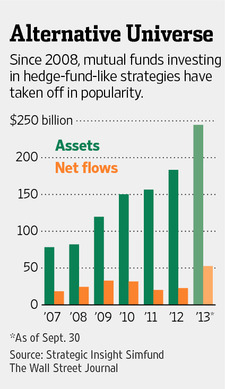
Five years later, the most ironic part of Bernard Madoff‘s legacy is clear: After his Ponzi scheme made hedge funds seem scary, especially to individual investors, the industry got busy making them seem safe enough for everybody. So-called liquid alternative funds have become the hottest thing in the mutual-fund business. These portfolios—essentially hedge funds with a longer, trendier name—employ such strategies as betting on mergers, wagering that stocks will go down as well as up, and using derivatives like futures and options. Their assets are up 33% this year to more than $244 billion, with nearly $53 billion flowing in through Sept. 30, according to Strategic Insight, a fund-industry research firm. Read more of this post

Traders Losing $1 Million Build EU Case for Bitcoin Regulation

Traders Losing $1 Million Build EU Case for Bitcoin Regulation

Trading Bitcoins could bleed you dry, the European Union’s top banking regulator said as it weighs whether to regulate virtual currencies. Thefts from digital wallets have exceeded $1 million in some cases and traders aren’t protected against losses if their virtual exchange collapses, the European Banking Authority said today in a report warning consumers about the risks of cybermoney. Read more of this post

Risk chasers emerge as QE market winners

Last updated: December 13, 2013 6:57 pm

Risk chasers emerge as QE market winners

By Michael MacKenzie in New York and Ralph Atkins in London

A hallmark of Communist centralised planning was the celebrated five-year plan. Next week the US – a bastion of laisser-faire economics – marks the fifth anniversary of the Federal Reserve’s switch to emergency interest rates anchored near zero per cent and to massive bond purchases. Clear winners under this grand monetary policy experiment – emulated globally – have been investors who held their noses, ignored fundamental market principles and bought equities and risky bonds, whose prices have been buoyed on a massive tide of central bank liquidity. Read more of this post

Rat-Infested South Africa Schools Foil Mandela Education Dream

Rat-Infested South Africa Schools Foil Mandela Education Dream

On his way to the toilet at his school in South Africa’s Soweto township, Simphiwe Bhengu passes broken chairs and piles of dumped textbooks. He steps through puddles of putrid water and skirts prowling rats before returning to a class of 40. Simphiwe, 15, is failing most of his subjects at Lamula Jubilee Secondary School. His father, David Bhengu, lays the blame on corruption and teachers who are too apathetic and underqualified to help his son achieve his goal of becoming a commercial lawyer. Read more of this post

Raising Minimum Wage Is a Bad Way to Help People

Raising Minimum Wage Is a Bad Way to Help People

Enthusiasm for a big increase in the federal minimum wage is building in the U.S. It’s a shame to see so much energy devoted to a policy that’s not only dubious but also sidelines better ideas. In his State of the Union address in February, President Barack Obama called for an increase in the federal minimum wage to $9 an hour from $7.25. Recently he said he supports a measure that would raise it in stages to a little more than $10. State and local governments across the country have been going ahead on their own. The president says there’s “no solid evidence” that raising the minimum wage would cost jobs. Read more of this post

Portuguese Conglomerate Espírito Santo Engages in Financial Gymnastics to Survive Crisis

Espírito Santo Engages in Financial Gymnastics to Survive Crisis

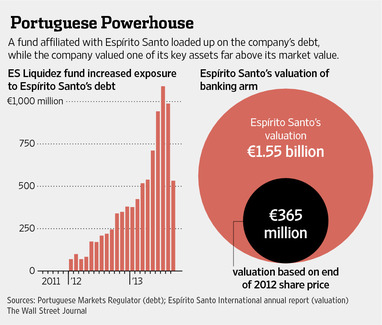
Portuguese Conglomerate Sold $8 Billion in Debt to One of Its Own Investment Funds

PATRICIA KOWSMANN

Updated Dec. 12, 2013 10:59 a.m. ET

EM-AY243_espiri_NS_20131212065406 (1)

LISBON—With Portugal all but shut out of global financial markets in 2011, one of the country’s largest conglomerates managed to find a source of easy cash: Over a 21-month period, it sold more than €6 billion ($8.27 billion) in debt to one of its own investment funds, sharply elevating the risk to investors. Read more of this post

It’s Hard to Summon Sympathy for Big Banks; Banks have gone from being viewed as national champions to being seen as a potential source of national disaster

December 12, 2013

It’s Hard to Summon Sympathy for Big Banks

By FLOYD NORRIS

It’s no fun to be a banker these days.

It is not just the increased regulation. It’s the lack of trust. “At what point does this stop?” asked Gary Lynch, the former director of enforcement for the Securities and Exchange Commission who has gone on to jobs with many leading Wall Street firms and is now global general counsel at Bank of America. He was referring to the escalation in penalties being levied on banks, culminating in the $13 billion JPMorgan Chase was forced to pay for a series of transgressions. Read more of this post

Is it better to play it safe or to place bets that risk bankruptcy? Society has a weakness for people whose foolish risks pay off and villains who tempt fate

December 10, 2013 3:51 pm

Is it better to play it safe or to place bets that risk bankruptcy?

By John Kay

Society has a weakness for people whose foolish risks pay off and villains who tempt fate

Financial options are difficult to value. It isn’t really the maths that is the problem.The Black-Scholes formula, which can be used to help value some of them, may look arcane to people who struggled with school algebra but is not – as they say – rocket science. (Rocket science is not very close to the frontier of mathematical knowledge either. Nor does Black-Scholes really solve the valuation question, though it is worth knowing that many people think it does). The problem is that the valuation of options exposes difficulties humans encounter in assessing risks and uncertainties. Read more of this post

In Russia, a Billionaire Scoffs at Oligarchs

In Russia, a Billionaire Scoffs at Oligarchs

Tinkov Considers Himself a Rarity in Country Known for Close Ties Between Business and Government

GREGORY L. WHITE

Dec. 13, 2013 4:52 p.m. ET

MOSCOW— Oleg Tinkov may have joined the ranks of Russia’s billionaires when his online bank went public in October, but don’t call him an oligarch. “Categorically not,” he says in his Russian-styled office on the outskirts of Moscow. Oligarch “means a person who works close to the government—there are lots of those,” he says, listing some of the country’s richest men. “But ones like me who built from nothing? Very few.” Read more of this post

IBM Says Economy Remains Discouraging

IBM Says Economy Remains Discouraging

International Business Machines Corp. (IBM), the world’s largest provider of computing services, continues to face economic challenges as it tries to reignite declining sales, Senior Vice President Erich Clementi said. Demand for technology services, IBM’s biggest source of revenue, “depends on what the economic climate is, and that has not been very encouraging,” Clementi said at a Bank of Montreal conference in New York yesterday. “Europe has shown signs of recovery. North America has been a little more uncertain.” Read more of this post

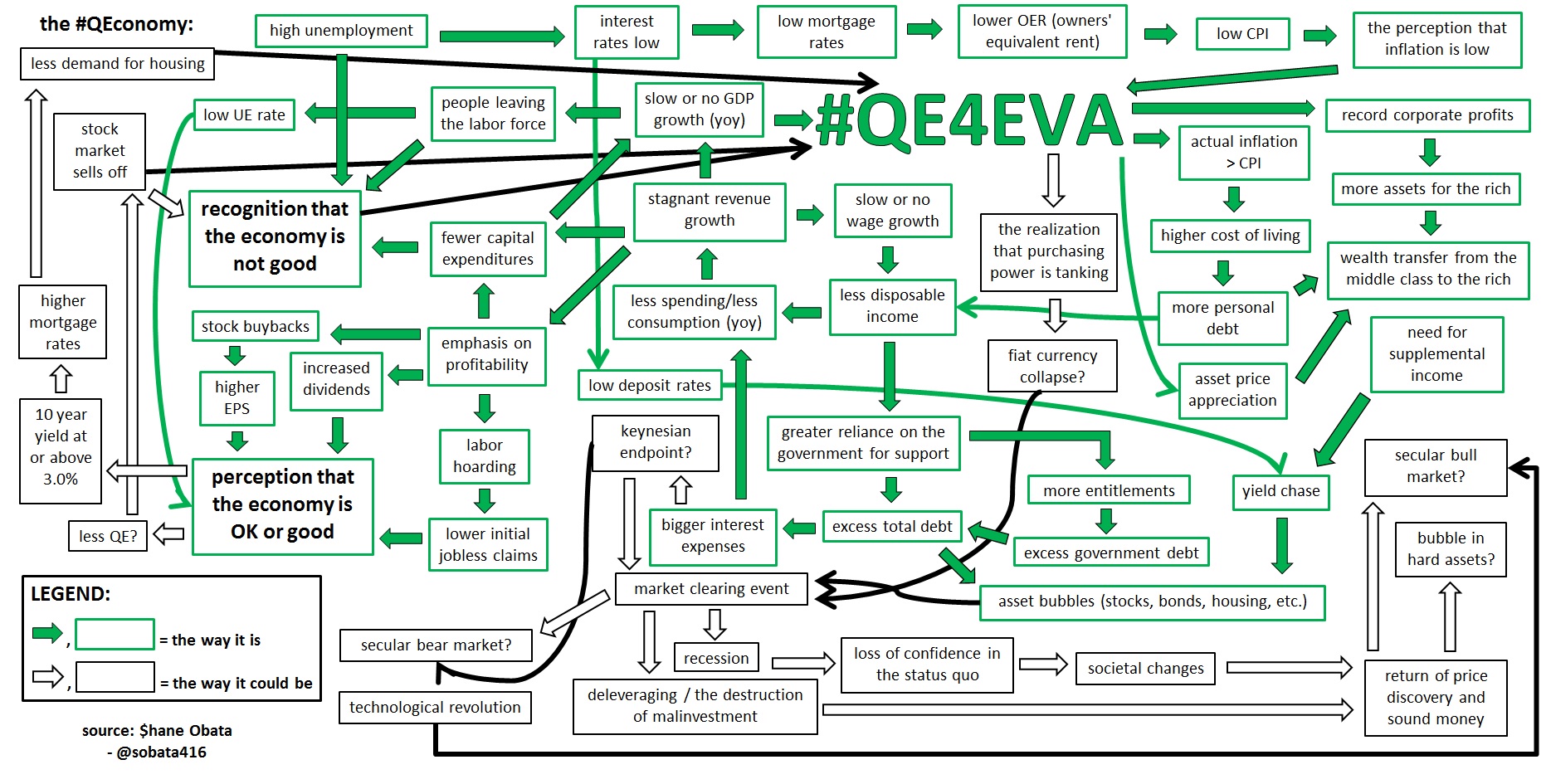
How The “QE Economy” Works (And Why It Doesn’t) In One Giant Flowchart

How The “QE Economy” Works (And Why It Doesn’t) In One Giant Flowchart

Tyler Durden on 12/12/2013 16:40 -0500

From liquidity-driven perception to the Keynesian endpoint economic reality… just follow the arrows… Or, as Bridgewater notes, The effectiveness of quantitative easing is a function of the dollars spent and what those people do with that money. If the dollars get spent on an asset that is very interchangeable with cash, then you don’t get much of an impact. You don’t get a multiplier from that. If the dollar is spent on an asset that’s risky and very different from cash, then that money goes into other assets and into the real economy. That’s really how you see the impact of quantitative easing.

20131212_QE_3

Hedge Funds Trail Stocks by the Widest Margin Since 2005

Hedge Funds Trail Stocks by the Widest Margin Since 2005

By Saijel Kishan and Kelly Bit  Dec 6, 2013

The $2.5 trillion hedge-fund industry, whose money managers are among the finance world’s highest paid, is headed for its worst annual performance relative to U.S. stocks since at least 2005. The funds returned 7.1 percent in 2013 through November, according to data compiled by Bloomberg. That’s 22 percentage points less than the 29.1 percent return of the Standard & Poor’s 500 Index, with reinvested dividends, as markets rallied to records. Read more of this post

Hedge Fund Inflated Value of Coal Investment and Client Fees, S.E.C. Says

DECEMBER 12, 2013, 4:12 PM

Hedge Fund Inflated Value of Coal Investment and Client Fees, S.E.C. Says

By ALEXANDRA STEVENSON

GLG Partners, a division of one of the world’s biggest hedge funds, has agreed to pay almost $9 million to settle Securities and Exchange Commission charges that it overvalued its investment in Sibanthracite, a Siberian coal mining company, and in turn, inflated client fees. Read more of this post

Hazards that could derail the rally in 2014

December 13, 2013 8:19 am

Hazards that could derail the rally in 2014

John Authers

The case for further gains is strong, but risks remain

Like Christmas decorations, which appear in the shops ever earlier in November, the investment community is rushing to publish its forecasts for the new year with weeks of 2013 still to go. Those predictions are themselves predictable. They are positive. Coming from organisations that sell investments, this is not a surprise. Read more of this post

Fraud fears grow in Bitcoin’s murky world

Fraud fears grow in Bitcoin’s murky world

December 6, 2013

Nathaniel Popper

The call went out on Twitter: “For insane profits come and join the pump.”

It was an invitation to a penny stock-style pump-and-dump scheme – only this one involved Bitcoin, the soaring, slightly scary virtual currency that has beckoned and bewildered people around the world. Read more of this post

Europe faces moment of truth on banks, with flawed defenses

Europe faces moment of truth on banks, with flawed defenses

8:40am EST

By John O‘Donnell

BRUSSELS (Reuters) – Europe’s banks face a moment of truth next year when health checks will spell out the repairs they need. The trouble is that fixing them could require cash-strapped governments to borrow more, often from the very banks that need their help. Read more of this post

Era of Lucrative Debt Team Fades as Credit Suisse Sees Exits

Era of Lucrative Debt Team Fades as Credit Suisse Sees Exits

Thirteen years after Credit Suisse Group AG crowned itself Wall Street’s new junk-bond king by buying Donaldson Lufkin & Jenrette Inc., the last vestiges of its reign in the most lucrative credit business are being squeezed out by post-crisis banking regulations. Read more of this post

Hedge Fund Manager John Burbank’s Investment Alchemy: The head of San Francisco–based hedge fund firm Passport Capital has figured out how to turn risk management into an alpha strategy

Hedge Fund Manager John Burbank’s Investment Alchemy

The head of San Francisco–based hedge fund firm Passport Capital has figured out how to turn risk management into an alpha strategy.

10 DEC 2013 – JAN ALEXANDER

HEDGE FUND MANAGER John Burbank III has made a career of anticipating how headline events and political edicts might affect the markets, and that’s why he was on something of a tirade the afternoon of September 19. Like every investment professional, the 49-year-old founder and CIO of Passport Capital in San Francisco had watched U.S. Federal Reserve chairman Ben Bernanke deliver a speech the day before in which he made the surprise announcement that the Fed would not start tapering its quantitative easing program yet. Read more of this post

Do Chinese CEOs Consume Abnormal Perks Before Leaving Their Firms?

Do Chinese CEOs Consume Abnormal Perks Before Leaving Their Firms?

Martin J. Conyon University of Pennsylvania – The Wharton School; European Corporate Governance Institute (ECGI)

Junxiong Fang Sr.Fudan University – School of Management

Lerong He State University of New York (SUNY) College at Brockport; University of Pennsylvania – The Wharton School

November 16, 2013

Abstract: 
Economic success is driven by the optimal design of economic institutions. We investigate whether Chinese CEOs consume abnormal or ‘excess’ perks prior to leaving their firms. Agency models predict that CEO incentives and behavior might change in the years leading up to CEO turnover (the ‘horizon effect’). We predict that CEOs might consume excess perks at the expense of owners’ interests. Using data on Chinese publicly traded firms between 2003 and 2011 we find that abnormal perk consumption is significantly higher in the last two years of CEOs’ tenure compared to previous years. We also find that abnormal perk consumption is lower when the board is more independent, when the firm is privately controlled, and when the external auditor is more reputable. We find that perk consumption in CEOs’ terminal years vary with the type of CEO transition. Voluntary CEO turnover is associated with excess perks, whereas forced CEO turnovers are not. We find no evidence that abnormal perk consumption is associated with lower level of executive compensation, dispelling the idea that cash compensation and perks are substitutes. Instead, we document that abnormal perk consumption has a significant negative effect on firm performance. Overall, our results indicate that abnormal perk consumption and poor institutional design are correlated with managerial excess in China and there exists a horizon problem for Chinese executives.
Asset managers could blow us all up; When funding conditions turn, relying on cheap dollars to finance local assets can be lethal

December 10, 2013 6:51 pm

Asset managers could blow us all up

By Martin Wolf

When funding conditions turn, relying on cheap dollars to finance local assets can be lethal

The most sobering lesson of the global financial crisis was that developments expected to increase resilience – in that case, the “originate and distribute” model of finance – turned out to reduce it. Does a similar danger now threaten stability? Yes. The next round of global illiquidity might derive from foreign currency bonds of non-financial companies of emerging economies. The centre would be asset managers, not banks. Read more of this post

Dead or alive? The puzzle of Schrödinger’s markets; True economic health will be known only when stimulus is removed

December 13, 2013 8:37 am

Dead or alive? The puzzle of Schrödinger’s markets

By Tracy Alloway in New York

True economic health will be known only when stimulus is removed

The current state of US financial markets might be best described with the help of a dead Austrian physicist and a logic-defying feline of unknown vital status. Schrödinger’s cat is a thought experiment designed by Erwin Schrödinger to highlight the apparent absurdity of one particular interpretation of quantum mechanics when transposed to everyday objects. Read more of this post

Bond funds end bad year with another headache: tax-loss selling

Bond funds end bad year with another headache: tax-loss selling

Mon, Dec 9 2013

By David Randall

NEW YORK (Reuters) – As the calendar closes down on 2013, many U.S. money managers are finding themselves in an unfamiliar position: selling some of the bond funds that have long been mainstays of their clients’ portfolios. With the benchmark Standard & Poor’s 500 Index up around 25 percent for the year, financial advisors are looking to sell some of their worst-performing bond funds before the end of December, in order to book losses to offset capital gain taxes on their stock portfolios. Read more of this post

Bitcoin Isn’t A Currency: Ernst & Young

Bitcoin Isn’t A Currency: Ernst & Young

by Michelle JonesDecember 11, 2013

A digital currency expert says bitcoins don’t act like a digital currency. Instead, he says they were designed as a payment system for ecommerce.

Although so many people refer to bitcoins as a “digital currency” (myself included), a expert on digital currencies says they actually aren’t. Alex Hern of The Guardian reports that an expert from Ernst & Young, a professional services firm, explained some of the myths about bitcoins, including the idea that they could one day replace “fiat” money. Read more of this post