The Next Front in Cancer Care; As More Patients Survive, Cancer Centers Handle Disease’s Knock-On Effects
December 15, 2013 Leave a comment
The Next Front in Cancer Care
As More Patients Survive, Cancer Centers Handle Disease’s Knock-On Effects
LAURA LANDRO
Dec. 9, 2013 7:34 p.m. ET
For cancer patients, getting through the rigors of treatment is the first hurdle. Then, life as a cancer survivor poses its own daunting physical and emotional challenges. A growing number of hospitals and community cancer centers, which treat the majority of the nation’s cancer patients, are launching survivorship-care programs. These include treatment follow-up plans, physical rehabilitation and emotional assistance, such as counseling and support groups. They resemble programs currently offered by big urban cancer centers like MD Anderson in Houston and Memorial Sloan-Kettering in New York.As more cancer patients are treated successfully, treatment centers are focusing on the next phase and discovering it can pose daunting challenges that require new approaches to care. Laura Landro explains on Lunch Break. Photo: Greenville Health System.
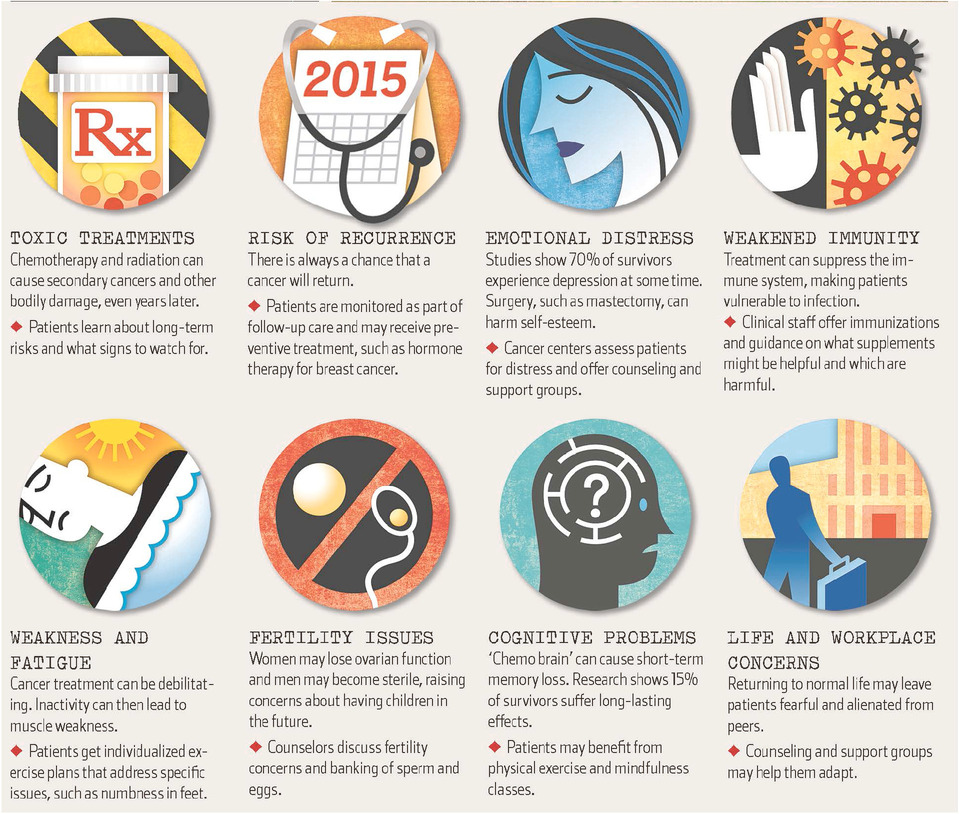
Chemotherapy and radiation can damage vital organs such as the heart and liver, possibly causing secondary diseases years later. The body can be debilitated, cognitive functions impaired and emotions distressed, making return to normal life and work difficult. Some 70% of cancer survivors experience depression at some point. Patients have higher levels of anxiety years after the disease is cured. And there is always the chance that cancer will return.
More patients are expected to face such health issues as the number of cancer survivors grows, partly due to improved early detection and treatment.
The Commission on Cancer, a consortium of professional organizations that accredits U.S. cancer centers treating 70% of newly diagnosed patients, will begin in 2015 requiring that they provide survivorship-care plans for their patients.
“I tell patients now we are going to follow you for your entire lifetime,” says W. Larry Gluck, an oncologist and medical director of the Greenville Health System’s Cancer Institute, in Greenville, S.C., which set up a Center for Integrative Oncology and Survivorship in 2011. “The mental and physical needs of cancer patients go on long after therapy has been completed.” In the past, patients typically were sent back to their family doctor, who might have little knowledge of delayed side effects or complications of treatment and recurrence risks, Dr. Gluck says.
There are close to 14 million cancer survivors living in the U.S., a number that is expected to grow to 18 million by 2022, according to the National Cancer Institute. About 40% have been alive 10 years or more after diagnosis (including this reporter, a leukemia survivor).
Private health insurers and Medicare typically cover cancer patients’ medical visits, during which some survivorship-care planning can take place. Cancer centers say some private insurers consider survivorship planning a necessary service. A bill currently in congressional committee, the Planning Actively for Cancer Treatment Act would require Medicare to cover care-planning services at diagnosis and once cancer patients finish treatment.
Nonprofit groups like Cancer Support Community, which was formed in 2009 through the merger of two of the largest support organizations, Gilda’s Club and the Wellness Community, offer free services including personalized assessment and care plans, distress screening, support groups and complementary therapies such as yoga and meditation. Last year, it announced a partnership with Greenville to incorporate its services into the hospital system as part of the recent survivorship center.
“Cancer hospitals are realizing that they have to be a one-stop shop, taking care not just of the body, but of the mind and soul of the survivor,” says Kim Thiboldeaux, chief executive officer of Cancer Support Community.
Renee Gossman, 71, a personal trainer who teaches water aerobics, was diagnosed at the Greenville Cancer Institute with uterine cancer in January 2012. She had a hysterectomy, chemotherapy and radiation. Ms. Gossman, who doesn’t have a lot of family living nearby, says she was fatigued and felt isolated during nearly a year of treatment. “You get through all of that, and then it’s like, what’s going to happen now?” she says.
Ms. Gossman says her oncologist, Larry Puls, referred her late last year to Greenville’s survivorship center where she met with a social worker, a nurse navigator and a dietitian. She received a summary of her treatment, copies of her pathology reports, a follow-up plan and a summary of other programs and activities she might find helpful.
“They give you a team of people who are going to look after you, get you back involved in the world and see to your physical, social and emotional needs,” Ms. Gossman says. She started a 12-week exercise program at the center that focuses on restoring aerobic conditioning, muscular strength and flexibility. She also began taking yoga classes and a writing workshop through the Cancer Support Community program at Greenville. Ms. Gossman currently volunteers once a week as a greeter in the lobby of the cancer institute.
Other services offered at Greenville include free nutrition counseling and help with the after-effects of specific cancers, such as swelling, called lymphedema, that often occurs after breast-cancer surgery.
Patients, and their caregivers, are encouraged to use the survivorship center as a resource, says Regina Franco, a nurse practitioner and manager of the survivorship center. “If you hear on the news that you should be taking vitamin E, call us and ask, ‘Is this really something I should be doing?’ ”
Greenville recently joined with researchers at the University of South Carolina to open a human-performance lab that will assess patients before and after treatment, billed as an office visit.
One area of research: how cancer and chemotherapy affect energy production at the cellular level and how exercise might restore some of the damage. Also being studied is the impact of complementary therapies such as yoga, massage and acupuncture, Dr. Gluck says.
Many smaller cancer centers and oncology practices are using a software program called Journey Forward, created by a group of advocacy organizations and health companies, to create customized follow-up plans. The program, which includes resources for both doctors and patients, has been downloaded about 30,000 times since it was launched in 2009, says Shelley Fuld Nasso, chief executive of the nonprofit National Coalition for Cancer Survivorship, which helped develop the software. For cancer survivors, “things can come up many years down the road that you aren’t expecting or prepared for,” she says.
 About bambooinnovator
 Bamboo Innovator