Asia Investors Suffer a Bruising Year; Stocks, Bonds and Currencies in the Region Posted a Lackluster 2013
December 20, 2013 Leave a comment
Asia Investors Suffer a Bruising Year
Stocks, Bonds and Currencies in the Region Posted a Lackluster 2013
ANJANI TRIVEDI And FIONA LAW
Dec. 17, 2013 12:13 a.m. ET
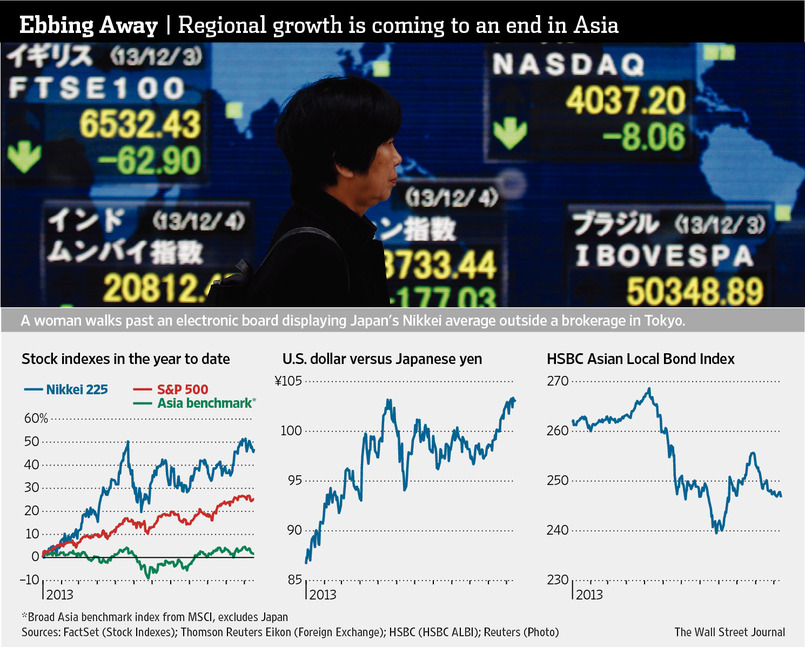
HONG KONG—After years of hefty gains, investors in Asia have suffered a lousy 2013, with bonds headed for their first slump in over a decade, almost every currency in the region tumbling and stocks underperforming the rest of the world.The retreat from one of the world’s hottest investment destinations has been a surprise for many, spurred by slowing growth throughout most of Asia and worries that the U.S. may end stimulus efforts that have supported inflows of cash to risky markets for years.
Heading into the final trading days of the year, the losses are showing few signs of letting up. Last week, investors pulled $1.7 billion out of stock and bond funds in emerging Asian economies, according to data from EPFR Global. This brings the cumulative outflow since May, when tapering talk first began, to $22 billion.
“Imagine this ocean of money that has come into a pond—that money is leaving,” said Teresa Kong, an Asia-focused portfolio manager at Matthews International Capital Management, which has $26.2 billion under management. Ms. Kong says her fund has reduced their exposure to local currencies.
Some of the biggest action has been seen in currencies. The Indonesian rupiah is down almost 20% and the Indian rupee has fallen 10.5% this year. Those moves have slammed interest in local-currency bonds, with debt sold in the rupiah and rupee set to register their worst year, and the broadHSBC HSBA.LN -0.84% Asian Local Bond Index down 5%, its first drop since at least 2001.
For stocks, it also has been a lackluster year. The widely followed benchmark for the region, the MSCI Asia ex Japan, is up just 2.2% year-to-date, one of its most dismal performances in the past decade. That compares with blowout years elsewhere; the Standard & Poor’s 500 stock index is up 24% and at record levels.
Even the euro zone, plagued by a recent sovereign-debt crisis and a sluggish economy, has seen its currency rally into the year-end, while the Stoxx Europe 600 index has climbed 9%. Stocks in Japan, Asia’s largest developed market, have been a rare standout, rising 47% this year as the Bank of Japan 8301.TO 0.00% has sought to weaken the yen and kick-start growth.
Much of the losses in Asia occurred during the summer, when an improving U.S. economy sparked worries the Federal Reserve could wind down its $85 billion-a-month bond-buying program. Markets then settled but some of those worries are re-emerging, with Treasury yields moving higher and detracting from the higher returns offered in Asia.
This time around the exodus is more controlled, and the wild swings much smaller, meaning investors aren’t spooked or scurrying away so fast.
“This time there is less panic. The moves are similar—emerging markets are weakening, the dollar is strengthening, U.S. yields are backing up but everything is happening much more slowly,” said Brad Bechtel of Faros Trading, a subsidiary of currency brokerageFXCM Inc., FXCM -1.76% a research and advisory firm that also executes trades for hedge funds, money managers and companies in the foreign-exchange market.
Mr. Bechtel says many of his clients are skeptical about emerging markets’ ability to recover, and are bullish on the dollar.
“When investors get worried [about emerging markets] then they retrench to the most defensive asset class,” said Nikolaos Panigirtzoglou, a managing director at J.P. MorganJPM -0.99% Asset Allocation in London. “When they get more positive, they are willing to take FX risk” in emerging markets, he said.
The shine has come off Asia as China’s economy expanded at the slowest in 20 years, dragging down growth in the region to an expected 6% this year, from 6.25% in 2012, according to the International Monetary Fund’s latest global outlook report. Southeast Asia suffered more, and is down to a forecast 5% growth rate this year from 6.2% last year.
To be sure, not all Asian markets suffered. Parts of North Asia found favor with investors. Returns on Chinese bonds were up 6% this year, according to HSBC, as the tightly controlled yuan made small gains against the dollar. The South Korean won also eked out gains of 1%, the only other currency gainer, because of its large current-account surplus and strong export growth.
“We believe there are investment opportunities in Asian local-currency bonds, though their room for upside may be mild,” said Cecilia Chan, Asia-Pacific fixed-income chief investment officer at HSBC Global Asset Management, which manages $419.1 billion in assets. “Indian and Indonesian bonds may rebound next year as their value has become attractive following a sharp drop in bond prices this year. Offshore yuan bonds will likely continue to be highlights next year as more global investors are looking to tap this market which is less sensitive to U.S. Treasury volatility.”
Some investors are even staying put in emerging markets and are willing to ride out the “ebb and flow of valuations,” said Alexis de Mones, a portfolio manager at Ashmore Investment Management, which has $78.5 billion under management.
But for now, many investors are still switching to the U.S., with traders increasing bets on Treasurys, U.S. equities and Japanese equities to rise, according to data from the U.S. Commodity Futures Trading Commission.
“We expect a stronger U.S. dollar in 2014, which poses a challenge for Asian currencies,” said Joel Kim, head of Asia Pacific fixed income at BlackRock Inc. BLK -0.58% which manages $4.096 trillion in assets.
Looking ahead, the “local-currency bond market in Asia will remain a tough place to be in until the U.S. Fed’s tapering really happens, when bond prices will tend to stabilize,” said Suvir Mukhi, a Hong Kong-based senior portfolio manager at Income Partners Asset Management, a $1.4 billion fixed-income manager, adding he will only tiptoe back into this market when bond prices have retreated to “levels with more attractive valuation.”
 About bambooinnovator
 Bamboo Innovator