Jim Rogers On “Buying Panic” And Investments Nobody Is Talking About

Jim Rogers On “Buying Panic” And Investments Nobody Is Talking About

Tyler Durden on 12/18/2013 19:22 -0500

Submitted by Nick Giambruno via Doug Casey’s International Man

I am very pleased to have had the chance to speak with Jim Rogers, a legendary investor and true international man. Jim and I spoke about some of the most exciting investments and stock markets around the world that pretty much nobody else is talking about. You won’t want to miss this fascinating discussion, which you’ll find below.

Nick Giambruno: Tell us what you think it means to be a successful contrarian and how that relates to investing in crisis markets throughout the world.

Jim Rogers: Well, there are two aspects of it. One is being a trader, being able to buy panic, and nearly always if you are a trader or an investor, if you buy panic, you are going to do okay. Read more of this post

Gold Town Turns to Dust as Metal Decline Shutters Mines

Gold Town Turns to Dust as Metal Decline Shutters Mines

A half-dozen unemployed workers from the Blyvooruitzicht gold mine southwest of Johannesburg finish off the last scraps of a slaughtered cow in the searing October heat. Since losing their jobs in August, meals have become much less predictable. Read more of this post

Gold Funds See Unprecedented 31% Slump With World Losing Faith

Gold Funds See Unprecedented 31% Slump With World Losing Faith

Investors are dumping gold-backed exchange-traded products at the fastest pace since the securities were created a decade ago, mirroring the steepest price drop in 32 years. Read more of this post

Gold Drops Below $1,200 an Ounce for First Time Since June

Gold Drops Below $1,200 an Ounce for First Time Since June

Gold fell below $1,200 an ounce in London and New York for the first time since June as an improving U.S. economy prompted the Federal Reserve to cut stimulus and reduced demand for precious metals as alternative assets. Read more of this post

FINANCE PROFESSOR: Bitcoin Will Crash To $10 By Mid-2014

FINANCE PROFESSOR: Bitcoin Will Crash To $10 By Mid-2014

MARK T. WILLIAMSCONTRIBUTOR DEC. 17, 2013, 5:18 PM 64,400 159

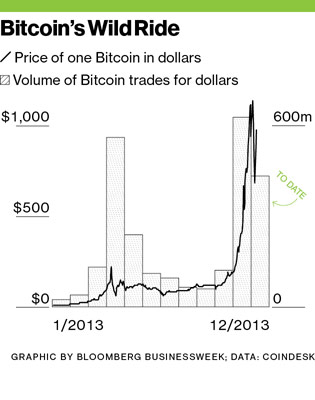
Bitcoin was above $1,200 a few weeks ago. Today it’s worth around $610. In Bitcoin World, a week can be the equivalent of a decade. At the start of December, Bitcoin topped out at over $1,200 as e-currency evangelists trumpeted the endless possibilities to be unleashed, comparing it to the breakthroughs not achieved since the start of the internet revolution.  Bitcoiners claimed market disruption would bring credit card companies and payment platforms such as Western Union to their knees.  Some even claimed that Bitcoin would supplant the U.S. dollar as the new global reserve currency.  Adding more helium to the story, the Winklevoss twins of Facebook fame, not being shy about talking up their own book, predicted prices would rise to a staggering $40,000 per coin. Read more of this post

Fidelity Plants Flag in Hedge-Fund Turf; Fidelity Investments launched two “event-driven” mutual funds, the latest foray by the firm into a sector traditionally dominated by hedge funds

Fidelity Plants Flag in Hedge-Fund Turf

JOE LIGHT

Dec. 18, 2013 7:10 p.m. ET

MI-CA308_FIDELI_NS_20131218182405

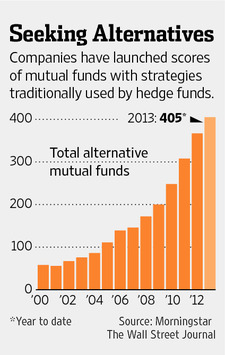
Fidelity Investments launched two “event-driven” mutual funds, the latest foray by the firm into a sector traditionally dominated by hedge funds. The launch on Wednesday of the Fidelity Event Driven Opportunities Fund and Fidelity Advisor Event Driven Opportunities Fund comes as alternative funds continue to pull in a record amount of investor cash. This year through November, alternative funds have taken in $88.55 billion, according to research firm Morningstar Inc., MORN -0.43% up from $18.34 billion in all of last year. Read more of this post

Fed’s $4 Trillion Assets Draw Lawmaker Ire Amid Bubble Concern

Fed’s $4 Trillion Assets Draw Lawmaker Ire Amid Bubble Concern

The Federal Reserve’s balance sheet is poised to exceed $4 trillion, prompting warnings its record easing is inflating asset-price bubbles and drawing renewed lawmaker scrutiny just as Janet Yellen prepares to take charge. Read more of this post

Farewell to the Age of Free Trade

Farewell to the Age of Free Trade

By Joshua Kurlantzick December 12, 2013

Since the end of World War II and the birth of the modern global economy, business leaders have come to accept an iron law: International trade always expands faster than economic growth. Between the late 1940s and 2013, that assumption held true. Trade grew roughly twice as fast as the world economy annually, as fresh markets opened up, governments signed free-trade pacts, new industries and consumers emerged, and technological advances made international trade cheaper and faster. Read more of this post

The Inside Story of GM’s Comeback and Mary Barra’s Rise

Exclusive: The Inside Story of GM’s Comeback and Mary Barra’s Rise

By Tim Higgins and Bryant Urstadt December 12, 2013

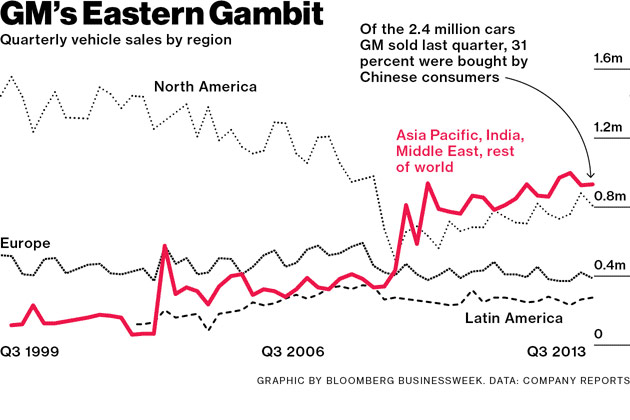
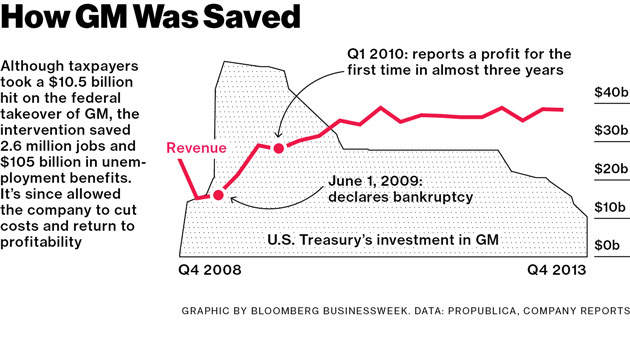
feat_GM51__01__gmsavedchart_630inline BW51_gmgambit_630_update

Dan Akerson, the chairman and chief executive officer of General Motors (GM), arrives at the company’s Technical Center on Nov. 13 to address about 1,000 engineers and designers. The sprawling, multibuilding campus in Warren, Mich., is about 15 miles north of downtown Detroit and includes a planetarium-like laboratory for studying secret prototypes under shadowless lighting. The helicopter landing pad used by former Vice Chairman Bob Lutz, the self-appointed king of the “car guys,” is here, too. The Tech Center isn’t GM’s headquarters, though it almost was: In 2009, GM was ready to move to Warren, abandoning downtown Detroit to the hustlers and hockey fans before political considerations scuttled the plan. Read more of this post

European Banks Dump Massive Amounts of Subordinated Debt on Investors ; Big rise in subordinated debt issuance by EU banks

December 17, 2013 6:34 pm

European Banks Dump Massive Amounts of Subordinated Debt on Investors ; Big rise in subordinated debt issuance by EU banks

By Christopher Thompson

Europe’s banks are preparing for the possibility their creditors could face losses in the event of bank failure by issuing bumper amounts of subordinated bonds designed to absorb losses. Read more of this post

European Banks Aren’t as Healthy as Investors Think

European Banks Aren’t as Healthy as Investors Think

By Erin Davis | 12-16-13 | 06:00 AM | Email Article

As the European Central Bank prepares to complete yet another stress test of the European banks, we question whether it is focusing on the right metrics. Given the significant increase in the sector’s stock prices over the past 16 months, we think investors might be too optimistic as well. We acknowledge that the banks are in better shape than they were, as the average core Tier 1 ratio has improved to 13.5% from 10% in 2010. However, we caution that European banks’ unweighted capital ratios have not improved nearly as much as headline regulatory capital levels would lead one to believe. For example, one more relevant measure (tangible common equity/tangible common assets) shows that the majority of European banks fail to meet a reasonable 5% standard. Shell-shocked investors who think brighter days are here again for European banks should be more wary. Read more of this post

EU Banks Shrink Assets by $1.1 Trillion as Capital Ratios Rise

EU Banks Shrink Assets by $1.1 Trillion as Capital Ratios Rise

By Ben Moshinsky  Dec 16, 2013

European Union banks have shed more than $1.1 trillion of assets since the end of 2011 in a shift away from risky investments such as asset-backed debt as regulators push lenders to shore up their balance sheets. Read more of this post

End of QE will test diversification faith

End of QE will test diversification faith

By Ewen Cameron Watt

Equities and bonds may no longer diversify portfolio risk

Diversification, the great free lunch of investing, is often taken for granted by investors. Bonds and equities have acted as effective portfolio diversifiers for much of the new millennium because of their different return and volatility patterns. Two of the three main assets in a typical portfolio, cash being the third, moved in opposite directions during financial crises such as 2001 and 2008. Read more of this post

Emerging nations produce more electronic waste than the West; By 2017, the annual piles of waste would be the weight equivalent of 200 Empire State Buildings or 11 Great Pyramids of Giza

Emerging nations produce more electronic waste than the West

OSLO — China and other emerging economies have overtaken Western nations in dumping old electronic goods, from television sets to mobile phones, and will lead a projected 33 per cent increase in the amount of waste from last year to 2017, a United Nations-backed alliance said in a report yesterday.

BY –

5 HOURS 7 MIN AGO

OSLO — China and other emerging economies have overtaken Western nations in dumping old electronic goods, from television sets to mobile phones, and will lead a projected 33 per cent increase in the amount of waste from last year to 2017, a United Nations-backed alliance said in a report yesterday. Read more of this post

Developing countries lost nearly US$1 trillion to fraud, corruption and shady business transactions in 2011, vastly outpacing the foreign aid they received and the pace of dirty money leaving emerging nations is accelerating

Updated: Friday December 13, 2013 MYT 7:53:26 AM

Developing nations lose US$1tril

WASHINGTON: Developing countries lost nearly US$1 trillion to fraud, corruption and shady business transactions in 2011, vastly outpacing the foreign aid they received and the pace of dirty money leaving emerging nations is accelerating, a new report found. Read more of this post

Despite more than two years of political and economic turmoil in its main markets inEgypt and Libya, Lecico, a listed tile and sanitary ware producer, has reported a double-digit increase in sales

December 18, 2013 4:09 am

Egypt business profile: Lecico’s sales prove resilient

By Nadine Marroushi

Despite more than two years of political and economic turmoil in its main markets inEgypt and Libya, Lecico, a listed tile and sanitary ware producer, has reported a double-digit increase in sales. The Alexandria-based company enjoyed an 18 per cent year-on-year rise in revenues for the first nine months of 2013 to reach E£1.1bn ($160m). Read more of this post

Citi’s cost-cutting drive has delighted investors but how much more can it cut before it squanders its global advantage?

December 18, 2013 6:57 pm

Finance: Shrunken ambition

By Tom Braithwaite, Camilla Hall and Stephen Foley

Citi’s cost-cutting drive has delighted investors but how much more can it cut before it squanders its global advantage? The fireplace on the 39th floor of Citigroup’s Manhattan skyscraper is a relic from a different era. It was installed by Sandy Weill, who indulged a passion for high-rise hearths, martinis and cigars during the acquisition spree that culminated in him co-founding the modern Citi in 1998, back in banking’s boom years. Read more of this post

Canadian Pension Funds, the New Buyout Kings, Take On Private Equity

Canadian Pension Funds, the New Buyout Kings, Take On Private Equity

By Katia Dmitrieva

and Matthew Campbell December 12, 2013

Mark Wiseman, chief executive officer of the Canada Pension Plan Investment Board, walked into Bergdorf Goodman in the mid-1990s looking for a suit. “I couldn’t afford anything there,” he says. While he still hasn’t bought a suit at Bergdorf’s, this year he did buy the store. Canada Pension, which represents 18 million workers and is the country’s largest pension manager, in October helped lead a C$6.3 billion ($6 billion) buyout of Bergdorf’s owner, Neiman Marcus Group. “Is that where I shop?” he asks. “No, thanks. But there are a lot of people who do. It’s the biggest mistake that you can make in investing: Don’t assume that the rest of the world is like you.” Read more of this post

Businesses that convert consumer credit card debt to fraudulent bank installment loans are opening faster than Turkish authorities can shut them down

Shadow Lenders Selling Phantom Phones Spook Banks: Turkey Credit

Businesses that convert consumer credit card debt to fraudulent bank installment loans are opening faster than Turkish authorities can shut them down. Once closed, “they immediately spring up under another name,” Soner Canko, general manager of Turkey’s Interbank Card Center, said in a Nov. 22 interview in Istanbul. “What we see here is a diabolical invention with astonishing creativity.” Read more of this post

BRICs Creator O’Neill Wowed by New Lula’s Success: Mexico Credit

BRICs Creator O’Neill Wowed by New Lula’s Success: Mexico Credit

Jim O’Neill has been tracking economic reform initiatives in countries across the world during his 33-year career on Wall Street. Only a few of them, he said, rank higher than what Mexico achieved this year. “I can’t think of many other countries that have had a period of such deep reforms,” said O’Neill, who coined the term BRICs while serving as a top Goldman Sachs Group Inc. economist in 2001, correctly predicting a surge in growth for Brazil, Russia, India and China. “Markets are only just really starting to give Mexico any credibility now that the energy reform is going through.” Read more of this post

BlackRock to Third Point Blindsided as Turkey Shares Plummet

BlackRock to Third Point Blindsided as Turkey Shares Plummet

BlackRock Inc. (BLK), the world’s biggest money manager, and billionaire Dan Loeb’s Third Point LLC. are among investors hurt by slumping Turkey stocks as a corruption probe into businessmen and politicians prompted declines.

Turkiye Halk Bankasi AS (HALKB) dropped 13 percent since its chief executive officer was detained yesterday as part of the probe, a day after a regulatory filing showed BlackRock bought 3.9 million shares. Emlak Konut Gayrimenkul Yatirim Ortakligi AS (EKGYO), Turkey’s biggest real-estate developer, posted a 12 percent two-day drop after Third Point invested $150 million last month.

Suleyman Aslan, the CEO of Halkbank, and Murat Kurum, his counterpart at Emlak Konut, were among dozens taken into custody during a probe into gold smuggling, money laundering and bribery in government tenders, state-run Anatolia news agency reported. The lira slumped and stocks dropped the most in the world after the executives were detained yesterday with the sons of three cabinet ministers by a unit of Istanbul’s police.

“Investors were blindsided by the developments yesterday morning,” Julian Rimmer, a trader at CF Global Trading UK Ltd. in London, said today in emailed comments. “Halkbank has long been considered among investors the best bank in Turkey owing to its higher return on equity.”

Halkbank said in a filing to the Istanbul bourse yesterday that documents and information had been requested in relation to the probe, without disclosing further details. Emlak Konut said its CEO was called in to give information late yesterday.

Buy Ratings

Halkbank is rated a buy by 26 of 29 analysts, according to data compiled by Bloomberg. The shares have lost 21 percent this year, compared with a 8.7 percent decline on the Borsa Istanbul National 100 index.

“The best-held bank on the Istanbul Stock Exchange falling 15 percent in 24 hours with just two weeks of the year remaining is an unmitigated disaster for many portfolio managers and now they have a dilemma,” CF Global’s Rimmer said.

Halkbank fell 0.7 percent to 13.75 liras at the close in Istanbul, after earlier dropping as much as 6.1 percent. Emlak Konut was unchanged at 2.32 liras, compared with the 2.50 liras that Third Point paid in last month’s secondary public offering.

Halkbank was favored by some investors because it is better able than some rivals to withstand both an increase in interest rates and regulatory changes intended to rein in consumer lending, Cetin Dogan, an analyst at BCG Partners Inc., said in e-mailed comments from Istanbul.

Power Struggle

The raids may suggest an escalation in a power struggle between Prime Minister Recep Tayyip Erdogan and followers of U.S.-based Islamic cleric Fethullah Gulen, who are influential in the judiciary and police force. News of the detentions led to the biggest market declines in Turkey since June, when anti-government protests roiled the nation.

Melissa Garville, a spokeswoman for BlackRock in New York, declined to comment on Turkey yesterday as did Elissa Doyle of Third Point in an e-mail from London. No one at Halkbank was immediately available to comment.

BlackRock’s purchases reported on Dec. 16 brought its holding in the Istanbul-based bank to 26 million shares, or a 2.1 percent stake. The asset manager is the second-largest shareholder after the Turkish state. BlackRock also increased its stake in Emlak Konut to 1.4 percent by buying about 500,000 shares, according to a regulatory filing on Dec. 16, making it the biggest owner after Turkish state housing authority TOKI.

To contact the reporter on this story: Isobel Finkel in Istanbul at ifinkel1@bloomberg.net

Turkey Raids Eclipse Fed as Risk Focus for Deutsche Bank

Turkish politics may become the top focus for the country’s investors, overshadowing decisions by the Federal Reserve, after stocks and bonds tumbled following the detention of prominent businessmen, Deutsche Bank AG said.

The Turkish lira slumped and stocks dropped the most in the world yesterday after the sons of two cabinet ministers and the chief executive officer of a state-owned bank were detained in a corruption probe by the financial crimes unit of Istanbul’s police force. The CEO of Turkey’s largest real estate company, whose biggest shareholder is the state housing authority, was also called in for questioning.

The raids are an escalation in a power struggle between Prime Minister Recep Tayyip Erdogan and followers of U.S.-based Islamic cleric Fethullah Gulen, who are influential in the judiciary and police force, according to Hakan Aksoy, who helps to oversee $5.5 billion of emerging-market debt at Pioneer Global Asset Management SpA in London. News of the detentions led to the biggest market declines in Turkey since June, when anti-government protests roiled the nation.

“Relations between business and the state are the key driver for emerging markets, so on the face of it this news is somewhat troubling and could represent a major escalation,” John-Paul Smith, a Deutsche Bank strategist in London, said in e-mailed comments yesterday. “Investors have been more focused on the prospect of Fed tapering and the policies of the central bank, but this may now change.”

2014 Elections

The Borsa Istanbul 100 Index fell 26 percent since Fed Chairman Ben S. Bernanke said on May 22 that he could begin to cut monetary stimulus. The U.S. central bank will decide whether to start so-called tapering after a two-day meeting that ends today.

While Erdogan will probably seek to reach a truce with Gulen’s so-called “Hizmet” movement, investors will look to local elections in March and presidential elections in August next year to evaluate the potential impact of the strife, Pioneer’s Aksoy said. Turkish markets may remain volatile until then, and he would want to see assets cheapen further before adding to positions, he said.

The Turkish lira weakened 0.3 percent to 2.0420 a dollar at 10:45 a.m. in Istanbul, the third-biggest decline among 24 emerging-market currencies tracked by Bloomberg. The Istanbul 100 stock index dropped 2.6 percent today, after slumping the most among 94 equity indexes ranked by Bloomberg yesterday.

Five local police chiefs involved in the graft probe were re-assigned, Fox TV Turkey reported today.

Gulen Schools

Suleyman Aslan, CEO of state-owned lender Turkiye Halk Bankasi AS (HALKB), and construction magnate Ali Agaoglu were among 22 detained in the investigation into bribery, corruption in government tenders, money laundering and gold smuggling, state-run Anatolia news agency reported yesterday. The raids were probably a response to government plans to close private exam preparation schools, many of which are run by Gulen’s followers, according to Timothy Ash, a London-based strategist at Standard Bank Group Ltd.

Halkbank dropped 12 percent in Istanbul, the biggest decline since at least 2007. Property developer Emlak Konut Gayrimenkul Yatirim Ortakligi AS (EKGYO)’s stock also slumped 12 percent, the most on record. Police requested documents and information from Halkbank as part of the probe, the bank said in a statement to Borsa Istanbul, without giving additional information. Emlak Konut CEO Murat Kurum was called in for questioning yesterday evening, the company said.

Yields on Turkey’s two-year notes rose 25 basis points to 9.35 percent at the close today, the biggest gain since Nov. 26, according to data compiled by Bloomberg.

Yields on Turkey’s benchmark two-year debt have risen 479 basis points from a record low close of 4.56 percent on May 17. Morgan Stanley lists the country along with Brazil, India, Indonesia and South Africa as part of the “fragile five” of countries it says are most vulnerable to capital outflows should the U.S. cut stimulus.

To contact the reporter on this story: Selcuk Gokoluk in Istanbul at sgokoluk@bloomberg.net

December 18, 2013 5:42 pm

Muslim political feud erupts in Turkish corruption probe

By Daniel Dombey in Ankara

Battle between Erdogan and preacher has long been brewing

“You know that the war already started? You know that, right?”

It was late 2012 and the war to which my interlocutor – a prominent former government aide – was referring pitted Recep Tayyip Erdogan, the Turkish prime minister, against Fethullah Gulen, the country’s most popular Muslim preacher.

At that point, the battle was just simmering – but it has boiled over this week with the arrest of dozens of people in an anti-corruption investigation.

Many of Mr Erdogan’s supporters accuse followers of Mr Gulen of masterminding the probe, which has involved the detention of three sons of leading ministers and business figures close to government.

Mr Erdogan, the most powerful leader in Turkey for at least two generations, has hit back by transferring 32 senior police officers.

Nonetheless, as the case continues, the government finds itself in a deeply uncomfortable position as allegations emerge on three fronts: corruption, particularly in the construction sector; gold smuggling, possibly linked to the export of billions of dollars worth of bullion to Iran last year; and the violation of zoning laws on building.

The causes of this conflict lie in Turkey’s recent history and the nature of the two protagonists. Mr Erdogan’s AK party and the Gulenist movement both have religious roots, but their origins are very different, while the threats to them both, which once led them into a marriage of convenience, have receded.

The AK party is successor to explicitly Islamist political parties that had deep concerns over the legitimacy of the republican state, which practised a repressive form of secularism; Turkish Islamists recoiled even from working for state institutions.

By contrast, Mr Gulen’s movement, which he has built up since the 1960s, is an heir to Turkish thinkers such as the Sunni theologian Said Nursi rather than following any pan-Islamic tradition, and rejects what it labels political Islam.

Mr Gulen encouraged his followers to learn science and mathematics – and, his opponents claim, infiltrate institutions such as the police and the prosecution service. Gulenists counter by saying their movement merely reflects views prevalent in Turkish society.

Despite their differences, when the AK party won power in 2002, it looked to the Gulenists within the bureaucracy for help.

The reason was obvious: the odds were stacked against the survival of Mr Erdogan’s government. It may have won 34 per cent of the vote, but barely five years had passed since a previous Islamist-led government had been ousted by the military. Secular institutions such as big business and big media retained their sway. The top judges were hand-in-glove with the ultra-secular army.

Mr Erdogan did indeed face overt challenges to his rule: in 2007, when the army openly threatened to intervene in politics; and in 2008, when the courts came close to banning the AK party.

That was the backdrop for investigations the Gulenists championed – probes into alleged coup plots known as Ergenekon and Sledgehammer, which imprisoned hundreds of alleged plotters, including senior military officers. Mr Gulen’s supporters called this a historic settling of accounts with Turkey’s anti-democratic past; his critics branded it a witch-hunt based on fabricated evidence and designed to neutralise opponents.

It is hard to deny that the investigations and trials went a long way to eliminating threats to the government from the military or other quarters. But that success put the AK-Gulenist axis under pressure, especially after Mr Erdogan was re-elected in 2011, with both sides complaining that the other sought too much power and was becoming less accountable.

Meanwhile, the differences in the two camps’ world views never went away, despite years of co-operation. Gulenists are friendlier to the US and Israel, and more hostile to Iran; Mr Erdogan has strongly identified himself with the ousted Muslim Brotherhood government in Egypt and is fiercely critical of the Israelis.

The reason the anti-corruption probe has hit Mr Erdogan now appears to stem from the prime minister’s push to shut down or reform the Gulenist-run pre-university cramming schools that AK officials say produce “missionaries” for the preacher. Some Gulenists admit that the schools – where students sometimes listen to recordings of Mr Gulen after normal lessons – are an effective recruitment tool.

By going after Mr Erdogan’s government as elections loom next year, the Gulenists have burnt their bridges with the prime minister and his party. Mr Erdogan makes no bones about his desire to purge the bureaucracy of Gulenists.

“In the ministries, they are trying to clean up,” said the former government aide who spoke of war more than a year ago. “But,” he accurately predicted, “a lot of stuff will come up.”

As for members of Turkey’s old secular elite, they watch the battle between their two foes as mere onlookers. “It’s like Alien versus Predator,” said one, referring to the science fiction series. “I don’t know who to root for.”
Wind Power Rivals Coal With $1 Billion Order From Buffett

Wind Power Rivals Coal With $1 Billion Order From Buffett

The decision by Warren Buffett’s utility company to order about $1 billion of wind turbines for projects in Iowa shows how a drop in equipment costs is making renewable energy more competitive with power from fossil fuels. Read more of this post

Why Bitcoin Needs Banks

Why Bitcoin Needs Banks

By Carter Dougherty December 12, 2013

mf_bitcoin51__01__315inline

On a mission to convince the world that Bitcoin is enduring and serious, enthusiasts convened at a place that symbolizes the ephemeral and the glitzy: Las Vegas. At the Inside Bitcoins conference on Dec. 10 and 11—sponsored by BubbleCoin, BitDeliver, CoinComply, and other companies—the top issue for many attendees was how to persuade regulators that the digital money and payment system is a valuable financial market innovation, rather than the currency of choice for illicit gambling and drug purchases. Banks shun Bitcoin companies “because it’s scary,” says Jered Kenna, founder of Tradehill, a Bitcoin exchange that shut down this summer after its bank closed its account. “If the banks aren’t sure, they default to ‘no.’ ” Read more of this post

The Bitcoin Ideology; To its creators and numerous disciples, bitcoin is a mostly ideological undertaking, more philosophy than finance

December 14, 2013

The Bitcoin Ideology

By ALAN FEUER

IF you’ve only recently tuned in to the seemingly endless conversation about bitcoin, you could be forgiven for thinking that the digital currency is little more than the latest Wall Street fetish or a juiced-up version of PayPal. After all, so many headlines in the last few weeks have focused on its market price and the cool stuff you can get with it: Bitcoin breaks $1,000! Bitcoin plunges by a half! Bitcoin has a banner Black Friday! Use bitcoin to buy a ride on Richard Branson’s starship! Read more of this post

Bitcoin Drops as China to Denmark Seek to Control Digital Money

Bitcoin Drops as China to Denmark Seek to Control Digital Money

Bitcoin prices plunged against the yuan and the dollar after China’s largest online market for the virtual currency stopped accepting Bitcoin deposits and Scandinavian authorities said they will impose regulations. Bitcoin fell as much as 49 percent to 2,011 yuan ($331) on BTC China, which said its payments subsidiary YeePay would no longer offer deposit services. Against the dollar, Bitcoin declined as much as 43 percent on the Bitstamp, an online market where the digital money can be traded for legal tender. Read more of this post

Billionaire Fredriksen’s Marine Harvest to Drive Fish Deals

Billionaire Fredriksen’s Marine Harvest to Drive Fish Deals

Marine Harvest ASA (MHG), the salmon farmer controlled by billionaire John Fredriksen, will lead the way in consolidating the seafood industry as record fish prices make deals more attractive, DNB ASA (DNB) and Nordea Bank AB said. “We saw the fight for Cermaq that was not successful from the Marine Harvest side, so some of those market players are looking to do more,” Ottar Ertzeid, head of DNB Markets, said in an interview in Oslo on Dec. 16. “Within the seafood area there’s probably more consolidation to bid on.” Read more of this post

Asset bubbles loom over 2014

Asset bubbles loom over 2014

AFP-JIJI

DEC 14, 2013

PARIS – Cash is so cheap these days that investors have been borrowing and plowing them in assets from artwork to wine to bitcoins, betting that prices would rise. And rise they did, some even setting records, but market watchers are now warning that asset bubbles may be forming and could well burst in 2014. Read more of this post

A tough 2013 is casting a shadow over BlueCrest Capital Management LLP, one of the most successful hedge-fund firms of the post financial-crisis era

Michael Platt’s BlueCrest Capital Poised for Rough Close to 2013

Hedge-Fund Firm Had Tough Year Amid Paucity of Clear Trends to Wager on

GREGORY ZUCKERMAN

Dec. 18, 2013 8:01 p.m. ET

A tough 2013 is casting a shadow over BlueCrest Capital Management LLP, one of the most successful hedge-fund firms of the post financial-crisis era. The firm, founded by former J.P. Morgan Chase & Co. traders Michael Platt and William Reeves, more than tripled in assets under management between 2009 and the end of 2012, to $35 billion. Read more of this post

Employee Spinouts, Social Networks, and Family Firms

Employee Spinouts, Social Networks, and Family Firms

James E. Rauch

NBER Working Paper No. 19727
Issued in December 2013
Recently collected data show that, within any manufacturing industry, vertically integrated firms tend to have larger, higher productivity plants, account for the bulk of sales, and also sell externally most of the inputs they produce. In a weak contracting environment characteristic of developing countries, vertically integrated firms are vulnerable to employee “spinouts”: managers of input divisions can start their own firms, making customized inputs formerly provided internally subject to hold-up and capturing the profits formerly made from external sales of generic inputs. This vulnerability is shown to lead to inefficiently low entry. Vertically integrated firms can fight back by hiring managers for their input divisions who are members of networks that informally sanction hold-ups or children who keep profits “in the family” even if they spin out. This is shown to predict the association of co-ethnic networks with high rates of entrepreneurship and the prominence of family-owned business groups in developing country manufacturing.