The flood of new information available to institutions has the potential to make both donors and charities more effective
December 20, 2013 Leave a comment
How Big Data Will Change the Face of Philanthropy
Flood of new information has the potential to make both donors and charities more effective
LUCY BERNHOLZ
Dec. 15, 2013 4:00 p.m. ET
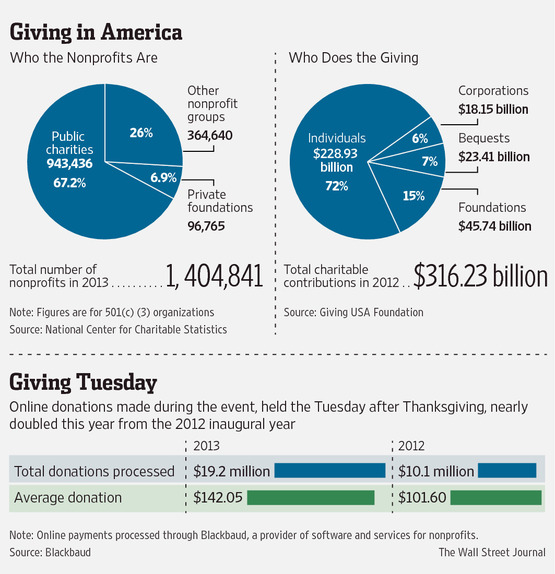
“It is more difficult to give money away intelligently than to earn it in the first place,” observed one of the great philanthropists of the 20th century, Andrew Carnegie. Today, with almost two million nonprofits in the U.S., the challenge of knowing which to support and which to avoid is more challenging than ever. How can individuals and foundations put their money where it’s most needed, and in ways that will be most effective? And how can charities themselves spend the dollars they receive in ways that best fulfill their missions?Just as the ability to access and analyze mountains of new information is transforming corporations, the era of big data has the potential to revolutionize the world of philanthropy—for both donors and charities. More, better and faster information can help donors channel dollars to the organizations that are most effective. It can help nonprofits identify the strategies that work best at fulfilling their missions. And it can guide philanthropies to the fundraising tactics that are most successful.
Donor Apps
Imagine, for example, if a donor could do a quick search on the criteria of his or her choosing to find organizations that have a proven record, can offer real-time reporting on how funds are being spent, and provide feedback from those they’ve served? Well, apps that are constantly pulling data from ongoing evaluations, common performance measures and beneficiary feedback will make this happen.
Similarly, foundations will be able to develop, assess and revise their giving strategies by pulling information from community surveys, organizational reports and an up-to-date “ticker” of other philanthropic giving. As a foundation, for instance, considers its annual giving in support of early-childhood education, it will be able to click on visualizations of the past few years’ progress on reading readiness at the programs it has previously funded.
Organizations doing similar work in different parts of the world will be better connected, sharing what works and doesn’t—no doubt upending many long-held assumptions. Online data from job-training programs, for example, will be available to organizations working with similar populations, and they’ll all learn from experiments with new class structures or curriculum. Effective interventions will spread quickly, and outdated or ineffective strategies will be retired. By sharing research, foundations will be able to lower the costs of administering grant programs so that more funds flow to the nonprofits.
The sharing of data will also enable nonprofits working in the same region to coordinate their work. A medical service, entrepreneurship group and educational program in a rural area, for example, may share transportation data systems, allowing them to use less fuel and fewer trucks—permitting them to serve more people with the same level of hard-earned charitable gifts.
The impact will also extend to fundraising efforts, as nonprofit executives get better and faster data to help them hone their pitches. They can focus the timing and content of the messages to meet the precise wishes of their most committed supporters. The volume of solicitations that every nonprofit sends out will plummet, as organizations learn what marketing efforts work best.
From Here to There
All of this is the shadow of things that may be. But it is far from a sure thing. To get to this new world—one in which passions meet results—certain challenges need to be addressed.
Specifically:
Big data isn’t democratic. Many sources of big data come from platforms built for commercial purposes. And that could be problematic. Donors looking to TwitterTWTR -3.73% or Facebook FB -0.08% streams will hear a lot from those who use Twitteror Facebook, but miss the perspectives and needs of neighbors who don’t. As a result, such data will let advertisers see what customers are saying about their products, but they don’t necessarily tell after-school programs what will excite kids into coming to their programs.
Funding choices informed by skewed samples could result in what MIT and Microsoftresearcher Kate Crawford calls “data discrimination.” For example, using social-media data as indicators of need after a tornado or hurricane will direct resources to where social-media usage is greatest and mobile-phone access is still intact, not necessarily where the need is greatest.
Foundations, therefore, should determine if the people they are trying to help are represented in the data set. If not, they need to search for more-relevant data, and invite the affected communities to reflect on and respond to the original, nonrepresentative data.
Digital data is forever. The data collected by nonprofits is no less vulnerable to security breaches than data collected by companies. But there is a level of trust in nonprofits that they need to protect for the long term. Just as a financial scandal in the nonprofit sector is more disappointing than one in the commercial sector, the misuse of digital data by nonprofits or foundations—now or in the future—will damage the sector’s trust and credibility. Nonprofits must be sure to do what they promise regarding people’s data, especially if that means keeping it offline or anonymous.
Local needs vs. outside data. Imagine that a foundation funds community revitalization efforts, mainly by building up residents’ relationships with city officials and local businesses. The foundation then insists on using data collected from outsiders to argue for a certain kind of program. If the local shopkeepers and residents don’t trust the data, they won’t trust the foundation, either. Instead the foundation will need to help their local partners acquire the skills they need to collect, use and analyze their own supporting data, not just have data dropped on them from the outside.
Will big data kill anonymity—and anonymous giving? Charitable giving is one way we use our private resources for public benefit. We give time or money as we choose, unwatched and without pressure from others. In the age of big data, our giving becomes one more type of data that others use to market or proselytize to us. Foundations need to be part of the effort to find ways to keep a sense of privacy in an increasingly transparent world.
Donor intent and data philanthropy. The donation of data for social good—whether it’s filling out a survey, giving a tissue sample or offering access to a digital library or photographs—is on the rise. How will we handle “donor intent,” a bedrock principle of American philanthropy, when it comes to the use of donated data?
As it is, a financial donor can spell out the specific purposes for how her funds will be used by the recipient organization. When these intentions aren’t followed, lawsuits ensue. Data, on the other hand, may be collected today for one purpose and be reused over time for other purposes. We have not yet defined any similar standard of donor intent when it comes to donating digital resources. Now is the time for foundations to develop data practices that align with their long-term philanthropic missions.
Philanthropy is part of civil society—deliberately separate from markets and elections. This is where we foster individual action and support multiple, often conflicting ideas about a robust and functioning democracy. As philanthropy steps into the world of big data, we are inventing a new digital civil society where personal independence and private interests intersect with the power and efficiency of digital data.
Lucy Bernholz is a visiting scholar at Stanford University, where she co-leads the Digital Civil Society Lab, and at the David and Lucile Packard Foundation. She writes about all things digitally philanthropic at philanthropy2173.com. She can be reached atreports@wsj.com.
 About bambooinnovator
 Bamboo Innovator