Amazon vs. Google: It’s A War for the Shopping Search
December 21, 2013 Leave a comment
Amazon vs. Google: It’s A War for the Shopping Search
Ads That Generate Product Photos, Prices Aim to Compete Against Amazon
ROLFE WINKLER
Dec. 19, 2013 1:51 p.m. ET
Fighting a battle with Amazon.com Inc. AMZN -0.19% to be the preferred entry point for Internet shopping, Google Inc. GOOG +0.14% last year retooled its lucrative search page. Its strategy is showing signs of progress.The change allowed retailers to post pictures, descriptions and prices of products at the top of search results, both on desktop computers and, later, mobile devices. For example, a Google search for “microwave oven” shows a grid of photos for specific models, sold online by retailers like Macy’s Inc. and Target Corp. TGT -2.20% , with prices clearly marked. The ads more closely resemble what Amazon shows shoppers than Google’s typical text-based ads. The same search on an iPhone shows a carousel of such ads that users can swipe through.
By directly helping searchers who know what they want, Google’s “product-listing ads,” as they are called, reduce the number of clicks before users get to the “buy” button. Searchers click on product ads 34% more frequently than regular text ads, according toAdobe
ADBE -1.54% Systems Inc.’s research arm.
Recent data suggest that such product-listing ads are attracting advertisers and revenue-generating clicks. Wal-Mart Stores Inc. WMT -0.90% and eBay Inc. EBAY +0.51% are the top buyers of Google’s product ads, according to AdGooroo, a search-advertising research firm. Marin Software Inc. MRIN -0.10% says its advertising clients more than doubled spending on Black Friday product ads, compared with last year.
One happy advertiser using Google’s new ads is John James, chief executive of Acumen Brands, which owns retailer CountryOutfitter.com. The product-listing ads “perform very well,” he says, particularly when searchers know what they are seeking, like the Ariat Rambler Cowboy Boots his company advertises on Google. “They are definitely a way to unlock value compared to old text ads,” Mr. James says.
At stake is supremacy in the U.S. e-commerce market, which comScore expects to rise 14% to around $210 billion this year. While many think of Amazon and Google as being in separate businesses, the two are locked in fierce competition to be the first search box shoppers turn to when they are browsing products online. As more Internet users begin searches on Amazon’s marketplace—which comprises an array of vendors besides itself—Google loses an opportunity to show them ads.
In a recent survey, analytics and software firm SDL asked people the top three places they intend to research gift purchases this holiday season. “Online search” registered 45%, down from 49% a year ago. Meantime, the channel growing the most in popularity was the one that includes Amazon, jumping to 37% from 31%.
Many e-commerce experts say Google has a long way to catch up to Amazon when it comes to online-shopping searches. Jeff Jordan, a former eBay executive who is now a partner at venture-capital firm Andreessen Horowitz, contends that Amazon thrives by offering a better shopping experience than Google. He says the formula of selection, price and convenience is “radically in Amazon’s favor,” with its large network of merchants, consistent low prices, one-click ordering and fast shipping.
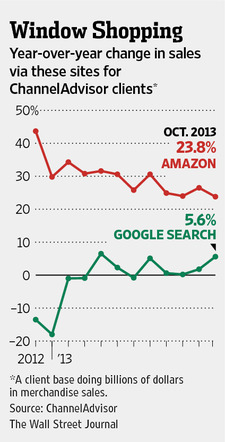
ChannelAdvisor, ECOM +4.80% which manages e-commerce efforts for retailers, says its clients’ sales via Amazon increased about 25% in the third quarter, compared with a year earlier. Sales to users who arrived via search engines like Google increased about 1%.
Amazon has an even bigger advantage on mobile devices, source of a growing share of searches and purchases, says Kevin Lee, chief executive of DidIt, a search-marketing firm. Clicking on a typical Google text ad takes users to retailer sites where shoppers may need to enter shipping and payment information on a phone’s small screen, he says. Amazon already has that addresses and credit card numbers on hand for many shoppers, although it doesn’t disclose the number of customers who store that information in its system.
Reducing the number of steps between search and buy is particularly important for smartphone users, who may have limited bandwidth and don’t want to click back and forth. Marin Software says the click rates for product ads on smartphones were about 20% higher than on desktop browsers on Black Friday and Cyber Monday.
The extent of the threat Amazon poses to Google isn’t clear, since the search company doesn’t break out its revenue from shopping-related clicks. Larry Kim of search-marketing firm Wordstream found that, in 2011, retailer ads were the second most-lucrative category in terms of revenue for Google, behind only finance/insurance. By the third quarter of 2012, retail fell to third, behind travel. Mr. Kim says the figures haven’t changed substantially since then.
An Amazon spokesman declined to comment.
Google hasn’t disclosed performance figures for its product-listing ads. But chief business officer Nikesh Arora told investors in October the ads were getting “great traction” both on computers and phones. A spokeswoman says the product ads are still in their early stages, but “feedback from shoppers and advertisers has been great.”
 About bambooinnovator
 Bamboo Innovator