China’s Online Retailers Eye Global Markets; Chinese Firms So Far Pose Little Threat to U.S. Giants
December 21, 2013 Leave a comment
China’s Online Retailers Eye Global Markets
Chinese Firms So Far Pose Little Threat to U.S. Giants
WEI GU
Updated Dec. 19, 2013 7:16 p.m. ET
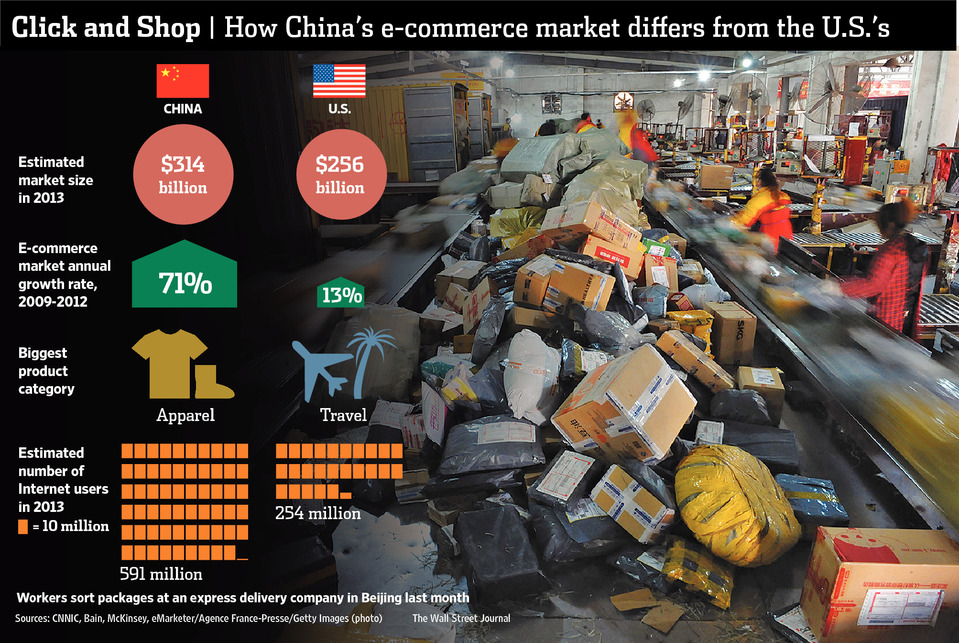
Chinese Internet retailers serve what has become the world’s biggest e-commerce market. Their next target: the U.S., and the rest of the world. Jingdong Corp., a leading Chinese Internet retailer by sales, has logged millions of yuan in sales on its English-language site in the past year, despite almost no advertising, according to the firm. AliExpress, which Alibaba Group launched in 2010 as its overseas platform, is growing rapidly in emerging markets, reaching 700,000 registered users in Russia alone.Chinese firms are attracted to overseas markets partly because of ferocious competition at home. “In China, price is the most important factor, and there is little customer loyalty,” says Liu Sijun, who is in charge of exports at Jingdong. “Outside China, services are more important.”
Jingdong’s gross margins outside China, defined as gross profit as a percentage of sales, are about 40%-50%, much higher than the 15%-20% level for e-commerce companies at home.
Entrepreneurial Chinese have long sold abroad, on platforms such as eBay Inc. Now, big players are testing the waters. Still, big Chinese firms so far pose little threat to giant U.S. Internet retailers such asAmazon.com, AMZN -0.19% as even the companies acknowledge.
But they could offer options to consumers shopping for products in niche areas.LightInTheBox Holdings, LITB +5.73% for example, started with wedding gowns and broadened its offerings to include items such as faucets with lights that change color with the water temperature.
Jingdong said Chinese-language books are selling well overseas. So are specialty electronics such as soymilk machines and Chinese noodle makers that are hard to find outside China.
At AliExpress, hair extensions and wigs accounted for 68% of all product purchases in the beauty and health category in the first half of 2013. Buyers in the U.S. accounted for 75% of those purchases, the company said. Most searches in the category are for “virgin hair,” according to Alibaba. Virgin hair is unprocessed and hasn’t been dyed, bleached or permed.
This year, the Chinese e-commerce market became the world’s largest by sales, overtaking the U.S., according to Bain & Co., the global consultancy firm. The Chinese market grew 42% in the third quarter from the same period a year earlier, according to iResearch, which tracks the Chinese Internet market. Figures from comScore Inc.,SCOR -1.07% a U.S. firm that measures what people do in the digital world, show growth of 13% in the quarter for the U.S. retail e-commerce market.
When Chinese companies push outside the mainland, Hong Kong and Macau tend to be their first stops, due to the cities’ physical proximity and Chinese-speaking populations. U.S.-listed Vipshop Holdings Ltd. VIPS +6.69% , an online discounter of luxury products, is launching a platform for Hong Kong and Macau this month.
When Richard Ji, managing partner of an investment fund, was preparing his Hong Kong apartment for his first child, his wife bought three ceiling lights from Taobao, a Chinese e-commerce site. Mr. Ji reckons the lights would have cost 10 times as much in Hong Kong.
“Chinese e-commerce sites offer value for money for customers outside China,” said Mr. Ji, who was Morgan Stanley’s head of Asia Internet and media research before launching his fund, which focuses on Internet-related companies.
As big orders from the likes of Wal-Mart Stores Inc. become harder to come by, Chinese manufacturers are more willing to sell online. The Chinese government is also eager to support this new growth area, seeing it as a way to help small exporters reach new customers. The Ministry of Commerce issued a notice in November to encourage cross-border e-commerce, making it easier for small exporters in terms of taxes, customs and foreign exchange.
If Chinese online retailers are serious about taking on global companies such as Amazon.com and eBay, they need to build their own logistics centers abroad for more efficient handling. So far, neither Jingdong nor AliExpress manage their own shipping or logistics, choosing to use partnerships instead.
A year ago overseas expansion wasn’t a topic at Vipshop’s board meetings, but now the company is exploring options, says Xing Liu, a Vipshop board member and managing director of Sequoia Capital. “E-commerce is a global business and many Chinese e-commerce players have global ambitions.”
 About bambooinnovator
 Bamboo Innovator