How A Promising Electric Car Battery Startup Completely Self-Destructed
December 22, 2013 Leave a comment
How A Promising Electric Car Battery Startup Completely Self-Destructed
ANTONY INGRAM, GREEN CAR REPORTS
DEC. 20, 2013, 5:16 PM 1,360 3
The race to find battery technologies of the future is not one without casualties. The trail left behind Envia, one of the most promising battery startups in recent years, has left something more akin to a warzone–and even huge companies like General Motors have taken shrapnel during their contribution.
Now, Steve LeVine at Quartz has pieced together Envia’s full story for a comprehensive and well-researched look into just what went wrong at Envia–and why it’s the subject of lawsuits from rivals and bemusement from GM executives.
Promising beginnings
Envia is the brainchild of Sujeet Kumar, an Indian who moved to the U.S. to study in 1990 and gifted in electrochemistry. Back in 2006, he was hired by NanoeXa, a battery startup formed by Pak, a South Korean-born entrepreneur.
During his time at NanoeXa, Kumar discovered a new nickel, manganese, cobalt (NMC) cathode technology developed by Argonne National Laboratory.
The technology allowed for faster charging and discharging of batteries, improving performance and energy density. The company liked it, and licensed it.
Just a year later though, Kumar resigned over “personal differences”, leaving NanoeXa in chaos as Kumar had been the main engineer. Kumar decided to form his own company, called Envia, telling Pak he wouldn’t compete–yet decided to use the same battery technology.
It’s this that resulted in the first of Envia’s lawsuits, though, the suit had no real strength–NanoeXa could provide no real evidence for exactly what technology Kumar had supposedly taken with him to Envia.
Kumar met with an old acquaintance, Atul Kapadia, who was able to arrange over $3 million in funding for the startup. By 2009, Kapadia had become CEO of the company.
GM pays attention
Shortly after, Kumar became aware of an ARPA-E competition to explore breakthrough battery technologies.
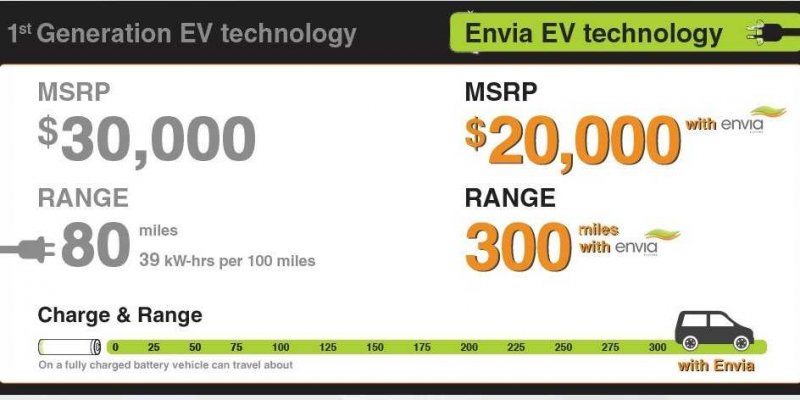
Using the NMC cathode, Kumar decided to pair it with a new silicon anode, also developed by Argonne, that didn’t swell and damage the battery under charging. Combining the two could deliver 400 watt-hours per kg of energy density–enough for a 300 mile battery at half the current cost. A prototype of this battery was made and it returned the desired characteristics.
Such a high-profile breakthrough attracted the attention of some high-profile companies. General Motors was one to take note, well into development of the Chevrolet Volt range-extended electric car and aiming to grant its next-generation Volt with high electric range.
GM’s ventures arm led $17 million in fundraising, $7 million of which was provided by GM itself. Envia would develop and provide the cathode for the next-gen Volt in 2015–with the aim of a 200-mile range, owing to GM’s accepted margin of error expanding the technology to a full-size battery.
It finally awarded a contract in November 2012, and even offered a $2 million-per-quarter deal based on tough performance targets–which subsequently proved too tough.
GM found it couldn’t replicate the high energy density, and an external report showed that, while would hit the targets initially, energy density subsequently plunged over following charge-discharge cycles. By 400 cycles, performance was down to half.
Envia begins to unravel
via High Gear Media
The 2013 Chevrolet Volt.
Kapadia then discovered the ARPA-E cell used anode material bought in from Japanese firm Shin-Etsu, notdisclosed to customers and passed off as Envia’s own. Subsequently, GM turned out not to care that much–provided the performance was okay. The main trouble was that it wasn’t–and Kumar responded by saying the timeframe given wasn’t realistic.
Kapadia’s role was subsequently reduced to selling the company and settling NanoeXa lawsuit. By July and August 2013, GM terminated the contract as Envia had failed to move the project forward. A meeting with GM mitigated the risk of a lawsuit through not meeting the contract.
Kapadia was laid off in late August, filing his own lawsuit against Envia.
Kumar alleges Kapadia wouldn’t share information on the GM deal within the company–but official records suggest otherwise. Kumar also said he’d never promised technology to be used in working electric vehicles, in terms in GM’s contract suggest they were expecting a product that could be used directly in its vehicles.
Currently, Envia is still researching new battery tech, winning a $3m DoE grant and looking into silicon-carbon anode technology.
But the entire story illustrates the difficulty of developing such advanced battery technology in a market clamoring for it–and the risks associated when so many companies can be led down a dead-end path.
It’s well worth reading the Quartz report in full to appreciate just how difficult it can be to introduce cutting-edge technology to market–and how wide the fallout can spread.
 About bambooinnovator
 Bamboo Innovator