Remembering Abe Briloff: A giant of the accounting profession, Briloff exposed the funny math that many companies relied on to look a lot healthier than they were. How the “Briloff effect” became the “Barron’s effect.”
December 22, 2013 Leave a comment
SATURDAY, DECEMBER 21, 2013
Remembering Abe Briloff
By BILL ALPERT | MORE ARTICLES BY AUTHOR
A giant of the accounting profession and treasured Barron’s contributor, Briloff exposed the funny math that many companies relied on to look a lot healthier than they were. How the “Briloff effect” became the “Barron’s effect.”
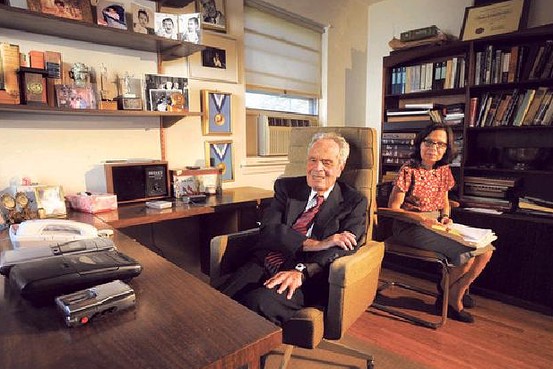 Abe Briloff and his daughter Leonore.
Almost every tale of Abraham Briloff’s heroic feats exposing the dirty tricks hidden in corporate America’s financial statements leaves ’til last the revelation that Abe showed us what we were all missing while he was legally blind. We never bury the lead here. Right up until about a month before his death on Dec. 12 at age 96, Abe regularly called Barron’sto alert editors to the sleight-of-hand he had found in, say, Footnote 18 in some large company’s annual report, having memorized pages of the company’s financials that had been read to him by his daughter Leonore or his grad students at City University of New York’s Baruch College, where he was the Emanuel Saxe Distinguished Professor of Accountancy.In describing Abe, especially in a eulogy, it’s tempting to call him a combination of an Old Testament prophet, John Milton, Sherlock Holmes, and the blind superhero Daredevil. But none of those guys did the math.
For 45 years, beginning with the July 15, 1968, story “Dirty Pooling,” Abe wrote accounting exposes in Barron’s that were instrumental in making this weekly’s reputation for investor protection. His jeremiads against abuse-prone practices, like pooling-of-interests accounting for mergers, were at first repudiated by the well-compensated accounting establishment. When financial disaster ensued, Abe’s views became generally accepted accounting principles.
Unlike his timid academic peers, Abe named names when he poetically decried sinful accounting practices. Those names included powerful and vindictive leaders of the last half-century in big business. Throughout his career, he endured attacks by the American Institute of CPAs, the trade association dominated by the Big 8 (in time, the Big 6…5…4…), whose auditors too often catered to the demands of stock-promoting corporate management. In the 1960s, he deconstructed the merger accounting of conglomerates LTV and Gulf & Western. In the 1970s, he sleuthed out inconsistencies in the lease accounting of Saul Steinberg’s Reliance Insurance. Steinberg unsuccessfully sued Briloff and Barron’s.
The last story we published by Abe and Leonore Briloff, in 2011, argued that the hospital chain HCA fluffed its profitability when it returned to the public markets after a private-equity buyout, by disappearing nearly $16 billion in costs (“Where Did the $15.8 Billion Go?” Oct. 3, 2011).
Abe’s crusading journalism was but a piece of this man of many parts. In his private accounting practice he served many not-for-profit groups and famously kept singer and civil rights activist Harry Belafonte on the right side of the law when the Internal Revenue Service futilely searched for lapses in 1967 audits of Belafonte and Martin Luther King.
Because Abe’s contributions to Barron’s go back so far, most of his work is preserved only in yellowed paper volumes dating from the 1960s. Those who have unwittingly benefited from his journalistic legacy should be aware that what’s now called “theBarron’s effect” of our exposes on inflated share prices originally was known as “the Briloff effect.” Finance researchers have pointed to the permanent moves in stocks Abe skewered in Barron’s as evidence against the efficient-market theory. Even on Wall Street you can find the truth, if you’re gutsy, brilliant—and blind.
 About bambooinnovator
 Bamboo Innovator