Chinese Energy Giants Refocus on Traditional Assets; Shale Gas and Oil Sands Are Losing Their Allure Because of a Lack of Export Infrastructure
December 25, 2013 Leave a comment
Chinese Energy Giants Refocus on Traditional Assets
Shale Gas and Oil Sands Are Losing Their Allure Because of a Lack of Export Infrastructure
YVONNE LEE
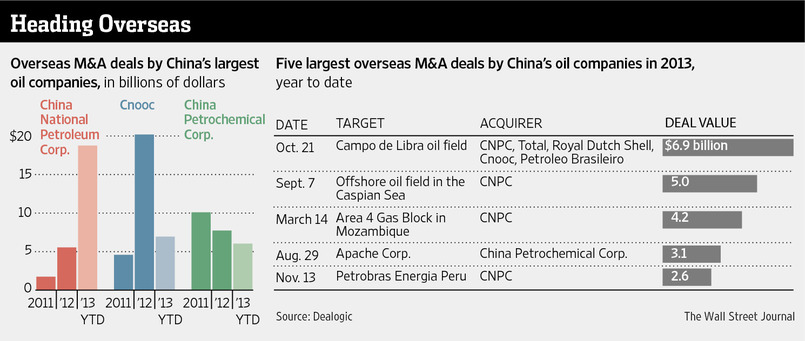
China’s energy giants, which have long been the country’s biggest foreign acquirers, are focusing on traditional oil and gas assets once again after favoring unconventional energy assets like shale gas and oil sands in recent years.The world’s biggest firms, or majors, are putting plenty of oil assets on the sale block, and Chinese companies are snapping them up. So far this year, China’s top three oil companies—China National Petroleum Corp., China Petrochemical Corp., or Sinpoec Group, and Cnooc Ltd. 0883.HK +0.70% —have spent $32 billion on conventional oil and gas asset acquisitions overseas, according to data provider Dealogic.
Once the darling of Chinese oil giants seeking overseas assets, shale gas and oil sands are losing their allure, because they hard to sell outside of North America.
“When [Chinese oil companies] start to look at their ability to bring unconventional gas to China, they have found out it is not so easy,” said Adi Karev, global head of oil and gas and managing partner at Deloitte Touche Tohmatsu. “Now they want to buy conventional oil and gas assets, as it is easier and faster to produce than unconventional fuel.”
China has pumped more than $44 billion into buying oil and gas resources, especially shale and oil sands assets, in the U.S. and Canada since 2008, according to Dealogic. Buying into shale or oil gas assets overseas was seen as an easier way to get western technology into China, which holds the world’s biggest deposits of gas in shale rock.
Unlike Canada or the U.S., where shale gas is widely produced, China’s shale gas reserves remain largely untapped. Most of the reserves in China are in remote areas that don’t have access to large quantities of water needed for shale gas extraction, and the country lacks contractors that can drill for gas under modern safety standards.
Oil sands are a mix of sand and tarlike heavy crude oil, while shale gas is gas trapped in rocks. The advances in technology that have allowed companies to access and convert these unconventional fuels to usable oil and gas have boosted energy production in North America in recent years. One high profile acquisition China has made into shale gas was state-run Cnooc’s $15.1 billion purchase of Canada’s Nexen Inc. The deal, which was completed in February, is the biggest overseas purchase by a Chinese company.
This year, however, Chinese companies have focused on conventional oil and gas acquisitions in South America, Africa and the Middle East. CNPC, China’s largest oil producer, is the most aggressive among Chinese oil giants in terms of acquiring overseas oil and gas assets. It has spent $19 billion so far this year to buy resources including Brazilian state oil company Petróleo Brasileiro‘s PETR4.BR +0.89%conventional oil and gas assets in Peru, and Italian oil producer Eni SpA’sENI.MI +1.17% stake in a giant Mozambique offshore natural-gas field, more than triple the $5.6 billion spent in 2012. CNPC couldn’t be reached for comment.
This was a year when oil and gas majors like Royal Dutch Shell RDSB.LN +0.22%PLC and BP BP.LN +0.56% PLC put assets in conventional fuel for sale. For instance, BP has sold more than $60 billion in assets since the 2010 Deepwater Horizon explosion and oil spill in the Gulf of Mexico, according to Dealogic. While major oil companies are pulling back around the world, Chinese companies are boosting conventional fuel production overseas.
“The number of North America shale deals by Chinese companies has dropped off dramatically,” said Tom Deegan, a Hong Kong-based China energy specialist and partner at law firm Sidley Austin.
But the tailoff in buying shale or oil sands won’t be permanent, and the U.S. will remain in the sights of China’s big oil players.
The U.S. and Canada, which are trying to transform themselves into net exporters of natural gas from net importers, have approved several liquefied natural gas export projects to LNG-hungry Asian markets such as China. But most of the infrastructure projects are in development stages and will take years.
“Chinese oil and gas companies are going to get involved in other parts of the shale business, on the delivery and services side of the business…they need to acquire knowledge in oil-field and gas-field services and energy delivery, and will be looking particularly at the U.S. for this,” said Mr. Deegan.
 About bambooinnovator
 Bamboo Innovator