Financial Scammers Increasingly Target Elderly Americans; One in Every Five Americans 65 or Older Has Been Abused Financially
December 25, 2013 Leave a comment
Financial Scammers Increasingly Target Elderly Americans
One in Every Five Americans 65 or Older Has Been Abused Financially
E.S. BROWNING
Dec. 23, 2013 3:20 p.m. ET
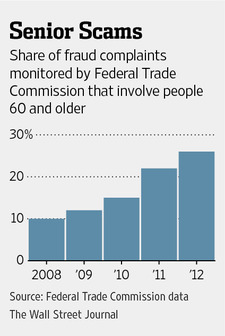
Minnesota State Rep. Joe Atkins spoke at a senior-citizen community last year and asked how many had recently been targeted by scammers. “Every single hand in the room went up, 75 for 75,” Rep. Atkins says. “Every single resident had gotten that same call.” always missed call.. Four told him they had sent money and were ashamed.The fleecing of older Americans is becoming an epidemic. People 60 years and older made up 26% of all fraud complaints tracked by the Federal Trade Commission in 2012, the highest of any age group. In 2008, the level was just 10%, the lowest of any adult age group.
Some of the Scams
Some of the most insidious scams are those targeting older people concerns about retirement security. Read how scammers got thousands of dollars in three cases.
Enforcement Elusive
One of the most frustrating things about financial fraud is how rarely the crimes can even be investigated, much less solved. Read more.
One in every five Americans age 65 or older has been abused financially, according to a 2010 survey by the Investor Protection Trust, a financial-education organization. Financial abuse cost older Americans at least $2.9 billion in 2010, up 12% in two years, according to Metropolitan Life Insurance Co. MET +0.09%
“It is a big and growing problem,” says Robert Roush, who runs a geriatric education center at Baylor College of Medicine.
The ability to recognize fraud can fade with aging, even among people without dementia, research shows. As the number of seniors increases, they also are becoming more-enticing targets. Cheap Internet phoning, emailing and rapid fund-transfer technology make it easy to contact—and swindle—potential targets. People strapped after the financial crisis can be more apt to fall for get-rich-quick schemes. They can lose thousands of dollars or more before families notice.
Only 10% of such frauds are reported, investigators estimate. Older people often fear losing their independence if their children find out. Most reported cases aren’t even investigated.
Vance Callender, an operations chief for Immigration and Customs Enforcement, once tabulated fake-lottery cases run from abroad. “We collected 36,000 victims” in six months in 2009, “and we can’t open 36,000 investigations,” he says.
“It is no secret that we have to prioritize our cases,” says Supervisory Special Agent David Nanz, who oversees corporate- and securities-fraud investigations in the FBI’s Miami office.
Financial scams are expensive for law enforcement to pursue. There can be little concrete evidence, and alleged scammers claim money was given to them freely or that losses were legitimate.
Some officials have given up individual investigations and are trying to build databases of criminal networks, or simply educate seniors. It is an uphill battle for which governments have little money.
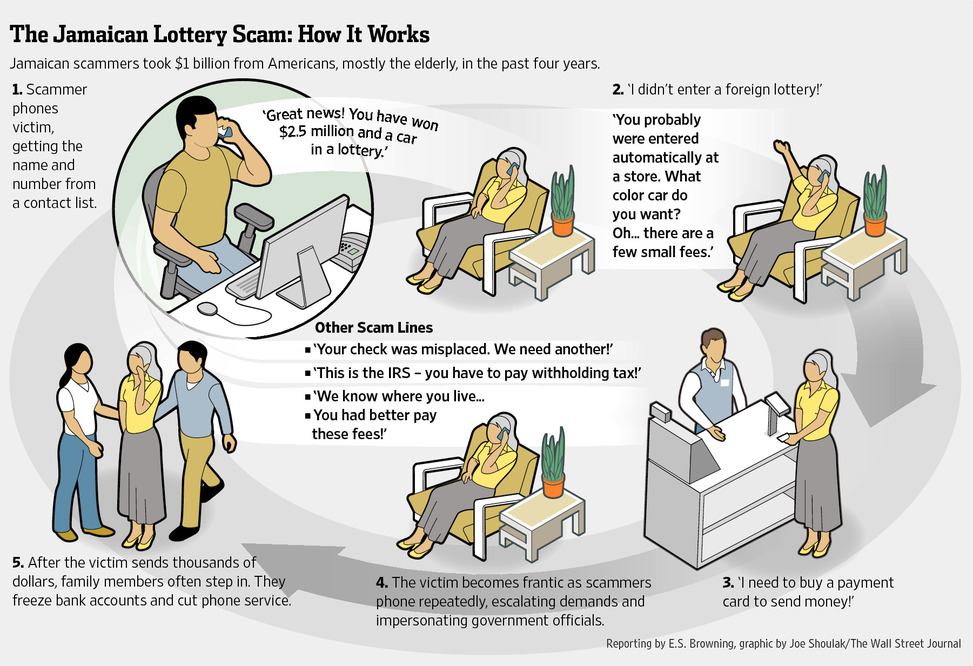
One fraud run from Jamaica roped in Delores Aird, 85 years old, forcing her into bankruptcy by persuading her she had won $2.5 million and a Mercedes-Benz in a 2010 lottery.
Ms. Aird sent $47,000 trying to collect “winnings” before her family took over her finances and changed her phone number. She tried to mortgage her house. When her son confronted her, she was shivering with anxiety on the back porch, phone in hand.
“They get you so that you don’t even know your name, you get so mixed up,” she says.
Scammers sometimes phone a dozen times a day, forging personal relationships with lonely victims. They talk about what color car to choose or what to do with winnings. They mention small “fees” that grow with time as “problems” develop. Victims become frantic about collecting winnings. The more money they send, the harder it is to walk away.
When Ms. Aird’s son answered her phone a scammer threatened to have him killed if he interfered, the son says. The con artists pretended to be car transporters, lawyers, bankers, even an FBI agent and a U.S. marshal, all needing funds to solve problems. Ms. Aird says she must have given them personal information because they appear to have renewed lapsed credit cards, which she then used for cash advances.
More than one-third of people age 71 and older have some form of cognitive impairment, a Duke University study found. Mild impairment is hard to detect, says Dr. Roush of Baylor, who has a Ph.D. in education. “You can play golf, go to restaurants, go to the opera. You can do almost everything you used to do except manage your money safely,” he says.
A doctor tested Ms. Aird and found she doesn’t have dementia, she and her daughter say, but she couldn’t resist the scam.
Now she is ill, her weight down to less than 100 pounds from more than 130. Her family watches her. “I feel that my independence is gone,” she says. “I just feel like I am a big worry to them now.”
Federal authorities often decline to investigate cases involving less than $100,000. A Minnesota police detective did look into Ms. Aird’s case but wasn’t able to recover anything.
A Jamaican law this year made such fraud a crime. “The scamming is highly organized,” says Inspector Dahlia Garrick, spokeswoman for Jamaica’s Major Organized Crime and Anti-Corruption Task Force. “We have been actively pursuing offenders under that act.”
The scamming originating in Jamaica began after foreign companies trained English-speaking Jamaicans to work in local call centers, according to Special Agent Callender. They learned the art of persuasion. Some turned to fraud. Violent gangs fight over what they call “sucker lists.”
There are other types of scams targeting the elderly. For example, with senior citizens using dating websites, romance scams have blossomed. Online sweethearts take money to finance supposed visits or emergencies.
Work-at-home frauds target people short of retirement money. Scammers persuade people to pay for expensive but ineffective online training and website creation.
The grandparent scam, which Rep. Atkins found at the seniors’ facility, features a scammer pretending to be a grandchild on the phone.
“Is that you, Billy?” the grandparent responds.
“Yes!” says the scammer. “It’s Billy. I’ve been kidnapped in Mexico. Wire $2,000 or they will hurt me! Don’t tell my parents.”
A surprising number of people send money.
Scams offering fraudulent stock tips and phony investments remain widespread.
“Everybody wants to participate because they see people getting 7% or 8% [returns with riskier investments], and their money is sitting in the bank getting 1% or 2%,” says Eric Bustillo, who directs the Securities and Exchange Commission’s Miami regional office
 About bambooinnovator
 Bamboo Innovator