WRONG: Nine Economic Policy Disasters and What We Can Learn from Them
December 26, 2013 Leave a comment
WRONG: Nine Economic Policy Disasters and What We Can Learn from Them Hardcover
by Richard S. Grossman (Author)
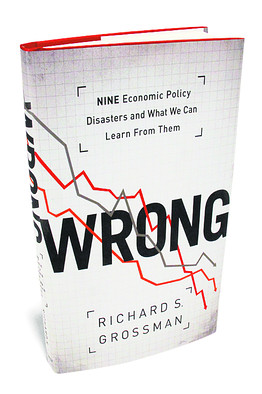
In recent years, the world has been rocked by major economic crises, most notably the devastating collapse of Lehman Brothers, the largest bankruptcy in American history, which triggered the breathtakingly destructive sub-prime disaster. What sparks these vast economic calamities? Why do our economic policy makers fail to protect us from such upheavals? In Wrong, economist Richard Grossman addresses such questions, shining a light on the poor thinking behind nine of the worst economic policy mistakes of the past 200 years, missteps whose outcomes ranged from appalling to tragic. Grossman tells the story behind each misconceived economic move, explaining why the policy was adopted, how it was implemented, and its short- and long-term consequences. In each case, he shows that the main culprits were policy makers who were guided by ideology rather than economics. For instance, Wrong looks at how America’s unfounded fear of a centralized monetary authority caused them to reject two central banks, condemning the nation to wave after wave of financial panics. He describes how Britain’s blind commitment to free markets, rather than to assisting the starving in Ireland, led to one of the nineteenth century’s worst humanitarian tragedies- the Irish famine. And he shows how Britain’s reestablishment of the gold standard after World War I, fuelled largely by a desire to recapture its pre-war dominance, helped to turn what would otherwise have been a normal recession into the Great Depression. Grossman also explores the Smoot-Hawley Tariff of 1930, Japan’s lost decade of the 1990s, the American subprime crisis, and the present European sovereign debt crisis. Economic policy should be based on cold, hard economic analysis, Grossman concludes, not on an unquestioning commitment to a particular ideology. Wrong shows what happens when this sensible advice is ignored.Editorial Reviews
Amazon.com Review
Seven surprising facts from WRONG: Nine Economic Policy Disasters and What We Can Learn from Them
1. The American Revolution was fomented by Britain’s insistence that Americans should provide the mother country with raw materials at a reasonable price and buy finished products in return. This led to a somewhat bizarre situation in which an American who wanted to wear a hat made of an American beaver pelt could only buy it after the pelt had been shipped to England, turned into a hat, and shipped back to America to be sold.
2. In the 1600s, Sweden managed to have a coin weighing 43 pounds, causing many large scale transactions to be impossible without a cart and horse. Shortly after this mistake, Sweden switched to paper money.
3. The Federal Reserve System is one of the world’s most powerful and well-regarded central banks. It was not, however, America’s first central bank—or even its second. America had established not one, but two central banks 200 years ago—and dismantled them both before the Federal Reserve was formed.
4. In the 1990s Japan suffered from a financial crisis and deep economic recession. The severity of this “lost decade” can be traced to the authorities’ decision to hide the country’s economic problems for as long as possible. This was accomplished by propping up failing banks, in hopes that they would return to profitability when the economy picked up, rather than closing them.
5. Why did Europe switch to the disastrous Euro as a unified form of currency? Consider the following: During the pre-euro era, if a tourist had started in one of the 12 countries that adopted the euro in 2002 with 100 German marks and then traveled to each of the 11 other eurozone countries doing nothing in each except exchange money into the local currency at each stop, and was charged a standard 3 percent per conversion, he or she would have spent about 28.5 percent of the original sum on commissions alone.
6. The German hyperinflation during the early 1920s was one of the most severe on record. The severity of the hyperinflation led Germans to burn banknotes to generate heat and use them as wallpaper. According to one story, a suitcase filled with money was left by its owner on the sidewalk while he went into a store; when the owner returned to retrieve the suitcase, he discovered that a thief had emptied out the money and stolen the now much lighter suitcase.
7. Shortly before Britain’s announcement of the return to the gold standard in 1925, Winston Churchill hosted a small dinner party with both supporters and opponents of the return to gold. According to the only surviving record of that evening, John Maynard Keynes –one of the era’s most articulate opponents of the gold standard–was not particularly persuasive that evening, and in the following days Britain switched to the gold standard which ultimately contributed to the severity of the Great Depression. Could Keynes’ “off night” have brought about one of the worst economic disasters the industrialized world has ever known?
Review
“Those who do not learn from the past are doomed to, well, not learn from the past. In an age when ideology rather than economic reasoning increasingly drives public policy, Richard Grossman’s provocative and entertaining review of historical experience reminds us of how ideology has led us astray before.” –Barry Eichengreen, George C. Pardee and Helen N. Pardee Professor of Economics and Political Science, University of California, Berkeley
“The best way to get economic policy right in the future is for aspiring journalists, economists, and policy wonks to read WRONG, a brilliantly concise and entertaining guide to learning from one’s mistakes. It’s going straight onto my business journalism students’ reading list.” –Sylvia Nasar, author of Grand Pursuit and A Beautiful Mind
“This is a fascinating book about great economic policy mistakes. If you do not want to be the one who triggers the Great Depression on your watch, or who loses an entire colonial empire because of a small tax, this is the book to read. It even tells you about why we are in the mess we find ourselves in. Full of great vignettes, it is an enjoyable introduction to history’s great economic bloopers.” –Raghuram Rajan, Eric J. Gleacher Distinguished Service Professor of Finance, Booth School of Business, University of Chicago and Chief Economic Advisor, Finance Ministry, Government of India
“Millions of people have suffered greatly, nations have fallen, and wars have been fought because of economic policy blunders. Yet while statesman and generals constantly restudy and relearn the lessons of Pearl Harbor or Vietnam or Munich, economists too often fail to learn lessons from past failures. That makes this book both novel and important. It should be read by anyone taking up a significant economic policy position and anyone seeking to understand and influence economic policy.” –Larry Summers, Charles W. Eliot University Professor, John F. Kennedy School of Government, Harvard University and former President of Harvard University and Secretary of the U.S. Treasury
 About bambooinnovator
 Bamboo Innovator