Temples of delight: Museums the world over are doing amazingly well, says Fiammetta Rocco. But can they keep the visitors coming?
December 27, 2013 Leave a comment
Temples of delight: Museums the world over are doing amazingly well, says Fiammetta Rocco. But can they keep the visitors coming?
Dec 21st 2013 | From the print edition
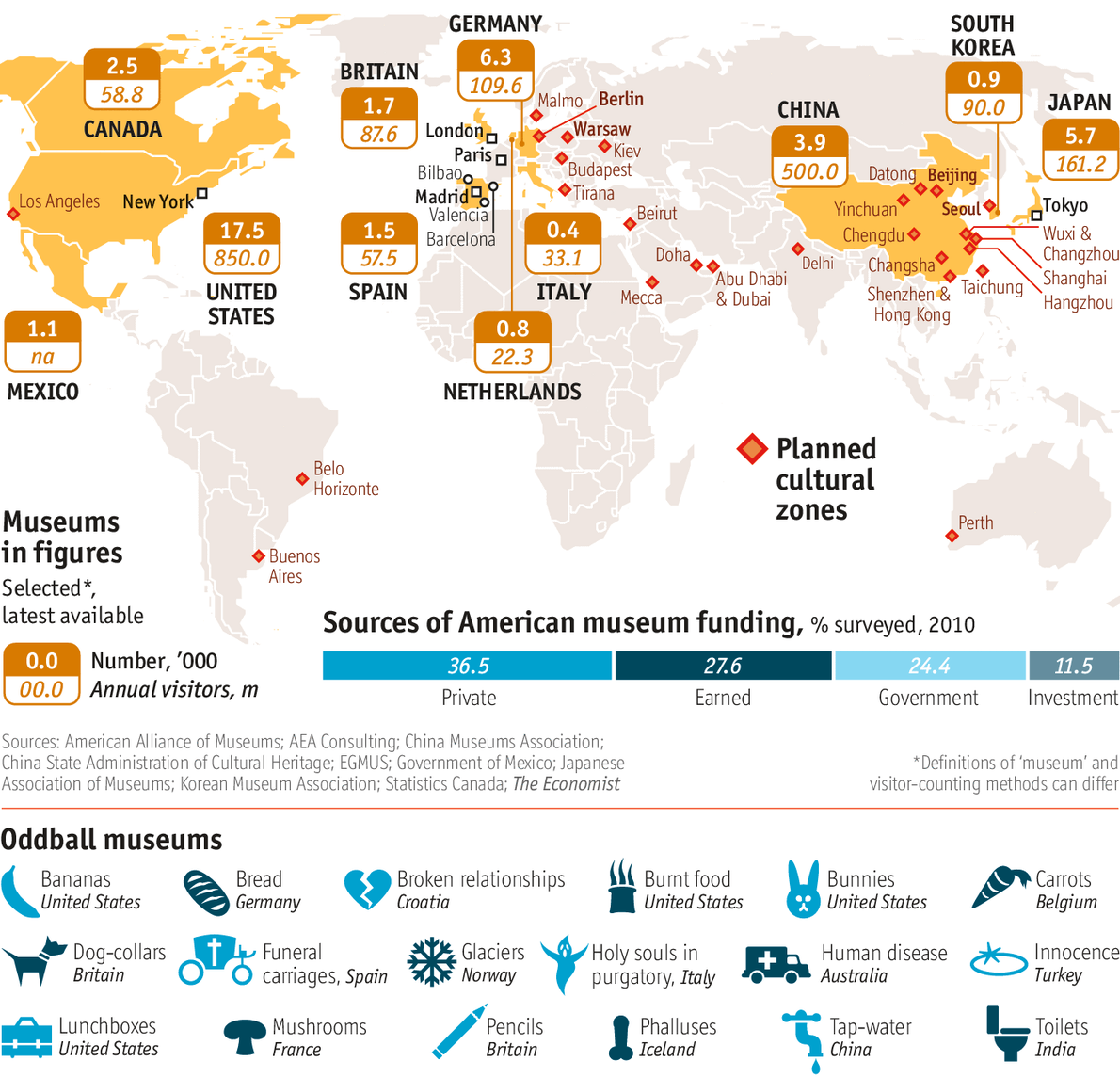
MUSEUMS USED TO stand for something old, dusty, boring and barely relevant to real life. Those kinds of places still exist, but there are far fewer of them, and the more successful ones have changed out of all recognition. The range they cover has broadened spectacularly and now goes well beyond traditional subjects such as art and artefacts, science and history (for a sample of oddball specialities, see chart). One of the biggest draws is contemporary art.To be sure, museums remain showcases for collections and repositories of scholarship, but they have also become pits of popular debate and places where children go for sleepovers (pictured, above, at the British Museum). They are no longer places where people look on in awe but where they learn and argue, as they would at universities or art schools. Sir Nicholas Serota, director of Britain’s Tate galleries, describes the museum as “a forum as much as a treasure box”.
The statistics suggest that these new-look museums are doing something right. Globally, numbers have burgeoned from around 23,000 two decades ago to at least 55,000 now. In 2012 American museums received 850m visitors, says the American Alliance of Museums. That is more than all the big-league sporting events and theme parks combined. In England over half the adult population visited a museum or gallery in the past year, the highest share since the government began collecting such statistics in 2005. In Sweden three out of four adults go to a museum at least once a year (though not all Europeans are equally keen). The Louvre in Paris, the world’s most popular museum, had 10m visitors last year, 1m more than in 2011. China will soon have 4,000 museums—still only a quarter the number in America, but it is racing to catch up.
A world of choices
On the face of it, that success seems surprising. People now have more choices than ever before in how to spend their leisure. Many travel to see the world, but mostly the world comes to them, often via television and the internet, conveniently delivered to their laptops or smartphones. So why would they want to traipse round museums if most of the stuff they can see there is available at the click of a mouse?
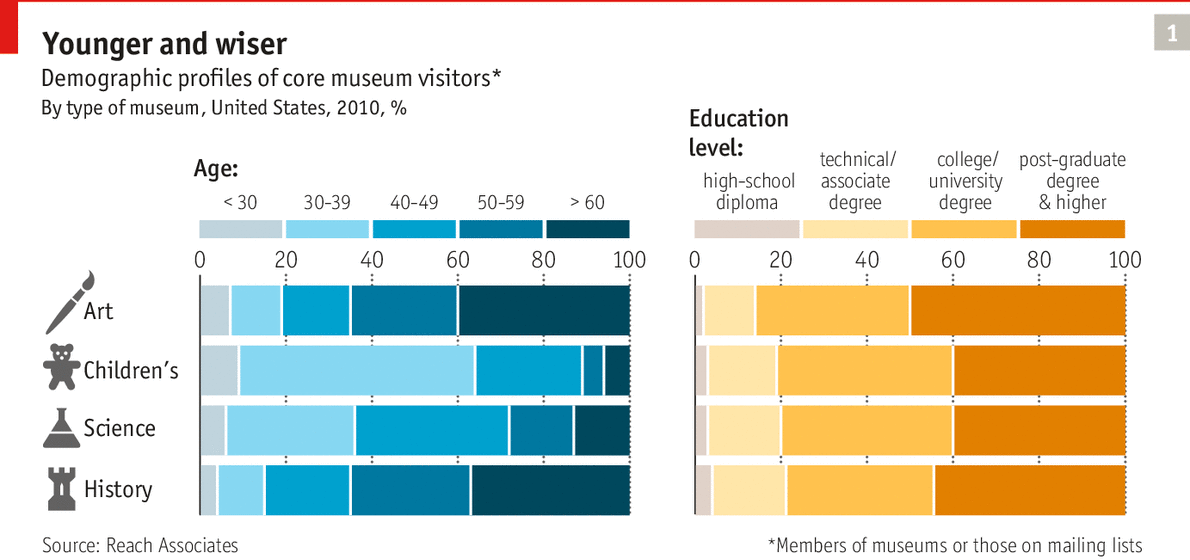
Some of the new enthusiasm for museums is explained by changes in demand. In the rich world, and in some developing countries too, the share of people who are going on to higher education has risen spectacularly in recent decades. Surveys show that better-educated folk are a lot more likely to be museum-goers. They want to see for themselves where they fit in the wider world and look to museums for guidance, which is why so many of these places have been transformed from “restrained containers” to “exuberant companions”, as Victoria Newhouse writes in her book, “Towards a New Museum”.
In developed countries museums are being championed by a wide variety of interest groups: city fathers who see iconic buildings and great collections as a tourist draw; urban planners who regard museums as a magic wand to bring blighted city areas back to life; media that like to hype blockbuster exhibitions; and rich people who want to put their wealth to work in the service of philanthropy (“a way for the rich to launder their souls”, as one director put it). For young people they are a source of something authentic and intriguing when their electronic entertainments start to pall.
In the more affluent parts of the developing world, too, museum-building has flourished, driven mainly by governments that want their countries to be regarded as culturally sophisticated (though wealthy private individuals are also playing a part). They see museums as symbols of confidence, sources of public education and places in which a young country can present a national narrative. Visitor numbers in such countries are also rising fast, boosted by a growing middle class. Some hope to use cultural offerings to attract many more foreign tourists. In Qatar and Abu Dhabi, for instance, a clutch of new museums under construction is meant to turn the Gulf into a destination for visitors from Europe, Russia and South Asia. Chinese museums received more than 500m visits last year, 100m more than in 2009.
A time for worship
Less than a century ago Benjamin Ives Gilman, who served as secretary of the Boston Museum of Fine Arts for over 30 years, published a personal manifesto, “Museum Ideals: of Purpose and Method”, in which he urged curators to treat museums as having a holy purpose. Collections should be contemplated for their aesthetic qualities alone, he argued, with no need for narrative, context or explanation. The best place to do that was in the rarefied surroundings of a museum. “A museum of art”, he wrote, “is in essence a temple.”
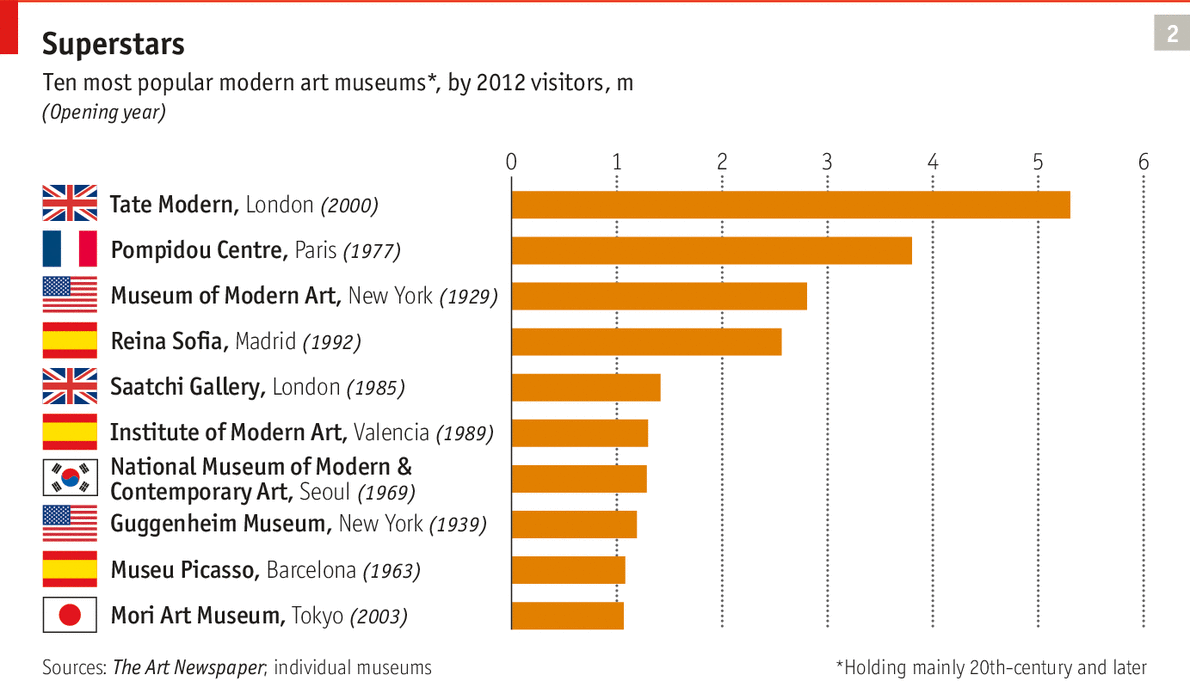
The demolition of the temple started with the opening of the Pompidou Centre in Paris in 1977. Renzo Piano and Richard Rogers turned the museum’s architecture inside out, literally and metaphorically. They put the utilitarian air shafts and escalators on the outside of the building and painted them in bright primary colours instead of hiding them away. Inside, visitors were encouraged to move from the permanent collection to the library and back again, and in and out of the special exhibitions. As if to emphasise that this museum was about having fun as much as about displaying art, jugglers and men on stilts entertained visitors all over the museum plaza in the fashionable Marais district. Ever since, cities have been vying to put up increasingly adventurous museum buildings and entire quarters to stake their claim as cultural centres (see article).
Not all of what Gilman stood for has been swept away. When the British Museum (BM) opened in 1759, it proclaimed itself as the world’s first independent national museum “for all studious and curious persons, both native and foreign-born”. That remains its aim. But whereas in Gilman’s day curators reigned supreme, now they have to enchant visitors rather than lecture them. Museums offer narratives in their exhibitions, provide a context for objects by linking them to other people and other places, work with digital experts to enable visitors to participate as well as watch and listen, and create innovative public programmes to bring in the young and the inexperienced.
According to Kenneth Hudson, a British museum trendspotter and author of “Museums of Influence”, “the most fundamental change that has affected museums is the now almost universal conviction that they exist in order to serve the public.” Some people may turn up their noses, fearing that some of what goes on in museums these days is getting too close to being mere entertainment. But modern visitors like being entertained, and are likely to drift away unless museums can connect with them both intellectually and emotionally.
The money for all this comes from a variety of sources. Some institutions were privately founded and continue to be privately funded, others are entirely state-financed. In recent years public funding throughout the developed world has been squeezed, so museums have had to become more adept at raising money themselves, and the barriers between the two traditional funding models have become more fluid. Most institutions in Europe, America and Australia now live on a mix of public, corporate and individual support. Even in Germany, where culture has traditionally been seen as the responsibility of the state, the climate is getting harsher. The main museums in Berlin are now expected to raise at least 8.5% of their annual operating budget in ticket sales and sponsorship.
One handy source of income is to make loans of artworks to galleries abroad. Berlin’s Gemäldegalerie has been able to raise €1m ($1.3m) by lending its two Vermeers to museums in Japan. The Picasso Museum in Paris raised €30m of the €50m it needed for its current makeover from lending works to museums abroad. Axel Rüger, director of the Van Gogh Museum in Amsterdam, says he has a list as long as his arm of foreign museums clamouring to borrow some of his most famous paintings.
A big institution such as the BM costs about £100m ($160m) a year to run, of which 40% goes on staff alone. Every pound from the Treasury is more than matched by a pound the museum raises itself. Admission charges for public museums in Britain were scrapped by a Labour government in 2001, though museums mostly ask for voluntary donations. But the BM has also made great efforts to strengthen its marketing and fund-raising and to sell its expertise. One way of doing that is to provide consultancy services to new foreign museums; a contract with the Zayed National Museum in Abu Dhabi, which will open in 2016, is thought to be earning the BM as much as £10m a year.
How to win Friends
Museums in America have traditionally been supported by rich individuals offering private endowments, but even there museums enjoy some state largesse in the form of tax breaks for donors and lenders, as well as rules favouring not-for-profit organisations (see main chart above for a breakdown of America’s museum finance). Other than in New York and Chicago, entrance fees as a source of income are becoming increasingly insignificant. When at the Dallas Museum of Art they shrank to just 2% of annual income, the trustees approved the launch of a radical new scheme: visitors sign up to a membership programme known as DMA Friends that gives them free admission if they provide their names, e-mail addresses and zip codes. Since January 35,000 people have joined, and they are signing up at a rate of 800 a week. The personal information they provide is overlaid with details from the census, allowing the museum to work out who their visitors are and exactly where they come from. Philanthropists love the scheme because it makes the use of their money more transparent.
Not all museums are doing equally well. Landmarks such as the Metropolitan Museum of Art in New York, the BM, the Louvre and the newly refurbished Rijksmuseum in Amsterdam steam on at full capacity. Small local museums also enjoy strong support from their communities. But historic houses and history museums are less popular than they used to be, and museums that cater for young visitors now have to compete with an array of other attractions.
And all museums, whether privately financed or funded by the state, are affected by the economic cycle. In Spain, for example, public funding has been slashed, so the many new museums that have been built in the past two decades are now struggling to cover their running costs. And in cities whose economic fortunes have declined, museums suffer too. Detroit has $18 billion-worth of debt, and on December 3rd was granted protection from its creditors. One proposal being considered for raising money is that it sell its fine collection of paintings by Bruegel the Elder, Van Gogh and Matisse, valued at $1 billion a decade ago.
Even so, new museums are still being opened every day, and in the West most of them are for contemporary art, because that seems to be the biggest draw just now.
The Bilbao effect
If you build it, will they come?
Dec 21st 2013 | From the print edition
A THRIVING CULTURAL sector is an essential part of what makes a city great, along with green spaces and immigrants who bring renewal and vigour to city life, according to a recent study by McKinsey, a consultancy. The opening of the Guggenheim Museum in Bilbao in northern Spain (pictured) in 1997, 20 years after the Pompidou Centre, shows how an imaginatively designed museum commissioned by an energetic mayor can help turn a city around.
Visitors’ spending in Bilbao in the first three years after the museum opened raised over €100m ($110m) in taxes for the regional government, enough to recoup the construction costs and leave something over. Last year more than 1m people visited the museum, at least half of them from abroad. This was the third-highest number ever, so the building continues to attract visitors even though the collection on display is modest. Other cities without historic cultural centres now look to Bilbao as a model for what vision and imagination can achieve.
Over the next decade more than two dozen new cultural centres focused on museums are due to be built in various countries, at an estimated cost of $250 billion, according to a study by AEA Consulting, a New York firm that specialises in cultural projects. Contracts have been signed and concrete is already being poured on some of them.
The most talked about are Saadiyat Island, a museum complex in Abu Dhabi that will be home to local offshoots of the Guggenheim and the Louvre, and the West Kowloon Cultural District in Hong Kong, which will house M+, the new museum of Chinese contemporary art, Hong Kong’s answer to London’s Tate Modern.
M+ has secured two large collections of Chinese contemporary art through a mixture of gifts and purchases. One is a large holding built up by a former Swiss ambassador to Beijing, Uli Sigg; the second was accumulated by a mainland businessman, Guan Yi. The decision to award the 38 pieces to Hong Kong rather than to a mainland museum ruffled feathers in Beijing. With four years to go before M+ opens, it is already set to become the leading institution of its kind in the region.
Plans are also well advanced for new cultural hubs centred on museums in Saudi Arabia (Mecca), Australia (Perth), Albania (Tirana) and Brazil (Belo Horizonte). And what will be Europe’s largest museum, the Mystetskyi Arsenal, with 50,000 square metres (540,000 sq ft) of exhibition space, is due to open fully in Kiev, Ukraine, next year.
Belo Horizonte, in south-east Brazil, is the town closest to a remarkable art and sculpture park known as Inhotim, founded in the 1980s by Bernardo Paz, a mining magnate. More than 20 galleries are filled with contemporary art, and hundreds of other works, many of them specially commissioned, are spread across 2,000 hectares of lush parkland. Inhotim has become an international art destination, with more than a quarter of a million visitors a year. The new cultural hub will make the city of Belo Horizonte itself part of the draw.
Such cultural hubs need a clear vision of what they can offer if visitors are to come more than once. The new centre in Perth, an expanded version of the existing Western Australian Museum, is relaunching itself as the museum of the Indian Ocean and is already planning exhibitions in collaboration with museums in Mumbai, Muscat, Abu Dhabi and Nairobi. The Mystetskyi Arsenal will open next year with a magnificent show by Ukraine’s best-known artist, Kazimir Malevich (1879-1935). But it is not clear how it intends to fill its vast spaces after that.
The example of the new Ordos Art Museum in Inner Mongolia, beautifully designed by a firm of Beijing architects, suggests that just building a terrific museum is not enough to ensure success. The city of Ordos has sprung up fast and is relatively rich, thanks to discoveries of oil and gas, but the museum has no collections and precious few plans for exhibitions. No wonder it is devoid of visitors. There may be a lesson here for the new cultural centres about to be built in other parts of the world.
On a wing and a prayer
Why so many museums are venturing into new works
Dec 21st 2013 | From the print edition
IT WAS A dark, damp winter in 2003 when Olafur Eliasson came to London. The 36-year-old Danish-Icelandic artist, who specialised in large-scale sculptures and installations, had a plan for Tate Modern: the “Weather Project” (pictured). He covered the ceiling of the Turbine Hall with a mirror and filled some humidifiers with a mix of sugar and water to create sweet-smelling mist. Visitors lay on the floor to watch a giant sun made out of hundreds of yellow lights rise out of the gloom, arranging themselves in distinctive groups to see their small reflections on the ceiling. Over the five months the installation was open, more than 2m people came to bask in a glow that was at once primeval and warmly communal.
The “Weather Project” made the global reputation of Tate Modern, which opened in 2000 to a mixed reception. Though its building was vast and impressive, its collection was small and unremarkable. Mr Eliasson’s work was a perfect example of what the museum was trying to do: create an experience in which the visitors themselves play a big part by harnessing technology to an artist’s imagination. This was the new contemporary art, and the public loved it.
Most significant new museums or museum wings built in the rich world over the past decade have been for contemporary art. (The few exceptions include Alice Walton’s enormous Crystal Bridges Museum of American Art in Arkansas, which concentrates on the 19th century.) Several dozen such new buildings have been completed in the past two or three years alone in cities as diverse as Buenos Aires, Cleveland, Cracow, Rome, Oslo and Sydney.
Contemporary art seems to be what the public wants—and artists, their dealers and museums are happy to supply it. Since the 1960s art-lovers have become accustomed to accelerating change. As veterans of cinema, television and more recently computer games and the internet, they are used to mixing visual languages and receptive to new ideas, however off-the-wall. “The interest in contemporary art is much broader, much richer and much deeper than it was when I started out 30 years ago,” says Paul Schimmel, a Los Angeles curator-turned-dealer.
Among museums, grand institutions like the Museum of Modern Art in New York are seen as stuffier than the Kunsthallen, the not-for-profit municipal art galleries found in many German cities. Earlier this year the Ludwig Museum in Cologne opened a retrospective by Andrea Fraser with a video of the artist having sex with one of her collectors. Los Angeles-based Ms Fraser is well represented in public collections in Britain, France and Germany, but considered too daring for an American retrospective.
Contemporary art seems to be what the public wants—and artists, their dealers and museums are happy to supply it
The rise of contemporary art is closely related to the growth in the art market, which has become global in its reach. Successful sales at the main international auction houses, Sotheby’s and Christie’s, generate a vast amount of publicity. This makes life easier for dealers who need to persuade collectors that contemporary art is worth huge sums. Jeff Koons’s “Balloon Dog”, a ten-foot-high shiny steel sculpture, comes in an edition of five, each a different colour. All the owners are world-class collectors such as Eli Broad and François Pinault. When the orange one was sold at Christie’s in New York last month it fetched $58.4m, a record auction price for a work by a living artist.
Collectors want to be sure that the art they are buying is of museum quality and widely sought after, and that it is part of a long art-historical tradition. To reassure them, dealers increasingly turn their showrooms into museum lookalikes. When Larry Gagosian, a famous dealer, showed a series of Richard Serra’s massive steel sculptures, “Torqued Toruses”, in one of his galleries in London in 2008, he presented each one on its own in a white-walled room. The settings echoed the artist’s 40-year retrospective at the Museum of Modern Art in New York in 2007 and a show at the Grand Palais in Paris a year later.
In the past three decades thousands of people have become super-rich, many of them in the financial sector in New York, London and Hong Kong and in natural resources in Australia and Central Asia. Since the 2008 financial crisis, investment consultants have taken to advising wealthy clients that art is a good way to diversify their portfolios. Contemporary art has become the universal benchmark for the new rich.
An early ambition for many of them is to join a museum board. In America the unwritten rule is to “give or get out of the kitchen”; board members are often a museum’s biggest donors. In exchange, membership of a museum board offers them entry to exclusive social circles and marks them out as serious art collectors. This is part of a long tradition: wealthy benefactors were responsible for starting many museums in the 19th century.
The Art Institute of Chicago has 50 trustees and 49 former board members who are now life trustees. Its director, Douglas Druick, says that keeping the trustees happy takes up at least a quarter of his time. He expects to be out with them four nights a week and recently had a record run of 14 nights in a row.
Being attentive has paid off. When the board decided that the Art Institute needed a new contemporary art wing, trustees agreed to cover a significant part of the $300m cost. It is now open, and Mr Druick (who likes to remind people that his institute was the first American museum to show Picasso) thinks that it has encouraged donors to hand over or promise more than 300 works, including several “pivotal private collections”, which would not have been forthcoming without it.
Perhaps understandably, museums want the setting they provide for their contemporary displays to be as new as the art itself. In Los Angeles Eli Broad’s new museum will open late next year and the Los Angeles County Museum of Art has big renovation plans. In New York the Whitney Museum of American Art is building a new outpost designed by Renzo Piano, an architect of the Pompidou Centre, close to the fashionable High Line park in Manhattan. It will allow the museum to exhibit three times as much work as it does now, including its collection of contemporary art. Not to be outdone, New York’s Metropolitan Museum of Art is separating its modern and contemporary collection from its 19th-century European paintings and giving it a new home of its own: the building the Whitney is due to vacate.
In Britain, even the grand 330-year-old Ashmolean Museum in Oxford, which used to house the stuffed body of the last dodo in Europe, is planning to build itself a new gallery for contemporary art. In July it announced a partnership with two renowned American collectors, Andrew and Christine Hall. To start with, Sir Norman Rosenthal, a controversial curator and art historian, will be putting on three displays from the Halls’ collection at the Ashmolean. Both sides hope the relationship will become closer.
 About bambooinnovator
 Bamboo Innovator