China’s Future Is Rich With Obligations
December 28, 2013 Leave a comment
China’s Future Is Rich With Obligations
ALEX FRANGOS
Dec. 27, 2013 1:06 p.m. ET
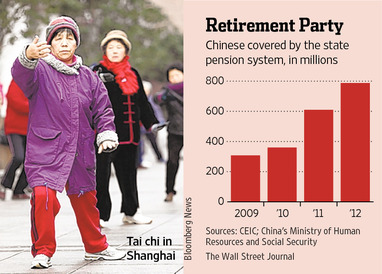
Imagine a country with 340 million old people. That is China in less than 20 years, with double the number of retirees it has today. In a land of big numbers, it could be the biggest of all when it comes to burgeoning pension liabilities.China has added half a billion people to its public pension systems since 2009, with a goal of full coverage by the end of the decade. The push to expand pension rolls is driven by sound economic thinking: Give savers a safety net and they will spend more. That would boost consumption’s share of the economy and rebalance growth away from China’s reliance on debt-fueled industrial investment.
But the burden on government finances could constrain Beijing’s state-driven economic model. While China’s central-government debt seems low at about 20% of gross domestic product, this doesn’t include sizable and largely uncounted local government debt, debt held by state-owned companies and banks, and the pension gap. Barclays estimates the pension funding hole is as large as 35% of GDP. Some academics figure it is even higher, adjusting for expected investment returns and variations in population growth.
The question then, is how to pay for pension promises. China’s demographic challenge is that its population is like a professional tennis player: getting old comes early. The country’s one-child policy brought an early end to the country’s prime demographic years. The result is a labor force that is diminishing far earlier in the development cycle than seen in advanced economies.
The working-age population shrank in 2012 for the first time, by 3.45 million. That trend will only get worse. Nearly 70% of China’s population is still of working age and only 14% are over 60. This means the so-called dependency ratio is a robust five income earners to each senior citizen. By 2030, that ratio drops to 2.5 to 1. In 2050 it will be 1.6 to 1.
This wouldn’t be a problem if China had a big pension reserve building. But it has been paying today’s benefits out of current pension contributions, a pay-as-you-go-type system that has bedeviled pension systems in the U.S. and Europe. This has led to the “empty accounts” phenomenon, in which 90% of pension accounts designated to individual workers have been used to fund today’s retirees, according to Zuo Xuejin of the Shanghai Academy of Social Sciences.
The loosening of the one-child policy is an unlikely fix. It will take 16 years before any increase in births filters into the workforce. And there are doubts whether China’s fertility rate, at 1.6 children a mother, will budge. Thailand, at a similar stage of development with no restrictions on household size, is at the same rate. South Korea, Japan and Singapore are even lower.
Other changes will help. November’s Communist Party plenum overhaul plan directs state-owned enterprises to double dividend payouts to state coffers and will put state-owned companies’ shares into the government pension manager. Letting bank deposit rates rise to market-determined levels will boost pension returns as most financial assets are tethered to bank rates in some way.
Raising the retirement age, currently between 50 and 55 depending on gender and profession, is also in the cards and would bring China closer to international norms. The Organization for Economic Cooperation and Development’s average retirement age is 64 for men and 63 for women. Moves to centralize a patchwork of locally administered pensions will let workers keep benefits when they move.
Even if Beijing fills the coffers in time, the harder task will be to persuade the population that promised benefits will be there for them. Chinese are deeply skeptical after the “iron rice bowl” of benefits disappeared with market overhauls of the 1990s.
As a result, they have eschewed voluntary contributions to government pension plans and turned instead to property, bank savings and, to a lesser extent, private insurance products. These industries will continue to benefit should pension fixes prove futile.
For Beijing, it is trust as much as solvency that will change the pension equation.
 About bambooinnovator
 Bamboo Innovator