Defenceless? Austerity is hollowing out Europe’s armies
December 28, 2013 Leave a comment
Defenceless? Austerity is hollowing out Europe’s armies
Dec 21st 2013 | From the print edition
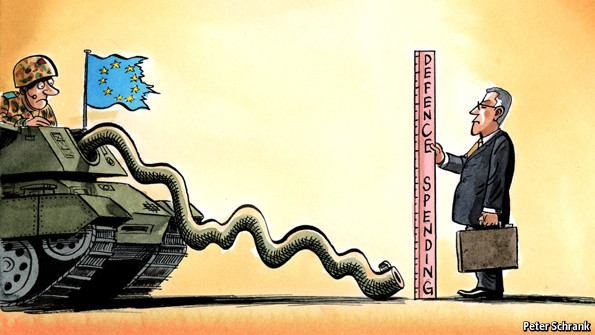
HOW quickly the need to cut deficits is reducing the European Union’s military ambitions. When EU leaders held a summit to discuss defence five years ago there was heady talk of being able to deploy 60,000 troops within 60 days. Today the objective is to get overstretched troops home from Afghanistan as budgets are cut. The EU is meant to have two “battle groups” of 1,500 men apiece ready to deploy at short notice, but it can barely muster one—and none has ever been used.Pressure to make better use of dwindling resources is pushing governments to share costs and pool equipment. At this week’s summit, leaders will bless plans to develop a European drone to follow the likes of America’s Predator and Reaper. The European version would be an unarmed surveillance system that, unlike military drones, is intended to fly in civilian airspace. Predictably, the plan has caused alarmist talk in Britain about Brussels building a “European air force”, prompting officials to redouble their effort to remove ambiguities from turgid EU texts.
Yet the truly alarming prospect is that Europe is demilitarising so fast. Forget about euro-troops crying “Banzai!” Worry instead that the endless pruning of brigades, tanks, ships and jets will reduce even the largest European armed forces into small “bonsai armies”, says Christian Mölling of the Stiftung Wissenschaft und Politik, a German think-tank. When European countries led by France and Britain conducted air strikes in Libya in 2011, America had to provide essential help, including drones, air-to-air refuelling, stocks of smart bombs and headquarters staff. Europe has far more soldiers than America, but can send far fewer abroad.
In Mali, and now in the Central African Republic, France has intervened alone, but it wants support from European allies: if not soldiers, trainers for African troops; if not trainers, at least some money. Now France knows how America feels in NATO when it demands more military burden-sharing from allies and chafes at free-riders. Where France was always the chief troublemaker in NATO, in the EU Britain leads the awkward squad.
The problem for EU defence policy, says Daniel Keohane of Fride, a Spanish think-tank, is that “Germany does not want to use military force, Britain does not want to use the EU, and France is caught in the middle.” In 2011 Britain vetoed plans for an EU operational headquarters, annoying not only France but also Poland. Within NATO, France contributed more forces than Britain to the Steadfast Jazz exercise in Poland and Latvia in November. Russia’s decision to put Iskander missiles in Kaliningrad confirms that threats have not gone away.
The theology of European defence is maddening. NATO and the EU are both based in Brussels but can barely speak to each other officially, largely because of the chronic dispute between Turkey (in NATO but not the EU) and Cyprus (in the EU but not NATO). A bigger problem is the growing shortage of resources. Overall defence spending in Europe now stands at about 1.5% of GDP, well below the NATO target of 2%. Worse, defence has shrunk as a share of public spending, it being easier to demobilise soldiers than sack teachers. Worse still, Europe gets little bang despite spending nearly €200 billion ($275 billion) a year on defence. Money is squandered among the myriad armies, navies, air forces and headquarters at national level.
A recent study by the Centre for European Policy Studies, a think-tank in Brussels, makes the point eloquently. Europe has nine kinds of fighters and ground-attack planes, compared with America’s four. It sails 16 different frigates compared with just one American type. Europe’s defence industry is also crying out for consolidation. As defence spending falls, even the most competitive firms are in trouble. EADS, the Franco-German aerospace consortium, has announced plans to cut 5,800 jobs in France, Germany and Spain because of shrinking defence contracts. Its attempt to merge with Britain’s BAE Systems was blocked in October 2012, because of German politics.
The state of the industry is one reason why the EU is waking up to the problem. The European Commission, the EU’s civil service, sees defence firms as important providers of jobs and high-end manufacturing. Some of its research-and-development funds are likely to be directed to “dual-use” technology. The same drones used to watch out for migrants at sea or fires on land can help armies look for the enemy in foreign wars.
Uncle Sam needs EU
For all of Europe’s shortcomings, it remains the first port of call when the United States needs military help. The EU does much useful smaller-scale work, combining military power with civilian assistance, for instance in and around Somalia to deal with piracy. But if Europe wants to remain a security provider, it must retain the ability to deploy force. That means more European collaboration, not less. Yet a problem with pooling and sharing is that economies of scale are often offset by the extra cost and complexity that adding countries to a procurement project can create. Another is the fear of mutual dependence: martial countries worry that they will be stopped from taking action by an ally that controls a vital capability; more pacific states fear being dragged into somebody else’s war.
Collaboration works best among countries of similar outlook and ambitions. France and Britain have gone furthest in merging capabilities. The Nordics and the Benelux countries have also embarked on some joint projects. But as the African interventions show, there will be times when one country wants to go it alone. Military co-operation is the obvious answer. But European countries must first agree on what they want. Until then, if there were ever such a thing as a European army, it would probably do nothing. Right now national forces are being hollowed out.
 About bambooinnovator
 Bamboo Innovator