Mumbai’s Last Generation Of Letter Writers Signs Off
December 28, 2013 Leave a comment
Mumbai’s Last Generation Of Letter Writers Signs Off
By Rachel O’Brien on 5:40 pm December 27, 2013.
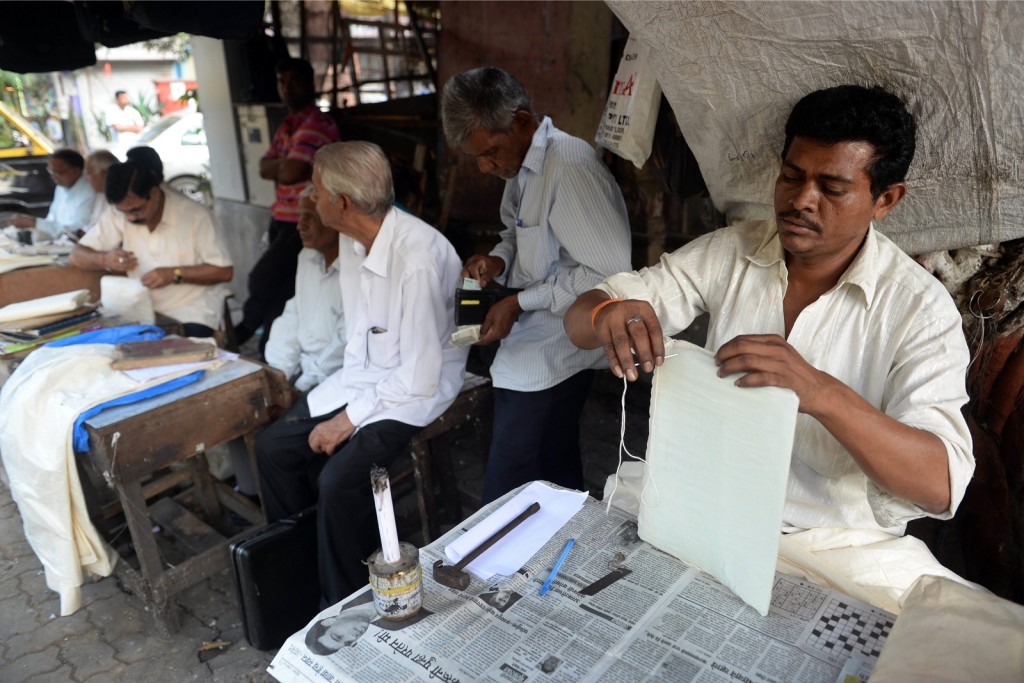
An Indian letter writer stitching together a parcel as others wait for customers at their roadside stalls located opposite the General Post Office in Mumbai on December 6, 2013. There used to be 17 letter writers in this bustling corner of the city’s south. Now there are eight, whose tasks are largely reduced to packing parcels and filling out forms. (AFP Photo/Punit Paranjpe).
Letter writer Shakil Ahmed is a proud keeper of secrets. For decades he penned the missives of Mumbai’s illiterate workers, whether lovers pledging devotion to faraway sweethearts or prostitutes sending home money while concealing their trade.Today, Ahmed is lucky if he gets to write an address.
“Thousands of people used to come — we didn’t have time to eat. But in the last seven years or so it’s been going down,” the scribe said at his weathered wooden desk, perched opposite the city’s domed century-old General Post Office.
“I will stay as long as I can,” he added. “But I can’t say how long that will be.”
There used to be 17 letter writers in this bustling corner of the city’s south. Now there are eight, whose tasks are largely reduced to packing parcels and filling out forms.
The men huddle by a disused stone fountain, also home to a mini Hindu temple and a feeding pen for a constant flurry of pigeons. A bamboo-propped blue tarpaulin keeps the birds from the writers’ heads.
On Ahmed’s desk sit piles of muslin wrapping and an old tin of pens, next to a seal engraved with his initials and a wax candle to stamp his work.
While the tools of his trade may have barely changed since he began 40 years ago — aged just 14 — the methods of communication have been transformed.
The mobile phone revolution and the rise of instant bank transfers have left little desire for cumbersome dictation and “snail mail”— even though a quarter of Indians remain illiterate.
“Now they have mobiles, people can talk in five minutes,” said Ahmed, who regularly checked his own phone while discussing his job.
“Without a mobile, you can’t do anything.”
The father-of-five said he earns 200 to 400 rupees ($3-6) a day — “enough to feed my family” — although a colleague at another desk bemoaned the ten rupees he had made all morning.
While they talked, a pair of western backpackers approached the writers to parcel up their souvenirs. Older local customers sought help filling out money order forms.
The scribes’ latter-day clerical duties hardly match their earlier status as the primary conduits between city and village life.
As Mumbai, the financial capital, sucked up rural Indians in droves, the new arrivals needed to send back hard-earned cash to their families — and selected versions of their news.
“A lot of prostitutes used to come and never tell us what they were doing in Mumbai,” Ahmed explained. “They just said they were doing a job here and getting this much salary.”
The writers’ respect for privacy was therefore key to their success.
“We had to keep secrets. If the customers didn’t trust us, they wouldn’t come. It’s a matter of trust only,” he said.
Yet Ahmed would not shy away from a tweak or flourish to their prose — “for the sake of the person they were writing to.”
Sometimes the customer “didn’t know what they were saying,” he added, somewhat dismissively.
In the era of instant messaging, Twitter and Facebook, letter writers are not the only vanishing messengers.
In July, India halted the world’s last major telegram operation, after 163 years of service.
Once the main form of long-distance communication, 20 million messages were dispatched from India during the traumatic partition of the subcontinent in 1947.
But since their jobs disappeared, several of Mumbai’s telegram delivery men have become gatekeepers and clerks at their old office building — now home to a telephone and broadband provider.
Such job switches look set to continue as digital technology strengthens its grip.
More than 40 percent of India’s 1.2 billion people own mobile phones, and a fraction of them smartphones, yet the country has overtaken Japan to become the world’s third-largest smartphone market. Internet penetration grew 31 percent from 2012 to 2013.
Agence France-Presse
 About bambooinnovator
 Bamboo Innovator