The Indie Innovator of Champagne Country: Anselme Selosse, the reclusive French vintner who helped uncork a bubbling movement
December 28, 2013 Leave a comment
The Indie Innovator of Champagne Country
Jay McInerney tracks down Anselme Selosse, the reclusive French vintner who helped uncork a bubbling movement
JAY MCINERNEY
Updated Dec. 27, 2013 5:31 p.m. ET
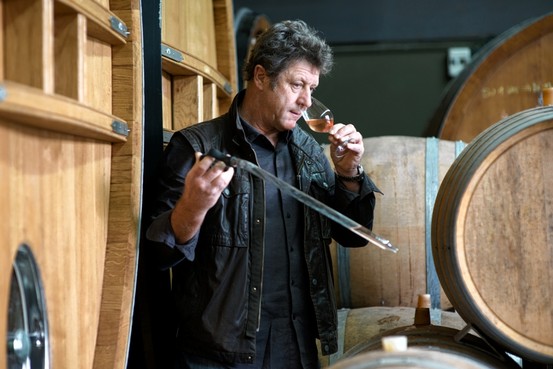
GROWER SPIRIT | Anselme Selosse, who runs Jacques Selosse, at his winery Michel Joly for The Wall Street Journal
CHAMPAGNE LOVERS should be grateful to Anselme Selosse, who has inspired a new generation of grape growers to produce their own bubbly rather than sell their grapes to the big, brand-name houses. The proliferation of small grower-made Champagnes, especially from Côte des Blancs, the area of France best suited to Chardonnay grapes, has been the most exciting recent development in Champagne. Grower Champagnes are the indie bands of the world’s most famous sparkling-wine region—not necessarily better, but quirkier and more distinctive than the products of the big houses.Mr. Selosse, who runs Champagne house Jacques Selosse (named after his father), wasn’t the first small grower to bottle his own wine, but when the influential French wine and restaurant guide Gault & Millau named him the best winemaker in France in 1994, the world took notice, and other growers followed.
Oenofile: Five Grower Champagne Grands
F. Martin Ramin/The Wall Street Journal
Blanc de blancs (Champagnes made solely from Chardonnay grapes) from small producers are increasingly available on these shores. Unfortunately, the same can’t be said of Mr. Selosse’s wines, which are almost impossible to find. In this regard, they resemble their elusive creator, whom I’ve begun to think of as the J.D. Salinger of the Côte des Blancs.
When, on the verge of a visit to France, I called Doug Polaner, Mr. Selosse’s U.S. distributor, to ask for an appointment, he said, “Good luck with that. I can’t even get in to see him.” Mr. Polaner suggested I make a reservation at the Hôtel Les Avisés, a 10-room inn adjacent to the winery owned and operated by Mr. Selosse and his wife, Corinne. “We’ll let him know you’re coming,” Mr. Polaner said. If I made a dinner reservation at the hotel’s restaurant, there was a decent chance that the master would stop by during the meal.
“Their bouquet is often compared with brioche, though I’m frequently reminded of Walkers Scottish shortbread.”
Meanwhile, I asked a judge from France’s “Top Chef” as well as a three-star Paris chef to call Mr. Selosse and vouch for me. On a rainy Sunday afternoon, I made my way from the town of Épernay through a green sea of vines to the tiny village of Avize. The hotel, a white neoclassical mansion, is perched amid gardens at the highest point of the village, alongside the less picturesque sheds that house the winery.
When I checked in, the young woman at the desk assured me that Mr. Selosse would almost certainly stop by during dinner. My meal was excellent, as was the bottle of 2002 Selosse, an incredibly rich, full-bodied bubbly that had the mellow, oxidative notes of an older Champagne—so powerful it even carried me through the steak. I rationed as long as I could, lingering over cheese, but the chatelain was a no-show.
The next morning, as I was checking out, I spotted the man himself, burly and bushy haired, striding across the courtyard between the winery and the hotel. I grabbed a copy of the book I’d been promoting in Paris out of my hand luggage and ran outside to pursue him. “Excusez-moi, Monsieur Selosse!” I knew he was averse to speaking English, so I’d already practiced a little speech declaring that he was featured in the book, which I thrust upon him. He nodded and scuffed his toe in the gravel, then apologized for failing to meet me last night, explaining that some family business had detained him. After an awkward pause, he asked me if I’d like a tour.
Off Duty’s Half Full
Enlarge Image
Millennium Punch F. Martin Ramin/The Wall Street Journal, Styling by Anne Cardenas
Infused Ice Cubes That Really Rock
Rums That Don’t Need Fruity Mixers
Stunt Whiskeys for Armchair Adventurers
The winery is on three floors, with presses on the highest level, the juice flowing downward via gravity in each stage of production. The middle level was packed with oak barrels, in which the wines are fermented and aged, allowing an exchange of oxygen that accelerates the maturation process. (Steel tanks are more commonly used in Champagne production.) But really, Mr. Selosse informed me, “It’s in the vineyards where the crucial work is done.” If this has become a winemaking cliché in recent years, it was certainly news in Champagne in 1974, when Mr. Selosse returned from a stint in Burgundy, where he’d studied at the Lycée Viticole in Beaune, to take over his father’s vineyards. At the time, heavy use of fertilizer, pesticides and herbicides were the norm, and high yields of barely ripe grapes were the goal of most growers, since the big houses paid by the ton.
Mr. Selosse slashed yields to allow the fruit on the vines to get riper, and reduced the use of chemicals, practicing organic farming. He also started preaching the gospel of terroir, that particularly Burgundian concept that equates a wine’s unique identity with its place of origin. The almost universal practice in Champagne was the blending of grapes from all over the region to create a homogenous product. Mr. Selosse’s ideas flew in the face of conventional Champagne wisdom.
“Selosse was the first to show a grower could make great wines,” grower Pierre Larmandier told me later that morning, when I visited him at his winery, Champagne Larmandier-Bernier. The facility was redolent of the fermenting must of recently harvested grapes in the town of Vertus, a few miles down the road from Avize. Mr. Larmandier inherited vineyards in Vertus as well as the grand-cru villages of Cramant and Avize. “Four generations of my family were growers,” he said, but older generations sold most of their grapes to the big houses. Inspired in large part by Mr. Selosse, in 1988 Mr. Larmandier started bottling his own production. In 1993 he adopted organic farming practices, which many thought was impossible in the cool, wet climate of Champagne, where mildew is a threat. Like Mr. Selosse, Mr. Larmandier has since moved to the extreme form of organic farming known as biodynamics. He drove me around to see some of his vineyards, showing off the healthy grass between the vines. (His neighbors’ soils were naked, seemingly denuded by herbicides.)
Mr. Larmandier’s Champagnes display a distinct mineral character suggestive of the chalk underlying the vineyards of Côte des Blancs. During my visit, Mr. Selosse described this particular aspect of the best wines of the region, “the true wines of terroir” as “l’eau de roche”—the water of the rock. The wines of both growers, as well as others like Pierre Gimonnet, Pierre Péters and Agrapart & Fils, have a signature that’s more stony than fruity. The idea that grapes can express the character of underlying bedrock is unproven, though it’s an article of faith in Burgundy, as it is with Mssrs. Selosse and Larmandier. In their defense, the notion of terroir seems empirically borne out when sampling the wines from different villages. The bubblies from Avize taste quite different from similarly made wines from Vertus.
The small-grower movement has spread to all corners of Champagne, and many excellent grower bubblies are made with the traditional blend of Chardonnay, Pinot Noir and Pinot Meunier, but I have a particular soft spot for the pure Chardonnay wines of Côte des Blancs. Blanc de blancs Champagnes are particularly zesty and lively in their youth. They also have a great ability to age, acquiring roundness and body as well as a bouquet that’s often compared with brioche, though I’m frequently reminded of Walkers Scottish shortbread.
I plan to drink plenty of blanc de blancs in the coming year, and while I may not open many bottles of Selosse, I will, from time to time, lift a glass in his general direction.
 About bambooinnovator
 Bamboo Innovator