Britain must look beyond London and put faith in manufacturing
December 29, 2013 Leave a comment
Britain must look beyond London and put faith in manufacturing
Redressing the balance of wealth to benefit the regions beyond the south-east is a big challenge – but one that must be met
The Observer, Sunday 29 December 2013
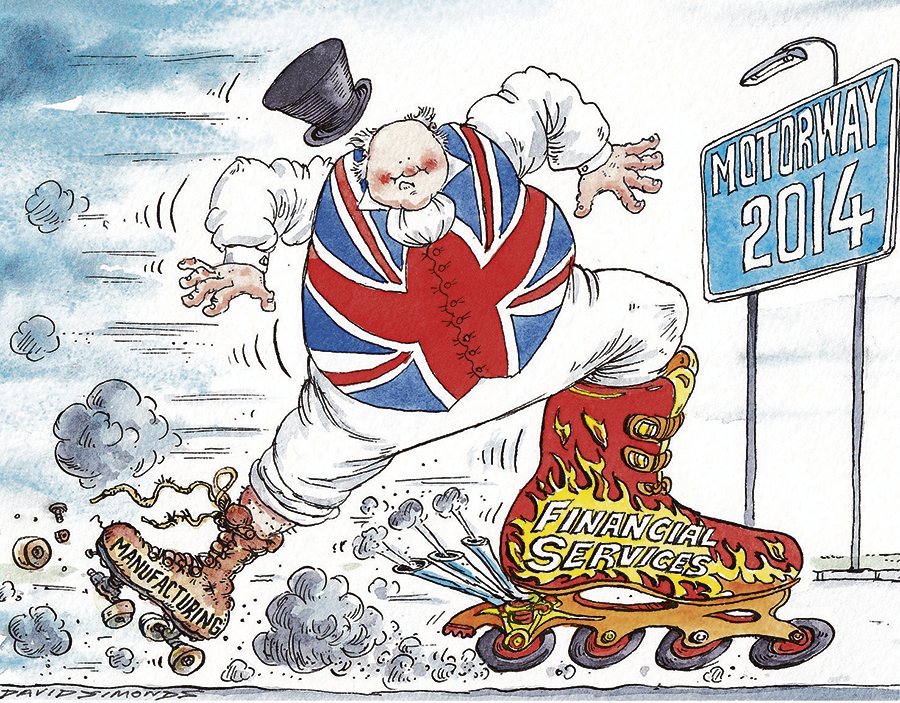
This month has seen further confirmation of Britain’s economic recoveryand an indictment of that recovery’s composition. If 2013 has brought some form of revival, then we must wish that 2014 brings balance to it. The evidence that this country’s return to growth is out of kilter was threefold. First, never-before-seen data showed that south-west London had more mortgage debt than all of Wales. The capital is at the centre of a housing market revival that is powering the recovery, while the rest of the UK trails in its wake. Indeed, 44% of all mortgage debt in the country is held by people in London and the south-east, areas which account for nearly 40% of British GDP.Redressing the issues thrown up by those statistics is a long-term challenge, one that involves tilting Britain’s centre of economic gravity away from financial services and London towards other sectors and other regions. Manufacturing, for instance, shares its wealth much more evenly across the UK than banking. But while the aspiration to spread the growth may be admirable, and is unlikely to draw much opposition from politicians of any stripe (barring the more fervent supporters of the City in the Conservative party), it is difficult to achieve.
Which brings us to the second piece of evidence. This month saw confirmation that the country’s current-account deficit with the rest of the world has soared to its highest level since 1989. This means that we are consuming too much and not exporting enough. According to the Office for National Statistics, the gap in value between imports and exports widened to £21bn in the three months to September from £6bn in the previous quarter. There was positive news in the data too, with an upward revision of the annualised growth rate to 1.9% from 1.5% – which only shows that the British economy is accelerating along a rutted path that we have travelled before.
An economy where manufacturing plays a leading role would benefit the UK not only because what industrial base we have is more evenly distributed than the financial services sector but also because, as a country that spends too much and manufactures too little, reversing that state of affairs will go some way to reducing our deficit in a way that is less painful than spending cuts or tax increases.
The third piece of evidence underlines the difficulty of transforming this wishful thinking into reality. BAE Systems, Britain’s largest manufacturing employer, announced nearly two weeks ago that it had failed to secure a £6bn order for Typhoon fighter jets from the United Arab Emirates, despite the enthusiastic backing of David Cameron for a deal. With the decline of the British state as a buyer of BAE’s equipment – hence the 1,775 job losses at Portsmouth and Glasgow – the company has been forced to seek new markets that can afford products with multibillion-pound price tags. It is a small market and one that is crowded with western competitors – such as France’s Dassault – that are also scrabbling for deals from the defence ministries of emerging countries.
BAE’s news showed that even our manufacturing base is unbalanced, dependent as it is on a single customer that will be in a sustained period of fiscal retrenchment regardless of which party gains power in 2015.
So, a wish for 2014 is for balance: a recognition among business and political leaders that economic growth is not an unalloyed good if it repeats the historical errors of stoking debt, consumption and estate agents’ fees. A balanced economy requires focus on education, targeted state support of industry, a functioning banking system to fund supply-chain businesses, a government procurement machine that is sympathetic to British companies, a system that encourages innovation by universities and then allows the private sector to monetise it, and decent infrastructure.
None of the above will come to fruition in 2014, of course: but for the picture to change in even a decade’s time, the work has to start now
 About bambooinnovator
 Bamboo Innovator