The lesson from Sarofim’s five decades in the investment business: Buy quality stocks; hold them forever
December 29, 2013 Leave a comment
SATURDAY, DECEMBER 28, 2013
A Lion in Winter
By ANDREW BARY | MORE ARTICLES BY AUTHOR
The lesson from Sarofim’s five decades in the investment business: Buy quality stocks; hold them forever.
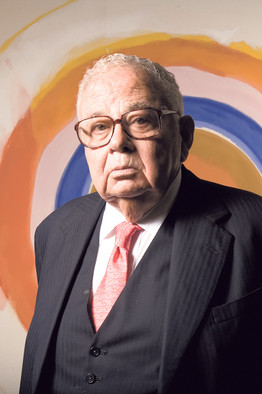
After more than five decades in the investment business, Fayez Sarofim remains bullish on U.S. stocks, particularly brand behemoths like Coca-Cola and Philip Morris International that he has owned for decades. Sarofim has long favored well-regarded industry leaders over smaller upstarts.“People always look for the needle in the haystack. Why not buy the haystack?” says Sarofim, 85, who came here from Egypt in 1946 and founded his Houston-based asset management firm, Fayez Sarofim & Co., 12 years later.
Today, Sarofim runs $30 billion for institutions and individuals, including mutual fund investors, most notably through the $6 billion Dreyfus Appreciation fund (ticker: DGAGX), which his firm subadvises. Over the years he has built a fortune, estimated at more than $2 billion, including an $875 million stake in Kinder Morgan (KMI, the energy-infrastructure giant), a large equity portfolio, and a superb art collection — including one of the few El Greco paintings in private hands and a raft of abstract expressionists. And, of course, a controlling stake in the Sarofim firm itself.
Fayez Sarofim: “It takes a foreign-born person to appreciate the United States, and the ability of the American people to adapt.”
Sarofim’s deceptively simple investment philosophy is similar to that of Warren Buffett: Buy great growth companies and don’t ever sell. Sarofim and Buffett’sBerkshire Hathaway (BRK/A) share similar investments, including Coke (KO),Procter & Gamble (PG) ExxonMobil(XOM), IBM (IBM), and Wal-Mart Stores (WMT). Buffett and Sarofim both recognized that riding dominant companies was a tax-efficient way to build wealth. In fact, much of Sarofim’s personal fortune comes from investing the firm’s money alongside his clients’ for more than 40 years.
Barron’s recently met with Sarofim, his son Christopher, 50, and other principals at the firm, which plans to remain private with the same investment approach after Sarofim leaves the scene. The firm has a staff of about 100 people, including 22 investment professionals.
Sarofim, who is known locally as the Sphinx due his Egyptian heritage and few public comments, rarely grants media interviews. Barron’s profiled him 16 years ago (“Brand Champion,” June 9, 1997).
“It takes a foreign-born person to appreciate the United States, and the ability of the American people to adapt,” Sarofim said over lunch at the old-line, wood-paneled Coronado Club in downtown Houston. Like Buffett, Sarofim believes that too much trading is a bad idea. “Nervous energy is a great destroyer of wealth,” he says. The firm’s portfolio turnover rate is regularly below 20%.
Sarofim’s patriotism reflects his only-in-America success story. “Here’s an Egyptian who came here with nothing, went to Harvard Business School, and made a fortune in Houston. Not New York, Houston,” says Byron Wien, vice chairman of Blackstone Advisory Partners. “He’s a warm and wonderful person. He has a quality that is so critical in business, which is to make you feel important.”
Sarofim’s view is that companies like Philip Morris International (PM), Coke, Nestlé(NSRGY), and Procter & Gamble offer great ways to play growth in the developing world. An upbeat Sarofim says the S&P 500, now around 1840, can top 2000 next year. “If you have $120 in earnings next year [for the S&P 500] in an environment of low inflation and low interest rates, a price/earnings ratio of 18 to 20 is not unreasonable.”
He has a good eye for stocks and arguably an even better one for art. He began buying abstract expressionists and pop art in the 1960s, and his downtown Houston office is home to a fabulous collection, including hundreds of paintings and other works from artists such as Robert Motherwell, Willem de Kooning, Robert Rauschenberg, and Jasper Johns. He also owns works by Mary Cassatt and Eugène Delacroix. Hanging amid more than a dozen paintings in his office could be his most valuable work, a small El Greco masterpiece from the late 16th century, The Crucifixion.
SAROFIM’S FIRM has a good long-term record, but it’s way behind the S&P 500 this year, after trailing the index in 2012. The Dreyfus Appreciation fund, which is representative of the firm’s portfolio, is up 20% through Dec. 24, 11 percentage points behind the S&P. Most of Sarofim’s big holdings, including Philip Morris International, Coke, and ExxonMobil, are lagging the benchmark.
This doesn’t faze Sarofim and his associates. “We’ve underperformed four times in the past 25 years, and in each of the past three, we have outperformed strongly after those periods. We’ve stuck to our knitting, and that has worked well over time,” says Jeff Jacobe, the firm’s director of investments.
Jacobe says the firm’s portfolio “is cheap on an absolute and relative basis” with a higher dividend, better growth prospects, lower leverage, and lower price/earnings ratio than the overall market. He argues that the Sarofim portfolio is at “its cheapest relative valuation since the 1980s.”
Over the past 20 years, the firm’s accounts are nearly a percentage point ahead of the S&P 500, based on annualized performance, but that doesn’t include fees. The Dreyfus Appreciation fund, up 8.9% annually since 1993, is slightly behind the index, reflecting its expense ratio of about one percentage point, according to Morningstar.
ONE INVESTMENT THAT SAROFIM never made was in Enron, the Houston energy outfit that collapsed into bankruptcy after financial fraud was uncovered in 2001. “They tried hard to get us to invest,” Sarofim said, referring to former Enron executives Ken Lay and Jeffrey Skilling. Sarofim said he could never get comfortable with Enron’s financials. “They said they’d get bigger than Exxon. We said we’d rather own Exxon.”
Critics would argue that Sarofim’s portfolio, which hasn’t changed much since Barron’swrote about it in 1997, amounts to an outdated growth-stock portfolio with little exposure to the dynamic companies that have powered the stock market in recent years, such as Google, Amazon.com, and Visa, as well as biotechnology firms like Biogen. For all of Coke’s power, given its global beverage-distribution network, its shares still are below their 1998 peak, as the company grapples with weakening soda markets in the developed world.
Jacobe responds that Sarofim looks at everything in the growth universe but that some of the marquee stocks haven’t made the cut. “To us, the duration of growth over the long term is more important than the rate of growth in any year,” says Jacobe. The firm did add Apple (AAPL) about six years ago. It is now overweight in consumer staples and energy relative to the S&P 500, and underweight in financials, with no exposure to telecommunications and electric utilities.
The firm’s assets under management are way below their peak of $59 billion in 1999, reflecting institutional outflows. Around that time, Sarofim reportedly came close to selling the firm to European banks for about $900 million, which is probably double what it’s worth now.
Brand Champion
Fayez Sarofim has long favored large multinationals with strong balance sheets.
| Sarofim’s Top 10 Holdings | Percent of Portfolio * |
| Philip Morris Intl / PM | 5.9% |
| Apple / AAPL | 5.3 |
| ExxonMobil / XOM | 4.6 |
| Coca-Cola / KO | 4.3 |
| Chevron / CVX | 3.7 |
| Nestlé / NSRGY | 2.9 |
| Johnson & Johnson / JNJ | 2.8 |
| McDonald’s / MCD | 2.8 |
| ConocoPhillips / COP | 2.6 |
| IBM / IBM | 2.6 |
| *As of Sept. 30 Source: Fayez Sarofim & Co. | |
SAROFIM RECOGNIZED IN THE1960s and 1970s the power of globally dominant companies. “They have the flexibility and critical mass to invest in developing countries,” Sarofim says. A prime example is one of the firm’s longest-standing holdings: Philip Morris, which Sarofim bought 50 years ago.
Back then, he recalls, Philip Morris had no international business, and its key cigarette brand, Marlboro, had just a 9% domestic market share, way below its 43% market share now. Cigarette cash flows were so strong as Marlboro grew over the years that Philip Morris was able to expand overseas and gobble up food companies, including Kraft. Sarofim now owns all four companies that have come out of the original Philip Morris: Altria (MO), Kraft Foods (KRFT), Mondelez International (MDLZ), and Philip Morris International, now the world’s largest investor-owned tobacco company.
He’s in the office most days, and when he’s not, he checks in with his former assistant, Raye White, a member of the firm’s investment committee who has been with him since the beginning. Sarofim gave up tennis when he turned 65, but often swims at his home in the exclusive River Oaks section of Houston. Dressed formally in a three-piece, blue pinstripe suit and red patterned tie, Sarofim enjoyed a cigar and several cups of espresso after lunch at the Coronado Club while discussing the firm’s history and investment style.
Sarofim recalls that Houstonians called him “a fly by night” after he opened his doors in 1958. At that time, there were few independent equity management firms, let along one run by a 30-year-old Egyptian with no real track record. The investment business then was dominated by New York banks and Boston firms like Loomis Sayles and Scudder Stevens & Clark.
Sarofim’s fortunes began to turn in the early 1960s, when he married Louisa Stude, the adopted daughter of Herman Brown, a founder of the Brown & Root construction company, now part of Halliburton. At that time, Brown & Root had close ties to the most powerful man in Texas, Vice President Lyndon Johnson.
The Brown family was well connected in Houston, and Sarofim soon was running money for the Rice University endowment, which remains a client of the firm. Sarofim has had two marriages and two messy divorces that were chronicled in the local media. He’s unmarried now. He quips that one reason he never became an activist investor is that he “wanted to stay out of the newspapers.”
As one of Houston’s wealthiest men, Sarofim has given money to range of organizations, as well as participating in a group that brought back to the city a pro football team, the Houston Texans, after the Oilers left town for Tennessee. That 2002 investment, which he jokingly called a “civic duty,” has turned out well, with the NFL team now valued at more than $1 billion, 50% more than what the franchise cost. Another shrewd investment that Sarofim made personally was participating in the leveraged buyout of Kinder Morgan.
Sarofim plans to continue working for as long as he can. “I’m like Buffett,” he says, “retirement is not in my vocabulary.” But his succession plans are in place. His son Christopher, who has been with the firm since 1988 and now is vice chairman, will follow him as chairman. Other firm veterans, including Jacobe; the current president, Gentry Lee; and the chief operating officer, Alan Christensen, will play key roles.
Transition isn’t easy for an investment firm closely associated with an aging leader whose name is on the door. Yet, the firm appears to be in a good position to successfully outlive its founder. Better performance certainly would help. That prospect looks like a reasonable bet, given the quality of Sarofim’s investments and the firm’s history of recovery after rocky periods.
 About bambooinnovator
 Bamboo Innovator