Watch them in 2014: We present personalities we think are the likely movers and shakers of Malaysia’s corporate scene
December 29, 2013 Leave a comment
Updated: Saturday December 28, 2013 MYT 1:13:07 PM
Watch them in 2014
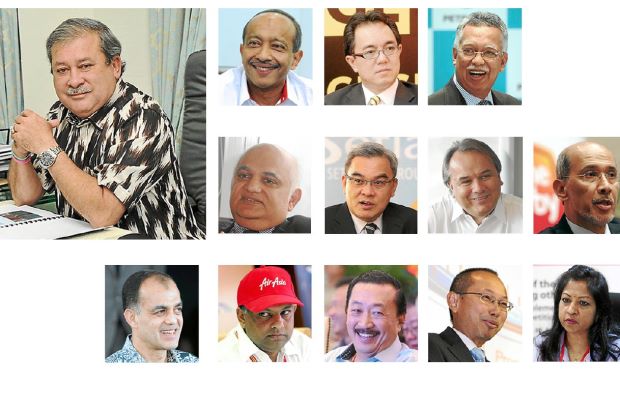
IT is generally going to be a challenging 2014 as the Government undertakes fiscal reforms to rein in on its budget deficit and address the shrinking trade surplus. Under this scenario, Malaysia’s corporate captains may need to re-look and up their game plans to ride out the tough times. We present personalities we think are the likely movers and shakers of Malaysia’s corporate scene. Some of them have made headlines this year and will continue to be watched. We also present the outlook of key sectors of the economy in this special edition.A pro-business Sultan
EVEN before the Sultan of Johor pulled off the RM4.5bil property deal with the Chinese this month, he had been displaying a certain business savvy.
At a chance meeting with the Sultan early this year, this writer learnt about how he was taking an interest in ensuring Johor Corp (JCorp) – the asset-rich but debt-laden state investment arm – had the right checks and balances in place.
Although proud of JCorp’s achievements in owning assets like KFC Holdings Bhd, plantation giant Kulim (M) Bhd and hospital chain KPJ Healthcare Bhd, it was under his leadership that JCorp refinanced its huge debt and bought back from Johorians the investment units of Dana Johor at RM1 apiece.
This was an old failed investment scheme by JCorp for Johorians that had seen its value significantly shrink over the years.
In that short meeting, the Sultan, who declined the request for a full interview, talked generally about how Johor should be looking to draw more foreign direct investment into the state, which, in turn, would bring about positive economic spin-offs for Johorians, such as jobs and contracts for small and medium enterprises or SMEs.
He was agreeable to be quoted on this: that he is “pro-business” and hopes to see Johor and Johorians prosper.
Clearly though, the Sultan is also keen to participate in business.
In 2012, it was reported that Singapore billionaire Peter Lim had teamed up with the Sultan of Johor to build a S$2bil (US$1.55bil) complex that would include a hospital, hotels, flats and entertainment outlets in Johor Baru.
This year, the pace of deals in Johor is gathering steam. And the Sultan made the headlines when it was disclosed that he had sold a parcel of prime land in Johor Baru to China-based Guangzhou R&F Properties Co Ltd for RM4.5bil.The price paid was a new record for Johor at RM890 per sq ft for the 47ha believed to be in the vicinity of the old Customs, Immigration and Quarantine Complex, which faces Singapore and hence holds much potential.
Aside from Singapore’s Peter, the Sultan is also working on ventures with Tan Sri Vincent Tan and Tan Sri Lim Kang Hoo.
The Sultan acquired a 20% stake in Berjaya Times Square Sdn Bhd.
In explaining the deal, the vendor – Berjaya Assets Bhd – made reference to the Sultan’s “stature and business acumen” as part of the justification for the discounted price.
Kang Hoo is already well-known as the man behind master developer Iskandar Waterfront Holdings Sdn Bhd (IWH), which, in turn, is a partnership between himself and the Johor state government.
Just this week, Kang Hoo’s IWH sold another piece of land to a Singapore party at a price that even topped what Guangzhou R&F Properties had paid.
Insiders say that the Sultan has a few able trusted advisers in the various sectors of business he is interested in.
Aside from property, the Sultan is also said to be very keen on oil and gas, power, shipping and transport.
The Sultan is evidently passionate about the transport sector and trains, in particular. Notably, the Sultan of Johor commandeered the last train out from the Tanjong Pagar railway station in Singapore before the historical station was closed.
He holds the record as the first ruler to obtain a Class 26 locomotive driving licence a few years ago.
It’s no surprise then that observers reckon that transport could be an area in which the Sultan of Johor would make headlines in 2014. The state is at the centre of two major rail projects – the last leg of the nationwide Electrified Double-Tracking Project (EDTP) from Gemas to Johor Baru and the high-speed rail link from Kuala Lumpur to Singapore. Johor constitutes the largest part of the latter.
Observers say the Sultan has already linked up with top Japanese companies that are keen to provide the technology for the high-speed train. Similarly, on the EDTP, the Sultan had reportedly travelled to China in 2012 to team up with a top player, namely, the state-owned China Railway 18th Construction Bureau Co Ltd (CR18G).
It has been reported that CR18G’s Malaysian partner is Dacing Engineering & Equipment Sdn Bhd, and checks show that it is owned by the Johor crown prince, Tunku Ismail Sultan Ibrahim, Datuk Seri Shafiq Abdullah and the late Datuk Seri Raja Ashman Shah Sultan Azlan Shah.
CR18G is part of China Railway Construction Company (CRCC), which, in turn, is one of the three short-listed Chinese companies that will be chosen as the main contractor for the Gemas to Johor Baru portion of the EDTP. CR18G’s projects under its belt include constructing what was known as the world’s highest railway system, which runs from China’s Xinjiang city to Lhasa in Tibet.
In 2012, CR18G was also awarded the prestigious fast-train project between Mecca and Madinah by King Abdullah of Saudi Arabia.
Johor will continue to be in the limelight in 2014 and don’t rule out the Sultan featuring in some of the state’s development. – By Risen Jayaseelan
Updated: Saturday December 28, 2013 MYT 10:55:08 AM
Datuk Abdul Farid Alias – President and CEO of Malayan Banking Bhd
FARID ascended to the top job at Malayan Banking Bhd (Maybank) under interesting circumstances.
His promotion in August was quickly followed by the departures of two key Maybank executives, namely veteran investment banker Tengku Datuk Zafrul Tengku Abdul Aziz and Datuk Khairussaleh Ramli.
Five candidates had vied for the position, including Farid, Tengku Zafrul, and Khairussaleh, while externally Datuk Tajuddin Atan of Bursa Malaysia Bhd and UEM Land Holdings Bhd’s Datuk Izzaddin Idris were considered.
Given the leadership shake-up in Maybank, Farid’s immediate task will not only be filling the holes, but also finding capable replacements both from outside and inside the bank. The competition is clearly heating up what with Tengku Zafrul and Khairussaleh both having assumed top positions at competing banks.
Taswin Zakaria has since been hired as president director of Maybank’s 88.29%-owned PT Bank Internasional Indonesia to replace Khairussaleh.
On a personal level, Farid will also have to overcome some level of obscurity, both within and outside the bank.
Until he was announced as Maybank’s new boss, few had heard of the low-profile 45-year-old, who is a two-decade veteran in finance.
Very little is known of his management style.
The Harvard Business School alumni has also yet to make himself a familiar face among banking analysts.
But don’t write him off, industry observers say. Farid’s track record in helming the global wholesale banking division, which now contributes to 40% of Maybank’s earnings, was no lucky shot.
He also has had stints at JP Morgan and was a director of investments at Khazanah Nasional Bhd.
Farid has given some guidance on his thinking. He told the media in November that Maybank “could have done a lot of things better over the last 2½ years”, noting that the bank had not taken on opportunities in “derivatives investments for clients”.
“Simple interest rate swaps, simple cross-currency swaps, these were left on the table,” Farid had said.
There’s also a plan to enhance collaboration among the various regional banks under the group. For this task, insiders say Farid is tapping on Datuk Lim Hong Tat, a long-serving Maybank top executive.
For Indonesia, however, analysts expect 2014 to be a tough year for Malaysian lenders with operations there amid rising competition.
In Thailand, where Maybank has long eyed its own commercial bank, Farid appears less keen on M&As to grow the contribution of its overseas earnings to 40% by 2015, a target set under its five-year business plan. In 2014, the market is bound to learn more about what Farid has in store for Maybank – By John Loh
Updated: Saturday December 28, 2013 MYT 10:58:07 AM
Tan Sri Shamsul Azhar Abbas – President and CEO of Petroliam Nasional Bhd
ENTRUSTED to manage the nation’s rich oil reserves, Petroliam Nasional Bhd (Petronas) is constantly under public scrutiny as it strikes a balance to fulfil a social role above delivering performance.
This arguably makes Shamsul’s job, not unlike his predecessors, the toughest in corporate Malaysia.
For instance, Petronas earlier this year was criticised for not doing enough to promote the bumiputra agenda in the oil and gas (O&G) industry. The critics alleged that Petronas had sidelined the bumiputra companies, including those that were qualified for the job.
Shamsul, on the other hand, countered the accusations using statistics that proved Petronas had not abandoned that particular social cause, while also stressing that while it was important to promote the bumiputra agenda, there was no room for rent-seekers.
Petronas was also thrust into the limelight when it attempted to take MISC Bhd private at RM5.50 a share, an offer minorities said was unfair given that the company had made a cash call at RM7.20 a share three years earlier. Interestingly several months later, Petronas announced that it would directly buy newly-built ships to meet its LNG transportation requirements, raising concerns that the move might impact MISC’s growth.
Meanwhile, Petronas will continue to drive the O&G sector again this year with its five-year RM300bil capital expenditure commitment and as it pushes for more deepwater oil fields.
In March 2014, it will also make the final decision on its RM60bil Refinery and Petrochemical Integrated Development complex in Pengerang, a project that is poised to spearhead a host of value-added petroleum-related industries.
Under Shamsul, Petronas has ventured into risk service contracts (RSCs) with the private sector for marginal oilfields. The results have been mixed.
Since RSCs were introduced, Shamsul and Petronas have decided that they themselves should be working on some of the marginal oilfields and as a result have set up Vestigo Petroleum Sdn Bhd. – By Gurmeet Kaur
Updated: Saturday December 28, 2013 MYT 11:03:00 AM
Tan Sri Shahril Shamsuddin – President and group chief executive of SapuraKencana Petroleum Bhd
SHAHRIL will be closely watched in 2014 for the execution of SapuraKencana Petroleum Bhd’s latest acquisition in Newfield Exploration Co and how he delivers on the company’s sizeable orderbook of RM28bil.
The market would also watch the restructuring of SapuraKencana’s debt.
Shahril has already said that he is looking to fill up unfilled capacity in SapuraKencana, bid for more jobs and address the Latin American market.
SapuraKencana is exploring several alternatives to restructure its debt into longer-dated debt, while still maintaining the stock’s syariah status.
It now has long-term and short-term borrowings totalling RM10.8bil, which includes the loan from its merger with Kencana Petroleum Bhd and the bridging facility for the acquisition of the tender rigs business.
On Newfield, SapuraKencana won the bid to acquire Newfield’s oil and gas (O&G) production blocks in Peninsular Malaysia, Sabah and Sarawak for US$898mil (RM2.8bil) back in October. This turned SapuraKencana into the country’s largest oil producer with a 4% market share. Development capital expenditure estimated for the SK310 and SK402 block in Newfield is US$2.7bil and US$217mil respectively.
Another issue is how SapuraKencana will ringfence the exploration and development assets from its service support business and how it would raise the project financing required for the development of the Newfield asset.
With Newfield, SapuraKencana stands among the few players that are both field owners and service providers. So far, only Petrofac and The Maersk Group fall into this category. Separately, SapuraKencana together with its existing risk-sharing contract (RSC) partner Petrofac is looking to tender for Petronas’ blocks PM-6 and PM-9 as well as two more marginal fields.
Just before the year closed, SapuraKencana scored another coup by being one of the recipients of Petronas’ Pan Malaysia offshore transportation and installation contracts worth some RM10bil.
Analysts have estimated SapuraKencana’s portion to be worth some RM6bil to RM7bil, thus also bringing up its orderbook to the RM30bil mark.
The group’s wholly-owned TL Offshore Sdn Bhd has secured packages C & D from 11 of Petronas’ Production Sharing Contractors to provide integrated transportation and installation services for offshore O&G facilities in 2014 to 2016 with a one-year extension option.
Commencement of these works is expected to be in March 2014 at various offshore locations in Malaysian waters.
Shahril has taken over the reins from his father Tan Sri Shamsuddin Abdul Kadir, the founder of Sapura Holdings, since the early 90s. Since then, Sapura has dabbled in information technology, security systems and O&G.
He found his playbook in the O&G sector, and today SapuraKencana has an orderbook of approximately RM30bil spread out in the regions of Brazil, Malaysia, South-East Asia and Australia. – By Tee Lin Say
Updated: Saturday December 28, 2013 MYT 11:08:12 AM
Tan Sri Liew Kee Sin – Group president and CEO of S P Setia Bhd
LIEW was the man of the moment when he got two Prime Ministers – Datuk Seri Najib Tun Razak and Britain’s David Cameron – to witness the ground-breaking ceremony for the £8bil (RM43bil) Battersea Power Station project in London in July.
It was not an easy feat, and Liew spent hours walking around the streets of London, personally checking on property prices before making the bid to take over Battersea in 2012. This was to ensure that he put in the right price for the bid.
Liew, who is the president and chief executive officer of S P Setia Bhd, also holds a 3% equity stake, according to Bloomberg.
S P Setia and Sime Darby Bhd have 40% each in the Battersea project, while theEmployees Provident Fund holds the remaining 20%. It was roaring sales for the first batch of apartments, and by April 2014, Battersea will open for sale 250 units of luxury apartments that could be priced at £2,500 per sq ft.
But that is not the only thing that Liew has to mull over in 2014.
His biggest decision is whether to complete 2014 at S P Setia or opt to leave earlier. His contract at S P Setia ends in 2015.
This is a company he has been with for 17 years until 2011 when Permodalan Nasional Bhd surprised him with a takeover offer. Although it was revised later, it drove a wedge between both parties.
Many are betting on him leaving earlier than 2015.
As he steers S P Setia, his eldest son, Liew Tian Xiong, and some business associates have been grabbing the headlines with the establishment of Eco World Development Holdings Sdn Bhd.
Eco World’s takeover of Focal Aims Holdings Bhd created enough buzz for the stock price to jump to more than RM3 in December from merely 60 sen in September.
Eco World has accumulated over 1,214ha of land in Penang, Johor and the Klang Valley with a gross development value of RM30bil.
Focal Aims seems to be Liew’s private vehicle, and if he does leave S P Setia early, will he emerge in Eco World?
If he does exit S P Setia in 2014, the other question looming is: Will there be someone with his expertise, persona and experience to push Battersea ahead, although S P Setia deputy president Datuk Voon Tin Yow is slated to take over? – By B.K Sidhu
Updated: Saturday December 28, 2013 MYT 11:14:44 AM
Mohd Emir Mavani Abdullah – Group president and CEO of Felda Global Ventures Holdings Bhd
BARELY five months at the helm of FGV, Emir has meticulously expedited several major mergers and acquisitions (M&As) for the company. And judging by the speed of the recent M&As concluded and the proceeds from FGV’s initial public offering (IPO), Emir is set to prove his mettle again by another round of new M&As next year while improving the productivity and efficiency within the group.
FGV’s main theme next year is to zoom in on acquisitions of greenfield and brownfield landbanks as well as mills and refinery for oil palm, sugar and rubber in Indonesia, Cambodia and Myanmar for the group’s expansion.
Specifically in oil palm, the geographical scope has also been expanded to Papua New Guinea and Africa as part of FGV’s portfolio optimisation.
In fact, the new batch of M&As will likely take place within the first quarter of 2014, says Emir in a recent interview with StarBizWeek.
Part of the RM4.5bil proceeds from the IPO has already been utilised to finance several major M&As last year – including the RM1.2bil takeover of Sabah-based plantation company Pontian United Plantations Bhd, the RM2.2bil purchase of the remaining 51% stake in its associate company, Felda Holdings Bhd’s RM35mil in a 100-tonne-per-hour biodiesel plant in Pahang and RM44.2mil to buy a 95% stake in two plantation companies with 21,037ha of oil palm estates in West Kalimantan.
Of interest in 2014 will be the inclusion of FGV’s “jewel in the crown” Felda Holdings as its 100% subsidiary and future contributions to the group. Also FGV is seen to be making aggressive inroads into biodiesel and biomass-related operations.
Another daunting task for Emir next year is to garner the interest of short and long-term investors as well as hedge funds on FGV. Its underperforming share price, trading below its IPO price of RM4.55 per share since being listed in July 2012, has been closely scrutinised by market analysts and investors alike.
To address this issue, Emir has indicated that an investors’ roadshow was being planned by the first quarter of next year. It is slated to be held in several countries to showcase FGV as an attractive long-term plantation investment play.
In addition, Emir is expected to spruce up FGV’s operation internally, particularly in terms of cost structure management in the entire palm oil supply value chain.
Hence, 2014 will be the year when FGV sees major changes in its management style, focusing on improvements in efficiency.
It is envisaged that FGV’s aggressive and ambitious stance under its new head honcho will bring the plantation conglomerate closer to becoming a top-10 global agro commodity player within the next eight years. – By Hanim Adnan
Updated: Saturday December 28, 2013 MYT 11:19:14 AM
Datuk Seri Abdul Wahid Omar – Minister in the Prime Minister’s Department
THE sting of politics – Wahid has tasted a few since joining the Cabinet as a senator about six months ago. And it is not surprising.
Given the intense political competition in Malaysia currently, Wahid has not been spared from being attacked from both sides of the political divide.
Wahid left as head honcho of Malayan Banking Bhd after being roped in to be one of the ministers in the Prime Minister’s Office by Datuk Seri Najib Tun Razak in May. His assignment is to head the Economic Planning Unit.
Understandably, Wahid’s mission is not easy as there are many tough and unpopular decisions to make and implement in order to rebuild a stronger foundation for the country’s economy.
At a luncheon with the media over the week, Wahid says there are three words that he will use to describe his experience thus far in government service.
They are “professionally-enriching”, as he is learning more new things than in the corporate world; “socially-enlarging” as he has the opportunity to build new contacts, especially with high-powered leaders; and “spiritually-fulfilling”, knowing that whatever he is doing now is for national interest.
And of course, there is another dimension to this “enriching” experience. Wahid concedes it is also “financially painful” for him, as the measures that he and his team have to recommend to the Government have significant implications on his own spending power as they have on that of the public.
“Running a regional banking group is simpler,” says the unassuming Wahid.
“Decisions that need to be made by the Government cannot always be based on popularity,” Wahid stresses.
And as he has found out over the last six months, “good intentions are often misunderstood”.
But what makes it even more frustrating is the fact that his comments would occasionally get twisted and be taken out of context by some media organisations. Whenever this happens, it often lands him in a tight spot, facing the unreasonable wrath of opportunistic politicians. The recent case being some comments he made in relation to the use of highways in the event of a toll hike. “It is not a good feeling,” concedes the soft-spoken Wahid. “But at the end of the day, you just have to pick yourself up again,” he says.
For Wahid, his conscience is clear, as he knows that he is merely trying to do what’s best for the country. A mammoth task at hand indeed for Wahid. – By Cecilia Kok
Updated: Saturday December 28, 2013 MYT 11:26:09 AM
Tan Sri Tony Fernandes – Founder and Group CEO of AirAsia Bhd
INDIA is the biggest market that Tony Fernandes is hoping to anchor in next year.
He had big dreams and had hoped to land in India this year, but it simply did not happen. He had to abandon two launch dates – September and October – as AirAsia India could not obtain a permit. While he hopes to receive the schedule operator permit or SOP in January to begin flying out of Chennai, Bernama has reported that he may now need to wait until mid-2014 before it can start flying.
Given his expertise in managing low-cost airlines, Fernandes remains confident of taking India by storm, but also knows all too well that India is not an easy market. There are too many players and it is a very competitive market, although it is booming due to its growing upper-middle-class segment.
Besides India in 2014, Fernandes – who has returned from his sojourn in Jakarta – has to come up with a strategy for AirAsia to take on the competition on home turf and increase income.
Barely two years after making Jakarta their new base, Fernandes and his confidant, Datuk Kamarudin Meranun, returned to Kuala Lumpur in November this year. Before leaving for Jakarta, they had left the running of AirAsia to Aireen Omar, but Kamarudin has since been redesignated as executive chairman of AirAsia, and Fernandes as group CEO and non-independent executive director.
The entry of Malindo Air has intensified competition on the home turf not just in the domestic routes but also some regional routes. Although both AirAsia and Malaysia Airlines have discounted the new player, they are, in reality, feeling the heat from the airline, and their return suggests that they are indeed worried about competition on the home turf.
One of Fernandes’ biggest challenges in 2014 is to manage competition and price fares right, although to him, “so long as we keep fares low, people will fly”.
Getting into India will give him a link to a vast market, but it will not give him immediate returns. Hence, AirAsia Malaysia remains the cash cow. However, he has to relook at costs once again.
Fernandes is also a lot richer after the back-to-back listings of his private companies, namely, long-haul carrier AirAsia X and Tune Ins Holdings Bhd this year, which raised more than RM1.2bil.
In 2014, Fernandes is looking at listing Indo AirAsia, and aside from India, he also wants to get into Myanmar, a tough market which other airlines are also eyeing. This will give him another hub that he needs, as he has dreams of AirAsia becoming like Emirates.
Also in the cards for next year are plans to introduce a mall in the sky – selling duty-free stuff to boost ancillary income.
He also has to shift operations from the low-cost carrier terminal in Sepang to KLIA2. Will he use aerobridges or make his passengers walk the tarmac at the new airport?
Most importantly, Fernandes has to deliver what the shareholders want – better dividends. – By B.K. Sidhu
Updated: Saturday December 28, 2013 MYT 11:55:11 AM
Tan Sri Mohd Bakke Salleh – President and CEO of Sime Darby Bhd
Mohd Bakke may have kept out of the limelight for most of last year, but things could change this year if Sime Darby Bhd embarks on what many are speculating – unlocking its hidden value.
It is said that Bakke and his team have been weighing the best option to extract value for shareholders, among which may include a merger of its Indonesian plantation arm or the listing of its property division for starters.
In August last year, Bakke had indicated that Sime Darby intended to list its core businesses at the right time. Later in November he said the group was aiming to finalise either a merger for its Indonesian operations or an initial public offering in Jakarta in 2014.
Due to regulations, Sime Darby will be looking to restructure its ownership of its Indonesian assets. And that in turn could lead to possible M&A activity, analysts say. Indonesian rules state that a listed vehicle that is majority owned by the public will be given more leeway to expand its asset base in the country and this had led to talk that Sime Darby may reduce its ownership of its Indonesian plantations to below 50%.
Then there is talk of a potential spinoff of the property division given the potential and the large amount of working capital required for the Battersea project in the UK. Some analysts estimate that a listing could happen before the completion of phase one of the Battersea project anticipated sometime in 2016 and 2017.
A property IPO would turn Sime Darby’s property arm into the largest listed developer on Bursa Malaysia in terms of land bank size and potential development value. Sime Darby currently has a land bank of 19,000 acres, which analysts say could generate a gross development value of over RM70bil. Additionally, it has 35,000 acres of land bank with property development potential in greater Klang Valley.
Under Bakke’s leadership, the conglomerate has revamped its structure with each of its six major business divisions – energy and utilities, plantation, healthcare, property, motor and industrial – having its own board of directors and committees. But due to the diversification, Sime Darby continues to suffer from a “conglomerate discount”. Its market cap of RM57.39bil as at Dec 27 is a far cry from the RM78.7bil it achieved on Jan 11, 2008 – the highest since it was listed on the local bourse on Nov 30, 2007 after its mega-merger.
That aside, the 59-year old trained accountant has his work cut out for this year given the challenging economic scenario. Sime Darby had recently lowered its key performance indicators for the financial year ending June 30, 2014 with a targeted net profit of RM2.8bil from RM3.2bil a year earlier. The return on average shareholders’ funds, meanwhile, was reduced to 10% compared with 12% previously. – By Gurmeet Kaur
Updated: Saturday December 28, 2013 MYT 1:20:53 PM
Shila Dorai Raj – Chief executive officer of Malaysia Competition Commission
SHILA made headlines in September when the Malaysia Competition Commission (MyCC), in what is seen as a landmark decision in the region, said it would fineMalaysia Airlines (MAS) and AirAsia Bhd for anti-competitive practices by entering into an agreement that saw the two airlines sharing markets in the air transport services sector within Malaysia.
This is the watchdog’s first fine since the Competition Act 2010 came into force on Jan 1, 2012 with a fine of RM10mil recommended for both companies although an appeal is pending.
The competition watchdog that she helms is expected to make a final decision on this in January, a decision that will resonate throughout the corporate sector.
Early this year Shila had reiterated that MyCC’s previous soft approach to enforcement had ended. “There is always the temptation for businesses to misbehave… (But) if they’re bad, they will have to be disciplined,” Shila had said in a media interview. Drawing from the experience in many developed countries, the regulation of competition has become crucial in keeping commerce on an even keel and this, in turn, will lead to an increase in national competitiveness. However, there is a perception that enforcement is lax in Malaysia and MyCC will be closely watched on how serious it is in combating anti-competitive behaviour.
Critics say that the fine on MAS and AirAsia Bhd would merely create more publicity than bite as both airlines could “swallow the RM10mil fine without a dent to their operations and balance sheet.” However others opine that the proposed penalty sends the right message out.
Since the act came into force, the watchdog has received 40 complaints with 26 complaints currently under investigation. Among others, the complaints came from the pharmaceutical and logistics/shipping sectors, insiders say. – By Gurmeet Kaur
Updated: Saturday December 28, 2013 MYT 11:47:28 AM
Morten Lundal – Chief executive officer of Maxis Bhd
MORTEN Lundal, a man who once transformed one of the nation’s smallest telcos,DiGi.Com Bhd, into a leader in the prepaid segment of the market, has been tasked with giving telecom giant Maxis Bhd a fresh coat of paint.
He surprised the market when he took up the role of CEO at Maxis in mid-July, mainly due to the fact that he once was DiGi’s CEO.
While he was engaged at DiGi between 2004 and 2008, Lundal broke down silos and refocused the company towards its consumers. His time at DiGi saw the group’s profit quadruple and its share price increase six-fold.
He then left the company well-known for its Yellow Man mascot, for Vodafone Group Plc, taking role as group chief commercial officer.
In late June, the market was rife with speculation that Maxis was courting Lundal, when he was spotted in Malaysia’s capital city.
Just a few weeks later, it was announced that Lundal had been hired as CEO to shake things up at the sluggish giant telco.
Lundal is intrigued by how Maxis has been drifting in the last two years and how hard it is to revive the momentum again. Although he says Maxis is not in any trouble, he adds that it is stuck in negative momentum.
The company has lost its touch with customers. He wants to instil a likeability factor in the company that would once again appeal to more consumers.
He wants to spend RM1bil in capital expenditure in 2014, which will go into branding, product innovation and network. Meanwhile, he says the company will still keep its 40 sen dividend commitment in 2014.
Also, more product innovation will be done to get the youth segment to re-choose Maxis.
Since coming on board in October, he has kick-started a plan that flattens the managerial structure in Maxis, which will see some 40% of managers becoming team players instead of leaders.
Lundal will be continuing Maxis’ career transition plan in order to restructure middle management.
On top of his list of things to do is to make a comeback in the prepaid segment. A fix in the company’s branding and distribution will help do that.
Lundal aims to improve the network from “good to great”, and wants the touch points with customers strengthened.
To inspire confidence, he wants to send the message that postpaid customers can get data the way they want it. Efforts to banish the perception that Maxis is an old man’s brand, and refocus on quality will also be made.
Although revitalising Maxis will probably prove to be a hard and tedious process, Lundal believes he can make the key changes the telco needs in a year’s time.
He sees the year 2014 as a transformational year and 2015 as a year of performance.
The market may see Maxis underperforming for a few more quarters, but it will not be for long. Lundal expects to keep the company’s margins while it invests more in marketing.
The future of the company is now in his hands, and needless to say, all eyes will be on him for the comeback of Maxis. – By Wong Wei-Shen
 About bambooinnovator
 Bamboo Innovator