‘Pain Free’ After Surgery Is New Goal at More Hospitals
December 31, 2013 Leave a comment
‘Pain Free’ After Surgery Is New Goal at More Hospitals
JESSICA HOLZER
Dec. 30, 2013 7:04 p.m. ET
German hospitals, dogged by a cultural grin-and-bear-it attitude toward pain, are starting to change.
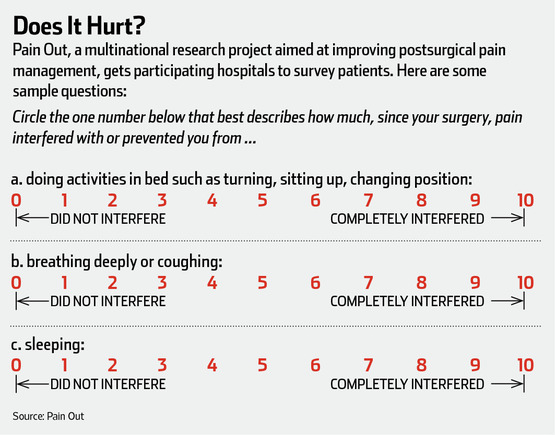
About 120 hospitals in the country now carry “pain-free” certifications—essentially a pledge to keep patients’ pain at bearable levels. Meanwhile, 170 German hospitals are participating in a multinational registry known as Pain Out to swap information on patients’ satisfaction with their pain control, in effect drawing a map of pain management in the country and highlighting particularly effective approaches.Hospitals world-wide are paying closer attention to patients’ postsurgery pain and adopting proven techniques for controlling it.
Comprehensive approaches to pain management—such as cocktails of medications given at different times, with some administered orally and others through injection—have been found to reduce the use of opioids, which can cause grogginess and risk addiction.
These approaches also help patients to be more physically active, which can speed recovery and shorten hospital stays.
Despina Sternberg had a painful bunion removed in what can often be a painful surgery. But Ms. Sternberg managed to dodge the pain almost completely by having the procedure done at a “pain-free” hospital. “I had a very good experience,” the 60-year-old professional cook said outside Berlin’s St. Joseph Hospital a few days after the procedure.
She recalled having nearly the same surgery at another Berlin hospital 35 years ago: “I was in a lot of pain.” This time, Ms. Sternberg’s pain was well controlled with doses of ibuprofen. She said she never needed anything stronger.
Pain management remains poor in many German hospitals, where the stoic attitude toward illness and pain has long prevailed, doctors and nurses say. Many surgeons don’t see the point in taming pain they believe will subside within days. Some patients, especially older ones, often expect high levels of pain after surgery and don’t complain to doctors, whose authority they are loath to question.
The shift to controlling pain is “quite new for people,” said Nadja Nestler, a nurse and pain researcher working on a project to improve pain management in the northwestern city of Münster. “In Germany, it was normal for many, many years for people to never talk about their pain,” she said.
New research is helping to change attitudes. There is a growing appreciation that poor pain control in the days following surgery can prolong hospital stays or cause acute pain to become chronic. German doctors also are responding to studies showing that small operations can generate intense pain. And hospitals are feeling pressure to compete for a younger crop of patients expecting better pain control.
Unlike in the U.S., most German hospitals don’t have to follow protocols for managing pain to receive accreditation. But the pain-free certification or the similar acute-pain-management certification require hospitals to set rules for assessing pain and to intervene to keep it low. Many doctors are quick to clarify that the goal isn’t to eliminate pain completely and say they find the pain-free label misleading.
At St. Joseph, nurses are required to assess patients’ pain every eight hours after surgery by asking them to rate it on a scale of 0 to 10. Fixed doses of an appropriate painkiller are prescribed for a given surgery or medical intervention. Patients automatically receive additional medication if they report pain above level 3.
Jessica Siemen had a hard time following the caesarean birth of her daughter at St. Joseph Hospital in June. The 26-year-old said the pain from the incision in her abdomen was so acute she couldn’t get out of bed for three days. Yet she said she was given only high doses of ibuprofen and acetaminophen because the nurses told her stronger drugs could harm her infant, who was breast-feeding.
“They asked me whether I had pain or not, but not how high or how low the pain was,” Ms. Siemen said.
Nurses marked numbers corresponding to “really high” pain on Ms. Siemen’s chart following the surgery and she was visited daily by a doctor, according to Michael Abou-Dakn, St. Joseph’s head of obstetrics and gynecology. He said Ms. Siemen should have gotten stronger painkillers, though he acknowledged the hospital doesn’t permit certain drugs for nursing mothers.
“I don’t understand why we weren’t informed about this,” Dr. Abou-Dakn said.
Winfried Meissner, an anesthesiologist at Jena University Hospital, in the city of Jena, about 160 miles southwest of Berlin, and one of the Pain Out registry’s developers, said that after the gynecology department at his hospital got bad patient reviews for pain control, he began injecting local anesthesia around the wound after hysterectomies. Both pain and opioid use decreased, the data showed, and he is now trying the technique with c-sections, he said.
“If you have hard data, you can demonstrate that another hospital is doing better. This is a very strong argument to hear from the patients,” Dr. Meissner said.
At Bethel Hospital, doctors say improving how they treat pain helped the hospital attract a larger share of Germany’s growing demand for hip and knee replacements. The small hospital in a neighborhood of former West Berlin tripled its volume of orthopedic surgeries over the past six years, said Dr. Rüdiger Haase, the chief orthopedic surgeon. Bethel, which obtained an acute-pain-management certification in 2006, introduced local anesthetic techniques following surgery and instituted protocols to require staff to routinely assess pain. As a result, patients stabilized and regained their mobility faster, Dr. Haase said.
“Without good pain management, you wouldn’t be able to do this rapid recovery program,” Dr. Haase said.
 About bambooinnovator
 Bamboo Innovator