Audi Plans $30.3 Billion in Investments to Challenge BMW

Audi Plans $30.3 Billion in Investments to Challenge BMW

Volkswagen AG (VOW)’s Audi division, the world’s second-biggest maker of luxury cars, plans to spend 22 billion euros ($30.3 billion) through 2018, pushing models such as electric autos to gain the top spot in the premium segment. Read more of this post

An emergency federal program that acts as a lifeline for 1.3 million jobless workers will end on Saturday, drastically curtailing government support for the long-term unemployed and setting the stage for a major political fight

December 27, 2013

Benefits Ending for One Million Unemployed

By ANNIE LOWREY

WASHINGTON — An emergency federal program that acts as a lifeline for 1.3 million jobless workers will end on Saturday, drastically curtailing government support for the long-term unemployed and setting the stage for a major political fight in the new year. Read more of this post

Amid Record Rally, Stock Picker Keeps Focus on the Basics; Sam Eisenstadt, a Pioneer at Value Line, Remains Bullish

Amid Record Rally, Stock Picker Keeps Focus on the Basics

Sam Eisenstadt, a Pioneer at Value Line, Remains Bullish

MARK HULBERT

Dec. 27, 2013 3:29 p.m. ET

BF-AG483_HULBER_G_20131227175645

Sam Eisenstadt, who devised Value Line’s much-admired stock-selection system, at home with his wife, Edith. Adrienne Grunwald for The Wall Street Journal

Few people listen to Sam Eisenstadt anymore. And that is a shame, since—even at 91—he still has a lot to say. Until he was fired four years ago, he had for more than two decades been head of research at Value LineVALU +2.63% the research firm founded in 1931 that pioneered individual stock analysis. Mr. Eisenstadt remains a close student of the markets, often emailing institutional investors and journalists to report the latest results of his research. (Value Line didn’t respond to requests for comment.) Read more of this post

Academics Who Defend Wall St. Reap Reward

December 27, 2013

Academics Who Defend Wall St. Reap Reward

By DAVID KOCIENIEWSKI

Signs of the energy business are inescapable in and around Houston — the pipelines, refineries and tankers that crowd the harbor, and the gleaming office towers where oil companies and energy traders have transformed the skyline. And in a squat glass building on the University of Houston campus, a measure of the industry’s pre-eminence can also be found in the person of Craig Pirrong, a professor of finance, who sits at the nexus of commerce and academia. Read more of this post

From Abe to Zhou: The Inaugural Naked Awards

From Abe to Zhou: The Inaugural Naked Awards

By William Pesek on 12:20 pm December 26, 2013.
It’s only when the tide goes out, as Warren Buffett famously said, that you learn who’s been swimming naked. Well, 2013 has been a banner year for skinny-dipping among Asian leaders, central banks and business people. In Japan and South Korea, talk of epochal change from two newish leaders was shown to be empty. China’s supposedly peaceful rise was laid bare by aggressive actions. Hopes that Indian Prime Minister Manmohan Singh would rediscover his reformist roots proved barren. Supposedly omnipotent Dear Leader Kim Jong-un executed his uncle and No. 2 for allegedly brewing a coup. Australia’s new leader found his approval ratings to be bottomless. As the year draws to a close, all too many would-be emperors in Asia were revealed to have all too few clothes. The most shameless top our first Naked Awards: Read more of this post

Sorry, haters: Unloved stocks had a great year; Stocks that analysts rated negatively in 2013 did better than the ones they liked

Dec. 26, 2013, 11:31 a.m. EST

Sorry, haters: Unloved stocks had a great year

Stocks that analysts rated negatively in 2013 did better than the ones they liked

By Brett Arends

What was the only thing better than following the advice of Wall Street analysts in 2013?

Easy. Not following the advice of Wall Street analysts. A MarketWatch analysis reveals that the stocks that these analysts hated the most a year ago produced spectacular investment returns in 2013. They beat the overall market indexes, and the stocks that analysts most loved, by a country mile. (Also see: The stupidest investment ideas of 2013) Read more of this post

Argentina’s socioeconomic statistics: Still lying after all these years; Official figures paint a rosy picture. So why are Argentines rioting?

Argentina’s socioeconomic statistics: Still lying after all these years; Official figures paint a rosy picture. So why are Argentines rioting?

Dec 21st 2013 | BUENOS AIRES | From the print edition

20131221_AMC050_0

FOR years the IMF turned a blind eye as Argentina doctored its inflation index and plumped up its numbers for economic growth. Then last February the fund steeled itself and censured the country, warning it to improve its statistics by September or face potential suspension or expulsion. This threat was unprecedented in the fund’s history. Yet it seems it was a largely empty one. On December 9th the IMF board met to review Argentina’s progress on a new inflation index. It declared that, although the country had not adopted the measures the fund wanted, it “recognised” the government’s “ongoing work” and deferred further action until March. Read more of this post

Defenceless? Austerity is hollowing out Europe’s armies

Defenceless? Austerity is hollowing out Europe’s armies

Dec 21st 2013 | From the print edition

20131221_EUD000_0

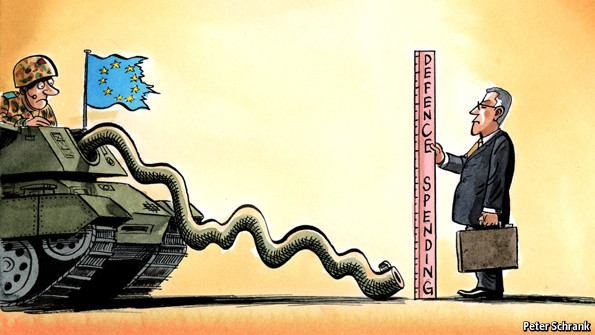
HOW quickly the need to cut deficits is reducing the European Union’s military ambitions. When EU leaders held a summit to discuss defence five years ago there was heady talk of being able to deploy 60,000 troops within 60 days. Today the objective is to get overstretched troops home from Afghanistan as budgets are cut. The EU is meant to have two “battle groups” of 1,500 men apiece ready to deploy at short notice, but it can barely muster one—and none has ever been used. Read more of this post

Here’s why Canada’s big banks keep on winning; There are was a lot of talk at the start of the year about the Great White Short, as some hedge funds bet against the Canadian banks. That didn’t work out so well

Here’s why Canada’s big banks keep on winning

John Shmuel | December 27, 2013 | Last Updated: Dec 27 2:53 PM ET
Better luck next year to those who shorted Canadian banks.

There are was a lot of talk at the start of the year about the Great White Short, as some hedge funds bet against the Canadian banks on the expectation that a slowing Canadian economy would hit financials hard. Read more of this post

Where There’s a Why, There’s a Way; Disruption is, by its very nature, discovery-driven. You can’t see the end from the beginning when you play where no one else is playing — so you simply start

Where There’s a Why, There’s a Way

by Whitney Johnson  |   12:00 PM December 26, 2013

At least once a week, I hear my son, a junior in high school, say, “What is the point of school? I am never going to use [insert subject] again.”  He may or may not, depending on his chosen profession.  My counter-argument tends to be, “You may not use all of it.  Some of it you will.  Regardless, good grades get you into college, and knowing how to work gets you into a happy life.”  On days when I’m desperate, or just exasperated, I huff (and I puff): “Do it because I said to.”  At which point I lament aloud, “Why doesn’t he have a vision for what his future might hold?” Read more of this post

Love of others is like quilting

2013-12-26 17:05

Love of others is like quilting

Lee Eung-tae
I believe others make us better people by sharing pieces of their personalities, their hobbies and their emotions with us.
Undoubtedly, their sweet fragrance is more than enough to warm our hearts. And the world will turn out to be a better place when we feel that hospitable atmosphere around us. I feel strong bonds whenever I am reminded of those people. A happy life is the process of building the bonds which change us into someone new.
We teachers go through many changes every March. Some teachers transfer to other schools, while others stay at the same school but assume different jobs.
So we come to meet new colleagues every year. And keeping a good relationship with people sitting around us is vital for a happy office life because we have to be together for a year. Read more of this post

Great Leaders Treat Integrity As A Habit

Great Leaders Treat Integrity As A Habit

ALISON GRISWOLD

DEC. 26, 2013, 6:23 PM 905 5

Building trust doesn’t happen in a day, but rather over weeks, months, and years. Trustworthy leaders spend the better part of their careers establishing their reputation and character, writes Joel Peterson, chairman of JetBlue Airways, in a recent post on LinkedIn. Because of that, they treat integrity as a habit and extend it to all aspects of their life. “No matter a leader’s competence, charisma, or authority, she’s either trustworthy or she’s not,” Peterson asserts. “Trustworthy people are trustworthy when it comes to family, friends, or colleagues. Obligations to show respect, to consider the welfare of others, and to keep your word don’t end when you leave the office.” Part of upholding those obligations means being constantly open to feedback, Peterson adds. The most trustworthy leaders are always ready to fix things about themselves and learn from their mistakes. “In the same way a mechanic keeps a car in top running condition, high-trust individuals monitor and tune their behavior, always striving to do better by team members and customers alike,” he says.

Jet Li has hyperthyroidism: “Like you, I have brilliant days when I am at my best … as well as days when I question whether I can still continue working. I can be in pain, but I cannot cry, and must face it head on.”

Jet Li has hyperthyroidism

POSTED: 26 Dec 2013 17:00
Action star Jet Li revealed Tuesday during a recording session for a Chinese television show that he suffers from hyperthyroidism.

TAICANG, China: Action star Jet Li revealed during a recording session for a Chinese televised talent show on Tuesday that he is suffering from hyperthyroidism, reported Chinese media. Read more of this post

How to bust through barriers to business growth; Most businesses fail to scale up. Here are three obstacles you need to blast through if you want your business to grow

How to bust through barriers to business growth

December 26, 2013: 10:01 AM ET

Most businesses fail to scale up. Here are three obstacles you need to blast through if you want your business to grow.

By Verne Harnish

FORTUNE — Most businesses fail to grow — with a vast majority remaining tiny, one- or two-person shops. I’d like to see more reach their potential. Even if a business isn’t destined to be the next Google, Amazon, or Facebook, it can still become a thriving, mid-market company. Here are three barriers to growth you need to blast through if you want your business to scale up. Read more of this post

Here’s The Reason Why Startups Crash And Burn, According To Silicon Valley Investor Paul Graham; they’re just not energetic enough. Part of what you have to be energetic enough about is going out and making users real, real happy

Here’s The Reason Why Startups Crash And Burn, According To Silicon Valley Investor Paul Graham

MEGAN ROSE DICKEY

DEC. 26, 2013, 4:32 PM 3,045 3

Startups fail all of the time, but what’s the reason for that? Prolific investor Paul Graham recently shed some light on that in The Information, Jessica Lessin’s new tech news site. His theory? Companies spend too much time making products people don’t want. Here’s the full quote:  Probably the biggest cause of failure is not making something people want. The biggest reason people do that is that they don’t pay enough attention to users. For example, they have some theory in their heads about what they need to build. They don’t go out there and talk to users and say “What do you want?” They just build this thing and then it turns out users don’t want it. It happens time and time again. Another reason might be that they’re just not energetic enough. Part of what you have to be energetic enough about is going out and making users real, real happy. They just do a half ass job of it. Maybe they’re pointing along the right vector but they only go half as far as they need to. Users look at it and they say, “Ah, it’s pretty good.” A million pretty goods, and you’re dead.

How Beer Created Civilization; What led early humans to begin cultivating grain some 10,000 years ago? It was beer — not bread

How Beer Created Civilization

DINA SPECTOR

DEC. 26, 2013, 6:15 PM 1,121 3

What led early humans to begin cultivating grain some 10,000 years ago? It was beer — not bread — a growing body of research shows.  Archaeologists have long hinted that Neolithic, or Stone Age, people first began growing and storing grain, like wheat and barley, to turn it into alcohol instead of flour for making bread. The hypothesis was recently revisited by writer Gloria Dawson in the science magazine NautilusRead more of this post

BILL GATES: 2013 Was A Huge Year For The Things That Really Matter

BILL GATES: 2013 Was A Huge Year For The Things That Really Matter

JULIE BORT

DEC. 26, 2013, 1:54 PM 13,417 28

Bill Gates is proud of how the world improved in 2013. “You’re probably seeing a lot of people’s year-end lists right now, going through the best movies, books, YouTube clips, grumpy cat memes, etc. I thought I would share a different kind of list: some of the good news you might have missed,” he wrote in a blog post. Here’s a summary of Gates’ 2013 Good News List, and we have to admit, this stuff is REALLY good

“We got smarter and faster at fighting polio.” An outbreak in the Horn of Africa was controlled in four month and that India hasn’t reported a case of polio in nearly three years.

“Child mortality went down—again.” Half as many children died in 2012 as in 1990. (A cup half-full way of looking at an awful problem.)

“The worldwide poverty rate went down—again.” The poverty rate has dropped by half since 1990, the Economist reported in June. Gates adds, “I never miss an issue of the Economist, and this might be the best piece they ran this year.”

“Rich countries re-committed to saving lives.” Gates points out renewed funding commitments to the Global Fund to fight AIDS, TB, and malaria.

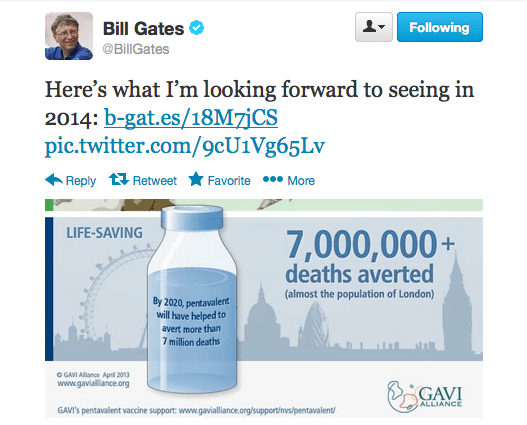
And next year, all of the world’s poorest countries will have access to a new vaccine called pentavalent. Gates is pretty excited about that, too. It’s called pentavalent “because it prevents five diseases,” Gates explained: Next year it will be available in South Sudan, the last of the 73 poorest countries to introduce it. India just announced that they’ll start giving it to every child in the nation in 2014. If other countries follow India’s example, pentavalent could prevent 7 million deaths by 2020. That’s 7 million more children protected from common, preventable childhood illnesses, in addition to the 440 million that an organization called GAVI has immunized since 2000, he says. The idea caused Gates to send this jubilant tweet:
bill-gates-tweet-deaths

Twitter/@BillGates

With so much bad news bombarding us daily, it’s nice to see how things improved, too.

Next year will be the year of “Gabo,” according to East Asia’s traditional 60-year lunar calendar. The previous Gabo years, 60 and 120 years ago, saw many turbulent events and became turning points for Korea

2013-12-26 17:02

‘Gabo’ years have many historic moments

By Lee Chang-sup
Next year will be the year of “Gabo,” according to East Asia’s traditional 60-year lunar calendar. The previous Gabo years, 60 and 120 years ago, saw many turbulent events and became turning points for the country. Reviewing what happened in these previous Gabo years will help us learn from our mistakes and help us move forward. Read more of this post

DocuSign’s CEO on getting in over your head (and succeeding): Programmer by day, thrill-seeker by night: We talk to Keith Krach about what makes him tick.

DocuSign’s CEO on getting in over your head (and succeeding)

December 26, 2013: 8:22 AM ET

Programmer by day, thrill-seeker by night: We talk to Keith Krach about what makes him tick.

By Chanelle Bessette, reporter

keith-krach-headshot-crop-620x348

FORTUNE — As the youngest-ever vice president and general manager of GMF Robotics, the industrial robotics division of automaker General Motors, Keith Krach used his early momentum in tech business to help found Rasna (which was sold in 1995 to Parametric Technologies for $500 million) and Ariba. He continued his entrepreneurial path by joining DocuSign — an electronic signature company that facilitates legal, contractual, and tax documents online — and becoming the company’s chairman and CEO. Krach holds a BS in industrial engineering from Purdue University and an MBA from Harvard, and he sits on several boards, including Angie’s List and Purdue University’s board of trustees. We asked him about his early days in business and what he considers to be his biggest achievements, as well as the thrill-seeking he does in his free time. Read more of this post

Cattle look good on gift cards, but look like poor investments; If one analysis is correct, the continued existence of cows disproves the main tenets of capitalism

December 26, 2013 7:30 pm

Cattle look good on gift cards, but look like poor investments

By Samuel Brittan

If one analysis is correct, the continued existence of cows disproves the main tenets of capitalism

Are there any central tenets of capitalism? If so, they are better provided by academic observers than by business people, who are too busy trying to earn a penny or two – not the least over the season just past – to know. So I turn to a slightly offbeat application of economics. I refer to Paper No. 9639 of the Centre for Economic Policy Research by S Anagol, A Etang and DS Karlan, portentously entitled “Continued Existence of Cows Disprove the Central Tenets of Capitalism?” Read more of this post

The first to fly: The true story of two eccentric 18th century inventors

The first to fly: The true story of two eccentric 18th century inventors

BY ADAM L. PENENBERG 
ON DECEMBER 26, 2013

The story of the first humans to fly involves two eccentric French brothers, lots of taffeta, a race against the French Academy of Science, King Louis XVI, Marie Antoinette, Benjamin Franklin, a scheming scientist, a nobleman, a rooster, duck, and a sheep. Read more of this post

Temples of delight: Museums the world over are doing amazingly well, says Fiammetta Rocco. But can they keep the visitors coming?

Temples of delight: Museums the world over are doing amazingly well, says Fiammetta Rocco. But can they keep the visitors coming?

Dec 21st 2013 | From the print edition

20131221_SRC114 (1) 20131221_SRC115 (1) 20131221_SRC756_0

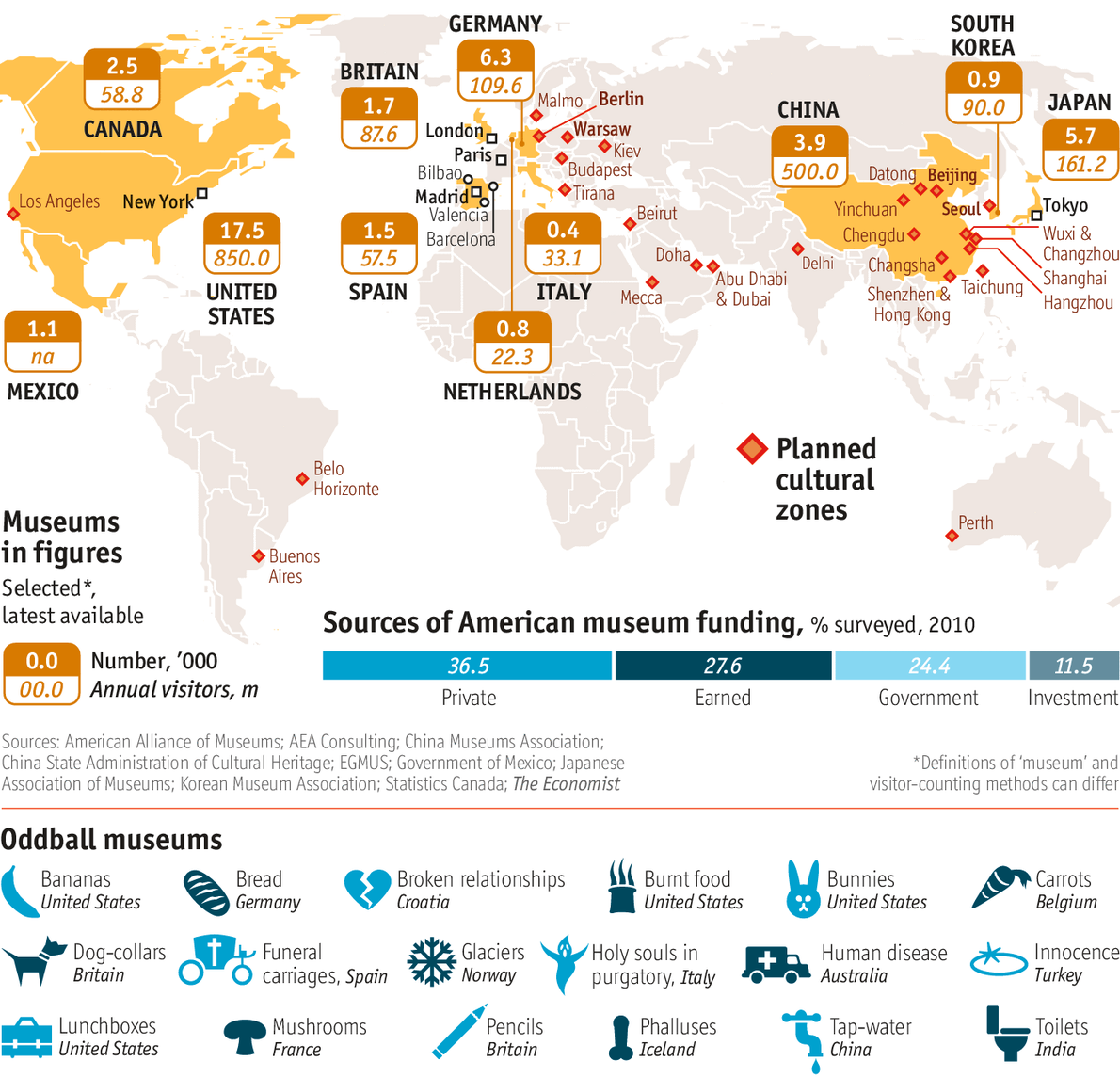
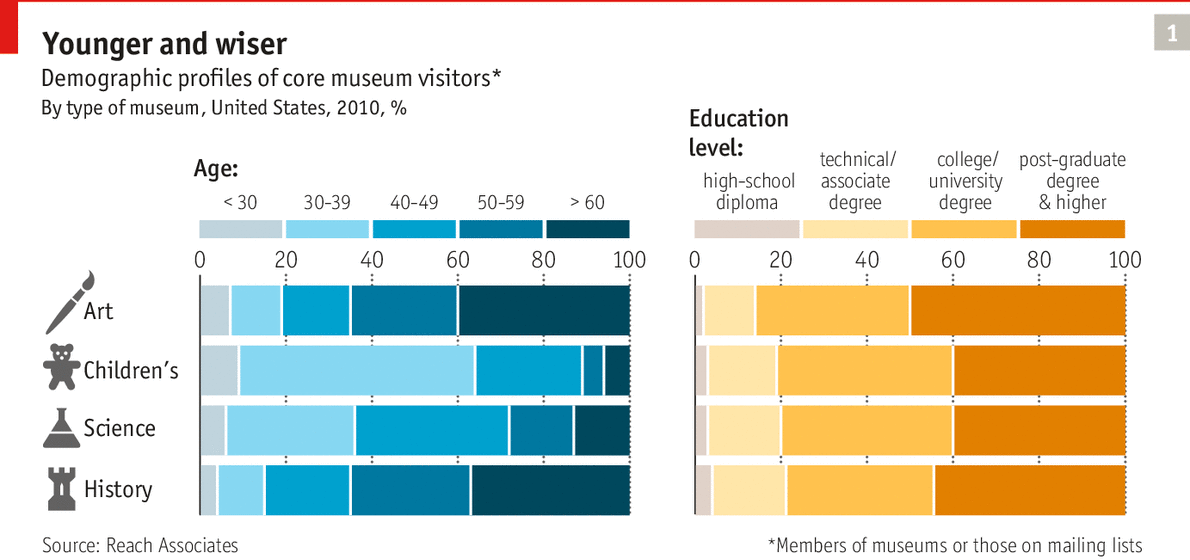
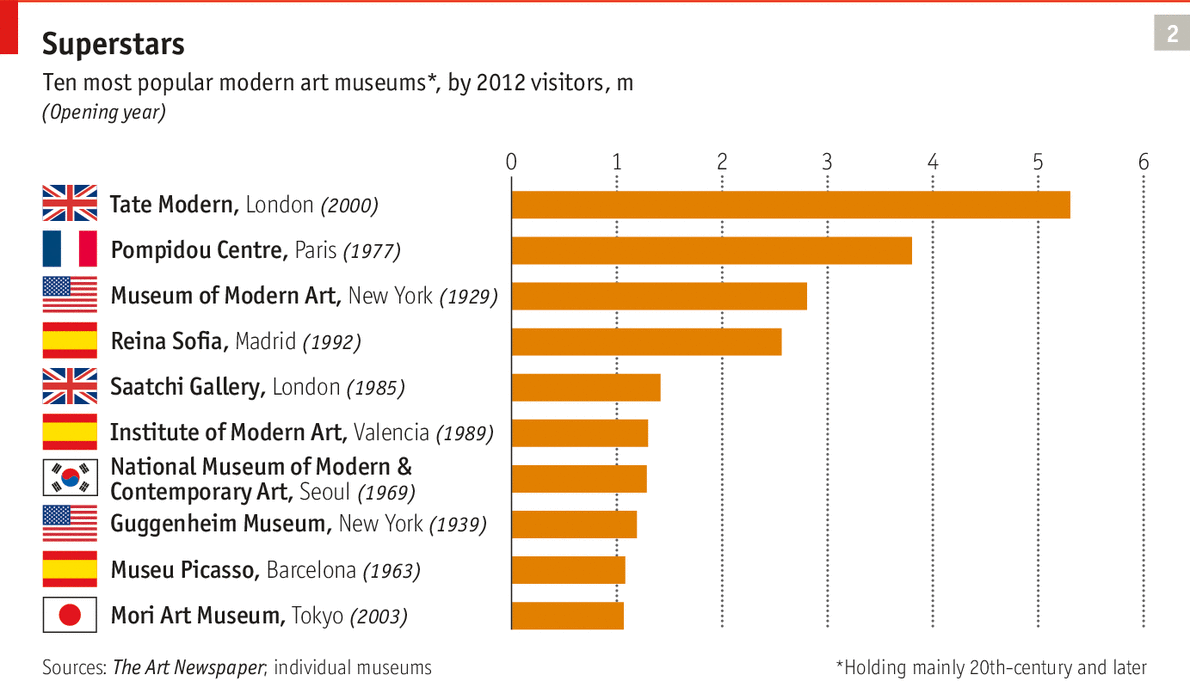
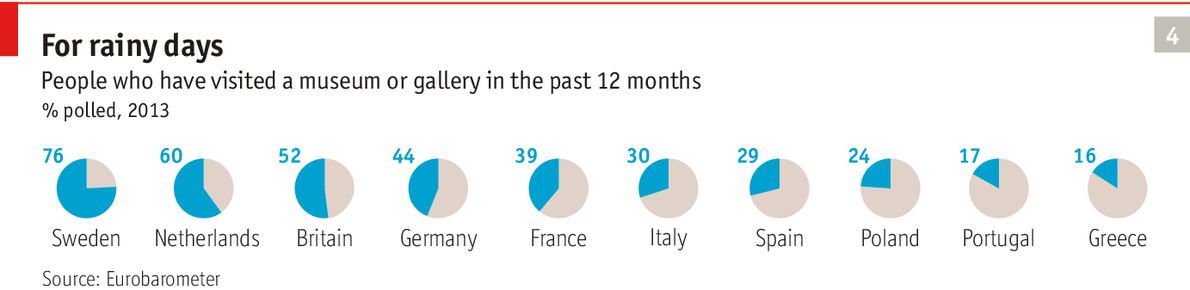
MUSEUMS USED TO stand for something old, dusty, boring and barely relevant to real life. Those kinds of places still exist, but there are far fewer of them, and the more successful ones have changed out of all recognition. The range they cover has broadened spectacularly and now goes well beyond traditional subjects such as art and artefacts, science and history (for a sample of oddball specialities, see chart). One of the biggest draws is contemporary art. Read more of this post

Feeding the culture-vultures: What museums must do to satisfy an increasingly demanding public

Feeding the culture-vultures: What museums must do to satisfy an increasingly demanding public

Dec 21st 2013 | From the print edition

20131221_SRC793_0

MUSEUMS ARE MEANT to preserve and safeguard the collections entrusted to them, which makes them naturally conservative. Yet with public funds likely to remain tight for the foreseeable future, and private money free to back institutions that are seen as winners, they will have to do some innovative thinking over the next 20 years, both to deal with unavoidable change and to seize new opportunities. Read more of this post

The Death of the Bedside Manner; ObamaCare is speeding the decline in the quality of medical practice.

Marc Siegel: The Death of the Bedside Manner

ObamaCare is speeding the decline in the quality of medical practice.

MARC SIEGEL

Dec. 26, 2013 7:17 p.m. ET

‘It is as painful perhaps to be awakened from a vision as to be born,” James Joyce wrote famously in his masterpiece “Ulysses.” I recently had such an experience when my office manager—who protects me from the daily insurance grind of referrals and approvals and pre-certifications and blood drawing—was out sick. Thus the veil was lifted from my eyes, and I awoke to the harsh realities of our medical future. Read more of this post

Fake Knee Surgery as Good as Real Procedure, Study Finds; Result Likely to Fuel Debate Over Common Orthopedic Operation

Fake Knee Surgery as Good as Real Procedure, Study Finds

Result Likely to Fuel Debate Over Common Orthopedic Operation

JOSEPH WALKER

Dec. 25, 2013 5:10 p.m. ET

NA-BZ418_KNEES_NS_20131225164807

A fake surgical procedure is just as good as real surgery at reducing pain and other symptoms in some patients suffering from torn knee cartilage, according to a new study that is likely to fuel debate over one of the most common orthopedic operations. Read more of this post

Ethics: End of the hard sell? Pharmaceutical groups are finding their marketing and sales tactics under increasing scrutiny

December 26, 2013 6:20 pm

Ethics: End of the hard sell?

By Andrew Jack

Pharmaceutical groups are finding their marketing and sales tactics under increasing scrutiny

When Johnson & Johnson wanted to boost prescriptions of Natrecor, a heart medicine, it channelled more than $100,000 through a subsidiary company to a sympathetic nurse. In exchange, she spoke favourably about the drug in talks, trained colleagues on how to use it, and put her name on an article in a medical journal to boost sales. Read more of this post

King of PCs, Lenovo Sets Smartphone Ambitions

December 26, 2013

King of PCs, Lenovo Sets Smartphone Ambitions

By ERIC PFANNER

In the United States, Lenovo is still best known as the Chinese company that bought IBM’s PC business in 2005. In China, it is better known as the world’s new No. 1 PC maker, a force to be reckoned with in smartphones and a bellwether for the nation’s economic and technological might. Read more of this post

China approves pilot to open mobile telecoms market, boost competition

China approves pilot to open mobile telecoms market, boost competition

5:27am EST

SHANGHAI (Reuters) – China has approved a pilot scheme allowing private companies to piggy back on the country’s three dominant telecommunications providers to offer own-brand mobile services, opening the world’s largest mobile phone market to increased competition. Read more of this post

Tech in China 2013: Chinese Internet Giants Shopping Crazily

Tech in China 2013: Chinese Internet Giants Shopping Crazily

By Tracey Xiang on December 26, 2013

The old story: Big Chinese Internet companies would, rather than buy or invest in startups, hire a bunch of engineers to build products on their own or do pixel-to-pixel knockoffs. Big names like Tencent are notorious for killing startups by doing so, with better products or the ability of converting existing users. Recognized reasons include 1) the costs of hiring several smart-enough Chinese engineers are much lower than buying a startup, and 2) intellectual property rights haven’t been well protected in China. Read more of this post

India Is Becoming A High-Cost Economy

India Is Becoming A High-Cost Economy

RAJESH KUMAR SINGH AND ADITI SHAHREUTERS
DEC. 26, 2013, 6:31 PM 1,128 3

A waiter carries plates of food for customers at the Britannia and Co. restaurant in Mumbai. The aroma of frying onions from the Britannia and Co. restaurant might not penetrate the office of Reserve Bank of India (RBI) Governor Raghuram Rajan a block away, but like the eatery’s customers, he can’t escape the soaring price of the pungent vegetable. Read more of this post