As M&A business cools, banks warm to activist investors

As M&A business cools, banks warm to activist investors

Fri, Jan 24 2014

By Jessica ToonkelOlivia Oran and Soyoung Kim

NEW YORK (Reuters) – Corporate raiders, long scorned by Wall Street, are gaining new credibility as activist investors, to the point that some investment banks are eager to bestow on them a new title: valued customer.

Big Wall Street banks like Goldman Sachs (GS.N: QuoteProfileResearchStock Buzz) and Morgan Stanley (MS.N: QuoteProfileResearchStock Buzz) are still content to defend corporate America against investors like Carl Icahn and Dan Loeb, who take large stakes in companies with the hopes of effecting such changes as spinning off a division, cutting costs or ousting management.

Protecting the corporate castle is profitable work, part of nearly $70 billion in corporate fees generated by investment banks annually, and big banks fear upsetting their best clients.

Smaller investment banks, though, see a new source of revenue: Working with investors on one corporate campaign could help them win future assignments from another company, which may seek defensive services from banks familiar with the inner workings of activists.

Getting involved in a merger-and-acquisition transaction is also opportune if the target company ultimately pursues a sale of itself under investor pressure.

That’s a potentially attractive proposition for an industry still grappling with slow dealmaking activity in the wake of the financial crisis. U.S. M&A fees last year were still down 27 percent from 2007, at $15.9 billion, according to data from Thomson Reuters and Freedman & Co.

“I keep getting calls from people who want to be in this space. Bankers are trying to figure out ‘how can I charge for working with activists?'” said Steve Wolosky at Olshan Frome Wolosky LLP, a top lawyer for activist investors such as Starboard Value LP.

“Everyone is expecting the big banks to start doing this … the answer as to when is ‘follow the money,'” said a banker at a large firm that has discussed working with activists.

“It’s not that different from what happened with the private equity firms in the 1980s. No one wanted to work with the ‘barbarians’ until they realized it was very lucrative,” he added, asking not to be named because he was not authorized to speak with the media.

Boutique banks including Houlihan Lokey, Moelis & Co and Blackstone Group LP’s (BX.N: QuoteProfile,ResearchStock Buzz) advisory group have worked with investors such as Barington Capital, Starboard and Pershing Square Capital on their activist campaigns.

Evercore Partners Inc (EVR.N: QuoteProfileResearchStock Buzz) and Jefferies LLC are also keeping a close eye on the trend, several bankers said.

Activist investors have become more respectable in recent years after a series of campaigns that brought about changes seen as instrumental to companies’ success.

Loeb, for instance, made a handsome profit for himself and his investors from his two-year crusade to increase Yahoo Inc’s (YHOO.O: QuoteProfileResearchStock Buzz) value. The shares, which were around $13 before got involved, now trade near $40. He was also instrumental in naming former Google Inc (GOOG.O: QuoteProfileResearchStock Buzz) executive Marissa Mayer as Yahoo’s chief executive officer.

On Wednesday alone, Icahn urged e-commerce giant eBay (EBAY.O: QuoteProfileResearchStock Buzz) to spin off its PayPal arm and renewed an attack on Apple Inc (AAPL.O: QuoteProfileResearchStock Buzz) to return cash to shareholders. Loeb revealed a major stake in Dow Chemical Co (DOW.N: Quote,ProfileResearchStock Buzz) and urged the largest U.S. chemical maker to spin off its petrochemical unit.

The number of activist campaigns against U.S. corporations has increased 20 percent over the last few years, according to FactSet Shark Watch, from 198 in 2010 to 236 last year.

While large activist firms mostly have the team and reputation to take on a fight without outside aid, other activists hire Wall Street advisors to render campaigns more believable, to perform financial analysis and sometimes to find potential buyers for the target company.

ADDING HEFT

For smaller or new activist investors, enlisting a bank helps to “show they are serious because they are paying the bank a significant fee to do the work and use their name,” said Gregg Feinstein, head of the M&A group at Houlihan Lokey.

Houlihan, which also defends companies against activist campaigns, represented its first activist publicly in 2011 when it assisted Orange Capital in its campaign against Australian REIT Charter Hall Office Management.

Orange succeeded in its push, which included the sale of its U.S. portfolio. Houlihan is now helping Barington Capital to persuade Darden Restaurants Inc (DRI.N: QuoteProfileResearchStock Buzz) to break up into two separate companies and to spin off its real estate.

Moelis advised Starboard Value during the hedge fund’s push for Smithfield Foods Inc to break itself up rather than sell to Shanghui International Holdings Ltd.

Blackstone will work with corporate clients as well as activists, including Pershing Square, the hedge fund founded by William Ackman. The bank helped Ackman when the billionaire invested in Canadian Pacific Railway Ltd (CP.TO: QuoteProfileResearchStock Buzz).

Some bankers work with activists because they are attracted by the opportunities to build relationships with investors, who often manage to secure board seats at major corporations.

“Many banks use the activist product as a means toward securing future mandates from a corporate client, including takeover defense or ultimately the sale of the company,” said Tom Stoddard, a senior managing director at Blackstone.

Banks working with activists generally charge a flat fee, a percentage of the gains the activist receives if the campaign is successful, and an additional fee if the activist publicly discloses the bank’s name, according to several people familiar with these arrangements.

The flat fees can range anywhere from $250,000 to $1 million, and the percentage of investor gains bankers earn can be anywhere from one to 5 percent, these sources said, asking not to be named because the information is not public.

It is hard to generalize fees because often caps and credits are associated with these structures, one of the sources added.

Banks fending off a high-profile attack can make from a few hundred thousand dollars to $2 million in monthly flat fees, on top of a success fee as high as $7 million to $8 million, according to one industry banker.

“People are willing to pay higher fees if you fight people like Carl Icahn than if you are fighting a new kid on the block,” the banker said.

Such fees are only a tiny fraction of what Wall Street banks generate from deals ranging from capital market transactions to mergers and acquisitions.

Computer maker Dell Inc’s $25 billion buyout by founder Michael Dell last year, for example, created $458 million worth of investment banking fees in 2013, according to Thomson Reuters data.

That reliance on corporations for revenue explains why it’s still rare that banks work with activists.

But as investors become more common in the boardroom and the amount of money activists make grows, more banks may change their view, said Lyle Ayes, managing director and head of shareholder activism practice at New York-based Evercore

(EVR.N: QuoteProfileResearchStock Buzz).

When Evercore brought on Ayes early last year, one of his first mandates was to help decide if the firm should represent activists.

In the end, Evercore decided against the idea. “It’s too close to home for too many of our important clients.” Still, he added: “Evercore asked the question before I arrived, they asked when I arrived and I suspect they will ask it again.”
 

Apple’s Mythical TV Could Add $40 Billion In Revenue Says Hedge Fund Manager

Apple’s Mythical TV Could Add $40 Billion In Revenue Says Hedge Fund Manager

Carl Icahn has some interesting thoughts on how big of a seller Apple’s currently nonexistent TV can be.posted on January 23, 2014 at 5:04pm EST

Matthew LynleyBuzzFeed Staff

Carl Icahn, the activist hedge fund manager who now holds $3.6 billion worth of Apple shares, thinks the company can sell 25 million new ultra high-definition televisions at a price of $1,600 each.

Only problem is, despite persistent rumors of its imminent release, an Apple TV does not yet exist.

But if it did, Icahn — not to mention at least one Wall Street analyst — thinks it will be a huge seller.

“With 238 million TVs sold globally in 2012, it would not surprise us if Apple could sell 25 million new Apple ultra high definition televisions at $1,600 per unit, especially when considering both its track record of introducing best in class products and its market share in smartphones and tablets,” Icahn said in a new letter to Apple’s shareholder that once again argued his case that the company isn’t doing enough with its money. “At a gross margin of 37.7%, which would be consistent with that of the overall company, such a debut would add $40 billion of revenues and $15 billion to operating income annually.”

Icahn released his latest letter this afternoon after disclosing yesterday on Twitterthat he bought another $500 million worth of Apple shares. The recently announced purchase brings his stake in the company to more than $3 billion — though that is still less than 1% of total ownership of the company. He is currently pushing Apple to increase its buyback program by an additional $50 billion, saying the company isn’t doing enough with its cash. Apple currently has more than $140 billion in its bank, and is in the middle of a $100 billion dividend and buyback program.

In the seven-page letter, Icahn spells out a few possible growth areas for Apple to illustrate why he believes it is currently undervalued. In particular, he says Apple could basically add $15 billion in annual operating income if it started selling a high-definition television set. And while Icahn did agree that Apple has shown interest in returning some capitol to investors, he essentially considers it a token gesture than a real buyback program:

“In this letter, we have summarized why we believe Apple is undervalued in order to express how ridiculous it seems to us for Apple to horde so much cash rather than repurchase stock (and thereby use that cash to make a larger investment in itself for the benefit of all of the company’s shareholders). In its statement in opposition to our proposal, the company claims that “the Board and management team have demonstrated a strong commitment to returning capital to shareholders” and we believe that is true, but we also believe that commitment is not strong enough given the unique degree to which the company is both undervalued and overcapitalized.”


What it’s like to work at Bill Gross’ Pimco; “Everyone knows when the big dog walks in, he wants silence”; As soon as Gross is seated, he requires updates from all corners of the markets. “His ability to scan and assess information is staggering”

What it’s like to work at Bill Gross’s Pimco

By Matt Phillips @MatthewPhillips January 23, 2014

The abrupt departure of Mohamed El-Erian as CEO of bond-fund megalith Pimco this week sparked much head-scratching amongst the financial press. Bill Gross, Pimco’s founder and managing director, told the Wall Street Journal that he didn’t want El-Erian to leave (paywall), but the Financial Times reports that a “frequently fractious” relationship (paywall) between Gross and El-Erian was part of the reason he departed.

So what’s it really like to work for the bond king?

Interviews with ex-Pimco traders suggest Gross, who served as a naval officer during the Vietnam war, runs an incredibly tight ship. And his management style can take its toll.

Traders arrive at the third-floor trading room of Pimco’s headquarters in Newport Beach, California, about an hour’s drive from central Los Angeles, before 5 am California time. (Early this year the firm is expected to move into a new 20-story headquarters in the same town.) Visitors—especially those who’ve visited the voluble trading desks of Wall Street before—notice something about the floor: the silence.

You can almost hear a pin drop. And that’s by design. Under Gross, conversation is kept to a minimum. If you must talk, it’s done in tones not much louder than a whisper.

“Everyone knows when the big dog walks in, he wants silence,” one former Pimco employee, who declined to be named, told Quartz.

Almost as soon as Gross is seated, he requires updates from all corners of the markets, which traders zap to him.

You certainly don’t talk to Gross himself.

“It’s kind of medieval. You only speak when spoken to,” the same trader said.

All communications about trade ideas for Gross are submitted according to his protocol. The trades are printed out, with charts, yields and prices. They’re handed to Gross’s assistant. She takes the recommendations and walks a few feet to put them in Gross’s in-tray, on his desk. Traders aren’t supposed to put the recommendations in the in-tray directly.

If his protocols aren’t followed, Gross has been known to issue somewhat random “demerits.” (Perhaps it’s some sort of throwback to his time in the Navy.) Traders’ recommendations reviewed by Quartz had hand-written queries and criticisms on them from Gross, with running tallies of the number of infractions (“Demerit #3″) added at the top.

Sometimes Gross’s attention to detail goes to extremes. As one story goes, confirmed by separate sources, Gross once sent a corporate bond trader home in the midst of the trading day with instructions to hand-write 1,000 times that he would not submit trade recommendations without charts.

Was it Gross’s managerial style that finally exhausted El-Erian? We don’t know. Traders say that while the two were publicly viewed as equals—in addition to their other titles, they are both called “co-chief investment officer”—within the firm Gross was clearly considered superior.

“There wasn’t a co-anything. Everybody knew that Bill ran it,” said another ex-Pimco employee, who declined to be named. “I was in investment committee meetings where he would just tear Mohamed apart.”

Of course, Gross has no trouble finding high-powered employees willing to work at Pimco. He built the firm into one of the world’s most influential asset managers with his laser-like focus on the unsexy world of bond markets. Pimco’s ”Total Return Fund” is the world’s largest bond fund. And traders don’t join trading desks because they want to work in a cushy environment. They follow the money, and Pimco pays well. (El-Erian reportedly earned $100 million in one of his years at the firm.)

And in fairness to Gross, traders acknowledge there’s a method to his approach. He is making a myriad decisions on titanic sums of client money. Though they might ruffle feathers, employees say his systems work, allowing him to quickly and accurately distill detailed information into fuel for investment decisions.

“His ability to scan and assess information is staggering,” said one former Pimco employee.

But El-Erian was also the long-standing heir apparent to Gross. Now Pimco’s investors will be asking what will happen to the firm should anything happen to Gross. He’s publicly claimed he’s “ready to go another 40 years,” though he subsequently told the Journal that five or ten years would be more realistic. When you’re searching for someone to assume the mantle at a company that’s the leader in its field, that’s not necessarily a whole lot of time.


Starbucks is getting ready to let you order coffee before you get to the store

Starbucks is getting ready to let you order coffee before you get to the store

By Roberto A. Ferdman @robferdman January 24, 2014

For its next trick, Starbucks may have your order ready before you enter the store.

After reporting strong fourth-quarter earnings yesterday, CEO Howard Schultz confirmed plans to allow customers to place orders through Starbucks’s mobile app and pick them up later. “I can tell you that we understand the value that that will create for our customer base,” Schultz said in reply to a question on the company’sconference call. He added, “You can assume that over time we will lead in this area.”

Starbucks first mentioned “mobile ordering” to investors in 2012, but didn’t elaborate on its intentions.

Pre-ordering would make sense for Starbucks as the coffee giant increasingly focuses on food, which is its fastest-growing segment. ”Everything we’ve seen so far encourages us that we’re just beginning to go after what is a big, big food opportunity,” CFO Troy Alstead said yesterday. Food is more complicated to prepare than coffee and can slow down service in Starbucks stores. “We’re definitely looking to increase the speed of our lines,” spokeswoman Linda Mills told Quartz today.

Some restaurant chains, like Chipotle, already allow mobile pre-ordering. Starbucks’s big advantage in this area would be that so many customers—over 10 million—already use its mobile app to pay for their orders.

But there are plenty of complications to consider. Will the company prioritize pre-orders, or in-store orders? And if pre-ordering takes off, could that diminish impulse purchases of its pastries, packaged food, and other goods? The company wants to make buying coffee and food as easy and fast as possible, but not if it comes at the expense of sales. Which is probably why Starbucks is being so deliberate about the program’s careful development.

Most Germans don’t buy their homes, they rent. Here’s why

Most Germans don’t buy their homes, they rent. Here’s why

By Matt Phillips @MatthewPhillips January 23, 2014

It’s just a fact. Many Germans can’t be bothered to buy a house.

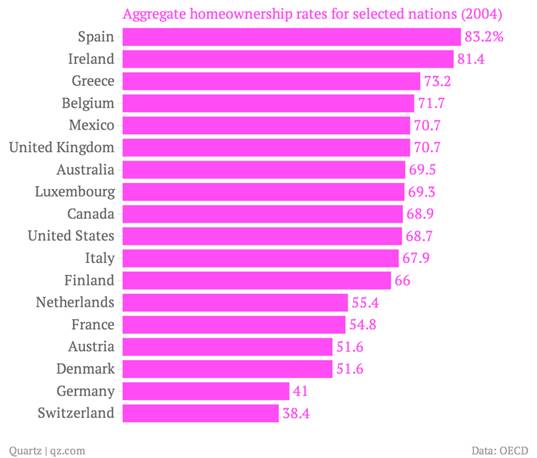
The country’s homeownership rate ranks among the lowest in the developed world, and nearly dead last in Europe, though the Swiss rent even more. Here are comparative data from 2004, the last time the OECD updated its numbers. (Fresh comparisons are tough to find, as some countries only publish homeownership rates every few years or so.)

image001-2

​And though those data are old, we know Germany’s homeownership rate remains quite low. It was 43% in 2013.

This may seem strange. Isn’t home ownership a crucial cog to any healthy economy? Well, as Germany shows—and Gershwin wrote—it ain’t necessarily so.

In Spain, around 80% of people live in owner-occupied housing. (Yay!) But unemployment is nearly 27%, thanks to the burst of a giant housing bubble. (Ooof.)

Only 43% own their home in Germany, where unemployment is 5.2%.

Of course, none of this actually explains why Germans tend to rent so much. Turns out, Germany’s rental-heavy real-estate market goes all the way back to a bit of extremely unpleasant business in the late 1930s and 1940s.

The war

By the time of Germany’s unconditional surrender in May 1945, 20% of Germany’s housing stock was rubble. Some 2.25 million homes were gone. Another 2 million were damaged. A 1946 census showed an additional 5.5 million housing units were needed in what would ultimately become West Germany.

Germany’s housing wasn’t the only thing in tatters. The economy was a heap. Financing was nil and the currency was virtually worthless. (People bartered.) If Germans were going to have places to live, some sort of government program was the only way to build them.

And don’t forget, the political situation in post-war Germany was still quite tense. Leaders worried about a re-radicalization of the populace, perhaps even a comeback for fascism. Communism loomed as an even larger threat, with so much unemployment.

West Germany’s first housing minister—a former Wehrmacht man by the name ofEberhard Wildermuth—once noted that ”the number of communist voters in European countries stands in inverse proportion to the number of housing units per thousand inhabitants.”

A housing program would simultaneously put people back to work and reduce the stress of the housing crunch. Because of such political worries—as well as genuine, widespread need—West Germany designed its housing policy to benefit as broad a chunk of the population as possible.

The rise of renting

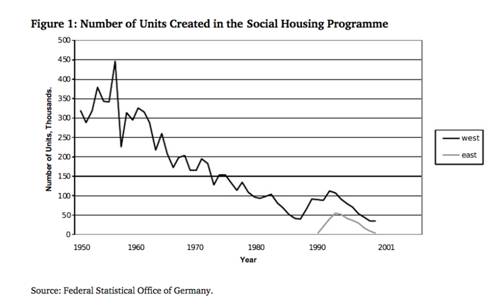
Soon after West Germany was established in 1949, the government pushed throughits first housing law. The law was designed to boost construction of houses which, “in terms of their fittings, size and rent are intended and suitable for the broad population.”

It worked. Home-building boomed, thanks to a combination of direct subsidies and generous tax exemptions available to public, non-profit and private entities. West Germany chopped its housing shortage in half by 1956. By 1962, the shortage was about 658,000. The vast majority of new housing units were rentals. Why? Because there was little demand from potential buyers. The German mortgage market was incredibly weak and banks required borrowers to plunk down large down payments. Few Germans had enough money.

image002-2

Why Germany?

It’s worth noting that Germany wasn’t the only country with a housing crisis after World War II. Britain had similar issues. And its government also undertook large-scale spending to promote housing. Yet the British didn’t remain renters. The UK homeownership rate is around 66%, much higher than Germany’s.

image003-1

Why? The answer seems to be that Germans kept renting because, in Germany, rental housing is kind of nice.

Economists think German housing policy struck a much better balance between government involvement and private investment than in many other countries. For instance, in the UK, when the government gave housing subsidies to encourage the building of homes after the war, only public-sector entities, local governments, and non-profit developers were eligible for them. That effectively squeezed the private sector out of the rental market. In Germany, “the role of public policy was to follow a third way that involved striking a sensitive balance between ‘letting the market rip’ in an uncontrolled manner and strangling it off by heavy-handed intervention,” wrote economist Jim Kemeny, of the German approach to housing policy.

Britain also imposed stringent rent and construction cost caps on developers of public housing. Under those constraints, housing quality suffered. Over time, the difference between publicly and privately financed construction became so glaring that rental housing—which was largely publicly financed—acquired a stigma. In other words, it became housing for poor people.

Germany also loosened regulation of rental caps sooner than many other countries,according to economist Michael Voightländer, who has written extensively about Germany’s housing market. By contrast in the UK, harsher regulation on rented housing stretched well into the 1980s, pushing landlords to cut back on maintenance and driving the quality of housing down still further.

Cheap rents

image004-1

​Of course, all that policy-design detail is interesting. But there might be a simpler explanation for the popularity of renting in Germany. For one thing, it’s relatively cheap. (Germany is listed as “Deu” above.)

Renter-friendly regulations

image005-1

​Why is renting cheap in Germany? Well, even though the country’s policies might have been slightly more balanced than in other countries, its rental market is still robustly regulated, and the regulations are quite favorable to renters. (Given the strong political constituency renters represent in Germany, this shouldn’t be too surprising.) For example, German law allows state governments to cap rent increases at no more than 15% over a three-year period.

Tax treatment

There’s another pretty simple reason Germans are less likely to own houses. The government doesn’t encourage it. Unlike high-homeownership countries like Spain, Ireland and the US, Germany doesn’t let homeowners deduct mortgage-interest payments from their taxes. (There’s more on the structure of European tax systems here.) Without that deduction, the benefits of owning and renting are more evenly balanced. “Both homeowners and landlords in Germany are barely subsidized,” wrote Voightländer in a paper on low homeownership rates in Germany.

Those regulations, a solid supply of rental housing, and the fact that German property prices historically rise very slowly —that’s a whole other story—mean German rents don’t rise very fast. And because one of the main reasons to buy a home is to hedge against rising rents, the tendency of German rents to rise slowly results in fewer homebuyers and a lower homeownership rate.

A number of other elements contribute too, but it’s tough to disentangle what is cause and what is effect. For example, German banks are quite risk-averse, making mortgages harder and more expensive to get. Others argue that the supply of rental housing might be higher in Germany because of its decentralized, regional approach to planning. (The UK is much more centralized.)

Is Germany just better at housing?

Not necessarily. It’s not as if Germans spend a lot less of their pay on housing. The data below show Germans actually pay more for housing—as a percentage of disposable income—than housing-crazed countries like the US, Spain and Ireland.

1

image006-1

​But given the economic spasms suffered in house-crazy economies such as the United States, Spain and Ireland in recent years, the German approach to housing looks pretty good right now—even if, before the crash, the low homeownership rate was seen as an albatross around Germany’s economic neck.

And German people clearly like how their system of housing works. According to the OECD, more than 93% of German respondents tell pollsters they’re satisfied with their current housing situation. That’s one of the highest rates of any nation the rich-country think tank surveyed. Then again, the Irish and the Spanish—where homeownership is much more widely spread—seem just as happy.

UBS at Davos: ‘We’ve swapped global imbalances for domestic disequilibrium’; Your guide to EM compartmentalisation

UBS at Davos: ‘We’ve swapped global imbalances for domestic disequilibrium’

FT Alphaville | Jan 24 09:01 | 2 comments Share

According to a white paper released by UBS for this week’s World Economic Forum in Davos, the world economy remains as unbalanced today as it has been over the past quarter century – with big implications for the global economic recovery.

The authors argue that the adjustment of current account imbalances in the world economy was mostly a function of recession, not shifts in competitiveness. Large current account deficit countries restored external equilibrium at the cost of domestic disequilibrium, so output plummeted and unemployment soared.

One of the consequences of shifting imbalances is changes in capital flows and hence financing conditions, particularly for sovereigns. A related point concerns the role of central banks. For instance, a different buyer of US Treasuries had to step in, which during quantitative easing has been the Federal Reserve.

A second consequence is that the unwinding of external imbalances and the ensuing sluggish global recovery have taken their toll on global trade.

One of the authors of the white paper, Stephane Deo, global head of asset allocation and macro strategy at UBS Investment Bank, will be joining FT Alphaville at 11am on Friday for a session of Markets Live.

Deo’s bullet points:

Over the past five years there has been a clear inverse relationship between changes in domestic demand and changes in the external balance.

With the advent of smaller US external deficits, the rise in foreign official holdings of Treasuries (from $600bn in 2000 to $4,000bn in 2013) has slowed and may even be reversing (with a decline of roughly $125bnbetween March and August 2013).

The trade intensity of the global recovery has fallen. Prior to the crisis, a 1 percentage point increase in global GDP growth boosted world trade by roughly 2 percentage points. In the past five years, the trade multiplier has collapsed. Trade is growing in line with sluggish world GDP growth.

With domestic demand still skewed towards the US, the UBS paper concludes conclude that:

The US is still the sole major economic region capable of driving up its rate of growth via increased domestic demand.

If the US is to restore full employment, it will have to do so without much help from the rest of the world.

Given that the US economy does not have the same vitality that it did before the crisis, the exported recoveries elsewhere will remain correspondingly weaker for longer.


Your guide to EM compartmentalisation

Izabella Kaminska

| Jan 24 16:50 | 4 comments Share

It’s been a tough day for EM. But just in case you were tempted to bundle the whole region together to make a sweeping generalisation about future performance, it’s worth reading through the following note from Capital Economics on Friday.

As they explain, EM is no longer the place it used to be. There are clear divisions emerging, and understanding which countries influence into each other more directly than others matters now more than ever:

Market turbulence in Turkey, Ukraine and now Argentina has led to talk of a new crisis sweeping emerging markets (EMs). But the emerging world has become a far more diverse place over the past decade. The real lesson from recent events is that the need for investors to discriminate between individual EMs has never been greater.

In the past, financial crises have indeed tended to sweep from one EM to another, primarily because they shared many of the same vulnerabilities. The financial crisis that began in Thailand in 1997 swept through the rest of Asia, hit Russia and also caused a wobble in parts of Latin America. Today, the emerging world is a very different place.

Readers wanting to know more might like to ask about our Emerging Markets services. But at the risk of generalising, there are perhaps five separate groups among the 56 EMs that we now cover.

1) The first is those countries where serial mismanagement by the authorities is now posing a risk to economic stability. Of the countries that have been in the spotlight recently, Argentina and Ukraine fall into this category. So too does Venezuela.

2) The second is those countries that have lived beyond their means and that now face a period of weaker growth. These countries are generally the ones that are most vulnerable to Fed tapering and the shift towards tighter global monetary conditions over the next couple of years, Turkey falls into this category, but so too does South Africa, parts of South East Asia and some countries in Latin America (such as Chile and Peru).

3) The third group is those where the legacy of previous booms continues to cloud the outlook. These are mainly in Emerging Europe, where a combination of the hangover from last decade’s credit bubble and strong financial ties to the euro-zone means that banking sectors are still fragile.Hungary stands out in this regard, but so too does Romania.The big risk for these EMs is a re-escalation of financial stress in the euro-zone.

4) The fourth (and by far the largest) grouping is of countries facing domestic structural problems, with the BRICs being the most important in this regard. Their prospects will be shaped by the extent to which policymakers implement economic reform, rather than events in Europe or the actions of the Fed.

5) The fifth and final group of countries is those where the outlook is brightening. This includes Korea (where the improving performance of key export markets should pull up growth), the Philippines (where economic reforms should lift growth) and Mexico(which should benefit from both economic reform and faster growth in export markets).

So there you have it. Don’t go mixing your Group 1 crisis with a Group 5 crisis.

Amazon and EBay Inch Into India’s E-Commerce Market

Amazon and EBay Inch Into India’s E-Commerce Market

By Mahesh Sharma January 23, 2014

For U.S. e-commerce companies, some of the most tantalizing expansion opportunities lie in India. Hong Kong-based investment bank CLSA forecasts that the country’s e-commerce market, now at $3.1 billion, will grow to $22 billion in the next five years. The problem for the likes of Amazon.com (AMZN) and EBay (EBAY) has been the Indian government’s strict rules barring companies backed by foreign money from warehousing their inventory on Indian soil—or selling it directly to the nation’s billion-plus consumers.

After several years of disappointing economic growth, the government is looking for ways to boost foreign investment. India’s Department of Industrial Policy and Promotion published a report earlier in January weighing whether it should relax regulations for online retailing and has asked e-commerce companies to register their opinions by Jan. 30. U.S.-owned companies are pushing hard to change the rules, says Amit Agarwal, Amazon India’s vice president and country manager.

U.S. companies have found a way to do business while they await the Indian government’s decision. They’re allowed to deliver and store goods on behalf of Indian merchants and are building local delivery and storage businesses and investing in e-commerce startups.

Amazon established an Indian online marketplace in June where merchants can hawk their wares and pay the company fees to store and deliver their goods. More than 2,300 sellers have signed up, listing 440,000 products including books, electronics, diapers, and jewelry, says Agarwal. That’s more than Indian e-commerce pioneer Flipkart but far shy of market leader Snapdeal.com, which lists some 20,000 sellers and 4 million products. EBay led a $50 million round of funding for Snapdeal last year. “Ninety percent of the assortment we have is not comparable to any other e-commerce company in India,” says Snapdeal Chief Executive Officer Kunal Bahl. “That’s where we’ve driven growth.” Snapdeal says it expects to hit $1 billion in sales conducted on its website this year; Flipkart says it will do the same in 2015.

Amazon said on Jan. 20 that it plans to open a 150,000-square-foot warehouse in Bangalore, matching a facility it maintains in Mumbai, to speed deliveries. On Jan. 15, EBay India announced a nine-hour delivery guarantee for customers in Mumbai. EBay India executive Vidmay Naini said in a statement that the service will expand to other cities over the next few months.

To appeal to local merchants, foreign companies will have to keep improving delivery range and speed, says analyst Rajiv Prakash, the founder of NextIn Advisory Partners, which advises Indian startups. In November, Amazon teamed up with India’s postal service to deliver packages to remote locations, a project Snapdeal says it has tested but hasn’t adopted. A month later, Amazon launched a guaranteed next-day delivery service for certain products in six major Indian cities; Flipkart and Snapdeal both followed, though the latter’s guarantee applies only to the municipality of Delhi. (Flipkart said it would undercut prices on Amazon’s Indian marketplace by 10 percent.)

Even with fervent lobbying, there are no guarantees that foreign companies will be able to expand into direct sales. India’s industrial policy department said in its report that easing rules could help cut prices and make supply chains more efficient but expressed concern that India’s small and midsize businesses would be hard-pressed to compete with the buying power and technology of an Amazon or EBay. “The market is not yet ready for opening up e-retail space to foreign investors,” the report read.

The bottom line: U.S. e-commerce companies are delivering goods for Indian merchants as they lobby to sell directly to customers.


How Much Do Medical Devices Cost? Doctors Have No Idea; Some device makers don’t allow hospitals to disclose what they paid, driving up spending by insurers and Medicare

How Much Do Medical Devices Cost? Doctors Have No Idea

By John Tozzi January 23, 2014

Healthcare1

Imagine taking your car to a mechanic who has no clue how much a battery or muffler costs—and has no way of finding out. Substitute “artificial hip” for “battery” and “doctor” for “mechanic” and you get a pretty good picture of the convoluted market for medical implants. Asked to estimate the cost of common devices such as replacement knees or spinal screws, physicians at seven major academic hospitals in the U.S. were wrong 81 percent of the time, according to a January study published in the journalHealth Affairs. The survey of 503 orthopedists at institutions including Harvard, Stanford, and the Mayo Clinic considered doctors’ answers correct if they came within 20 percent of what their hospital paid suppliers. The worst guesses ranged from a small fraction of the actual price to more than 50 times what the hospital paid.

The doctors did so poorly in part because many medical device manufacturers require hospital purchasing departments to keep prices confidential, allowing sellers to charge some institutions more than others for the same products. “Widespread dissemination of device prices is not an option at many institutions,” note the authors of the study, which didn’t disclose what hospitals included in the survey paid. Prices “often varied considerably across institutions.”

Total spending on medical devices in the U.S. reached about $150 billion in 2010, or roughly a nickel of every health-care dollar, according to the Advanced Medical Technology Association (AdvaMed), the industry’s trade group. The device is often the most expensive part of an orthopedic procedure, and the bill is ultimately paid by either private insurers or Medicare and Medicaid. On average, hospitals paid suppliers $5,842 for an artificial hip in 2012, according to Orthopedic Network News; a replacement knee averaged $5,104. Stan Mendenhall, the publication’s editor, says that depending on their ability to negotiate with manufacturers, hospitals can pay anywhere from $2,000 to $16,000 for artificial hips and knees. A 2012 study by the U.S. Government Accountability Office also found wide variation in prices. “Some hospitals have substantially less bargaining power with the small group of companies that manufacture particular [implantable medical devices] and consequently face challenges in obtaining more favorable prices,” the GAO wrote.

Martin Makary, a surgeon at Johns Hopkins Hospital (which was not part of the Health Affairs survey), points to the example of surgical mesh, which depending on the type ranges in price from $75 to $10,000. Because doctors never see the insurance bill and often aren’t privy to how much various options cost, they have little incentive to choose a less expensive mesh from one company that may work as well as a costlier one from another. “We don’t know what the patients end up getting charged for it and if there is an up-charge,” Makary wrote in an e-mail.

A 2007 Senate bill would have required device makers to report their average prices to regulators and the public, but medical device makers successfully lobbied against it. “It’s a market that’s working extraordinarily well,” says David Nexon, AdvaMed’s senior executive vice president. He points to research, funded by the lobbying group, showing that spending on medical devices has remained at about 6 percent of total U.S. health-care costs since the early 1990s and that prices for major implants such as knees and hips have fallen since 2007.

In 2009 the Cleveland Clinic began using its clout to buck the system, enlisting surgeons on its staff to help contain costs by sharing prices with them and limiting the menu of devices they can choose from. Spinal implants that once came from 10 different companies have been narrowed to two, says Simrit Sandhu, who’s in charge of the clinic’s supply chain. Cleveland has kept some contracts with suppliers of expensive devices, but surgeons must justify using them instead of more economical options. Over the past four years, Sandhu says, the program has saved the hospital system $190 million. Last year, Cleveland Clinic formed a company called Excelerate Strategic Health Sourcing to help other hospitals copy its system.

Getting physicians to embrace such changes is easier in hospitals where doctors are salaried employees. John O’Brien, former president of UMass Memorial Health Care, says the Massachusetts hospital system encouraged its doctors to choose devices from a short list of suppliers, enabling the hospital to negotiate better prices.

That’s a harder sell with independent surgeons, who pick where they want to perform operations and can avoid hospitals that try to limit which devices they can use. “They don’t particularly care about the cost. They don’t know what the cost is,” says O’Brien, now a professor at Clark University in Worcester, Mass. For that reason, hospitals competing to attract surgeons to perform joint replacements and other lucrative procedures will continue stocking their preferred devices, even if less expensive ones would suffice. As O’Brien puts it, “You don’t want them to go across town.”

The bottom line: Some device makers don’t allow hospitals to disclose what they paid, driving up spending by insurers and Medicare.


Evernote Market: App Maker’s Retail Strategy Pays Off

Evernote Market: App Maker’s Retail Strategy Pays Off

By John Tozzi January 23, 2014

image021

Cloud software company Evernote lets people store musings, links, photos, and other files with its popular personal management app. It has built a user base of about 85 million by pitching itself as a cooler, more effective organizer for creative minds than business-focused data management services such as Dropbox and Box. The problem for Evernote is that most users don’t pay for the basic service, which allows them 60 megabytes of uploads per month. It’s been relying largely on about 10,000 businesses to cough up $10 per user per month for subscriptions that come with “business notebooks” and other collaboration tools. The company says it has a total of 4.5 million paid users, including those business customers, trial subscriptions, and individuals who pay a $45 annual premium for such features as more capacity (about 1 gigabyte per month) and a better search engine.

Now the privately held company, based in Redwood City, Calif., has hit on a new revenue stream with its four-month-old online store, Evernote Market. The store sells branded merchandise from scanners to Moleskine notebooks to socks, and Vice President Jeff Zwerner says it has delivered more than $4 million in revenue since its late September debut on Evernote’s website and apps. “This is about diversifying the revenue streams for the business and allowing us to transform into a larger lifestyle brand,” says Zwerner, who runs Market. At an Internet conference in Paris in December, Chief Executive Officer Phil Libin said the new venture was responsible for 30 percent of the company’s sales. It’s also helping the company broaden its paying audience, says Zwerner. Roughly half of Market customers don’t pay for the premium app, and 1 in 9 haven’t used Evernote before.

Market customers pay high prices for sleek-looking goods, often bearing Evernote’s elephant logo. A 16-inch-long gray triangular bag made of nylon, polyester, and leather sells for $199. A package of five pairs of “business socks” costs $85. The retail strategy dovetails with Evernote’s cooler-than-thou image, says Doug Weltman, a senior analyst at researcher PrivCo. “These are people who want to be organized and don’t mind spending a fair amount of money doing it,” he says.

The surge of revenue comes as Evernote, which has raised $305 million since its 2007 founding, has struggled to convince longtime users and business customers that its software is stable and secure. In March, Evernote revealed that hackers had gained access to users’ e-mail addresses and encrypted passwords. The latest version of its iPhone app, released the week before Market’s launch, drew user complaints about technical problems and a cluttered design. Libin, in a Jan. 4 mea culpa blog post, noted the “frustrating roll-out” and said he’d begun “a company-wide effort to improve quality.” On Jan. 21, Evernote announced a deal with European wireless carrierDeutsche Telekom (DTE:GR) to give DT customers six months’ worth of the premium app.

Chris McConnell, a premium Evernote subscriber who writes a technology blog called DailyTekk, says he worries that Evernote Market is distracting the company from app development. “Some of this stuff has nothing to do with anything Evernote,” he says, adding that he was disappointed with a stylus he bought from Market to review. “Let the bagmakers make the accessories, and you focus on your core product.”

The Market development team, formed in 2012, comprises just six of Evernote’s 300 employees, says Zwerner. Still, he and Libin have made clear that the company’s retail interests are growing. Evernote has leased warehouse space in Los Angeles, Lancaster, Pa., and near Tokyo. Its headquarters prominently features a retail store packed with Market products, and Libin said at the Paris conference that he expects a “complete blending together of physical and digital products” within five years. Its new business gives Evernote an opportunity to expand beyond technology, says Ronda Scott, the company’s director of communications, who is pitching Market gear to Vogue. “Vogue would not have taken a meeting for an app,” she says.

The bottom line: Boutique cloud app company Evernote has sold more than $4 million worth of branded merchandise in less than four months.


Upscale Shaving: Unilever Bets More Men Will Spend Big

Upscale Shaving: Unilever Bets More Men Will Spend Big

By Kurt Soller January 23, 2014

How much is a great shave worth? If you visit one of Manhattan’s high-end Fellow Barbers, the answer’s $40. Dove Men+Care is hoping guys will spend even more. This January the Unilever (UL) brand introduced its Expert Shave, a three-step, five-product regimen promising to eliminate stubble. It has a steep buy-in: $21.99 for one of two preshave options—an exfoliator to fight ingrown hair or a softening oil—and $21.99 or $25.99 for shaving cream for either normal or drier skin, plus $25.99 for a postshave balm the company claims repairs skin while being “intense.” All told, it’s about $70.

“Fifty percent of guys don’t like shaving because of irritation,” says Rob Candelino, Unilever’s vice president for marketing. For this group, the company launched more basic Dove Men+Care face-moisturizing and shaving products last March, with prices under $8. It sold well, so executives decided to upgrade the concept. “With our mass-market stuff, 10¢ can make a lot of difference,” Candelino says. “But when competing with products sold at department stores, we’re less interested in the minutiae of a dollar.” That’s because the majority of potential customers will already be using equally expensive competitors such as the $19 Ultimate Brushless Shave Cream by Kiehl’s, owned by L’Oréal (LRLCY) since 2000, or the $25 lavender-scented lather fromProcter & Gamble’s (PG) Art of Shaving line. Unlike these offerings, the Expert Shave items will be sold primarily at mainstream retailers such as Target (TGT), where curious men can stumble upon them while checking off their shopping lists of deodorant, toilet paper, and Doritos.

Last year, market research firm NPD Group found that sales of “prestige” men’s skin care (which doesn’t technically include Dove Men+Care’s line, but is the closest category comparison in terms of price and premium ingredients) jumped 3 percent, to $70 million, according to analyst Karen Grant. “The younger generation is more accustomed to buying these products,” she says. “So we expect it to continue growing as more men come of age.”

Many companies are getting in on the game. In November, Tom Ford introduced a dozen face products for men, including a $25 lip balm. L’Oréal in September bought Baxter of California, a niche luxury skin-care line, in an attempt to expand in e-commerce. One of the founders of eyewear startup Warby Parker co-created Harry’s, an Internet company that mails shaving cream and $40 monogrammable aluminum razors. And GQ magazine plans to profit from $75 shave-and-haircuts at its new barbershop in Brooklyn’s Barclays Center. (P&G’s Gillette is going the opposite direction, introducing $7.97 men’s body razors this February for shaving below the neck.)

To sell the new shaving routine, Unilever used money that might have gone toward conventional advertising to produce sleek in-store displays telling men to “think beyond your razor” and offering tester bottles. These displays also highlight the line’s packaging, which is conveniently mirrored. Because a man has no better argument for pampering himself than a good hard look at his own scruffy face.


Bubble Wrap: Sealed Air’s Still Popping After All These Years; Who doesn’t love popping Bubble Wrap? “It doesn’t matter if you’re 103 or 3 years old. Dogs and cats love it, even parakeets.”

Bubble Wrap: Sealed Air’s Still Popping After All These Years

By Caroline Winter  January 23, 2014

image01

Rohn Shellenberger, the business manager of Sealed Air (SEE), knows his company’s trademark product has wide appeal. Who doesn’t love popping Bubble Wrap? “It doesn’t matter if you’re 103 or 3 years old,” Shellenberger says. “Dogs and cats love it, even parakeets.”

On Jan. 27 the world will celebrate the 14th Annual Bubble Wrap Appreciation Day. In advance of the festivities, fans submitted more than 2,000 Bubble Wrap-inspired videos, featuring everything from rhythmic pop-inducing dance routines to a bike designed to unspool and run over a carpet of the bulbous plastic. On the big day, the company will nominate one of three finalists for induction into the Bubble Wrap Hall of Fame. The winner will take home a bale of the stuff.

Engineers Marc Chavannes and Alfred Fielding came up with the precursor to Bubble Wrap in 1957 when they sealed together two shower curtains. The pair (now deceased) initially pitched their product as wallpaper. Then Chavannes had an epiphany: “He was on an airplane coming back from a business trip, and the rolling clouds resembled a Bubble Wrap sheet,” Shellenberger says. “As the plane was descending down to Newark Airport, he felt like it was bouncing on the clouds, which gave him an idea.”

In 1960, Chavannes and Fielding launched Sealed Air out of a tiny building in Hawthorne, N.J.—not far from the company’s present-day headquarters in Elmwood Park. IBM (IBM) was one of the first major clients. Other customersincludeAmazon.com (AMZN), Wal-Mart Stores (WMT), and Staples (SPLS). Publicly traded Sealed Air logged sales of $7.8 billion in 2013.

The company has been able to hang on to its first-mover advantage by preempting rivals. Early on it produced lower-grade, uncoated bubble packaging to win over those “who had previously used cardboard, paper, peanut shells, and pieces of foam,” writes Adrian Ryans, a professor emeritus at IMD Business School in Lausanne, Switzerland, and the author of Beating Low Cost Competition. More recent innovations include inflatable packaging and a wrap that’s 50 percent recycled plastic.

An Indiana radio station inspired Bubble Wrap Appreciation Day in 2001 after some on-air shenanigans. Now Sealed Air promotes BWAD as an occasion for people around the world to celebrate what Shellenberger calls a “pop culture phenomenon.” Businesses that distribute packaging materials mark the day with special deals. “We’ll ship out over a thousand packages for orders” on BWAD, compared with 25 on a normal day, says Jason Archambault, president and chief executive officer of Fastpack Packaging in Lee, Fla. Archambault says he was hoping to spur sales of some of his other merchandise in 2011 when he unilaterally declared the first Monday in October Packing Peanut Appreciation Day. “It never really took off.”

The bottom line: Although it’s getting on in years, Bubble Wrap continues to undercut lower-priced competitors.

The 2014 Global Risk Matrix

The 2014 Global Risk Matrix

By Mark Glassman January 23, 2014

Even the scariest scenarios are worth sweating over only if they’re likely to happen. (Really, how often do you worry about a tornado full of sharks?) With that in mind, the World Economic Forum’s latest annual report on global risks sizes up the impact of some all-too-real threats in the year ahead.

risk001

The Good News About Slow-Motion Money

The Good News About Slow-Motion Money

By Matthew Philips January 17, 2014

money1

One of the more obscure indicators economists use to gauge the strength of the economy is money velocity. In essence, this is the speed at which a dollar moves from one transaction to another. The more times a dollar is used to buy something, the greater its velocity, and the quicker the economy grows.

More than four years after the recession ended, you’d think money would be cycling through the economy at a faster rate than a few years ago. But you’d be wrong. Dating to 1959, money has never moved through the U.S. economy at a more glacial pace than it has over the past year. As of the third quarter of 2013, the velocity of the M2 money supply—cash and checking deposits, plus “near money,” which includes savings accounts, retail money market mutual funds, and CDs—was 1.5, according to data tracked by the Federal Reserve. This means that of the $11 trillion in bank accounts (not to mention all the cash stuffed under mattresses), each dollar was spent just 1.5 times over the past year. That’s down from 2 times in 2006 and a high of 2.2 times in 1997.

Because money velocity is roughly the ratio of the size of the economy (gross domestic product) to the size of the money supply, it’s no wonder money is moving so slowly. In 2008 the Fed began its aggressive quantitative-easing program of monetary stimulus that included buying bonds and flooding banks with capital in hopes of spurring lending and investment. Since then, the money supply has grown about 46 percent. GDP has averaged only 2.3 percent annual growth since the recession ended in June 2009.

With all the money the Fed has pumped into the economy, GDP would have to grow almost 10 percent annually for money velocity to keep pace with the money supply. And since this isn’t China, that type of growth isn’t remotely plausible. This also explains why all that new money hasn’t triggered inflation: If it’s not getting spent, it’s not raising prices. “We’re simply not going to get inflation until velocity gets back to something normal,” says Austan Goolsbee, a former chairman of President Obama’s White House Council of Economic Advisers.

Money tends to slow down in the early stages of an economic recovery as people reduce spending, pay down debt, and increase their savings rate, and it doesn’t pick up speed until about four years into a turnaround. During the economic boom of the 1960s, annual GDP growth averaged more than 5 percent from 1961 to 1965, but money velocity fell during much of the first half of the decade and didn’t bottom until the end of 1964, at about 1.6 percent—not far from where we are today. Afterward, the economy ticked off another five years of solid growth, as the money speed indicator started rising. Twenty years later, something similar happened. After a deep recession in the early 1980s, the economy went through almost a decade of growth. And yet money velocity fell during much of that recovery, bottoming in 1987 and then racing up through the late ’90s. “To me, this is totally normal,” says James Paulsen, chief investment strategist at Wells Capital Management, who has studied the variations in money velocity through the years.

Based on these historical examples and improving economic data, we may be on the verge of money finally speeding up again, especially as the Fed tapers its bond purchases and mops up excess liquidity, slowing the expansion of the money supply. This would in theory lead to stronger growth, but it could also unleash some moderate inflation. That’s not entirely a bad thing if rising prices boost spending. Some economists think the Fed wouldn’t mind a small inflation jolt. “This is not your father’s Fed,” says David Rosenberg, chief economist at Canadian investment firm Gluskin Sheff + Associates (GS:CN). “When it comes to inflation, this is a Fed that will say, ‘Bring it on.’ ”

The bottom line: The money supply has grown 46 percent since 2008, pushing the money velocity reading to record lows.


SEC auditor ban could hit US companies in China

January 23, 2014 7:07 pm

SEC auditor ban could hit US companies in China

By Gina Chon in Washington

US public companies operating in China could be hit by a ruling that bans the Chinese units of the Big Four global auditing firms from working on US-listed companies for six months.

The decision by a US Securities and Exchange Commission judge on Wednesday may also give Chinese authorities an incentive to agree to certain co-operation agreements the US has been seeking, such as joint audits.

SEC administrative trial judge Cameron Eliot ruled that the four joint ventures – Ernst & Young Hua Ming, KPMG Huazhen, Deloitte Touche Tohmatsu, and PwC Zhong Tian – had violated the Sarbanes-Oxley Act by refusing to turn over documents of companiesinvestigated for accounting fraud.

The accounting firms are appealing the ruling, which will not go into effect until the case is resolved. “In the meantime, the firms can and will continue to serve all their clients without interruption,” they said.

The auditors attempted to comply with both US and Chinese laws and hand over documents to the SEC, people familiar with the matter said. But a Chinese government directive ordered the firms to send their documents directly to Chinese regulators, who would then pass it on to the SEC, according to a legal brief by the firms. This could have slowed the process.

Chinese companies listed publicly in the US will be the hardest hit by the ruling because many of them use one of the Big Four for all of their audits. But US companies doing business in China could also be affected because the ruling prevents the joint venture accounting firms from “appearing or practising” before the SEC for six months, people familiar with the matter said.

The US Public Company Accounting Oversight Board (PCAOB) rules also require an audit firm to be registered and declared on a firm’s financial statement if it handles more than 20 per cent of a company’s assets or revenue.

That means a public US firm using the Chinese affiliate of one of the Big Four accounting firms for their Chinese business may have to stop using that company if the ruling goes into effect. Specific details on how US companies should handle the matter are being worked out, people familiar with the matter said.

The SEC did not want the issue to affect US multinationals. But the judge’s ruling could have unintended consequences since the US companies would probably be better examined in China by a Big Four joint venture than a local Chinese firm. The decision could also drive other Chinese companies seeking to go public to avoid US exchanges.

The SEC and PCAOB declined to comment.

The ruling is part of a longstanding dispute between regulators in the US and China over access to documents of Chinese companies listed in the US, which now total more than 100.

The Big Four accounting firms had refused to turn over documents to the SEC, saying it would violate Chinese law. Last May, the PCAOB, the China Securities Regulatory Commission, and the Chinese Ministry of Finance agreed to co-operate on the exchange of documents related to investigations in either country.

Afterwards, the SEC had received some but not all of the documents it was seeking from the Big Four joint ventures, people familiar with the matter said. Therefore, the SEC had sought a ruling from a judge to obtain the rest of the documents.

“The Division is gratified by the [Administrative Law Judge’s] decision which upholds the commission’s authority to obtain essential records from audit firms registered in the US even when they are located overseas,” said Matthew Solomon, the SEC enforcement division’s chief litigation counsel. “These records are critical to our ability to investigate potential securities law violations and protect investors.

The ruling could provide incentives for China and the US to agree to other co-operation initiatives. The US has been seeking an agreement with Chinese authorities to conduct joint inspections of audit firms in China registered with the PCAOB, in addition to auditing Chinese companies listed on US exchanges.


Cash hoarders are unlikely to ride to the rescue

January 24, 2014 7:46 pm

Cash hoarders are unlikely to ride to the rescue

By Brooke Masters

Consumers are not the only ones sitting on their hands at the moment. Research from Deloitte shows that the 963 non-financial groups in the Standard & Poor’s 1200 Global index have amassed a $2.8tn gross cash pile despite calls from politicians for corporate investment to stimulate economic growth.

But business executives do not appear to be rallying to the cause. In the US, where a growing economy might be expected to prompt increased investment, capital expenditure by non-financial companies in the S&P 500 index is forecast to rise just1.2 per cent in the 12 months to October, according to Factset, the data group.

Corporate leaders wandering around Davos for the World Economic Forum reinforced that view. Zhang Xian, chief executive of Soho China, a Chinese property developer, said of the Rmb11bn ($1.8bn) on its balance sheet: “I am simply sitting tight on the cash.”

In some cases groups may be being sensible. The cash is not evenly spread – the data show that 200 companies are holding $2.2tn, or 71 per cent of the cash. Many of the others, particularly in Europe, are highly indebted. The net cash pile for the broader group is nowhere near as out of whack with historical norms as the gross numbers.

For indebted companies, hiking capital expenditure just as interest rates look likely to rise may not be the best choice. And energy groups and miners are famous for overspending during boom times, only to see profits fall with prices and demand. Shareholders are rightly asking for caution from these sectors given the uncertainty in emerging markets.

But fund managers are growing irritated with the rest. A record 58 per cent of those who responded to a closely watched Bank of America Merrill Lynch survey released this week said they wanted more capex spending.

In some ways this looks like a failure of nerve. When Deloitte looked closely at the hoarders versus those who have been spending, it became clear that more experienced chief executives had been more willing to take a risk and spend. The chiefs of hoarding companies have been in post on average nearly three years less than their more active peers.

The researchers argue that leaders who successfully steered their companies through the downturn are more comfortable taking a risk on the nascent recovery.

Author and asset manager Andrew Smithers blames the caution on executive pay structures. Tying bonuses to share prices, or short-term return on equity, encourages executives to maximise current profits rather than investing for future growth, he says. If he is right, long-tenured chief executives may be more willing to spend because they have run out of easy ways to keep profits up and are worried about their legacies.

There is a further wrinkle. In the US just six tech companies hold a quarter of the big corporates’ cash, and that is unlikely to change soon. Companies such as Apple andGoogle are in high-margin, winner-takes-all businesses that generate enormous free cash flow, and their capital needs are generally low. It is hard to imagine them investing heavily in new plant or making acquisitions large enough to dent their growing cash piles.

Politicians who dream that the corporate sector will ride to the rescue and spur recovery are likely to be disappointed. If corporates do not spend more, governments may have to.


Thailand could lose one million tourists in political turmoil

Published On: Sat, Jan 25th, 2014

Tourism | By Daniel Lorenzzo

Thailand could lose one million tourists in political turmoil

The deepening political turmoil in Thailand, along with a political impasse that may not be resolved soon, will inevitably affect the numbers of inbound tourists, as visits by one million overseas travelers could be lost if the protest prolong until mid-2014, according to a leading economic think tank.

Kasikorn Research Centre (KResearch) said the tourism industry this year still has bright prospects as business could grow if the political turmoil ends soon.

KResearch said 29 million foreign tourists were forecasted to visit the country this year, an 8.5 per cent increase from the previous year and could generate more than Bt1.4 trillion in income, as the European economy was picking up and China has relaxed its rules and regulations concerning the tourism business.

If the demonstration dragged into mid 2014, Thailand could lose one million tourists

The ASEAN Ecomomic Community (AEC) set to be established by 2015 and new low cost airlines have facilitated tourists visiting Thailand, KResearch said.

However, the ongoing political crisis which led to the invocation of the Emergency Decree on January 22 could suppress the growth of tourism business.

KResearch said that if the protest prolonged to the Q1, the numbers of foreign tourists would dwindle by 500,000 to Bt28.5 million tourists, generating Bt1.38 trillion, Bt20 billion lower than targeted.

If the demonstration dragged into mid 2014, Thailand could lose one million tourists, down to 28 million, and the income from tourism business would stand at Bt1.35 trillion or a Bt50 billion loss from last year.

Japan calls off all tours to Thailand

The decision to impose an emergency decree to manage the spreading and intensifying anti-government protests in Bangkok has led to cancellations of all Japanese tours to Thailand, according to Anake Srishevachart, president of the Thai-Japan Tourist Association.To foreign tourists, the emergency decree is a sign of a possible outbreak of violence between the government’s foes and its supporters, and with security forces.

Last year, 1.4 million Japanese tourists visited Thailand. They spent an average of Bt20,000-Bt30,000 per person and stayed in Thailand for an average of about five days on each trip. Thus the cancellation of Japanese tours to Thailand will likely be a big blow to the revenue of the tourism and service sectors, especially during the current high season.

nding corporate America’s investment drought; Capital expenditure relative to sales is at a 22-year low. CEOs must start to put record cash holdings to work

January 23, 2014 6:13 pm

Ending corporate America’s investment drought

CEOs must start to put record cash holdings to work

If 2014 is the year the US economy finally picks up speed, it ought to be the moment companies start investing. US non-financial companies are sitting on record levels of cash – almost $1.5tn. Alas, there is scant sign that chief executives are preparing to put their balance sheets to better use. The latest survey of non-financial companies in the S&P 500 index shows they are expected to boost capital expenditure by just 1.3 per cent for the year ending in June, according to Factset, a data company. This hardly looks like a vote of confidence in the US recovery. Unless companies show signs of stepping up their investments, there will be a question mark over its sustainability.

One piece of good news is that investors are increasingly demanding that chief executives put their cash to work. Until recently the pressure went the other way. Investors demanded share buybacks and companies complied. But the continued rise in US equity prices has made buybacks increasingly expensive. And investors, at least, appear to be regaining their animal spirits. In a Bank of America Merrill Lynch survey published on Tuesday, 58 per cent said they wanted companies to prioritise capital expenditure over other uses of cash flow, the highest number since the survey began in 2001. Their next step should be to punish risk-averse bosses by shifting money to more ambitious companies.

Washington should also do its part by showing it is serious about cleaning up the US corporate tax system. A large share of the non-financial cash mountain is held offshore by just five US tech companies – Cisco, Apple, Google, Oracle and Qualcomm. At $150bn, Apple’s cash reserves alone account for a 10th of the total. And a large share of the cash that chief executives have been returning to shareholders has been raised through the proceeds of debt in the domestic markets. This is tax arbitrage at its worst. US repatriated earnings are taxed at 35 per cent – the difference between what they pay abroad and at home, which is close to the highest headline rate in the world. That needs to change. Washington also needs to get rid of its generous tax subsidies on debt interest.

Third, US companies may be held back by fear of a continuing lack of demand in the economy. There is precious little they can do about this on their own. Paying employees more would help. So too would a rise in the federal minimum wage, which is near historic lows in real terms. But these will only assist at the margins. A better fiscal stance from Washington that took advantage of low borrowing costs to upgrade US infrastructure would also help. Politics makes that unlikely. A more plausible solution comes from John Delaney, a centrist Democrat from Maryland, who has submitted a bill that would give companies a partial tax holiday on any repatriated earnings they put into infrastructure bonds. Such imagination is in short supply in Washington. It should be rewarded.

Ultimately, there is no single fix for what has become a prolonged corporate investment strike. The remedies are manifold. But investors could do more to alter the misaligned incentives facing bosses. Remuneration based on stock price performance rewards chief executives who squeeze their companies for short-term returns. These must be rejigged. And bosses themselves must show more leadership. The problem is not unique to the US. Companies around the world held almost $7tn of cash and equivalents at the end of 2013 – more than twice the level of 10 years ago – according to Thomson Reuters. Capital expenditure relative to sales is at a 22-year low. The moment is long past due to ask why. Everyone, including investors and governments, will need to pitch in to reverse this trend.


Knowing your customer too well has risks for Bezos; Amazon’s venture into ‘anticipatory shipping’ is pushing the concept of service too far

January 24, 2014 7:08 pm

Knowing your customer too well has risks for Bezos

By Christopher Caldwell

Amazon’s venture into ‘anticipatory shipping’ is pushing the concept of service too far

Like a rollercoaster, the information economy can thrill you and make you queasy at the same time. US retailer Target’s discovery that women often buy unscented lotion and then mineral supplements early in their pregnancies is a masterpiece of marketing analytics. It is also intrusive and creepy. The news that Amazon obtained a USpatent for “anticipatory shipping” last month has evoked the usual mixed feelings about companies that try to know what we want before we ourselves do. Imagine some garrulous delivery worker waving a just-released blue movie at you and announcing to the neighbourhood that, since you liked all the others in the series, you are bound to like this one.

Anticipatory shipping has been overhyped. It is a breakthrough not so much in customer psychology as in inventory and warehousing. But it still tells us a lot about the ratio of thrills to queasiness that will determine Amazon’s future.

The vaguely worded patent describes shipments to a “destination geographical area” and a computer system for filling out detailed addresses en route. Amazon does not assume that, having just read the essays of WH Auden, you will pay for the radio plays of Louis MacNeice when they show up unordered on your doorstep. But the process could streamline a traditional distribution strategy – the idea that, say, given the historic demand for Ian Rankin novels around Belsize Park, it would save time and money to have a couple of hundred copies circulating around north London on publication day.

Amazon has such vast amounts of data from its customer base that whatever computer system results from this patent will probably be powerful. But the general concept is scarcely more sophisticated than “anticipating” that the 85,000 people who attend the Super Bowl at MetLife Stadium in New Jersey next weekend will probably want a certain amount of beer. Although people still associate Amazon primarily with books and music, it delivers everything from appliances to (in Seattle and Los Angeles) groceries. It also has a “Subscribe and Save” feature that allows people to place standing orders for household staples.

The positioning of inventory has always been an obsession of Jeff Bezos, Amazon founder and chief executive. The company has big warehouses throughout the world. But what is special about online retail is the way the line blurs between warehouse and shop, wholesale and retail, storing and selling. Now there seems to be a blurring of the line between storage and transit. It is as if Amazon has stopped thinking of inventory in terms of physical plants and begun thinking of it as a set of geolocational co-ordinates. On the public roads of some cities, the company’s trucks will be like little orbiting entrepots.

Amazon has a reputation for extraordinary efficiency and customer-friendliness – at a steep price to its rivals. It was long exempt from charging sales tax in most US states, giving it an outrageous pricing advantage over far smaller competitors. Courts have lately ruled against that exemption in a number of high-profile US cases. Amazon faces labour unrest in Germany and elsewhere. Yet the company is viewed ever more fondly by consumers. Last year the annual Harris poll’s “Reputation Quotient” ranked it the most trusted US company. Maybe Amazon has dispelled people’s misgivings. Or maybe it has simply crushed their resistance. In his recent biography of Mr Bezos, The Everything Store , tech writer Brad Stone summed up America’s ambivalence about Amazon: “We want things cheap, but we don’t really want anyone undercutting the mom-and-pop store down the street.” In many US towns, there is no longer any mom-and-pop store down the street, and retail options have shrunk to two: a well-functioning Amazon versus a malfunctioning Amazon. The prospect that people will avoid the internet giant in order to save beloved retail institutions has probably passed, along with the institutions themselves.

Longer-term problems may come from what is best about Amazon’s business model. The more efficient a service, the better. But predictability is just as important. People will sacrifice a little in average quality of service to avoid volatility. If Amazon could, through an “anticipatory” message to a truck already on the road, fill a customer’s next-day order in two hours, would it be wise to? Not necessarily. The next time that customer made a next-day order, he might consider a mere on-time delivery a disappointment. Marriages, not love affairs, are the model for most good retail relationships. A retailer ought to care about customers but without ever importuning or disorienting them. That may sometimes be hard to remember in a company where the adjective “disruptive” is thought a high compliment.


Western vanities that do little to help the world’s poor; Bill Gates overstates foreign aid’s contribution to the poorest regions, says William Easterly

January 24, 2014 7:10 pm

Western vanities that do little to help the world’s poor

By William Easterly

Bill Gates overstates foreign aid’s contribution to the poorest regions, says William Easterly

Bill Gates said last week that the world is better than it has ever been. Contentment may come easily to the richest man on earth. Yet the object of his satisfaction was not his own billionaire’s lot, but the improving prospects of the planet’s poorest people.

Mr Gates has spent the past 13 years giving away a large part of the fortune he amassed as co-founder of Microsoft. In that time, the foundation whose chairmanship he shares with his wife Melinda has made grants amounting to almost $30bn. In a letter published last week, Mr and Mrs Gates attacked the defeatist attitude that sometimes surrounds discussions concerning global development.

As they rightly insist, incredible progress has been made in the past 35 years towards the eradication of hunger and premature death. This refutes the dogma that poor countries are doomed to stay poor, that foreign aid is all wasted, and that saving lives inevitably leads to the misery of overpopulation. These myths, they say, threaten to hold back the poor by persuading humanity that deprivation is an evil with which people must learn to live, when in fact it is a blight that can be eradicated.

But Mr and Mrs Gates promulgate myths of their own. They overstate the contribution that foreign aid makes to economic progress in the world’s poorest regions. And they exaggerate the role played by philanthropists and politicians. These misconceptions, too, are pernicious, for they focus attention on development programmes that spread a costly misunderstanding on how poverty really ends.

Begin with the role of leaders. Mr Gates says there has been much progress, but that “we’ll need to apply human ingenuity and act on our compassion” to keep it going. Conversely, he equates the idea that “the world is getting worse” to the idea that “we can’t solve extreme poverty and disease”. For Mr Gates, apparently, much depends on what “we” do. But who are “we”, and who put us in charge? Mr Gates seems to have in mind the global elite whose most prominent representatives were this week assembled in Davos: political leaders, business executives, philanthropists, academics and functionaries from international institutions such as the World Bank.

Yet the progress that Mr Gates celebrates began long before this club appointed itself troubleshooter of the world’s problems, and before the advent of organised foreign aid. Consider the case of public health. In the rich countries of today, life expectancy has been rising and infant mortality falling at least since 1900. Poor countries began seeing similar advances shortly after the second world war. While there is still great global inequality on health outcomes, sickness is declining in almost all countries, regardless of how they are governed and how much foreign aid they receive.

This revolution is a story of many actors rather than conspicuous heroes, as Angus Deaton explains in his superb book The Great Escape. The germ theory of disease led to more effective efforts to clear up the water supply, and spurred the invention of drugs such as penicillin. Improvements in transport spread knowledge, medicine and equipment more quickly. Educated parents practised better hygiene and knew how to get medicines for their sick children. Money was only a small part of the story. Ghana at the turn of the millennium was a far poorer country than the US at the beginning of the second world war. Yet it had reduced its infant mortality rate to a similar level.

The contribution made by philanthropists and politicians should not be overplayed. Yet, if aid is a feeble instrument of economic progress, it is nonetheless a powerful tool of self-aggrandisement for the western elite. “We” are important because we are the rich people giving aid, the political leaders of the poor countries that receive it and the experts who broker the exchange.

True, some aid programmes have targeted sickness with triumphant success. Mass vaccination campaigns kept millions of children from dying of measles and smallpox. Unicef promoted oral rehydration therapy to fight diarrhoeal diseases that used to cause far more deaths. But even if health aid has been a success, it does not follow that most progress on health is due to aid.

In other important areas, international assistance programmes have a patchy record. As Mr Gates himself acknowledges, there is no definitive proof that aid stimulates the economic growth necessary to lift people out of poverty.

Mr Gates is right that the world’s rich should do more to support public health programmes that work. He is right, too, to decry the time wasted arguing over whether aid works. But the reason he gives – that the argument should concentrate on how to make aid work better – is the wrong one. Aid spending is a drop in the ocean of the budgets of the governments that give it and the economies of the countries that receive it. Whether it works scarcely matters for development.

The obsession with international aid is a rich-world vanity that exaggerates the importance of western elites. It is comforting to imagine that benevolent leaders advised by wise experts could make the poor world rich. But this is a condescending fantasy.

The progress that Mr Gates celebrates is the work of entrepreneurs, inventors, traders, investors, activists – not to mention ordinary people of commitment and ingenuity striving for a better life. Davos Man may not be ready to acknowledge that he does not hold the fate of humanity in his gilded hands. But that need not stop the rest of us.

The writer is author of the forthcoming book ‘The Tyranny of Experts’


When even bad strategy is worth doing well; Good implementation of even a poor strategy can lead to the discovery of better ones

When even bad strategy is worth doing well

Sat, January 25 2014, 7:00 AM

Good implementation of even a poor strategy can lead to the discovery of better ones.
When an assignment to create the first version of Apple’s Graphing Calculator software was cancelled in 1993, freelance software developers Ron Avitzur and Greg Robbins paid no heed. In an act of innovation-as-rebellion that has become legendary, they used their Apple ID badges to gain unauthorized access to the campus, working into the wee hours for six unpaid months until the project was finished. Ten years after its completion, the Graphing Calculator software had shipped with an estimated 20 million machines.
This is a compelling example of what organizational researchers call “bottom-up exploration” – employee deviations from official strategy that sometimes result in huge gains for companies. Apple isn’t the only Silicon Valley firm to have benefited from letting staff follow their muse: Google famously allows employees to spend 20 percent of their time on company-related personal projects, a policy that led to Google News, AdSense, and Gmail.
But knowing as we do these benefits of deviations from strategy, as well as the reality that the strategies coming from the C-suite are seldom perfect, is it sensible for managers to place such a heavy emphasis on implementing them effectively? In a recent working paper Explaining the Implementation Imperative: Why Effective Implementation May Be Useful Even With Bad Strategy, my co-author Eucman Lee (a PhD candidate at London Business School) and I develop a theory that explains why aggressively pursuing effective implementation may in fact be very sensible indeed.
By effectiveness at strategy implementation, I mean the extent to which an organization’s actions correspond to its strategic intentions. Thus, a company that seeks to pursue a low-cost strategy can be said to have successfully implemented the strategy if its costs indeed fall relative to its rivals; whether this leads to high profits or not depends on the appropriateness of the low-cost strategy in that particular industry.
The fundamental feature of strategy implementation we focused on in our research is the separation between beliefs and actions; i.e., in the typical company the people who come up with strategies and refine them are typically not those who implement them. In an attempt to study the consequences of this separation carefully, we built what is known as an “agent based model”, basically a computer program that replicates the logic of interaction between individuals in a way that allows us to project what is likely to occur over many such interactions, and in a wide variety of circumstances.
Our model involved a manager and a subordinate, programmed to try to look for the biggest possible profit by choosing from a range of options through trial and error, akin to a gambler facing a slot machine with several arms. Each period, the manager would pick a strategy, “tell” the subordinate what to do, the subordinate would implement the strategy as he understood it, there would be a performance outcome, and the manager would then modify his beliefs about the value of the strategy based on the performance observed.
We ran the model through numerous periods, building in different types of features corresponding to the real world such as communication errors and top-down and bottom-up exploration of ideas.
Across a range of conditions, we found that, in fact, it was generally a good idea to improve the implementation effectiveness of the subordinate, even when the strategy the manager chose was not necessarily a good one to begin with.
As we picked open the model to see what was going on, we discovered there are two main reasons for this phenomenon. Firstly, bad implementation makes it quite difficult for companies to learn from failure or success. When a strategy produces undesirable outcomes, how are leaders to know whether the problem lies in the strategy itself or all the deviations that crop up in the absence of effective implementation? If the outcome was good, how do we know if it was indeed because of the strategy? This could lead a CEO into unfortunate decision-making based on a confounded impression of the outcome.
Secondly, the organization as a whole does indeed benefit from learning better strategies through some deviations from current strategy. Beyond a certain point, these aberrations hurt because they don’t allow the organization to extract the value of the good strategies uncovered. Any communication gap between managers and employees will automatically foster some amount of divergence, and attempts by senior managers to look for new strategies also generate deviations over time. On top of these, deviations resulting from imperfect implementation tip the level of deviation into the harmful zone.
Our results also suggest that not only should companies continue to invest in improving their strategic implementation but they should also focus on sharpening their measurement of implementation effectiveness. Indeed, a manager who looks and listens and accurately interprets implementation effectiveness can be a greater asset than a silver-tongued boardroom orator who knows how to communicate the strategy effectively.
Why? The communicated strategy may not be the best anyway, and deviations arising from misunderstanding it can be benign. But an unobservant manager may contribute biases, false realities about what actions were actually driving current performance. Indeed, eagle-eyed managers who can measure implementation effectiveness are the most likely to help companies capitalize on innovations originating from bottom-up exploration. The potential breakthroughs that occasionally come about when employees (wittingly or unwittingly) deviate from company strategy are unlikely to be replicated, let alone propagated as best practice, without managerial intervention.


Google Pushes Back Against Data Localization

JANUARY 24, 2014, 6:28 PM  2 Comments

Google Pushes Back Against Data Localization

By CLAIRE CAIN MILLER

The big tech companies have put forth a united front when it comes to pushing back against the government after revelations of mass surveillance. But their cooperation goes only so far.

Microsoft this week suggested that it would deepen its existing efforts to allow customers to store their data near them and outside the United States. Google, for its part, has been fighting this notion of so-called data localization.

“If data localization and other efforts are successful, then what we will face is the effective Balkanization of the Internet and the creation of a ‘splinternet’ broken up into smaller national and regional pieces, with barriers around each of the splintered Internets to replace the global Internet we know today,” Richard Salgado, Google’s director of law enforcement and information security, told a congressional panel in November.

Data crisscrosses the globe among data centers, and companies often store redundant copies of data in different places in case of natural disaster or technical failure. In most cases, companies cannot even pinpoint precisely where certain data is located.

At the same time, the United States government is tapping the fiber-optic network that connects data centers worldwide, according to leaked documents. So even if data is stored outside the United States, it could be intercepted during its travels.

Still, Microsoft and other tech companies are trying to prevent foreign customers from switching to services outside the United States. In the next three years, the cloud computing industry could lose $180 billion, 25 percent of its revenue, because of such defections, according to Forrester, a  research company.

Yet even though Google faces these same risks and requests from foreign customers, its policy position is for surveillance reform instead of data localization, according to a person briefed on Google’s policy who would speak only anonymously.

Though Google at one time tried to offer customers the ability to store their data in one location in response to requests, it does not offer that feature now because it determined it was illogical, the person said. Google decided data is more secure if it is stored in multiple locations and that storing it in one location slows Google services and makes accessing the data less convenient for customers, the person said.

Mr. Salgado said a proposed law in Brazil that would require all data of Brazilian citizens and companies to be stored in the country would be so difficult to comply with that Google “could be barred from doing business in one of the world’s most significant markets.”


Bank-Run Fears Continue; HSBC Restricts Large Cash Withdrawals

Bank-Run Fears Continue; HSBC Restricts Large Cash Withdrawals

Tyler Durden on 01/24/2014 21:31 -0500

Following research last week suggesting that HSBC has a major capital shortfall, the fact that several farmer’s co-ops were unable to pay back depositors in China, and, of course, the liquidity crisis in China itselfnews from The BBC that HSBC is imposing restrictions on large cash withdrawals raising a number of red flags. The BBC reports that some HSBC customers have been prevented from withdrawing large amounts of cash because they could not provide evidence of why they wanted it. HSBC admitted it has not informed customers of the change in policy, which was implemented in November for their own good: “We ask our customers about the purpose of large cash withdrawals when they are unusual… the reason being we have an obligation to protect our customers, and to minimise the opportunity for financial crime.” As one customer responded: “you shouldn’t have to explain to your bank why you want that money. It’s not theirs, it’s yours.”

Via The BBC,

Some HSBC customers have been prevented from withdrawing large amounts of cash because they could not provide evidence of why they wanted it, the BBC has learnt.

Listeners have told Radio 4’s Money Box they were stopped from withdrawing amounts ranging from £5,000 to £10,000.

HSBC admitted it has not informed customers of the change in policy, which was implemented in November.

The bank says it has now changed its guidance to staff.

When we presented them with the withdrawal slip, they declined to give us the money because we could not provide them with a satisfactory explanation for what the money was for. They wanted a letter from the person involved.”

Mr Cotton says the staff refused to tell him how much he could have: “So I wrote out a few slips. I said, ‘Can I have £5,000?’ They said no. I said, ‘Can I have £4,000?’ They said no. And then I wrote one out for £3,000 and they said, ‘OK, we’ll give you that.’ “

He asked if he could return later that day to withdraw another £3,000, but he was told he could not do the same thing twice in one day.

Mr Cotton cannot understand HSBC’s attitude: “I’ve been banking in that bank for 28 years. They all know me in there. You shouldn’t have to explain to your bank why you want that money. It’s not theirs, it’s yours.”

HSBC has said that following customer feedback, it was changing its policy: “We ask our customers about the purpose of large cash withdrawals when they are unusual and out of keeping with the normal running of their account. Since last November, in some instances we may have also asked these customers to show us evidence of what the cash is required for.”

The reason being we have an obligation to protect our customers, and to minimise the opportunity for financial crime.However, following feedback, we are immediately updating guidance to our customer facing staff to reiterate that it is not mandatory for customers to provide documentary evidence for large cash withdrawals, and on its own, failure to show evidence is not a reason to refuse a withdrawal. We are writing to apologise to any customer who has been given incorrect information and inconvenienced.”

But Eric Leenders, head of retail at the British Bankers Association, said banks were sensible to ask questions of their customers: “I can understand it’s frustrating for customers. But if you are making the occasional large cash withdrawal, the bank wants to make sure it’s the right way to make the payment.”


Why Crash Tests Have Auto Makers Looking to 2017 Unless the Obama auto-mileage rules are rolled back, all cars will be small cars

Why Crash Tests Have Auto Makers Looking to 2017

Unless the Obama auto-mileage rules are rolled back, all cars will be small cars.

HOLMAN W. JENKINS, JR.

Jan. 24, 2014 6:50 p.m. ET

In the strange world created by the government’s highly irrational policies toward the auto industry, car makers got some good news-bad news this week. Their new minicars were found to be sadly lagging on safety by an independent testing lab.

Among the teensy euro-style cars flying off the assembly lines, only the Chevy Spark rated “acceptable” by the vaunted Insurance Institute for Highway Safety in a common type “front overlap” crash at 40 miles an hour. Ten others, including the Fiat F.MI -3.41% 500 and theToyota 7203.TO -1.37% Prius C, were rated “poor” or “marginal.”

This bad news, which has been all over TV the past few days, is good news for an industry gearing up for the lobbying fight of its life—the 2017 “mid-term review” of President Obama’s strict new fuel-economy rules. The review was the key concession ceded to auto makers when the White House had the industry by the throat in 2009.

Economists puzzle over the matter in a world of yo-yoing gas prices and advancing technology, but let’s just say a back-of-the-envelope estimate is that the 40-year-old fuel-economy regime known as CAFE, or corporate average fuel economy, has never secured any real benefit for the United States. Consider: The mileage targets went unchanged from 1990 to 2009 and yet the U.S. light-vehicle contribution to global greenhouse emissions fell from a negligible 3.3% to an even more negligible 2.6% for reasons beyond Washington’s control.

But one thing is certain: However much government agencies keep insisting lighter cars don’t have to be smaller and more dangerous cars, vehicles would get a lot smaller under the Obama out-year targets. In 2013, the average vehicle tipped the scales at 4,041 lbs. By 2025, the average vehicle would hardly be heftier than today’s 2,500-pound minicars—about 2,976 lbs., according to an MIT study.

Voters may not care about auto-industry profits, but they do care about safety and comfort. Auto makers make a near-riskless bet that Washington will rein in the rules before they really bite. In the 1990s and 2000s, pols carved out the SUV loophole to keep auto makers and car buyers happy. Only one big question lingers, on which millions in lobbying fees will be spent, and that’s the exact form Washington’s climb-down will take.

Indeed, CAFE shows how terrible government policy, like ladies of the night and oversize oil paintings, can become respectable with age. The Bush White House once routinely criticized the rules in its annual economic report. When President Bush got in trouble in Iraq, he seized on higher mileage targets as a kind of recognizable currency to show that his only approach to a messy Mideast wasn’t to send in the troops.

President Obama, for his part, routinely blames Detroit’s focus on selling big cars for its financial meltdown. This is complete nonsense, of course. Big cars earn all of Detroit’s profits. But Mr. Obama is borrowing the logic of cognitive linguist George Lakoff, who teaches Democrats to say what voters want to hear. And liberals and environmentalists want to hear that Detroit’s bankruptcy was punishment for SUVs.

As a House GOP investigation would later find, the current target of 54.5 miles-per-gallon target in 2025 was picked by Team Obama because it made an impressive-sounding “headline number.” Decimals apparently indicate seriousness. In reality, the rules are full of fudge factor to favor the electric cars Mr. Obama likes to talk about and Detroit’s pickup truck business. A more realistic claim would be about 47 mpg in 2025, though that’s still far more fuel economy than car buyers would likely find worth paying for at any gas price below $7.

Which brings us to the small cars that fared so badly in the front overlap tests, including the 2014 Ford Fiesta.

Ford was louder than most in predicting that Americans would become more like Europeans, willing to hand over top dollar for teensy cars with luxurious touches. But Europeans pay $9 and $10 for gas. Plus, even as they get fatter and older like Americans, Europeans spend fewer hours behind the wheel, which makes a lack of full-size comfort easier to accept.

In the U.S., gasoline is about $3.28. At this week’s Detroit auto show, Ford was talking up not its minicars but its full-size pickup and a forthcoming 155-mph Mustang.

But then fraudulence in all things is not the worst practical slogan for anybody practicing politics. We don’t exaggerate when saying all auto makers are focused on 2017. Hard to find is an executive who believes the rules will survive as written. Get ready for one of the great regulatory scrums. Not only will car makers send lobbyist hordes to shape the successor rules to their own advantage, but to the disadvantage of their rivals.


The Bernanke Tide What the Fed gives to emerging markets it also takes away

The Bernanke Tide

What the Fed gives to emerging markets it also takes away.

Jan. 24, 2014 6:41 p.m. ET

In Warren Buffett‘s famous formulation, only when the tide rolls out do you see who’s been swimming naked. So it goes in emerging markets with the skinny dippers being exposed as the Federal Reserve tapers its unprecedented bond-buying.

That’s the story of the week in global financial markets, as it becomes clear that some of the swimmers need a better workout regimen. The last few years have been good for countries such as Brazil, Turkey and Indonesia as the Fed’s low-interest-rate policies have had investors hunting for yield around the world. Any semi-respectable country without Hugo Chávez or Ayatollah Khamenei in charge could attract foreign capital. Not all of that money went to productive use. And now that the Fed seems set on drawing down the QE era, investors are hedging their bets and returning to dollar and euro assets.

The hardest hit are the countries with policies least able to stand without the Fed prop. That includes Argentina, which the Kirchner clique has run like Venezuela without the populist charm. Turkey’s lira has taken a bath amid the political showdown over corruption, a large current-account deficit, and monetary policy that has been too easy for too long. Russia’s ruble is also hitting new lows against the euro, as its economy increasingly looks like a one-act play (oil).

China is a special case because its growth jitters have more to do with the withdrawal of its own domestic financial stimulus. But China’s hints of slowdown, and the probability of a big bill for cleaning up bad debts, have spooked investors elsewhere worried that global growth may slow.

One lesson is that countries are going to have to improve their policies to attract capital. South Korea is in better shape than most in part because it has struck free-trade agreements that have made it more globally competitive. Mexico’s energy and other reforms have investors optimistic about its growth prospects and burgeoning middle class. The end of Ben Bernanke’s Fed tide will have its uses if it spurs the kind of tax, trade and investment reforms that have been put off in too many places.

The question is how much damage will be done as this global adjustment takes place. One of the conceits of the Bernanke era has been that U.S. monetary policy need only be concerned with America’s domestic economy. The rest of the world would take care of itself. This was always an illusion.

A country that runs the world’s reserve currency is also the world’s central banker, as the rude shifts in capital flows have shown. The last week’s exchange-rate gyrations are a repeat of what happened last summer when Mr. Bernanke made clear he wanted to begin tapering the Fed’s bond-buying. A few bad weeks in global markets at the time caused the Fed chief to blink in September and put off the start of tapering until December. Now the Fed is leaking that it will keep tapering at its meeting next week, probably by another $10 billion, and markets are moving again.

Will the Fed blink again? This will be Mr. Bernanke’s final meeting as chairman and it’s unlikely that the Open Market Committee will pull a surprise after the recent leaks. Mr. Bernanke will go out having set the Fed on a tapering course. But continued market ructions will put the pressure on new chairman Janet Yellen, especially if they spill into U.S. stocks and affect U.S. business and consumer confidence.

Yet sooner or later the world will have to adjust to a normal monetary policy. QE and near-zero interest rates can’t last forever without running risks of even more misallocated capital and market distortions. The end of the Bernanke tide was always going to leave somebody naked, and the sooner they get dressed the better.


Time to Retire The Simplicity of Nature vs. Nurture

Time to Retire The Simplicity of Nature vs. Nurture

Jan. 24, 2014 7:39 p.m. ET

Are we moral by nature or as a result of learning and culture? Are men and women “hard-wired” to think differently? Do our genes or our schools make us intelligent? These all seem like important questions, but maybe they have no good scientific answer.

Once, after all, it seemed equally important to ask whether light was a wave or a particle, or just what arcane force made living things different from rocks. Science didn’t answer these questions—it told us they were the wrong questions to ask. Light can be described either way; there is no single cause of life.

Every year on the Edge website the intellectual impresario and literary agent John Brockman asks a large group of thinkers to answer a single question. (Full disclosure: Brockman Inc. is my agency.) This year, the question is about which scientific ideas should be retired.

Surprisingly, many of the writers gave a similar answer: They think that the familiar distinction between nature and nurture has outlived its usefulness.

Scientists who focus on the “nature” side of the debate said that it no longer makes sense to study “culture” as an independent factor in human development. Scientists who focus on learning, including me, argued that “innateness” (often a synonym for nature) should go. But if you read these seemingly opposed answers more closely, you can see a remarkable degree of convergence.

Scientists have always believed that the human mind must be the result of some mix of genes and environment, innate structure and learning, evolution and culture. But it still seemed that these were different causal forces that combined to shape the human mind, and we could assess the contribution of each one separately. After all, you can’t have water without both hydrogen and oxygen, but it’s straightforward to say how the two elements are combined.

As many of the writers in the Edge symposium point out, however, recent scientific advances have made the very idea of these distinctions more dubious.

One is the explosion of work in the field of epigenetics. It turns out that there is a long and circuitous route, with many feedback loops, from a particular set of genes to a feature of the adult organism. Epigenetics explores the way that different environments shape this complex process, including whether a gene is expressed at all.

A famous epigenetic study looked at two different strains of mice. The mice in each strain were genetically identical to each other. Normally, one strain is much smarter than the other. But then the experimenters had the mothers of the smart strain raise the babies of the dumb strain. The babies not only got much smarter, they passed this advantage on to the next generation.

So were the mice’s abilities innate or learned? The result of nature or nurture? Genes or environment? The question just doesn’t make sense.

New theories of human evolution and culture have also undermined these distinctions. The old evolutionary psychology suggested that we had evolved with very specific “modules”—finely calibrated to a particular Stone Age environment.

But new research has led biologists to a different view. We didn’t adapt to a particular Stone Age environment. We adapted to a newly unpredictable and variable world. And we did it by developing new abilities for cultural transmission and change. Each generation could learn new skills for coping with new environments and could pass those skills on to the next generation.

As the anthropologist Pascal Boyer points out in his answer, it’s tempting to talk about “the culture” of a group as if this is some mysterious force outside the biological individual or independent of evolution. But culture is a biological phenomenon. It’s a set of abilities and practices that allow members of one generation to learn and change and to pass the results of that learning on to the next generation. Culture is our nature, and the ability to learn and change is our most important and fundamental instinct.


Cory Booker: Building on the Success of the War on Poverty; The government’s half-century of effort has slashed poverty rates. It’s time to strengthen and scale up what works

Cory Booker: Building on the Success of the War on Poverty

The government’s half-century of effort has slashed poverty rates. It’s time to strengthen and scale up what works.

CORY BOOKER

Jan. 24, 2014 7:01 p.m. ET

In my three months as a senator, I have already seen firsthand that partisan debates in Washington can distract us from uniting around common-sense actions to address our most urgent needs. I always try to remember the old African saying: “When there is a snake in the hut, there is no need to debate its color.”

Two of the interrelated dangers we face today include an underperforming economy and, in everything from health care to criminal justice, the continuing problem of spending too much money and not getting the results we want in return.

Our national investment strategy is hardly a strategy at all. We are failing to invest in areas that not only produce great social returns but also reduce federal spending in the long run. Most glaring of all, we’ve got our priorities wrong: We are failing to maximize the productivity of our greatest natural resource—our people.

Opposing Argument

In America, tragically, social mobility is flat or, by some measures, actually declining: If you are born poor, you are likely to stay poor. This fact contradicts the very concept of America, deprives us of the genius of our people, damages our economy and threatens our way of life.

Against this backdrop, we are now having a debate over the War on Poverty, marking the 50th anniversary of President Lyndon B. Johnson’s 1964 speech. Listening to pundits and politicians over the past month, I’ve felt that too much of the discussion has been fueled by our partisan divide and has failed to unite us around actually addressing the pressing crisis of poverty.

Don’t get me wrong: I’m happy to hear more people talking about poverty. But we can’t fall prey to the debilitating simplicities of our seemingly binary political world.

Data, not stultifying political or ideological rhetoric, must drive our agenda. So let’s be clear on the facts. The federal government’s half-century of effort has slashed poverty among seniors from 35% in 1960 to 9% in 2011; it has brought so-called “deep poverty” (those living 50% below the poverty line) down to 5.3%; and it has cut overall poverty by a third, when you factor in tax credits and other payments, according to a recent report by the Council of Economic Advisers.

Continuing our fight against poverty—an endeavor that President Johnson rightly warned would be long and difficult—is fiscally responsible. If we are going to have a real conversation about it, we must abandon the rigid ideological view that, simply by virtue of being a government initiative, the Great Society was a failure.

We must dispense with the false choice between pursuing fiscal responsibility and funding programs to help the poor. Instead, we should be focused on outcomes and substantive cost-benefit analyses. So how do we best leverage societal investment for maximum return?

As mayor of Newark, it always frustrated me to see constant assaults on initiatives—from food stamps to Medicaid expansion—that keep so many New Jersey families out of the quicksand of poverty and make financial sense.

Take food stamps—formally known as the Supplemental Nutrition Assistance Program. A 2010 National Academy of Sciences study found that it lifted four million people out of poverty. But those dollars also “ripple throughout the economies of the community, state and nation,” according to the U.S. Department of Agriculture, which also found that “every $5 in new SNAP benefits generates a total of $9 in community spending.”

I’m sure many Americans share my frustration and worry about whether their federal government feels a sense of urgency on poverty. The failure to extend unemployment insurance is the current case in point.

But I believe we have a profound opportunity: Fifty years after the War on Poverty began, we can greatly advance our common cause if we recommit to policies that have been successful and update our approach, based on the evidence of what works and what doesn’t. There are many sound ideas, ranging from addressing the educational needs of our children to stimulating more investment and entrepreneurship in pockets of urban poverty. Here are just a few.

In a global, knowledge-based economy, the genius of our children is our nation’s greatest asset. Universal pre-K is a must: Based just on cost-benefit analysis, the evidence is overwhelming. We know that every dollar spent on high-quality early education returns roughly $7—through reduced spending on social services, as well as higher earning and productivity for participants as adults.

In focusing on kids, we must be willing to confront some uncomfortable truths. Whether a child grows up in a two-parent home is one of the top predictors of social mobility. This doesn’t mean that we demean single-parent households. But we should focus on proven strategies that empower couples to stay together (like eliminating the marriage penalty in the Earned Income Tax Credit) and better support single parents (like raising the federal minimum wage).

As mayor, I saw countless families broken apart and economically hobbled when one parent went to jail for a nonviolent drug offense. We can save taxpayer money and keep families together by reforming our ineffective criminal-justice system. For instance, re-entry programs that help former prisoners move quickly toward training and work have been shown to produce profound benefits, with significant reductions in recidivism and future taxpayer expenditures.

In terms of anti-poverty impact and return on investment, few programs surpass at-home nursing initiatives designed to serve low-income, first-time mothers. A study funded by the Pew Center estimated that the returns of such programs exceed $73,000 over the life of a child. Other studies have shown marked reductions in crime, child abuse and other problems, including infant death rates.

For young people entering the workforce, apprenticeships are a great way to close the skills gap and to increase lifetime earnings—by up to $300,000. But the U.S. had just 358,000 active, registered apprenticeships in 2012—a tiny fraction compared with other industrialized countries. We should expand private-sector-led apprenticeship strategies similar to those in South Carolina, which saw a 580% increase in apprenticeships in recent years.

The above examples give me hope that we can cut through the old false debates. We’ve proved, through strategic investments, that we can tackle poverty by empowering people to succeed—and save taxpayer dollars in the long run.

What excites me about being a senator is the opportunity to strengthen and scale up these common-sense programs through federal investments, public-private partnerships and incentives. Significantly reducing poverty isn’t a question of whether we can—it is a question of whether we have the collective will.

I welcome a broad conversation about poverty and social mobility, but the balance sheet is indisputable after a half-century of the War on Poverty. We need to do more, not less.

But doing more doesn’t mean wasteful and indiscriminate spending. Doing more means making smart investments in proven programs and innovating around promising new strategies.

We have a historic opportunity today to lift millions out of poverty, to limit government spending in the long term and to create middle-class jobs. Doing so isn’t just a moral imperative; it will also profoundly improve our global competitiveness and the economic security of American families. As that African saying goes, the snake is in the hut; it is now time for us to act on the urgent challenges before us.


When a Giant Gain Causes Pain; Succeeding as an investor takes a strong mind, but a stronger heart. That is especially true when stocks plunge-or soar

Jan 24, 2014

When a Giant Gain Causes Pain

JASON ZWEIG

Succeeding as an investor takes a strong mind, but a stronger heart. That is especially true when stocks plunge—or soar.
In his letter this week to investors in his hedge funds, manager David Einhorn of Greenlight Capital pointed to “the parabolic rise of a growing number of market-leading story stocks.”

If you have explosive gains on stocks like Fannie MaeFNMA -3.54% (up 968% over the past 12 months),NetflixNFLX -0.68% (up 163% over the same period) orPriceline.comPCLN -2.39% (up 74%), it isn’t just time to reassess what you are investing in. It is time to reassess what kind of investor you are.

For proof, look no further than the remarkable story of Ross Miller and Mary O’Keeffe, a married couple who took a wild ride on a supersonic stock.

Mr. Miller, who died last May at age 59, was a professor of finance at the State University of New York in Albany. Every year, he had his classes analyze and track a stock in the news. But, says Ms. O’Keeffe, Mr. Miller never bought any of them, investing exclusively in diversified index funds—until last February, when that semester’s stock caught his fancy.

It was Tesla MotorsTSLA -3.80%, the manufacturer of electric cars, which he bought at around $38 a share.

The stock doubled in the next three months. Then Mr. Miller bought call options on Tesla—bets on a further rise in price that made roughly $30,000 in one week, according to Ms. O’Keeffe.

Early last May, Mr. Miller said to her, “I have something to confess to you.” He had kept the options trade a secret from his wife. “I was so relieved that was what he was confessing,” she says.

Decades earlier, as a young professor at the California Institute of Technology, Mr. Miller had become addicted to options trading, in which even small price movements can produce big gains or losses. “He made some money, then lost it all,” Ms. O’Keeffe recalls. Mr. Miller then made a written commitment never to trade options again, placing the couple’s two favorite stuffed animals next to the pledge and having them “witness” it.
So Mr. Miller felt the need to confess last year because he had violated one of his own rules of self-control. “I gave him absolution,” Ms. O’Keeffe says.

But the options were making Mr. Miller “stressed out,” she recalls. So he sold them and told his wife that if Tesla hit $200 a share, he would consider selling the stock, too.

Ten days later, Mr. Miller died of sudden heart failure.

“Nothing prepared me for the sudden responsibility of managing this,” says his widow. “By training and intellectual preparation I should have been qualified, but I was utterly unprepared for how difficult it would be emotionally.”

Ms. O’Keeffe hadn’t merely been married to a finance professor who pioneered a method for estimating the value that fund managers provide for their investors.

Like her husband, Ms. O’Keeffe earned a Ph.D. in economics at Harvard University. She had taught a course on financial management for nonprofits. She and Mr. Miller ran a consulting firm that advised companies on how to manage financial risks. Ms. O’Keeffe, now 60, is a professor of public finance and tax policy at Union College in Schenectady, N.Y.

But as Tesla “gyrated wildly up and down,” she says, the stock was “too stressful to watch.” She sold most of it at around $140 a share in August. After the stock went up to $194 and down again, she sold the last of her shares at around $130 in November.

Tesla was back above $180 this week, but Ms. O’Keeffe doesn’t care. “I have no regrets,” she says. “I’m so glad not to have to think about it anymore.”

What happened to Mr. Miller and Ms. O’Keeffe isn’t unusual, say experts in the psychology of investing.

If you have a small stake in a company, you own the stock. But if that stake suddenly grows enormous, the stock owns you. Thinking rationally about it then can become all but impossible—even if you have a doctorate in economics.

No matter how closely you analyzed a stock when you bought it, if it has since gone way up, then it is time to start analyzing yourself, says Meir Statman, a professor of behavioral finance at Santa Clara University.

“What many people are afraid of when they have a stock with a big gain,” he says, “is regret.” So you need to figure out which will bother you more: selling the stock and then watching it go up even more, or not selling and then watching it go down.

To manage both kinds of regret on a highflying stock, consider selling, say, 20% in five equal installments at regular intervals. That reduces the risk of selling too soon and of holding too long. As Terrance Odean, a behavioral-finance professor at the University of California, Berkeley, puts it: “Investors should diversify emotionally as well as financially.”


Microsoft earnings illustrate move to devices and services from software; A picture of the new Microsoft – one transformed from a software factory into a maker of devices and online services – has come into sharper focus

Microsoft earnings illustrate move to devices and services from software

SEATTLE — A picture of the new Microsoft — one transformed from a software factory into a maker of devices and online services — has come into sharper focus.

BY –

6 HOURS 31 MIN AGO

SEATTLE — A picture of the new Microsoft — one transformed from a software factory into a maker of devices and online services — has come into sharper focus.

The old Microsoft had an almost unmatched ability to chug out profits by selling software on discs to customers. The new Microsoft has an expanding portfolio of hardware products with decidedly lower margins.

That was clear on Thursday, when the company reported a 14 per cent increase in quarterly revenue — in large part from brisk holiday sales of its new Xbox game console and Surface tablets — and a 3 per cent rise in profit.

Microsoft management has been coaching Wall Street for some time to expect major changes in its business as it refashions itself to what it calls a devices and services company.

The person driving that change at Microsoft has been Mr Steve Ballmer, its Chief Executive. But if the vision is going to be seen through to the end, it will be by someone other than Mr Ballmer, who is stepping down in the coming months. His successor was not named on Thursday, as the search for a new leader dragged on.

The holidays are an especially strong time for hardware sales and they offered a good test of the company’s evolving focus. The new Xbox One turned out to be one of the most sought-after gifts this year and Microsoft’s new versions of the Surface tablet received better reviews than its first tablet offerings.

Those sentiments translated into sales. Microsoft sold 7.4 million Xbox consoles, including the Xbox One and the older Xbox 360, up from 5.9 million a year ago. And revenue from the Surface tablet more than doubled to US$893 million (S$1.14 billion) from the previous quarter.

In the last quarter ended Dec 31, revenue from devices and consumer hardware rose 68 per cent to US$4.73 billion, growing faster than any other part of the company.

“The real growth you see is hardware,” said Mr Brendan Barnicle, an analyst at Pacific Crest Securities. “It was the devices and consumer business driving everything in the quarter.”

And Microsoft’s hardware ambitions are only getting bigger, too, with the company nearing the completion of its US$7.2-billion deal to acquire Nokia’s handset business.

THE NEW YORK TIMES


The 13-F Spotlight: Revealing And Concealing Hedge Fund Trades

The 13-F Spotlight: Revealing And Concealing Hedge Fund Trades

Jan 22 2014 | 8:28am ET

By Ronan Cosgrave
Director and Sector Specialist
for Convertible Bond Hedging, PAAMCO

One of the more interesting snapshots of the investing universe is captured by the 13-F filings with the U.S. Securities and Exchange Commission (SEC), which come out 45 days after the end of each quarter. Institutional investors, including hedge funds with more than $100 million in assets, are obliged to file their long U.S. equity positions, other securities such as select options, and some convertible bonds with the SEC at the end of each quarter. The SEC then publishes them for the world to see 45 days later. The $100 million asset threshold captures hedge funds above a moderate size that are investing in U.S. equities whether they are U.S. based or not.

Plenty of people find it very interesting and useful to see where the largest and most successful hedge funds are investing. In fact, there is now an index that tracks the best-regarded managers’ largest 30 investments as well as an upcoming ETF of the same theme. For example, if one just invested in the top 10 holdings of the hedge fund universe identified in the 13-F filings released on July 15, 2013 and sold them when the next holdings release occurred on November 15, the portfolio would have had a total return of 17.3% (11.6% when you exclude Icahn Enterprises which is in the top ten purely due to Carl Icahn’s own holding of his eponymous holding company). The S&P 500’s return for the same time period was 7.65%.

13-F: A Game of Cat and Mouse

The 13-F filings of hedge funds have spurred an ongoing game of cat and mouse. Everybody with a high profile knows that their 13-F filings are going to be dissected. These investors hardly have a problem with the world piling into their trades behind them, and sometimes they even take advantage of these trades by subsequently lightening up on their holdings. To further add to the confusion, some of these long positions may be hedges to short exposures, such as put options, where the fund may actually have a negative bias on the individual company. It is for this reason that inferences should not be drawn from the holdings of firms like Susquehanna Investment Group, and other options traders and market makers, which regularly feature in the 13-F data. Regardless of these firms’ opinions on any given company, they are, in general, simply hedging an exposure derived from their dealings in the options and other related markets.

While large funds file considerably more data privately with the SEC, other government agencies in the U.S., and in other jurisdictions, the 13-F filing offers a rare chance for comparative analysis of the equity positions of the hedge fund world in general. At PAAMCO, we have transparency into our own fund investments, and we furthermore have a reasonable idea of what is going on in the broader hedge fund universe. Having an actual external comparison, however, is a very useful tool.

September Filing

The data from the filing on September 30 covers $1.48 trillion worth of U.S. equity holdings spread across 860 filing hedge fund managers. This very non-trivial number represents an average holding of $1.72 billion of long U.S. equities for each reporting hedge fund. While this may seem rather high, it is fair to say an element of distortion is introduced by the quantitative market neutral funds that may be levered multiple times as they can have thousands of names with tiny weights in their portfolios. To put the $1.48 trillion number in perspective, the total market cap of the S&P 500 is nearly $16 trillion (as of November 29) while the total full market capitalization of all listed U.S. stocks is (as measured by the Wilshire 5000) $22 trillion (as of November 29). For further comparison, the most recent Hedge Fund Intelligence biannual Global Review estimates that hedge funds around the world manage $2.6 trillion, $1.8 trillion of which is managed out of the U.S.

13-F filings will only show approximately half of the hedge fund books as the 13-F filers are not obliged to show short positions. Also, the number of managers holding many positions is artificially increased by the aforementioned market neutral funds. However, the sum of the dollars invested in each name is a good indication of where hedge fund assets are flowing.

Top 10 Positions by Market Value among Hedge Fund Managers from 13-F Filings Sept 30 2013

  Ticker Market Cap (bn) 13F Market Value (bn) % Total 13F HF Allocations
APPLE INC AAPL 433.1 12.039 0.81%
GOOGLE INC-CL A GOOG 291.9 11.105 0.75%
MICROSOFT CORP MSFT 277.2 11.034 0.74%
AMERICAN INTERNATIONAL GROUP AIG 71.8 10.874 0.73%
ICAHN ENTERPRISE IEP 9.4 8.71 0.59%
TWENTY-FIRST CENTURY FOX-A FOXA 77.5 8.048 0.54%
PRICELINE.COM PCLN 52.1 7.432 0.50%
VALEANT PHARMACEUTICALS VRX 34.7 7.113 0.48%
CITIGROUP INC C 147.5 6.958 0.47%
JPMORGAN CHASE JPM 194.6 6.47 0.44%
           

The Numbers

Taking the S&P 500 as a guide, out of aggregate 13-F filings, 46% of the dollars represented are invested in S&P 500 companies. The S&P 500 is approximately 75% of total U.S. market capitalization, so one might infer there is a relative bias away from the large/mega cap companies. However, within the S&P 500 it is relatively unevenly distributed ranging from very popular (e.g., Dollar General: held by 97 funds with ownership of 30% of the shares outstanding) to ignored (e.g., Windstream: held by 20 funds with ownership of 0.57% of the company; though Windstream is certainly not ignored on the short side with a 13.9% short interest as of October 31). The average market cap of the top ten holdings is $159 billion. While on average just over 19% of reporting managers hold each of the top ten holdings, it is hard to draw many conclusions from that. Notably, there is a very distinct technology and financial sector bias within the top ten.

As noted before, Icahn Enterprises is a holding company for activist investor Carl Icahn and while it would seem like a very direct example of investors piggybacking on another investor’s ideas, in fact it is Carl Icahn’s own hedge fund which holds just over 88% of this company.

It is interesting for us to compare our PAAMCO portfolio to the 13-F filings; only 10% of PAAMCO’s U.S. equity investments are in S&P 500 companies and the average market cap of the top 10 U.S. equity names in the PAAMCO book is $8.5 billion as of September 30, 2013. The PAAMCO top 10 holdings add up to 15.3% of our long equity portfolio and are held on average by two managers out of a possible 41 13-F eligible managers (4.9%). Based on this data, it is apparent that PAAMCO’s managers are more concentrated in top names and that these names are smaller than what the overall hedge fund universe focuses on.

Conclusion

Good trade ideas are limited in number and hard to come by. When a lot of smart people are given more or less the same objective (make money!), the same information (Reg FD!) and the same tools (the market!) they can at times look very similar. However, investors should be careful to make sure that passive hedge fund herd-following is not masquerading (and charging) as active investing. Having a fund with a consistent overlap with the most popular names or with the portfolio of various famous investors’ positions is not value-adding active management.

In general, hedge fund assets are concentrated in the larger cap names, though to be fair, less so than the actual market. However a large weight in mega-cap names is an inevitable result of the sheer size of some of the funds in the hedge fund industry. Don’t forget that the average size of long portfolio in this sample is close to $2 billion. This inhibits the amount of impact smaller market cap investments could possibly have on a portfolio, while also magnifying liquidity issues. Another take-away is that hedge funds seem to like ‘growthier’ names. For example, more staid large-cap investments such as Exxon Mobil or J&J are comparatively ignored in favor of names such as Apple, Facebook or Qualcomm. Finally, it is important to know what is in underlying portfolios and to use that information in a cohesive manner recognizing that there are many different angles one must examine to truly understand risk exposures.

13-F filings throw into relief the use of portfolio transparency; a large part of the hedge fund universe already offers this transparency to larger clients. However for those that don’t, the SEC has done their clients a favor and given them a tool to monitor their hedge fund investments and assess them relative to other hedge funds: 13F filings can be used to monitor crowdedness of individual positions in hedge fund portfolios and risk-manage exposures in times of hedge fund de-leveraging; they can be used to measure overlap between managers in the same portfolio or to independently assess sector weightings independent of different sector categorizations by underlying managers. It is up to investors to make use of this data as an evaluation tool and judge accordingly.

Ronan Cosgrave, CFA, CQF is a Partner and Sector Specialist for the Convertible Bond Hedging strategy at PAAMCO. He also serves as the Portfolio Manager and main point of contact for certain institutional investor relationships. He is responsible for global manager research and portfolio construction within this sector. Ronan is a member of PAAMCO’s Investment Oversight and Risk Management Committees. Prior to joining PAAMCO, Ronan worked as a Process Engineer at IBM’s Storage Technology Division sites in Silicon Valley, Germany and Ireland. He also did chemical engineering design and commissioning for ProsCon, an Irish engineering and process control consultancy. Ronan received his MBA in Finance and Economics from Columbia Business School, and B. Eng. in Chemical and Process Engineering (Honors) from Cork Institute of Technology.


Immigration debate mars Norway’s liberal reputation

Immigration debate mars Norway’s liberal reputation

MORTENSRUD (NORWAY) — Ms Lise Ulvestrand and her husband went to the southern Oslo town of Mortensrud in 2005 for the space, the forest and the cheaper rents. A former development worker in Latin America and a social worker who worked with Norway’s immigrants, she says she is comfortable around foreigners and different cultures.

6 HOURS 28 MIN AGO

MORTENSRUD (NORWAY) — Ms Lise Ulvestrand and her husband went to the southern Oslo town of Mortensrud in 2005 for the space, the forest and the cheaper rents. A former development worker in Latin America and a social worker who worked with Norway’s immigrants, she says she is comfortable around foreigners and different cultures.

However, as the number of immigrants, including Muslims, gradually increased in Mortensrud, she began to worry about her children and their education. So, the Ulvestrands decided last summer to move back to comfortable western Oslo, where she grew up. The family wanted a stable environment and had some questions about the social challenges at the children’s school, where the non-ethnic Norwegian majority was growing rapidly.

Their concerns about immigration and perceptions that Islam is challenging prevailing national values are widely shared, both among some Norwegians, like the Ulvestrands who are on the left of the political spectrum, and among many on the right, who in September put the Conservative Party into office after eight years of Labour Party-led leftist coalitions.

The intensifying debate about immigration has focused on the anti-immigration Progress Party, which is part of the new Conservative-led government. It came under intense scrutiny in 2011, when a former member, Anders Behring Breivik, bombed government buildings in Oslo, killing eight people, before going on to kill 69 others at a Labour Party summer camp on the island of Utoya. Breivik quit the party in 2006 because he felt it was not sufficiently radical.

Mr Ketil Solvik-Olsen, Minister of Transport and Communications and a deputy leader of the party, scoffed at the notion that the party had anything to do with Breivik’s ideas. “We are strict on immigration, but this is not a war on cultures. Our idea is to protect our welfare system,” he said.

Instead, he spoke about the kind of discomfort that the Ulvestrands felt. “Some people feel they wake up one morning and their old neighbourhood is gone,” he said. “Strangers move in and people don’t even understand what they’re saying; we have a generous welfare system and you feel like a stranger in your own neighbourhood.”

After the killings and a disastrous showing in local elections in 2011, the populist party began tamping down more extreme voices. In September, the party won 16.3 per cent of the vote, down from the 22.9 per cent it won in 2009, but enough to form a coalition with the Conservative Party led by Prime Minister Erna Solberg.

The Progress Party is now considered mainstream and its level of support has required “more moderate rhetoric” than that from smaller, more extreme parties such as the Swedish Democrats, said Mr Thomas Hylland Eriksen, a social anthropologist at the University of Oslo.

“Yet they firmly belong with other parties … that see immigrants, and in particular Muslims, as a threat to the integrity of society,” he said.

The party, however, is facing criticism by older, more ideological members and beginning to lose support in opinion polls. Mr Anders Romarheim, a fellow at the Norwegian Institute for Defense Studies said the new acceptability of the party may have encouraged the fierce anti-Islam opinion that remains prevalent on Norwegian social media.

However, there is also a new reticence about public rhetoric, the Prime Minister said in an interview. Public discussion of Islam is less about their beliefs or their colour and more about lack of education and need for training, Ms Solberg said.

Mr Hylland Eriksen said Breivik’s massacre had regrettably little lasting impact on Norway’s politics. “Some of us were hoping that it would serve as a loud and clear reminder of the need to accept that we live in a culturally diverse society,” he said. “Instead, the political dimensions of the attack have been consistently dodged.” The New York Times