China bears face investment challenge; Hurdles make it difficult to place bets on corporate downturn
April 1, 2014 Leave a comment
March 21, 2014 6:31 am
China bears face investment challenge
By Josh Noble in Hong Kong, Ralph Atkins and Delphine Strauss in London
Like their furry namesakes, China bears often go into hibernation – whether due to improving economic data, government stimulus measures, a rising currency, or bulging foreign exchange reserves.
But as spring arrives, the bears are back out in force. China has recently witnessed its first bond default of modern times, its biggest currency sell-off in years, a fresh slide in its equity markets, and multiple downgrades to growth forecasts. Investors have rarely been so universally negative on the world’s second-largest economy.
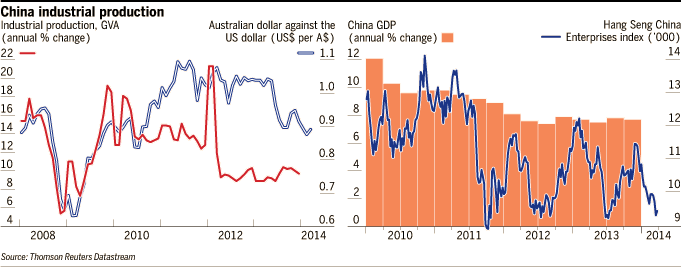
The challenges in expressing bearish views on China are the same as those facing the bulls. China’s domestic equity markets remain almost entirely closed to foreign funds, dominated by retail investors and driven by liquidity, not data.
Those who do get in, through an arduous investment licensing process, have little ability to short stocks or take negative bets through futures. The domestic bond market, while vast, is even more restricted and less transparent, with most trading done between banks.
China’s currency market poses similar problems. Though the renminbi has emerged as a possible way to play China after the authorities signalled an end to the currency’s label as a one-way bet, it is far from straightforward. The renminbi remains in the hands of the central bank, restricted by the daily trading band it sets. In spite of the recent weakness, few truly believe the currency has already peaked.
Global money can tap Chinese assets offshore in the Hong Kong market, where many of China’s largest state-owned companies have dual listings. Shorting stock is relatively simple to do, although thin liquidity is often a concern.
Using this market to short Chinese banks, property developers and construction companies – all sectors closely tied to the flow of money through the shadow banking system – has long been a popular trade for hedge funds.
That has already pushed valuations on many stocks to near record lows. Most listed lenders in Hong Kong – including China Construction Bank and ICBC – already trade at less than 5 times price to earnings.
As the sector with the biggest weighting in the most followed index, financials have dragged the market down to near two-year lows – although still some way off the troughs of the financial crisis in 2008. That helps explain why China-tracking exchange traded funds (ETFs) saw their largest weekly outflow on record this week, with $1.3bn being taken out.
Many investors looking to express bearish views on China have turned to nearby proxies – many of them imperfect and subject to local factors.
[Exporters of industrial commodities – mainly in Latin America and Africa –] look particularly vulnerable to a slowdown in investment spending
– Neil Shearing, Capital Economics
Australia is the most popular avenue – thanks to its reliance on Chinese demand for its natural resources, such as copper and iron ore. Being short on the Australian dollar has been a common ploy. But it has been a choppy trade, with local employment data and central bank minutes both still playing their part in guiding the currency.
Mining stocks listed in Sydney have also seen their fortunes ebb and flow with economic data from China. In the past month, as concerns have surfaced over the extent to which copper has been imported for use in financing deals rather than construction, miners have suffered badly. Rio Tinto has fallen 13 per cent, BHP Billiton is down 10 per cent, while Fortescue Metals has lost almost a fifth.
The link between Chinese growth and mining stretches far beyond Australia, and into developing countries across Africa, central Asia and Latin America. The impact of slower Chinese growth on other emerging markets “will be determined by what, rather than how much, they export to China”, says Neil Shearing, chief emerging markets economist at Capital Economics.
Exporters of industrial commodities – mainly in Latin America and Africa – “look particularly vulnerable to a slowdown in investment spending”, he adds.
More video
Another popular move is simply to short the commodities themselves, such as copper or zinc, through futures contracts. Some investors have also targeted luxury goods companies, which now rely heavily on China for sales of all things from watches to wine.
Those shorting China also need something to buy. Within Asia, many have rotated in and out of southeast Asia as an alternative to the mainland. While Taiwan, South Korea and Japan are all closely tied to export demand from China, southeast Asian countries – notably Indonesia and the Philippines – are driven more by domestic demand. India too has benefited from its perceived insulation from the Chinese slowdown. Stocks there have risen to a record high this week as election optimism builds.
But there are opportunities in many parts of the world, says Didier Saint-Georges, investment committee member at Carmignac.
“China has lost a lot of cost competitiveness. A way to hedge against it slowing is to buy those countries that have benefited from that – countries that have gained relative competitiveness. Mexico is a good example,” says Mr Saint-Georges.
“China has to make the transition from a labour-intensive economic model to much more of a capital-intensive model. You could profit by buying into robot technology makers, which you find in Japan, Switzerland and Germany. They are the ones who are going to help fix China.”
 About bambooinnovator
 Bamboo Innovator