German property rush chases concrete gold; Low interest rates see savers invest in houses and flats
April 5, 2014 Leave a comment
March 23, 2014 2:44 pm
Germany’s property rush is based on concrete gold
By Claire Jones in Frankfurt
For Germans these days, some things that do not glitter are gold. A property boom across the biggest cities has been dubbed a betongold – literally concrete gold – rush.
In Frankfurt’s well-heeled Westend, Michael Stegerwald has been selling kitchens for two decades. Last year was his most successful yet.
“We’ve had a very special situation here. People are buying more houses and flats,” he said. “And, when they do, they need kitchens.”
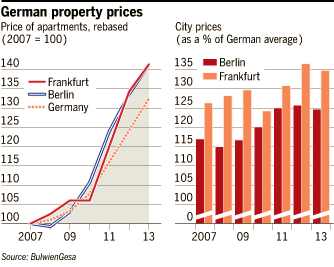
In Westend, the most expensive district of Germany’s fifth most populous city, prices rose by almost a quarter between 2011 and 2013 to €6,000 per square metre, according to data from property researchers BulwienGesa. Across Frankfurt they are up by 18 per cent to €4,000 per square metre. An average apartment of around 100 square metres would cost €400,000, up from €340,000 in 2011.
Frankfurt’s boom is symptomatic of cities across the country: in Berlin, prices are up by 14 per cent over the past two years to €3,700 per square metre.
Germany, the eurozone’s economic powerhouse, is famed for its renting culture. But a combination of low interest rates and economic uncertainty stemming from the currency bloc’s twin economic and financial crises are slowly changing that.
“This phrase ‘betongold’ is very common,” Mr Stegerwald said. “People here don’t want to own property. But they now feel they must because there’s no interest on savings. All you can do is buy real or concrete gold.”
Across town and the rest of the country, the European Central Bank has faced savage criticism from the German media for cutting its benchmark main refinancing rate to just 0.25 per cent, penalising a nation that saves 10 per cent of its income. At the same time, it is enabling lenders to offer would-be homeowners the deal of a lifetime on the 10-year fixed-rate mortgages common here.
The hiring of around 1,000 staff for its new supervisory role has added to the ECB’s unpopularity with the city’s residents, who believe these highly paid workers will put additional pressure on property prices.
“The city and region around Frankfurt will profit from the set-up of the single supervisory mechanism,” the ECB said. “Banking supervision will create new jobs in Frankfurt, even beyond the 1,000 employees working directly in supervision, and contribute to the local and regional economy.”
The low savings rates coupled with a so-far unfounded angst over inflation that are pushing some Germans into property are increasing prices more rapidly in cities than the rest of the country. In Germany as a whole, the average house price rose by 31 per cent over the past five years, compared with 42 per cent in the capital.
Cities across Germany are growing. The depopulation of the 1970s, when young families moved out to towns such as Bad Homburg, about 20km north of Frankfurt’s city centre, is reversing. Since the millennium, Frankfurt’s population has risen by 8 per cent to 678,691.
There is not much space here for bigger developments. Frankfurt’s still growing. That will keep prices high, at least in the central locations
– Sven Carstensen, BulwienGesa
Instead of leaving town, people in their 30s have bought apartments in the city centre and its fringes in previously rundown districts such as the Ostend, home to the ECB’s new headquarters due to open later this year, and Gallus. Families with children, fed up with bad traffic on the daily commute, are staying within the city limits, moving to inner suburbs like Riedberg.
“In the more central locations, you are seeing high demand from singles and high-earning couples,” said Sven Carstensen, manager of BulwienGesa’s Frankfurt office.
Frankfurt’s large expatriate community, the result of its location as a global financial and transport hub, are also flocking to the centre.
Ralf Kröh, owner of Küchenwerk, an upmarket kitchen store located in the shadows of the skyscrapers that house the city’s banks, said: “When I opened for business in 2000, about 90 per cent of my customers were German. Now about half are foreign.” Mr Kröh added: “These people prefer to live in town. Ten years ago, Frankfurt was dead in the evenings. Now it’s improving.”
Foreign investors, particularly from Asia, are also keen to own property in the centre of town, according to Mr Carstensen. The website of Skyline Boulevard, a development project in Gallus, is available in Chinese and English, as well as German.
In Berlin, money has poured in from other parts of the currency bloc. “In the centre, we have a lot of people who are buying an apartment as an investment,” said André Adami, manager of BulwienGesa’s branch in the German capital. “A lot of investors are coming from Spain and Italy. They think Berlin is more stable.”
The rapid rise in property prices across German cities has stoked fears of a bubble.
Like bullion, some think betongold is due a fall. North of Frankfurt’s Westend is the Bundesbank, Germany’s powerful central bank, which earlier this year warned that the properties in the biggest cities were now overvalued by as much as 25 per cent.
Others are more optimistic. “There is not much space here for bigger developments,” Mr Carstensen said. “Frankfurt’s still growing. That will keep prices high, at least in the central locations.”
 About bambooinnovator
 Bamboo Innovator