Perseverance pays off for Math Magc board game inventor Jimmy Yeoh; Yeoh says he has sold over 60,000 sets of Math Magic, in 12 languages, since it was introduced at RM120 locally and £25 in the UK
April 5, 2014 Leave a comment
Updated: Monday March 24, 2014 MYT 9:38:46 AM
Perseverance pays off for game inventor
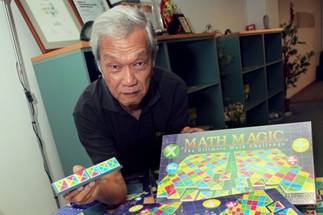
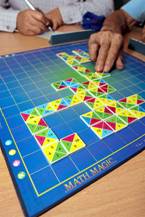
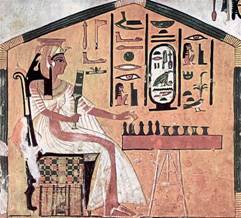
A measure of success: Magic Gamewerks Sdn Bhd founder Jimmy Yeoh and the Math Magic board game he successfully commercialised. Children who play Math Magic enhance their mathematics skill while having fun. The philosophy behind MathMagic is to match each coloured side of the tile, which is divided into four triangles with different colours and numbers. A painting on the wall of her tomb depicting Egyptian Queen Nefertari (1295- 1255 BCE) playing Senet.

BOARD games have long existed in many cultures and societies around the world.
The history of broad games can be traced back as far as 3,500 BC in Egypt.
Paintings of senet, a popular Egyptian board game, were found in several tombs. Between 1,550 and 1,077 BC, it became a talisman for the dead and it was believed the gods would protect any successful player.
Consequently, Senet boards and pieces became important burial objects among Egyptian royalty and the upper class.
Today, despite being eclipsed by video games, board games are still a business worth hundreds of millions.
Malaysia can claim a stake in the business thanks to Math Magic, a popular and critically acclaimed board game invented by Jimmy Yeoh of Magic Gamesworks Sdn Bhd.
Yeoh says the game has been a success because, besides being a board game, it is also a learning tool.
By chance
He says he discovered Math Magic by chance in 1995 and has since managed to commercialise the game.
“When my daughter was four years old, I used building blocks to teach her to add and subtract. It became a challenge when I wanted to teach her to multiply and divide with those blocks,” said Yeoh, a former teacher turned businessman.
Using logic, he managed to crack the conundrum and find an answer to his quest to use blocks for arithmetic proficiency.
But that was not the end of it. Yeoh discovered a formula to make money from his blocks when he decided to turn his findings into a proper board game.
The mechanics behind Math Magic is to match the coloured sides of a tile, which is divided into four triangles with different colours and numbers.
The colours denote which mathematical operations to apply, with yellow for addition, blue for subtraction, red for division and green for multiplication.
In the second version of the game, Yeoh introduced cube, square, and cube root and square root functions for higher secondary school students.
Each triangle contains a number and the player match the colours and perform the appropriate mathematical calculation until all the squares are used up.
“Like Scrabble, each player starts with six tiles and the person subsequently picks the tile with the largest number starts the game.” he said enthusiastically.
While Scrabble improves one’s vocabulary, Math Magic uses colours and numbers to improve the players mental mathematics.
The players have to compute the mathematical operations in their head and jot it down on a scorecard. The winner is the player with the highest tally.
Break through
But promoting Math Magic was no easy task for Yeoh.
With the market already dominated and driven by western board games made by big companies, there was little room for him to break into the scene.
Believing firmly that his game had a place at the table because it was unlike other board games and had education value, he wasted no time to roll out Math Magic.
With RM25,000 he introduced Math Magic to the world.
His first attempt met with little success. The presentation of the game was not quite right and he faced challenges in promoting the new invention.
In 1996, he decided to go back to the drawing board and rework Math Magic in terms of its presentation, quality and appearance.
Yeoh came up with plastic tiles, a better playing board and new packaging.
Repeat orders
He then promoted the game at the Singapore Book Fair in 1997 and managed to sell 200 sets.
With the money from the sales, Yeoh decided to venture to Europe in the same year and use the Frankfurt Book Fair as a launching pad into bigger markets.
“I did not sell anything there, but managed to meet people who were keen on the product,” he said.
Yeoh returned to Frankfurt in 1998 and received his first order of 500 sets from a South African company.
“It was an exciting moment for me. I clearly remember stopping at a German restaurant to have a nice steak to celebrate the success on my way back to the hotel.”
The following year, the same client ordered another 2,000 sets.
Orders from France, Germany and Sweden then started to trickle in.
Through an education fair in the United Kingdom, Yeoh said he managed to engage distributors to sell his product.
To date, more than 30,000 boxes of MathMagic have been sold in the UK, he says.
“We have a college lecturer who sold Math Magic on a part time basis and eventually resigned from his job to be a full time distributor in the UK. He is now my top distributor,” Yeoh said.
To promote Math Magic, Yeoh also organises workshops and holds competitions among local school children.
He also sells the board game to parents and works closely with the schools authorities to push his game.
Yeoh says he has sold over 60,000 sets of Math Magic, in 12 languages, since it was introduced.
The game, available for RM120 locally and £25 in the UK, is ideally suited to pupils in Standard Three to Form Three.
“Math Magic is not just a board game, but also a teaching aid for those who have just started to learn mathematics.”
Despite the game having been in the market for nearly two decades, Yeoh never stops promoting it.
He continues to harbour a wish to see his board game become as famous as Scrabble or Monopoly one day.
 About bambooinnovator
 Bamboo Innovator