TB reappears in developed world; Resurgence of an illness that respects no borders
April 7, 2014 Leave a comment
March 24, 2014 12:01 am
TB reappears in developed world
By Rose Jacobs
Cruising the streets of London, a white van emblazoned with the National Health Service’s logo is seeking out a specific subsection of the capital’s population: the people most vulnerable to tuberculosis.
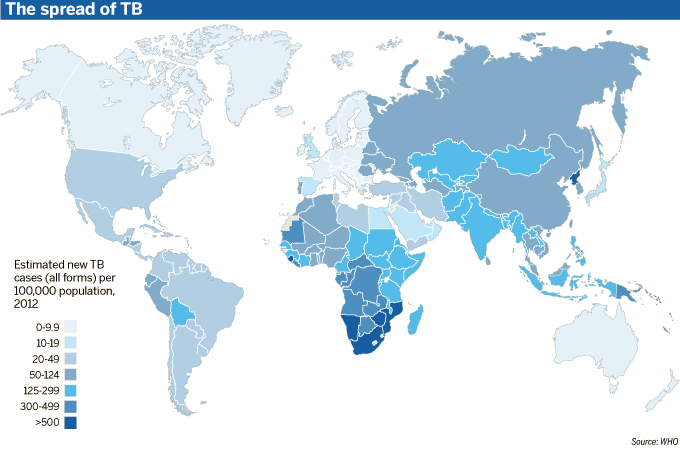
The infection is often thought to have been purged from the developed world. But London is western Europe’s TB capital. Some boroughs have incidence rates comparable with those of Nigeria, Mali, Brazil, and Iraq.
The disease does not respect national borders. It destroys people’s lives and racks up huge medical costs. And so the white van project, set up in 2005 by a medical professional called Al Story and staffed by a small team of nurses, social workers and former TB patients, has its work cut out: find people who might be suffering an active infection (a third of the world population is infected but it lies dormant in 90 per cent of that group); persuade them to start a course of medication; and make sure they see it through the minimum six-month period.
Two independent evaluations have found the Find & Treat service to be not only highly cost-effective, but potentially cost-saving – and no wonder, given that treating TB can run from £5,000 for “straightforward” cases to £250,000 in the case of multi-drug-resistant strains.
Vehicles like Mr Story’s van were used in the UK after the second world war, but were phased out in the late 1970s and early 1980s as TB prevalence fell. Today’s model, however, operates in a more targeted way than its predecessors, which aimed for broad screening of the population and whose usefulness was dwindling by the time they were scrapped. When Mr Story was testing the idea in 2002, he borrowed a Dutch unit and focused on high-risk communities: “We found three active cases in a day and a half of screening. We decided we should reintroduce this.”
The van has cutting-edge diagnostic technology that is particularly useful for testing people with HIV – a common pairing with TB. Other risk factors include homelessness, addiction and immigration. And yet 80 per cent of cases in the UK are either people born in the country or who have lived in Britain for more than two years.
“Most of the TB among the immigrant community is latent activation,” says Aaron Oxley, executive director of Results UK, an anti-poverty group. Poor diet, exhaustion or crowded housing weaken the immune system, allowing TB to break free from the body’s walling-off mechanisms. It is no coincidence that immigrants often face these conditions. People from the former Soviet Union present a particular problem, says Fanny Voitzwinkler at Global Health Advocates in Brussels. They are much more likely than anyone else in the world to become infected with multi-drug-resistant strains of the disease. Eastern European approaches to treatment, such as insisting on in-hospital rather than ambulatory care, have meant patients often avoid seeking help, thereby infecting others with the more dangerous MDR strains.
“It’s the MDR bug that’s spreading,” Ms Voitzwinkler says, adding that some European countries, such as Romania, have lower MDR treatment success rates than, say, the Democratic Republic of Congo. She fears the situation could worsen as the Global Fund to Fight Aids, Tuberculosis and Malaria changes its funding model to focus more on the world’s lowest-income countries.
In Germany, the law can force hospital treatment on patients. Timo Ulrichs, a doctor leading the TB section of the Koch-Metschnikow-Forum, a health partnership with Russia, sees this as one of many tools for fighting the disease in the developed world.
Others include technology, such as public health information that can be translated into multiple languages using a smartphone, and reintegration of TB into the medical education system, where it has been neglected.
This measure might have helped Amy McConville. The 27-year-old policy assistant at a UK charity visited her GP in Ealing, London, in 2005 when she was an aspiring law student with a persistent cough. Nine months of visits failed to identify the problem, despite the borough having high rates of TB. She says: “I don’t fit the profile of the illness, and I hadn’t travelled anywhere with high rates of TB.”
By the time she started the daunting treatment, she had lost three stone, her hair was falling out and her left lung had collapsed.
Struck by both the harrowing side effects of the drugs – including joint pain, nausea and, in extreme cases, blindness – and the loneliness of being a TB patient in a “low-burden” country, Ms McConville helped found the TB Action Group, the UK’s only support and advocacy group for TB. Its work includes running telephone help lines, political advocacy and awareness-raising. “When you look at the people in our network, many of whom are not representative of the disease, you can see what happens when people don’t think about TB.”
 About bambooinnovator
 Bamboo Innovator