Citi’s Stress-Test Mess
April 9, 2014 Leave a comment
Citi’s Stress-Test Mess
JOHN CARNEY And DAVID REILLY
March 26, 2014 6:02 p.m. ET
Citigroup C -0.28% is doing a good impression of the Keystone Kops.
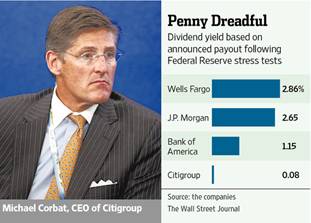
The bank on Wednesday achieved the dubious honor of becoming only the second bank, aside from Ally Financial, to have its capital plan twice rejected by the Federal Reserve as part of annual stress tests. It is a bitter pill for Citi shareholders who were eagerly awaiting an increase in the penny-a-share quarterly dividend and the prospect of a heftier share buyback. Now they will have to wait even longer.
The Fed’s rejection of what Citi hoped would be an increase in the quarterly dividend to five cents a share and a buyback of up to $6.4 billion is in some ways even more damaging than its 2012 rebuke. Back then, the Fed objected because Citi’s return request would have pushed the bank’s stressed capital levels below minimum test requirements.
This time, capital strength wasn’t the issue. Rather, the Fed cited deficiencies in Citi’s capital-planning processes. Making matters worse, the Fed said it had previously warned Citi about such problems but the bank failed to adequately address them. This is all the more troubling in light of last month’s disclosure that Citi’s Mexican subsidiary lost hundreds of millions of dollars to fraud, raising concerns about internal controls.
The rejection is likely to dent investor confidence in Citi’s management, in particular chiefMichael Corbat. And, if nothing else, it could make for a stormy Citi annual meeting next month, especially as it relates to executive compensation.
In 2012, barely a month after Citi’s first capital-plan debacle, shareholders voted against the compensation package of then-chief Vikram Pandit. That rebuff—the first time shareholders issued a nonbinding rejection of a pay plan at a major bank—was followed some months later by Mr. Pandit’s ouster.
That history may not bode well for Mr. Corbat. In the bank’s proxy statement detailing his 2013 total compensation of $14.5 million, the bank called out Mr. Corbat’s work on improving “risk outcomes and controls.” Tellingly, the bank also noted his efforts to make progress with regulators, citing the Fed’s approval last year of its capital plan. That didn’t call for any increase in the dividend, although it did include a share buyback of up to $1.2 billion.
That now looks like a case of one step forward, two steps back. And the shadow cast by this year’s stress test may stretch beyond the executive suite and into Citi’s boardroom. After all, Chairman Michael O’Neill is widely seen as having engineered Mr. Pandit’s ouster in part due to the capital-plan mishap.
If there is any solace for Citi shareholders, it is that the bank’s capital isn’t going anywhere. It will continue to pile up on the balance sheet. Citi already has a stronger capital position than big-bank peers. Barring catastrophe, Citi should eventually be able to return more capital to investors.
But “eventually” won’t pay shareholders’ bills.
 About bambooinnovator
 Bamboo Innovator