Broken contacts: Finance, not economics, may explain copper’s recent plunge
April 10, 2014 Leave a comment
Broken contacts: Finance, not economics, may explain copper’s recent plunge
Mar 29th 2014 | From the print edition
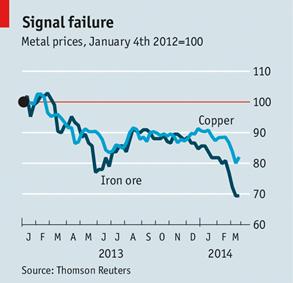
THE copper price has long been held to signal the state of the global economy as reliably as the metal conducts electrons. But that reputation—never fully deserved—is now in tatters. Copper’s plunging price (see chart) says a lot about China, but little about the rest of the world.
China consumes about 40% of global copper production. But not all of that goes straight into manufacturing or construction. Chinese companies have also been using copper as collateral for their hard-currency loans: “buy, store, hedge and pledge” in the words of one trader. That has led to an overhang, with far more of the metal stockpiled than users need. Any change in the conditions that created this stockpile can have a big effect on the price.
A sign of this is that when the Chinese economy slows, as seems to be happening now, with manufacturing activity weakening for a fifth consecutive month, those stockpiles rise. CRU, a metals researcher, now says the copper-market surplus this year will be four times bigger than it previously estimated, with forecast production outpacing demand by 140,000 tonnes.
Chinese data are notoriously opaque, so judging the real health of the country’s copper-consuming industries is hard. A rebound in growth later this year could revive demand for the metal. But other factors are piling pressure on to the copper price. One is a growing wariness among creditors, following a corporate-bond failure this month (the first since the 1990s). As banks worry about their customers’ abilities to service debts, Chinese firms are finding it harder to get loans. This is making some sell their copper to raise cash.
Another factor is that Chinese regulators are cracking down on companies using copper stockpiles for speculation. Joel Crane of Morgan Stanley, an investment bank, argues that the authorities are targeting the “shadow-banking network” used by companies to evade controls on hard-currency lending. Chinese importers have long used letters of credit issued by banks for raw-material imports as a way of raising funds which they then use for other purposes. Such shadow banking created lucrative arbitrage possibilities for those able to take advantage of the difference between local and international interest rates. This is a useful dodge when times are good, not so when scrutiny increases. A reform in mid-2013 made companies holding copper for collateral keep it onshore, rather than in bonded warehouses, raising the cost of storage.
A similar story seems to be unfolding with iron ore. China accounts for half of world steel production, so the iron-ore price is hypersensitive to any downward flicker in demand. Iron-ore stocks at Chinese ports are at record highs. China is also trying to substitute its own, lower-quality ore for the higher-grade imported stuff. It wants to cut overcapacity and pollution, including using the financial markets to put pressure on the steel industry through higher interest rates and tighter credit. Companies who used iron ore as collateral for their borrowing may now have to use it for debt repayments instead.
Copper bears fear that this could easily get out of hand. But the likelihood is more a slow unwinding of positions than a crash. Goldman Sachs, another bank, notes that it is not in the Chinese authorities’ interest to shut down commodity-financing deals altogether. It makes more sense just to increase the hedging and storage costs of those firms using commodities to speculate. Stephen Briggs of BNP Paribas, also a bank, notes that the “few hundred thousand tonnes” involved in these deals is only a small part of a 20m tonne market.
The truth may be that jitters in China have just accelerated a change in perceptions about copper: from chronic deficit to surplus. This stems from the impending extra metal coming this year and next from new mines in places such as Mongolia, Peru and Mexico. Speculators may come and go, but at least copper, unlike gold, has a comfortably wide range of uses.
 About bambooinnovator
 Bamboo Innovator