Most of Toyota’s Indian employees refused to return to work, the latest example of workers demanding more from global auto makers as they push into emerging markets
April 10, 2014 Leave a comment
Toyota Workers in India Refuse to Return to Work
Dispute Reflects Broad Hurdles for Global Auto Makers in Emerging Markets
SANTANU CHOUDHURY And DHANYA ANN THOPPIL
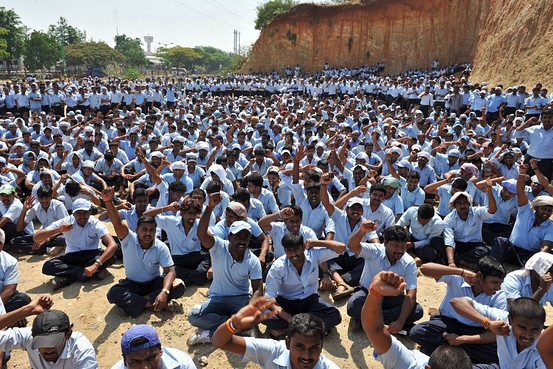
Toyota Kirloskar workers protested last week during a lockout at the company’s auto plants in Bangalore. The lockout was lifted this week, but union members refused to return. Agence France-Presse/Getty Images
BANGALORE, India—Most of Toyota Motor Corp.’s 7203.TO +0.37% Indian employees refused to return to work this week, the latest example of workers demanding more from global auto makers as they push into emerging markets.
The union at Toyota’s twin factories outside this southern city said its 4,200 members remain on strike as they await a better deal on wages, holidays and housing. The union also is demanding that the Japanese auto maker reinstate employees who were suspended last week.
Toyota locked out workers on March 16, saying they were disrupting production and threatening managers. The company suspended 30 workers who it said were the most disruptive. Toyota lifted the lockout this week but said each employee had to sign a guarantee of good conduct.
Most union workers at the Indian unit, Toyota Kirloskar Motor Pvt., haven’t signed the document. That has forced the auto maker to operate here without union laborers, who make up around 65% of its India workforce.
“I expect both parties to sit together and discuss the issues before it escalates further,” said Anil Sharma, a senior research analyst at IHS Automotive. “But if it drags on beyond a month, then Toyota stands to lose big time.”
The dispute between Toyota and its workers in India has been simmering for months and offers a glimpse into the shaky relationship between industrial workers and management in India.
Most of the disputes have been resolved through negotiations, though some have festered and turned violent. Korea’s Hyundai Motor Co. 005380.SE +0.41% , Japan’s Honda MotorCo. 7267.TO +0.20% and India’s Mahindra & Mahindra Ltd. 500520.BY +0.62% have been affected by labor strife here. Two years ago, workers at a Maruti Suzuki India Ltd.532500.BY -0.08% factory set fire to one of its two plants, killing a manager.
Auto makers are pushing back against demands for higher salaries to keep a leash on costs in an increasingly competitive but sluggish Indian market.
“Workers are demanding more wages because the cost of living has gone up,” said Abdul Majeed, a partner at Price Waterhouse, the Indian arm of PricewaterhouseCoopers. “But management also needs to keep a tight control on costs as the auto market in India is facing one of its toughest years.”
Toyota’s Bangalore factories produced 570 vehicles a day before the labor strife. The company, the world’s biggest auto maker by volume, declined to say how many vehicles it is producing without the workers.
Toyota Kirloskar—of which Toyota owns 89% stake and India’s Kirloskar Group owns the rest—manufactures Etios, Corolla, Camry and other models at the two plants. The facilities have a combined workforce of about 6,400.
India accounts for 1.6% of Toyota’s global sales. But global auto makers have forecast that the country will become the world’s third-largest market in the next five to seven years, behind China and the U.S.
Toyota, the fifth largest auto maker in India, already was in a slump here. Its sales fell 17% to 120,605 vehicles for the past 11 months. Industrywide, India sales declined 5.9% to 2.26 million passenger vehicles over the same period.
The company’s workers are demanding more holidays, company housing and raises of up to 4,000 rupees, or about $65, a month. The company has offered raises of up to 3,050 rupees.
“Whenever it makes a good profit in a year, it shifts all the profit to the headquarters, that is Japan,” said Satish Rangaswamy, the union’s general secretary. “Why can’t they share it with our employees?”
He said the union is willing to sign the so-called code on good conduct on behalf of members but that the demand for individuals to sign the code was unacceptable.
While some union workers have signed the document and returned to work, Toyota is building cars with nonunion employees, mostly supervisors and engineers, said Toyota Kirloskar Vice Chairman Shekar Viswanathan.
The company has offered workers a fair wage increase, up from a previous offer of 2,650 rupees a month, while managers’ wages have been frozen, he said.
“If we increase the salary too much, then it will affect the rest of our ecosystem of suppliers and in the end, we may have to pay more for our parts, which will increase our costs,” making Toyota less competitive, he said.
 About bambooinnovator
 Bamboo Innovator