Q&A: Aamir Khan; What did you learn from the first season of “Satyamev Jayate” (“The Truth Prevails”), a one-hour talk show that dug into India’s problems: ?
April 10, 2014 Leave a comment
Q&A: Aamir Khan
Talk-show talent
Mar 27th 2014, 10:18 by E.C. | MUMBAI
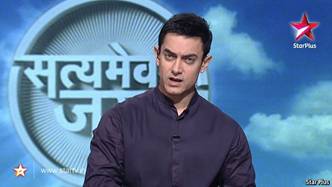
AAMIR KHAN is one of India’s most sought-after actors and has become known in recent years for taking on roles dealing with social and political issues. In the Oscar-nominated “Lagaan”, for example, he played a poor farmer stuck in drought-ridden Gujarat, fighting off taxes from the British. In “Rang de Basanti”, he was a jaded 20-something who discovers his civic duty after playing an Indian freedom fighter for a British documentarian. And in “Taare Zameen Par”, also Oscar-nominated, he was a thoughtful art teacher captivated by a dyslexic student.
At first glance, his recent foray into television seemed to be an extension of his films. Two years ago he launched “Satyamev Jayate” (“The Truth Prevails”), a one-hour talk show that dug into India’s problems: sexual abuse, female feticide, domestic violence, medical malpractice, shortage of water and more. It was the first Indian television show to appear on both STAR, a private channel, and Doordarshan, the national broadcaster. Some wondered about the public appetite for a socially conscious, Sunday-morning talk show. But nearly 9m people tuned in to see the first programme.
This month Mr Khan returned with a second season of “Satyamev Jayate”. We spoke to him before the first episode.
What did you learn from the first season of “Satyamev Jayate”?
My biggest learning from season one was that the root cause of a number of the problems that we face today is our patriarchal thinking. The second learning was that wherever we found people working as a community, where the individual was thinking for the larger group and not exclusively for his or her own good, there we found communities happier, more prosperous, more progressive and more sensitive.
Several members of government approached you after the first season. Can you give examples of concrete actions that came out of the television show?
After our episode on female feticide, the government of Rajasthan set up fast-track courts to hear cases against doctors who had been caught on camera indulging in illegal sex-selection abortion. In a country where court cases can stretch to over 20 years, this move resulted in 31 doctors being convicted within a period of 18 months.
Then the government of Maharashtra conducted raids on illegal clinics and doctors indulging in illegal sex-selection or sex-selective abortion. 38 doctors were arrested and 317 cases were filed against unregistered sonography clinics.
After our episode on child sexual abuse, Parliament passed a bill on child protection that had been pending for close to two years.
And, after our episode on untouchability, I met the prime minister regarding the issue of manual scavenging [removing waste from dry toilets that do not have a flush system] and he promised action. Approximately a year later, the government amended the present law and made it much stronger. According to this law, the definition of “manual scavenger” has been widened to include a person engaged or employed for manual cleaning of human excreta in an insanitary latrine, an open drain or pit, on railway tracks, etc. Rehabilitation has been included in the act, and scholarship for children of manual scavengers, and training in another profession along with a stipend.
What is your goal for the second season?
It is the same as for season one, which is to sensitise people, empower them with information and knowledge, and share with them rich emotional experiences and the learnings of people who have been working in a particular field for decades.
At the end of season one, you shared a story about the “Mountain Man”, who dug a road for 22 years in remembrance of his wife. She died because she couldn’t get to a clinic in time, given the bad state of roads in the area. He didn’t want anyone else to endure that loss. So, to remember him, you will be launching season two at that road in Bihar, correct? What does his story mean to you?
Dashrat Manjhi and his story was the last story that we highlighted in our last episode of season one. We wanted to make our announcement of season two from where we left off. Also, the story of Dashrat Manjhi is an extremely inspirational one. It’s the story of one man achieving the seemingly impossible through perseverance. I, too, am inspired by him and hope to move ahead with “Satyamev Jayate” with the same perseverance.
Does all this travel, learning and reporting compel you to start your own foundation or social programme?
I believe that my strength lies in communication, so rather than concentrate on any one issue, I prefer to research numerous issues and share with people what comes before me. I am doing “Satyamev Jayate” as part of my responsibility as a creative person.
In one of the promos, you point to the power of the mobile phone. How will “Satyamev Jayate” incorporate them?
We have started a campaign termed “Vote for Change”. The device used for this is “missed call” on a toll-free number. At different times during the episode, when a certain solution emerges, or when I want the opinion of people to be recorded, I invite people to give a missed call on a toll-free number. This enables us to understand what the viewers’ opinions are, and it gives viewers an opportunity to engage better with the show.
After one episode which looked at the state of the police in India, we received more than 40 lakh (4m) missed calls in less than 72 hours.
 About bambooinnovator
 Bamboo Innovator