China’s ‘Bad Bank’ Conundrum
April 11, 2014 Leave a comment
China’s ‘Bad Bank’ Conundrum
AARON BACK
Updated March 28, 2014 11:30 a.m. ET
China’s “bad bank” experiment is entering uncharted territory.
China Cinda Asset Management, 1359.HK +6.02% created as a bailout vehicle for China’s bad debts, is scooping up distressed loans at blistering pace. Assets rose by 51% last year to 384 billion yuan ($62 billion), much faster than earlier management guidance of 20% to 30%, according to a Morgan Stanley MS +1.00% note. It’s also levering up, with the ratio of assets to equity rising to 4.6 from 4.2 in 2012, according to the company’s first quarterly report as a public company.
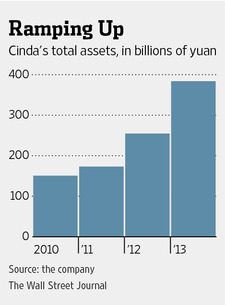
With debt distress among Chinese companies popping up daily, it makes sense for Cinda, listed in Hong Kong and majority-owned by the Ministry of Finance, to expand during the down cycle.
The question for investors is how much money Cinda can make on these purchases, and when. The restructuring process typically takes one to two years, the company says. But the company as currently composed has never been through a credit down cycle. It’s hard to accomplish quick asset turnaround if the market value of collateral on bad loans is falling. With growth slowing and credit relatively tight, corporate defaults are spreading in property and coal, areas where Cinda has large holdings.
Much will depend on what Cinda pays for the distressed debt. A loan bought for 30% to 40% of face value, as seems the company’s historical precedent, should provide enough cushion. But investors know little about the assets. Debt backed by a closed coal mine or property in a ghost city might be worth even less. Cinda, like much of China’s financial system, is still in many ways a black box.
In the meantime, Cinda’s financial performance is weakening. Return on assets fell to 2.9% in 2013 from 3.4%, the third straight year of decline. And despite the rise in leverage, return on shareholder equity fell, to 13.8% from 15.8%.
How to classify Cinda, with arms in restructuring, asset management and brokerage, remains an open question. Cinda trades around 1.4 times estimated 2014 book value, slightly below the average for Chinese securities firms. But given its tight relationship with the banking system, there’s an argument it should trade closer to where investors rate the commercial banks, which is even with book value.
In a slowing economy, the asset recovery process that Cinda is supposedly so good at could prove more difficult than hoped. Investors should prepare for the “bad bank” to lose its premium value.
 About bambooinnovator
 Bamboo Innovator