China’s sprawling state-owned conglomerate Citic Group is accomplishing a massive public listing with limited investor scrutiny
April 11, 2014 Leave a comment
China’s Citic Misses the Transfer
ABHEEK BHATTACHARYA
March 27, 2014 10:44 a.m. ET
China’s largest state-owned conglomerate is going public in Hong Kong, but in an opaque way. Heard on the Street columnists Alex Frangos, Abheek Bhattacharya and Aaron Back discuss whether this is genuine reform.
Making a sprawling Chinese government conglomerate go public should instill market discipline. Doing it through a process that limits public due diligence undermines the exercise.
That’s the case with the massive asset transfer between Beijing-based Citic Group and one of its listed subsidiaries in Hong Kong, Citic Pacific. 0267.HK -4.76% The listed company will pay cash and shares for the assets of its unlisted state parent. A price hasn’t been settled, but government rules require that it be at least the assets’ book value, an impressive $36 billion of banking, brokerage, property and energy operations. That would make this the biggest-ever public market asset transfer in Chinese history, according to Dealogic.
The move is likely an early example of the Communist Party’s push for state-owned enterprises to become more market-oriented. In theory, instead of hiding assets out of view, a move like Citic’s forces sheltered business units to be subject to investor scrutiny. It also removes the risk that the nonlisted parent can siphon profits by forcing the listed company to acquire the parent’s assets at artificially high prices. Citic has its fingers in finance, publishing, tourism and engineering, emblematic of how unfocused China’s state-owned firms can get.
In practice, the move is but a small opening of the scrutiny window. By backing into its subsidiary, Citic Group avoids the sunshine of a full initial public offering. The subsidiary, Citic Pacific, listed in the early 1990s through a similar maneuver. Even after a possible share offering, private shareholders are almost certain to remain a minority to Beijing.
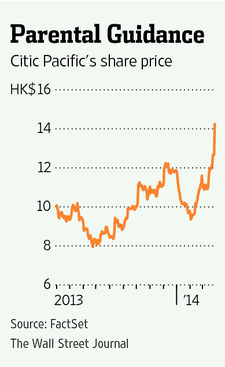
Citic Pacific’s shares climbed 13% Thursday, adding to a 14% increase in the two weeks before the deal was announced. Some of Thursday’s rally is justified because the listed firm is paying for the parent’s assets with shares valued at a 6.5% premium, besides the cash.
Beyond that, investors face a bevy of question marks—especially the final sales price. Many of Citic Group’s assets are in stressed sectors and may not be worth the book value Citic Pacific will pay. Separately listed China Citic Bank 601998.SH -1.50% and Citic Resources Holdings 1205.HK +0.99% fetch 0.7 times book, and China’s property sector on average is about 0.9 times, says UBS. UBSN.VX +0.39% It could be a repeat of state-owned China Mobile’s injection of $32.8 billion worth of assets into its listed Hong Kong company in 2000, at a massive premium to those assets’ future earnings, according to Carl Walter and Fraser Howie, co-authors of the book “Red Capitalism.”
Getting Citic’s full set of attributes into public view is a step forward. But that doesn’t mean investors should like what they see.
 About bambooinnovator
 Bamboo Innovator