Seoul’s Missing Ingredient: Chefs; Many of South Korea’s family-owned, down-to-earth restaurants specialize in a single dish that are based on recipes laid down by family matriarchs, but don’t have chefs who create their own sauce base
April 11, 2014 Leave a comment
Mar 25, 2014
Seoul’s Missing Ingredient: Chefs
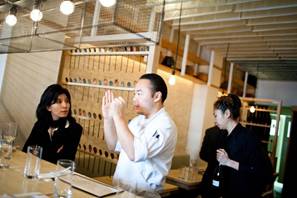
Head Chef Hooni Kim with patrons at his inside New York restaurant, Danji
Ramsay de Give for The Wall Street Journal
Korean cuisine arouses so much national pride that some South Koreans reach into their own pockets to advertise a single dish on major U.S. newspapers. So why are South Korean restaurants often ignored by food critics?
Hooni Kim, owner and chef of New York’s Danji restaurant–one of the few Michelin-starred Korean restaurants–says Seoul’s food scene lacks a key ingredient: chef-owned Korean restaurants.
Many of South Korea’s family-owned, down-to-earth restaurants specialize in a single dish that are based on recipes laid down by family matriarchs, but don’t have chefs who create their own sauce base, according to Mr. Kim.
“If it’s chef-owned, it adds character” to even the mundane staples, Mr. Kim said in a recent interview.
From next month, he will feature as a judge on the third season of Master Chef Korea, the local iteration of the competitive, American cooking show.
Mr. Kim, who has worked at some of New York’s most reputed restaurants such as Daniel and Masa, says he learned there to use the best ingredients for his creations.
Mr. Kim said fresh ingredients in Korean cuisine have often taken a backseat to jang, the sauce that is found in almost every dish from meat to rice and soup. It represents the spicy kick that most foreigners associate the cuisine with.
He also wants more attention to be paid to local ingredients such as thin, local chives that he says are only found in South Korea and raves about Korean meat, including pork, that he says is outstanding in its depth of flavor.
And when the flavor of the ingredients comes forth, additives are unnecessary.
“For us, jomiryo (food additives) is (equivalent to) Armstrong and the PEDs (performance-enhancing drugs),” Mr. Kim said, referring to disgraced cyclist Lance Armstrong who admitted to having resorted to doping to win many of his celebrated titles.
Mr. Kim provided a list of his favorite food joints in Seoul. The list below provides both the old and new addresses, following a recent reclassification of streets.
Bongsanjib:
Address (old): 1-21 Yongsan-dong 3-ga, Yongsan-gu
Address (new): 24 Hangang-daero 62na-gil, Yongsan-gu
Specialty: Chadol, a fatty part of beef brisket that resembles bacon when grilled.
Hadongkwan:
Address (old): 10-4 Myeong-dong 1-ga, Jung-gu
Address (new): 12 Myeong-dong 9-gil, Jung-gu
Specialty: Gomtang, a soup made with single-sourced beef, with bone marrow stock boiled for at least seven to eight hours
Heuirae:
Address (old): 368 Yangjae-dong, Seocho-gu
Address (new): 37 Dongsan-ro 6-gil, Seocho-gu
Specialty: Dakgalbi, chicken ribs marinated in hot pepper paste and cooked over charcoal
Ojangdong Hamheung Naengmyeon:
Address (old): 90-10 Ojang-dong, Jung-gu
Address (new): 108 Mareunnae-ro, Jung-gu
Specialty: Hamheung-style naengmyeon, buckwheat noodles topped with raw sole
 About bambooinnovator
 Bamboo Innovator