Taiwan will lose if trade pact not approved: central bank head
April 11, 2014 Leave a comment
Taiwan will lose if trade pact not approved: central bank head
CNA
2014-03-29
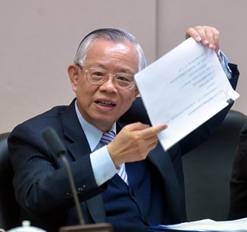
Perng Fai-nan speaks at the association council meeting. Mar. 27. (Photo/Yen Chien-lung)
The head of Taiwan’s central bank has said the island must reach out to other countries and approve a trade pact with mainland China, otherwise its industries and workers would suffer.
Commenting on the dispute over the controversial trade agreement for the first time, Perng Fai-nan, governor of the Central Bank of the Republic of China (Taiwan), said Thursday that Taiwan risks being marginalized if it shuts others out.
He warned that if the pact opening up China and Taiwan’s service sectors to each other fails to clear the Legislature, the ongoing talks with Beijing on lifting trade barriers for Taiwan’s merchandise could be hampered.
He explained that both Taiwan’s flat panels and South Korea’s flat panels are exported to China and subject to 5% import tariffs, but the tariffs imposed on South Korean products will be cut to zero once South Korea signs an FTA with China, as it is negotiating to do.
Without a merchandise trade pact with China, Taiwan’s flat panels will be subject to 5% import tariffs, directly impacting the 100,000 people employed in the sector.
Perng made the remarks after a meeting of the bank’s directors and supervisors as student-led protesters continued to occupy the nation’s parliament for the 10th day.
The signing of free trade agreements involves give and take, Perng said, adding that as long as the benefits are greater than the disadvantages, it is worth signing.
Perng also pointed out that Taiwan falls behind its main export rival South Korea in the number of free trade agreements it has been able to reach with other countries.
He said Taiwan’s openness is greater than South Korea’s, but the number of FTAs Taiwan has been able to sign with other countries is lower than South Korea’s by two.
More importantly, South Korea has signed FTAs with two large trade partners — the European Union and the Association of Southeast Asian Nations. That has helped boost its trade with those trade partners to 36.1% of its total trade, compared with only 9.3% in Taiwan.
Taiwan has to deal with this situation squarely, Perng said.
 About bambooinnovator
 Bamboo Innovator