Pizza Hut goes premium in Korea; Korea’s largest pizza franchise to differentiate itself; Special prizes motivate Pizza Hut employees
April 14, 2014 Leave a comment
Posted : 2014-03-30 14:15
Pizza Hut goes premium

Korea’s largest pizza franchise to differentiate itself
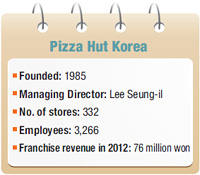
Lee Seung-il, managing director of Pizza Hut Korea
By Chung Hyun-chae
The buzz phrase in the food service industry these days is to “go premium” as restaurants realized it is difficult to stay in business by offering only conventional products and services.
For instance, the premium strategy has been sweeping the country’s rapidly growing coffee franchise industry, helping the industry expand 27 percent in 2013 despite the sluggish overall consumption in the country.
Starbucks Korea recently opened its first premium store, “Starbucks Reserve,” in southern Seoul to cater to coffee drinkers seeking higher quality products and services. Other coffee franchises are about to follow in the footsteps of the Seattle-headquartered multinational franchise in order to generate larger revenues.
The same holds true for the pizza industry. In order to serve the increasingly trendy and fast-moving Korean consumers, Pizza Hut Korea decided to introduce a premium dining restaurant, “Pizza Hut Kitchen,” in downtown Seoul in January.
Should Pizza Hut’s first premium store succeed in Korea, the company will introduce the concept to other markets.
Pizza Hut Kitchen is a fast-casual dining restaurant, a concept that integrates casual dining with fast food. It offers premium quality menu items not found at existing Pizza Hut stores. Customers order at the counter like in fast food chains, including McDonalds and Lotteria, and are able to see the whole cooking process through the open kitchen.
“We reduced labor costs by simplifying the ordering system in order to provide premium menu items at a reasonable price,” Lee Seung-il, managing director of Pizza Hut Korea, said in a recent interview with The Korea Times’ Business Focus at Pizza Hut Kitchen.
In March, the number of customers at the restaurant jumped 144 percent from January when the store opened, but it doesn’t mean the restaurant is already profitable.
“It’s quite difficult for food service companies here in Korea to have a high profit margin. In Korea, the costs of food ingredients and rent are high. Besides, labor costs are increasing rapidly these days. These three things should not constitute over 70 percent of the total cost, but they far exceed the threshold in Korea,” Lee said. “Nonetheless, considering that the food service industry is changing very quickly, we felt the need for a new concept in order to survive in the pizza chain industry. This is why we launched Pizza Hut kitchen.”
Food service industry trend in 2014
Since Lee took office in 2008, he has been pushing for a qualitative growth approach focusing on gentrifying the stores rather than expanding the number of stores. He has been trying to change the way Koreans in their teens and 20s enjoy dining.
“Young people crave new places and ambience. Even if a certain restaurant is really good, they prefer to try new places. This is how young Korean people behave when it comes to food,” the managing director said. He added that the food service industry trend this year will be restaurants that have a “fancy atmosphere.”
“Actually, this move started a few years ago, probably initiated by social media, I think. When you go to popular places in Itaewon, they have huge windows that show people inside the restaurant, sipping wine or enjoying a gourmet meal, to passersby,” Lee added.
Pizza Hut Kitchen also has a big window and an open ceiling, which Lee said are gaining popularity among female customers in their 20s.
Difficult-to-satisfy Korean customers
The managing director, who is known in the industry as “Mr. Turnaround,” said he was never afraid of facing challenges. Lee earned his nickname due to his dramatic success with “chal dough” following his failed attempt at “Pasta Hut.” Chal dough is a type of dough with air cells which makes the dough soft and chewy. Chal is Korean word used to describe elastic or glutinous food.
He added that Korean consumers are hard to please, particularly female customers in their 20s and early 30s.
“The point is that the success of the food service industry depends on young female customers in Korea. We are not concerned about male customers at all. We don’t even conduct research on them as they don’t visit fine dining restaurants,” Lee said. “When you look at any table around you at the restaurant, however, you’ll see that there is always at least one woman, who probably invited the others to the restaurant. This is an unusual landscape that is seen only in Korea and not in China, Hong Kong, Taiwan or Japan.”
A few years ago, Pizza Hut launched a well-being salad bar, S-line Salad, to target young female customers. The salad bar was well received in the consumer testing but did not fare well when it was launched. Lee learned a simple fact from this failure.
“Customers want tasty food. The most popular menu items in the Pizza Hut salad bar, including the potato salad and pumpkin salad tossed in mayonnaise, are also high in calories. People coming to Pizza Hut expect a great taste even if the food is greasy and unhealthy,” Lee said.
The consumers’ enthusiasm for delicious food prompted Lee to create “chal dough.”
“I wondered why pizza chains couldn’t make a delicious pizza with a thin crust, like the traditional European pizza. For more than 25 years, many pizza chains tried, but no one succeeded. The key to the chal dough was to make air cells in the dough. We finally created chal dough with air cells that prevent the pizza dough from turning hard as it gets cold. Thanks to this innovation, pizza lovers can now enjoy delicious thin pizza at home even after it freezes. Pizza Hut now uses chal dough globally,” Lee said.
Market position and target customers
Despite the introduction of the thin dough, most customers do not think Pizza Hut is an expensive venue to dine, and with good reason. The chain provides high-value promotions, including two pizzas for 25,000 won and a Wow Box with pizza, chicken wings, wedge potatoes and pasta for 27,900 won.
“We aim to provide good value for money. Regardless how much it is, we hope our customers feel they enjoy more than what they pay for,” Lee said.
Since Pizza Hut started its premium dining restaurant, it has decided to separate existing customers seeking delivery pizzas from those coming to the restaurant. Pizza Hut Korea has already began implementing different marketing strategies for each target customer group. Its major customers are still young females in their 20s who are willing to come to stores, as well as young housewives in their 30s who usually order pizza for their families.
“The most important factor for those using delivery services is speed, followed by price. Those visiting our stores come for the taste,” he said.
Success factor in Korea
Pizza Hut Korea has become a successful global company in Korea, where many leading international firms have failed to gain a foothold.
“I think we could make it because we offer good food. The key to our success in Korea is localization. We have a local laboratory, which invents tailored menu items. For example, Korean people tend to eat plain, so we reduced the salt content in our pizza,” the managing director said. “In addition, we initiated digital marketing in order to target tech-savvy customers.”
Posted : 2014-03-30 14:17
Updated : 2014-03-30 15:42
Special prizes motivate Pizza Hut employees
By Chung Hyun-chae
Pizza Hut Korea Managing Director Lee Seung-il reckoned that the most crucial factor that determines a company’s success is a good corporate culture.
“The reason I came to Pizza Hut Korea was also because of its culture,” Lee said, recalling the moment he received the proposal from a headhunter.
“At first, I was not willing to take the chance because I was satisfied with my work at another company at the time, but after I visited Pizza Hut’s main office in Texas and met the people there, I decided to devote myself to this company. I was completely mesmerized by its culture,” he said.
A good company culture, he said, means an environment where employees work happily.
Most notable is Pizza Hut’s encouraging culture, created by David Novak, chairman and CEO of Yum Brands, operator of Pizza Hut, Taco Bell and WingStreet, and the world’s largest fast food restaurant company in terms of number of stores.
“Pizza Hut is mainly operated by store or restaurant owners, not by the head office. And the majority of people working at the stores are part-timers. This is why Pizza Hut thinks of the part-timers first and tries to create a culture to encourage them,” Lee said.
Pizza Hut calls part-timers “teammates.” It encourages and honors teammates by awarding them prizes that symbolize something that’s important to the managing director. Lee presents a rugby ball to employees who achieved good results from a challenge. “A rugby ball bounces off the ground into multiple directions. My wish is that employees behave unexpectedly like this rugby ball. Innovative thinking comes from facing a challenge,” Lee said.
Besides the rugby ball, Pizza Hut gives teammates other meaningful prizes, including a mouth-shaped toy with feet called “Walk the Talk,” created by Novak. Lee himself has received the “Walk the Talk” from the CEO and feels honored.
Pizza Hut believes complimenting teammates by giving them special prizes makes their jobs worthwhile.
“I know that teammates, mostly in their teens, first come to Pizza Hut in order to earn pocket money. As you know, the hourly rate is low. The money is not enough to motivate them to work happily and feel that it’s worthwhile. There should be something more than money. This is the company culture,” Lee explained.
To emphasize that each restaurant or store is important, Lee has been working with store employees since he was appointed as the managing director.
Lee regularly works at the restaurants and call centers, even wearing the same uniform as the employees’.
“I know that I cannot be of a great assistance even though I wash the dishes and deliver pizzas. What I want to tell the employees by doing this is that the restaurant or store is the most important place, with the head office simply supporting them,” Lee said, adding that he believes there is no better way than working at stores himself to learn what employees and customers want and need.
 About bambooinnovator
 Bamboo Innovator