Home-grown nuts firm Tai Sun has an annual turnover of over $40m
April 15, 2014 Leave a comment
Business built from nuts
Wednesday, Apr 02, 2014
Rebecca Lynne Tan
The Straits Times
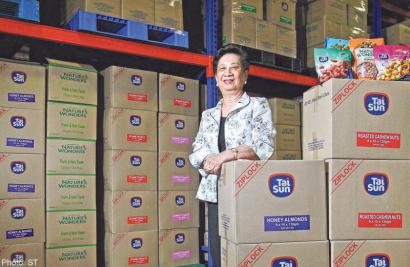
An unassuming woman with short salon-set hair, whose only accessories are a pair of simple but classic pearl earrings, greets you with a smile as you enter the office of nuts and snacks specialist Tai Sun (Lim Kee) Food Industries in Pandan Loop.
Few would be able to tell that she is the business’ co-founder Han Yew Lang. The home-grown firm has an annual turnover of over $40 million.
She and her late husband, Mr Lim Jit Syong, started the business in 1955, shelling, peeling and frying peanuts in small batches in a coffee shop in Pekin Street, where they used to live with his family.
Since then, chances are you might have tasted a little of Madam Han’s hard work if you have munched on crunchy salted peanuts at Chinese restaurants or in pubs, especially from the 1950s to mid-1970s when everything was still done by hand.
These days, Tai Sun’s offerings include not just roasted peanuts but also honey-roasted almonds, crunchy green peas coated in a light and crisp batter, as well as potato and cassava chips. Packets of these line the shelves of many supermarkets and convenience stores here.
The company is also behind the attractively packaged Nature’s Wonders fruit and nut packs that include baked premium macadamia nuts and jumbo-sized golden raisins; and biscuits, love letters and other Nonya confections under the Ah-Ma label.
And you know the house-brand nuts and chips at leading supermarket chains? Many of those are made by Tai Sun, which does contract manufacturing for each chain.
The company exports its products to more than 10 markets around the world, including the Middle East, the United Kingdom, Hong Kong and Malaysia. Madam Han, who is 78 years old but does not look a day over 65, tells you in Mandarin that Tai Sun’s snacks are one of life’s “simple and affordable” luxuries.
Prices start at about $1.40 for a 150g packet of Tai Sun roasted peanuts, and about $6.40 for a 240g packet of Nature’s Wonder’s baked almonds or baked cashew.
Singapore’s favourite nut, according to Tai Sun, is its bestselling roasted cashews, thanks to its robust flavour.
A bowl of Nature’s Wonders Royal Mix, which consists of various nuts and dried fruit, is placed at the table and she gestures to you to tuck in. You oblige politely at first, but soon find the healthy mid-afternoon snack addictive. A gentle smile spreads across her face.
Madam Han, who still comes into the office for several hours each day to keep herself busy and abreast of operations, leaves the running of the business to her three children. She took a step back some time in the 1980s, while her husband, who died of liver cancer in 1992 at the age of 64, was still very much involved until his last days.
Their children are Sandy, 57, who handles finance and administration; Winston, 56, who is in charge of sales and marketing; and Lawrence, 53, who handles the production. All had been exposed to every aspect of the trade from young and joined the business full-time about 40 years ago. Her sons completed their O Levels and national service, while her daughter studied up to pre-university.
The elder three of Madam Han’s nine grandchildren are also involved in the business. They hold university degrees and handle areas such as marketing.
The sprightly and energetic but very reticent Madam Han is of Hainanese heritage. She says she keeps fit by swimming and brisk walking on alternate days before heading to the office. She still drives herself to work and around town in her Lexus IS 250. She learnt to drive in the 1950s, at the age of 21.
Ask her what prompted her to learn to drive back then, considering it was not common especially for a woman, and she brushes it off, laughing and saying: “Why not?”
She took lessons from a driving instructor because she thought it would be a useful skill. Also, she would be able to help her husband with deliveries.
Madam Han had a hard life growing up in the Dempsey area where her widowed mother was a maid who cleaned the homes and looked after the children of expatriate families. Her father died in a bomb blast in Thailand during World War II.
But she does not resent that life was tough. “It was just the way things were,” she says matter-of-factly. She was the second of four children – her older brother died many years ago, while her younger sister, now 76, is a housewife and her younger brother, now 74, is a retired teacher who helps out with paper work at Tai Sun.
The young Madam Han barely finished two years of primary school before she had to find work to help the family make ends meet. By the age of nine, she was cutting and clearing grass by hand and helping to care for expatriate kids. She also sold sweets to moviegoers outside Capitol Theatre.
When she was 16, her mother arranged for her to meet an eligible Hainanese bachelor, a son of a distant relative who was eight years older than her. His family ran an arcade and coffee shop.
“My mother told me he was a good man from a good family, so I said, okay, good,” says Madam Han, who did not question her mother’s judgement.
“Apparently, he had fancied me the moment he came to our house to see me, but at the time, I didn’t even know he was there to suss me out.”
That man was Mr Lim. They were pledged to be married a couple of months later and courted for two years before tying the knot. She lights up when she recounts how he would take her to watch movies and to the seaside to go swimming on weekends. He was kind and also sent her home. They got married in 1954, when she was 18 and he was 26.
At the time, Mr Lim was in a family business of distributing imported nut dispensing machines to bars and collecting money from them. The entrepreneurial young man soon realised that there was money to be made in the salted nuts.
He would buy groundnuts from wholesalers while Madam Han would shell, peel and then fry the nuts in hot oil before salting them generously. Her in-laws would help with the laborious peeling of the peanuts. “I would cook about 140 taels of peanuts, which is about 84kg, every three days. By then, we had 100 machines in bars, cinemas and several coffee shops,” she recalls.
She had her first child, Sandy, in 1957, two years into the business, and Winston, a year later.
Motherhood scarcely interrupted the work over the wok. Business was picking up as the trend of eating nuts gained popularity. Soon, the dispensing machines became obsolete – they were too small, required too much maintenance and bar owners complained about the small margins they were making.
The couple did away with the machines and started distributing the peanuts in 10kg tins, selling them directly to bar owners. That marked the birth of the couple’s wholesale business. Madam Han was the cook who managed the production and operations behind the scenes, while Mr Lim looked after the sales and the marketing.
With the growing revenue, they moved out of the living quarters above her in-laws’ coffee shop and into a rented terrace house in Ean Kiam Place, a Hainanese area, in 1961. By then, she had just given birth to her third child, Lawrence.
Gradually, they added more snacks to their list of products, such as keropok or prawn crackers, and then potato chips and other types of nuts, which they wrapped in paper and later small polythene bags.
Bags of nuts had to be sealed by hand, with the heat of a candle, and later with a soldering iron. Her two older children would help with various tasks such as these after school.
Up until the mid-1970s, production for their snacks was still done out of their home, with the help of about eight neighbours, whom they paid only in kind.
They did not have any permanent workers and could not afford to pay anyone.
Madam Han says: “All the neighbours were very close and they would come over to help peel the nuts. I would serve them coffee and snacks.”
To express her gratitude, she would buy each neighbour live chickens, mandarins, and two crates of Green Spot, a popular orange-flavoured soft drink in those days, during Chinese New Year.
The business was laborious and back-breaking. Even with the help of neighbours, they could prepare and cook only two large sacks of nuts each day.
To fry the nuts, Madam Han would have to light a kerosene stove and constantly bend over to adjust the air valve to keep the flame on high. Once, she singed her eyebrows and the hair around her forehead while lighting the stove.
Of the incident, she recalls: “I had no eyebrows for quite a while and blackened skin around my face because of the burns.” Fortunately, there was no permanent scarring.
In 1976, they moved the business into a factory in Jalan Senang, when they were told by the authorities that food production could no longer take place in the home.
Those were stressful times, with a large loan from the bank looming over their heads. It was the first time they had been in debt.
“It was really the only time that I had to worry about the business, even though my husband took most of the stress upon himself,” she says. By that point, they had been married for 22 years and had become each other’s confidantes.
Business continued to grow in the 1970s and into the 1980s. By then, Mr Lim had also started supplying wholesale nuts to restaurants which would serve items such as peanuts as appetisers. With the help of their grown children, they also solicited business overseas and began exporting their products.
Processes were automated with machines and the company outgrew its production facility. It moved into a factory space in Pandan Loop in 1985. Now, the space is used as a warehouse.
By 1989, the business, which had started in a humble coffee shop, had a turnover of about $10 million a year. Twenty- five years on, and its turnover has quadrupled to $40 million.
It now has two factories in Johor Baru – the first opened in 2000 and the second in 2009 – that have a combined area of 100,000 sq ft and employ about 150 workers. Moving the factories to Malaysia helped to reduce costs. In Singapore, it has about 50 workers doing distribution, packing and administrative tasks.
The company also buys its ingredients directly from suppliers and farmers in China and the United States to cut down the costs of using middlemen. Madam Han says the company was sparred the brunt of economic crises over the years.
As her son Winston says: “We are largely crisis-proof because (our snacks) are a low-cost item. People usually cut back on more expensive things.”
Both mother and son, who live together in a landed property in the Katong area, attribute the growth of Tai Sun to evolving with the times and adapting to consumer tastes. For instance, the company introduced its healthier, premium nuts range Nature’s Wonders in 2008, and in 2011, introduced gluten- and transfat- free cassava chips, which appeal to increasingly health-conscious consumers.
Repositioning and updating the brand is a task that falls on Madam Han’s eldest grandchild, Esther Loo, 32, who joined the business in 2010. This has helped Tai Sun to gain traction and it has its eyes set on expanding to China and India. Changes include contemporising the Tai Sun logo and updating the packaging.
On the expectations of working in a family business, Mr Winston Lim says: “We were groomed from the very start to be part of the business, and in those days, we didn’t have much of a choice. I respect the hardships that my parents went through to start this business.”
Tears start to well in Madam Han’s eyes as she reminisces about her late husband. Even after all the years of shelling, peeling and frying peanuts, it still remains her favourite nut, she adds. Perhaps it is because it reminds her of the times she shared with him.
Her biggest hope is that the business will remain in the family for years to come.
She says of her husband: “I still miss him. This is his legacy.”
 About bambooinnovator
 Bamboo Innovator