Rewriting the gloomy headlines; Investment from the likes of Jeff Bezos is changing US journalism
April 15, 2014 Leave a comment
Last updated: March 31, 2014 7:40 pm
Rewriting the gloomy headlines
By Emily Steel
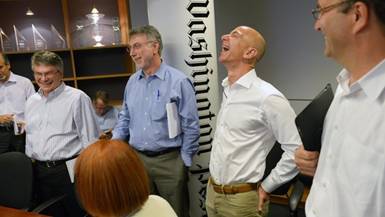
Jeff Bezos, centre-right, visits the Post after buying it last year, but he does not sit in on news meetings
Marty Baron has been the top editor of a top US newspaper for the past 14 years. In each one of those years at the Miami Herald, The Boston Globe and now The Washington Post, he has had to cut budgets and cut staff.
“That’s been my life as an executive editor,” he says, sitting in his fifth-floor office at The Washington Post, where his desk is covered with newspapers and a black Royal Typewriter sits on a corner table.
This year is different. The Washington Post has entered a new era of investment after Amazon founder Jeff Bezos swept in last year with $250m to buy the American journalism institution after eight decades of ownership by the Graham family, taking the company private and eliminating the pressure to deliver quarterly profits.
It has been only about six months since the deal closed but some initiatives already under way point to Mr Bezos’s influence and the Post’s efforts to build a sustainable digital journalism business for the future. These include a new programme that broadens the national and international reach of the Post by offering subscribers of partner newspapers and services free access to the Post’s paid digital products. The initiative kicks off in May with other newspapers but could expand to include any company that sells subscriptions, such as Amazon’s Prime delivery service.
In the editorial department, Mr Baron is hiring about three dozen additional employees for the Post’s newsroom of about 600 people. That means recruiting data journalists and editors for a new initiative focused on explaining the real-world impact of public policy, and mobile designers to create prototypes for editorial projects.
“That takes some getting used to, but I’m getting used to it very quickly,” Mr Baron says. “We’re thinking very expansively about what our future might be rather than merely thinking about how do we live within the constraints of our resources.”
The scorched earth of the journalism industry suddenly is providing fertile ground for reinvention.A series of ventures have emerged in recent months, each with different models seeking to reinvent the benighted news business – most without the legacy costs of publishing a printed newspaper. These include Mr Bezos’s acquisition of The Washington Post, eBay founder Pierre Omidyar’s launch of First Look Media with journalist Glenn Greenwald, and New York Times veteran Bill Keller’s departure for The Marshall Project, a non-profit investigative news outlet covering the US criminal justice system.
“For all the press about how the media is dying, there clearly is a huge group of people who think there is something there,” says Katharine Weymouth, whose great-grandfather bought The Washington Post in 1933. She has stayed on as publisher of the newspaper following its acquisition.
Katharine Weymouth, whose great-grandfather bought the Post in 1933, has stayed on as publisher
A surge of new money from the technology sector, philanthropists and venture capitalists is slowly starting to fill the gaps left when advertising dollars dried up.
“The traditional models have been so eroded and dysfunctional that you look wherever you can,” says Mr Keller. The former New York Times correspondent, executive editor and columnist recently left his perch at the publisher to become editor in chief at The Marshall Project. The start-up will have a full-time staff of about 20 to 25 journalists and an annual operating budget of $4m to $5m. “What sets us apart from the rest of the media world is that we’re going to be non-profit on purpose,” he says.
Mr Keller was lured away after meeting Neil Barsky, the former journalist and investor who had witnessed the erosion of investigative journalism and wanted to participate in its revival. Mr Barsky saw opportunity in creating a digital investigative journalism project diving deep into the US courts and prisons system, where he says stories have gone uncovered as news outlets cut back on in-depth reporting.
“Just as every town, every community that really wants to be worth anything should have a museum and an orchestra, it should have independent journalism,” says Mr Barsky.
The combination of cheap publishing technologies and the ability for journalists to use social media to build individual brands and attract audiences is spurring innovation. “You can really see that there is a moment, there is a zeitgeist thing that is happening. It is like the simultaneous invention and discovery of calculus,” says Eric Bates, the former Rolling Stone executive editor who is leading First Look’s editorial team. “What we are about to see is a real-time journalism experiment, where a bunch of different people are doing the same thing in different ways.”
The traditional models have been so eroded and dysfunctional that you look wherever you can
At First Look, Mr Omidyar is planning to invest as much as $250m in the creation of the non-profit journalism group, described as a “marriage between a technology company and a new kind of newsroom”. The group will produce multiple digital publications with a flagship site launching later this year, covering everything from entertainment and sports to politics and business. This will draw on a series of digital magazines about specific topics led by an experienced journalist, with the first being Mr Greenwald’s The Intercept.
First Look will also build an entirely separate tech company. The group is still working out how it will make money, saying it will depend on new and old revenue sources.
At The Washington Post, Mr Bezos did not come with a strict vision to carry the 136-year-old newspaper into the future, says Ms Weymouth. He visited the Post before the deal closed, spending one day mostly in the newsroom. A small group of senior leaders travelled to Washington state to see Mr Bezos, and typically talk with their new boss via teleconference every couple of weeks. Ms Weymouth says Mr Bezos is “very interested in the tablet experience” and pushing executives and editors to take advantage of the “gifts of the internet”, such as digital video and readers’ ability to interact with stories.
The newsroom is embracing experimentation. The Post is launching a contributor network for analysis and commentary by outsiders, its version of The Huffington Post’s network. It is also rolling out a series of new blogs and preparing to extend the Post’s operations across 24 hours a day to jump on the stories sparking conversations across the web.
“He firmly believes that The Washington Post is going to have a place in that new world and that it’s going to be digital,” Ms Weymouth says, adding that the print paper remains important. “But there isn’t some magic bullet. If there were, we would have all done it.”
Wearable technology: a new frontier for news
A visit to Cory Haik’s office offers a glimpse of what the future may bring for news outlets. The Washington Post’s executive producer and senior editor for digital news is in the midst of creating prototypes for technology such as Google Glass (right). Other innovations relate to publishing Washington Post content on platforms such as the Snapchat ephemeral messaging service and the Secret app on smartwatches.
Ms Haik holds out her wrist to show off the latest experiment. She scrolls through Washington Post articles on her Samsung smartwatch, selects a story and her iPhone – which is connected to her smartwatch – reads the text of the story aloud.
Digital experimentation has not always been easy in the industry, she admits, given the need to keep producing cash-generative but resource-intensive print products at the same time.
“So the idea that a benefactor who changed the retail world as we know it by way of technology showed up here: I’m like, OK, I’m good for a while. I think it’s going to work out.”
 About bambooinnovator
 Bamboo Innovator