Fidelity star manager Anthony Bolton: ‘I was wrong about the market in China’
April 16, 2014 Leave a comment
April 13, 2014 3:06 am
Anthony Bolton: ‘I was wrong about the market in China’
By Bradley Gerrard
Star manager Anthony Bolton has admitted he was wrong about the Chinese stock market, as he hung up his fund management hat after 35 years.
Mr Bolton, who is best known for his stellar performance while managing Fidelity’s flagship Special Situations fund for 28 years, will now become a member of the board but will no longer run any money.
He came out of retirement in 2010 following a trip to China, and the launch of his Fidelity China Special Situations investment trust was a feeding frenzy for his hoards of faithful investors.
After an initial surge the Chinese market slumped and Mr Bolton’s focus on smaller companies and his use of gearing – borrowing money to boost the trust’s pool of investments – magnified his investors’ losses.
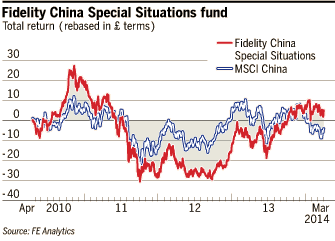
In early 2012 Mr Bolton extended previous plans for a three-year tenure to try to turn the trust’s portfolio around. It has now beaten the wider Chinese stock market, but it is still trading only slightly above its launch value.
“The most disappointing thing for me – and I am happy to admit it – is that I was wrong about the market in China,” the manager said during a press briefing on his last day in the office on March 31.
“I thought it would go up for four years but it has gone down for more than four years.”
He points to the trust’s borrowing as a main detractor of performance.
“I had a geared fund when everything was going down. I made a big play to ‘new China’ and in the past 18 months that has really come into its own. But I would have liked to have seen a better share price at the end of my tenure,” he says.
In share price total return terms the trust gained 5.2 per cent from launch to the end of March, versus a 4 per cent loss on the MSCI China index, according to FE Analytics, the data provider. A year ago it lagged behind the index with an overall loss of 4 per cent. Management of the trust has now passed to Dale Nicholls.
One of the trust’s heavy exposures is in technology, a sector in which Mr Bolton previously made key calls during his tenure on the Special Situations fund.
His decision to back Nokia, the mobile phone maker, in 1993 and to buy shares in security company Securicor in the belief that its stake in Cellnet, the mobile subsidiary it co-owned with BT, would push its value up proved to be major moves.
While the tech stocks in his China trust may not all have paid off in the same way, his predictions about technology have been proved right overall.
Mr Bolton is pessimistic about economic growth prospects in China, predicting 6 per cent a year as a likely figure – lower than the consensus 7.5 per cent.
He welcomes the current Chinese government, headed by premier Li Keqiang, saying it has made significant attempts to enact positive economic change and eradicate corruption.
Asked about valuations in markets, Mr Bolton says US valuations are “not expensive, but high against history”, meaning the market is “not in danger, but flashing an amber light”.
However, he says Chinese stock market valuations are “very low against history” and as far as two standard deviations below their long-term level.
 About bambooinnovator
 Bamboo Innovator