Passport to an Indian success; “Entrepreneurship is like a bug. Your mind is always churning, looking around, observing things, observing people.”
April 16, 2014 Leave a comment
Passport to an Indian success
By Avantika Chilkoti
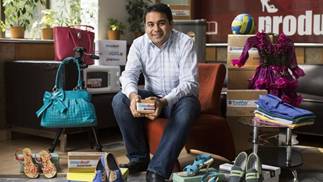
International retailers are watching Snapdeal co-founder Kunal Bahl’s progress in developing online retail in India
Kunal Bahl’s plans as a young graduate to work in the US for a few years were dashed in 2007, while he was working at Microsoft. The US government refused to renew his visa and he was forced to return home to Delhi. But that was just the push he needed, he says, to fulfil longstanding dreams.
“Entrepreneurship is like a bug,” he says. “Your mind is always churning, looking around, observing things, observing people.”
Seven years later, 30-year-old Mr Bahl is chief executive and co-founder of Snapdeal, the Indian online marketplace. By last year eBay had begun investing in the site, which was set up just under two and a half years ago. In that short time it has grown to more than 20m registered users and 4m listed products.
Snapdeal began in discount coupons well before Groupon, the US deal site, became known in India, and then morphed into an online marketplace, evolving along with India’s developing retail sector.
Rather than an online shop that sells its own goods, Snapdeal is simply a website on which retailers list the wares they have for sale. This means Snapdeal does not have to administer expensive delivery services and avoids the risks of managing inventories, while earning revenues by taking commission on sales. There is no listing fee.
“We felt that most of the ecommerce companies in India were just copying everything they saw elsewhere,” says Mr Bahl. “Just because it may or may not have worked elsewhere doesn’t mean we have to do it.”
Certainly, the international retail sector is watching keenly to see how online shopping develops in India, eyeing a nascent market of more than 1.2bn people. Some, such as Amazon, are even starting to operate in India. Industry experts expect substantial growth, as the Associated Chambers of Commerce and Industry of India forecasts that ecommerce will grow to $56bn, or 6.5 per cent of the total retail market, by 2023.
Snapdeal’s own sales have grown fivefold in the past 12 months, and are fast approaching $1bn a year, says Mr Bahl.
The business has had many guises since he realised he must return to India, armed with an engineering degree from the University of Pennsylvania and a business degree from Wharton. His first thought was to contact Rohit Bansal, a school friend working in financial services with Capital One, the US credit card issuer, in Bangalore. Mr Bansal is now chief operating officer and co-founder of Snapdeal. “Even when we were in school, though our ideas were half-baked, we were always talking about what we could do together,” says Mr Bahl.
MoneySaver, the business they launched in 2008, offered offline discount coupons – booklets of vouchers granting deals at various merchants – a concept Mr Bahl discovered as a skint foodie in the US.
Signing up merchants was not easy but the pair were tenacious. If a marketing manager did not reply to calls for two consecutive days, they turned up in person. On one occasion, Mr Bansal camped outside a Delhi reception for seven hours in 45C heat. “We had nothing to offer them outside of just hope and faith,” Mr Bahl says, laughing at his own salesmanship.
Question time: Kunal Bahl
Most important breakthrough? Investment by eBay
“EBay’s participation has been a pretty strong [breakthrough] because of its contribution to our success beyond just being a financial investor. [Also] it has added a great deal of validation to our business.”
Biggest mistake? Keeping someone on too long
When an employee, at whatever level, is not fitting in with the objectives of the business, “have that conversation with them and quickly. Cut the cord for mutual benefit . . . I don’t think we did that soon enough in our earlier days.”
Best technology for frequent travel? Minimalist
“I just need three things: a credit card, a passport, a mobile phone . . . No iPad or anything, I don’t need to compose a lot of things like Powerpoints.”
In 2010 clients began asking the plucky pair to shift online and within eight days of floating the idea they launched a website. “The only thing we knew about an internet business was how to register a domain name,” says Mr Bahl, who is dubbed “Mastermind” on the company website – Mr Bansal is “Brainbox”. “Both of us are engineers but both of us couldn’t write a line of code.”
Soon clients wanted to sell goods via the website, and Snapdeal was remodelled again as the online marketplace it is today.
“It was difficult emotionally but easy logically,” Mr Bahl says. “We can ignore what people are asking us to do or we can follow natural supply and natural demand.” It was, in fact, a classic example of how entrepreneurs’ best ideas are often not the ones they began with.
Mr Bahl had seen the life of an entrepreneur first-hand as his father set up a business making plastic car parts after leaving a job in India’s coalmines – “not hard labour but just one level up”. That was before the Indian economy was liberalised in the early 1990s, so it involved reams of red tape but he took the risk.
“I just knew growing up that starting your own business isn’t easy.”
His style of leadership is also a relic of his childhood, with an elder brother who studied at one of the prestigious Indian Institutes of Technology and the Institutes of Management, ultimate marks of success in India. “I have always felt that I’m not nearly the smartest guy in the company,” Mr Bahl says. “You become more focused on finding more people who are smarter than you and then giving them a lot of leeway.”
He does not like to call the 1,000-plus people now working for the privately held business “employees”, regarding it as “too industrial”.
As a distraction from managing a big team in a fast moving industry – where technology is always changing, regulation is in flux and competitors come and go – Mr Bahl tests his mettle with adventure sports. He goes white-water rafting and has an “addiction” to rollercoasters. “Doing these things allows you to let go which, in our day-to-day intense work, it’s very hard to do,” he says.
Amid the challenges and the hiccups, however, Snapdeal made headlines last year when eBay invested in the business for an equity stake and came on board as a commercial partner, followed by further investment in February, when the Californian group led a $133.8m round of funding.
Although Mr Bahl says he has not simply copied what others did, he has nevertheless watched his overseas peers. He realised, for instance, that mobile users were an important market for eBay, even though they contributed only 5 per cent of Snapdeal’s business a year ago.
Mr Bahl believes customers using mobile apps quickly develop a loyalty to these services, presenting a first-mover opportunity, so he challenged Snapdeal’s mobile team to compete directly with the company’s own traditional version of the business. The mobile user base expanded sharply and now contributes 35 per cent of sales.
Another source of growth for the company is the proliferation of ecommerce beyond the young and tech-savvy and the traditional male consumers, who control the purse strings in most Indian households. Where women were responsible for just 30 per cent of the site’s sales a year ago, that figure has reached 50 per cent. “We sell in a month about 200,000 saris,” Mr Bahl says. “Who’s buying those? It’s typically the housewives with children, the middle aged.”
With evolving audiences and constantly changing technology, there remain obstacles ahead for Snapdeal, and international retailers are likely to watch ever closer how Mr Bahl and his team scale those hurdles.
Snapdeal has received more than $200m of funding over the years, but it is eBay’s involvement that feels particularly significant. This relationship brings added pressure – more so than with a financial investor, he feels. “Everything they touch needs to work,” he says.
 About bambooinnovator
 Bamboo Innovator