H.E.R.O.’s Journey in Tech (Weekend Reads 11-12 August 2018) – For Reliance Industries, consumer data is the ‘new oil’: Indian conglomerate’s transformation centers on telecom business + You See Less Than You Think: Our seemingly detailed view of the world is more of an ever-changing sketch than a rich portrait-our minds fill in the blanks

H.E.R.O.’s Journey in Tech (Weekend Reads 11-12 August 2018) – For Reliance Industries, consumer data is the ‘new oil’: Indian conglomerate’s transformation centers on telecom business + You See Less Than You Think: Our seemingly detailed view of the world is more of an ever-changing sketch than a rich portrait-our minds fill in the blanks

Companies

  • Tencent-backed news aggregation app Qu Toutiao (趣头条), or “Fun Headlines,” is said to list in September in the US (Technode)
  • Behind the fakes: Pinduoduo is leading the way for low-income consumption (Technode)
  • The liquidators tasked with unravelling the massive fraud behind the bankruptcy of China Medical Technologies Inc. are suing the company’s former senior vice-president of operations, Zhu Feng (Charles), seeking to freeze assets including a $2.9 million home. They claim Zhu was part of the management team at China Medical that perpetrated a US$521.8 million fraud against the company through sham purchases of technologies from a company called Supreme Well Investments Ltd. The company bought “fluorescent in situ hybridization technology” or “FISH technology” for $176.8 million in 2007 and “surface plasmon resonance technology” (SPR) for $345 million in 2008. “Former management touted the merits of the acquisitions and represented that Supreme Well was an arm’s-length company,” the claim states. “However, in reality, the FISH technology and SPR technology were of no, or no significant, value and Supreme Well was secretly controlled by former management. Zhu in particular touted the merits of the acquisitions to the board.” China Medical’s financial adviser, Credit Suisse, “made numerous unsuccessful requests for information about the shareholder and beneficial owners of Supreme Well, the operations of its board and shareholder, the chain of title of its shareholding and the FISH technology for the purposes of due diligence.” “Zhu was directly involved in the due diligence process,” the claim states. “Shortly after the acquisitions, Zhu received US$1.68 million directly and indirectly from Supreme Well for his role in facilitating the fraudulent transactions.” With China Medical now insolvent, creditors have claims of more than $400 million against the company and its assets “have only a nominal value.” (Richmond)
  • Mechanical motion control component and industrial robot maker Hiwin Technologies has reported strong profits for 1H18 (Digitimes)
  • PCB firm Zhen Ding July revenues hit 6-month high (Digitimes)
  • Which Stocks Will Benefit from Samsung’s 180 Trillion Won Investment? Wonik Holdings and LOT Vacuum are among the stocks that can expect to receive orders soon. Display equipment and material producers that can benefit from the resumption of investment are SFA, AP system, ICD, Wonik Tera Semicon, and Duksan Neolux (BK)
  • Investors sold off shares of Netmarble Games — Korea’s leading mobile game maker — after disappointing second quarter earnings combined with a rather glum outlook. (Investor)
  • For Reliance Industries, consumer data is the ‘new oil’: Indian conglomerate’s transformation centers on telecom business (Nikkei)

BATTSS – Baidu, Alibaba, Tencent, TSMC, Softbank, Samsung

  • Alibaba tweaks a controversial legal structure: Jack Ma’s role in the firm’s “variable interest entities” will be reduced (Economist)
  • Samsung’s new $1,000 power-user phone reflects slowdown in hardware innovation (Japan Times)
  • SoftBank’s Son says WeWork is his ‘next Alibaba’; Entrepreneur bets $1bn more on office sharer’s network-building vision (Nikkei)

FAANNMG – Facebook, Amazon, Apple, Nvidia, Netflix, Microsoft, Google

  • ‘Stories’ was Instagram’s smartest move yet: Can it become Facebook’s next big business? (Recode)
  • Microsoft’s AI can convert images into Chinese poetry (TNW)

Asia Tech & Innovation Trends

  • This edtech startup is using AI to help students with their entrance tests (TIA)
  • Singapore image recognition solutions firm Trax leverages new retail in China (KRA)

Global Tech & Innovation Trends

  • Jack Dorsey Is a Double-Duty CEO for Twitter and Square. Here’s How He Revived Them Both. (Barron’s); How Some CEOs Successfully Run More Than One Company (Barron’s)
  • Rising Dividends From Data-Center Giant Equinix. Founded in 1998, Equinix originally specialized in connecting various networks to one another to deliver email messages, for example. But the technology world has evolved exponentially since then, with massive amounts of data and software routinely exchanged around the clock. That has intensified the need for more speed, security, and high-quality data network connections, whether for a bank’s trading desk or a retailer tracking its inventory in real time. (Barron’s)
  • Dead robots raise questions on how far home technology has come Failed designs and undeveloped markets claim many projects before they switch on (FT)
  • Climbing The Wall Of Worry: Disruptive Innovation Could Add Fuel To This Bull Market (SA)
  • Stitch Fix: A Bull Says Digital Dresser Can ‘Continue to Outgrow Expectations’ (Barron’s)
  • RPA Provides a Lightweight, Agile Approach to Automation; It allows companies to automate processes at a fraction of the cost and time of classic software development (WSJ)
  • What MoviePass Can Teach Us About the Future of Subscription Businesses (HBR); Maybe MoviePass shouldn’t compare itself to uber (Wired)

Life

  • You See Less Than You Think: Our seemingly detailed view of the world is more of an ever-changing sketch than a rich portrait-our minds fill in the blanks (WSJ)
  • Eren Ozmen and her husband spent the last quarter of a century carefully building Sierra Nevada from a tiny, 20-person defence firm into a multibillion-dollar aerospace concern. Now she’s betting their fortunes on the billionaire space race (Forbes)
  • Earnings surprises are bigger, thanks to growing use of non-GAAP metrics; More S&P 500 companies are using non-standard numbers to report bigger earnings beats and boost share prices (MW, PDF)

Evidence of a Positive Trend in Positive Quarterly Earnings Surprise over the Past Two Decades

ABSTRACT

This paper confirms our prediction of a sustained positive trend in positive quarterly earnings surprise (ES) over the past two decades for reported and forecasted quarterly “Street” earnings. The timeseries distribution of Street ES has not shifted symmetrically to the right, however. Specifically, the shift is the result of fewer small ES in the bins at or just below zero and more and larger positive ES in the bins further away from zero. This descriptive evidence supports two explanations: of (i) increasingly upwardly biased Street earnings and/or increasingly downwardly biased forecasts of Street earnings and (ii) of greater use by analysts of adjustments to bias Street earnings to exceed GAAP earnings, especially in the fourth quarter. An analysis of ES based on the difference between GAAP earnings and time-series forecasts of GAAP earnings (GAAP ES) does not show the same trends, however, implying that the positive trend in Street ES would more likely stem from analysts’ efforts to bias ES rather than firms’ actions to manage GAAP earnings to achieve the same result. We also document that, whereas forecast accuracy improves for shorter forecast horizons, analysts’ Street ES bias increases for shorter forecast horizons. These results are robust to firm size and the earnings surprise shocks of the Sarbanes Oxley legislation and the 2007–2008 global financial crisis.

H.E.R.O.’s Journey in Tech (10 August 2018) – When the disruptor becomes the disrupted: Seek co-founder Andrew Bassat on what happens when you get complacent + Warren Buffett’s Biggest Wins & Fails

H.E.R.O.’s Journey in Tech (10 August 2018) – When the disruptor becomes the disrupted: Seek co-founder Andrew Bassat on what happens when you get complacent + Warren Buffett’s Biggest Wins & Fails

Companies

  • Flea market operator Mercari in search of new hit services; Former Japanese unicorn sinks deeper into the red on heavy US spending (Nikkei); After Mercari: Japanese asset managers see new era in venture capital investing (Reuters)
  • Chatty multilingual robot assists guests at hotels in Japan; AI-infused ‘Unibo’ set to guide foreign tourists as 2020 Tokyo Olympics nears; The robot has found a home at tour operator I.S’s Henn-na Hotels, where it has been a hit since being introduced in April (Nikkei)
  • Japan Triathlon Union is working with Weathernews ‘s Sports Weather Team to use meteorological data for sporting events, (Mainichi)
  • Apple supplier Pegatron mulls India facility amid trade tensions; Taiwan company considers expansion outside China, warns of market uncertainty (Nikkei)
  • When the disruptor becomes the disrupted: Seek co-founder Andrew Bassat on what happens when you get complacent (SmartCo)
  • LiveTiles signs Microsoft AI partnership as its growth rate soars (AFR)

BATTSS – Baidu, Alibaba, Tencent, TSMC, Softbank, Samsung

  • Alibaba scouting firms to feed apps; Thailand seen as strategic for supply (BP)
  • Tencent to merge Doctorwork with Trusted Doctors to build its online and offline medical network in China; Tencent Doctorwork has been developing its AI and big data capabilities in partnership with hospitals and clinics across the country (SCMP)
  • Tencent merges medtech investees to build an online-to-offline medical network (KRA)
  • Spotify shares turn up on Samsung partnership (FT)
  • WeWork gets another US$1 billion from SoftBank – this time in the form of convertible notes (SCMP)
  • Cyberattack on iPhone chipmaker exposes big tech’s vulnerability; TSMC and industry peers race to overhaul security to fend off WannaCry virus (Nikkei)

FAANNMG – Facebook, Amazon, Apple, Nvidia, Netflix, Microsoft, Google

  • Facebook adds quirky Messenger games to video chats (CNN)
  • The next stop on Amazon’s journey toward world domination is your car (qz)
  • Google’s New Facial Recognition Patent Wants To Stalk Your Social Media (CBI)

Asia Tech & Innovation Trends

  • Chinese mobile game-makers made more than $600 million in the US market in the first half of 2018 (Technode)
  • What China’s history of overseas tech IPOs says about the current wave; The number of Chinese tech IPOs is expected to rise in the near future in Hong Kong and the US (e27)
  • Japan’s ‘mad scientists’ pursue a cyborg-friendly future: An emerging scientific field seeks to combine living tissue with metals and plastics (FT)
  • Why Osaka Is Becoming The Hottest Spot For Startups In Asia (Forbes)
  • Musical.ly investor bets on internet radio with $17M deal for Korea’s Spoon Radio (Techcrunch)

Global Tech & Innovation Trends

  • Yelp Sees Boost in New Accounts, but Revenue Growth Is Uncertain (Barron’s)
  • Megamergers are not a silver bullet for success; The answer for incumbents in any industry is to embrace the model of the disrupter (FT)
  • Bots vs. Trolls: How AI Could Clean Up Social Media; Many tools exist that could help identify bad actors on social media. There’s just no consensus on how to use them. (WSJ)
  • The Battery Pioneer Who, at Age 96, Keeps Going and Going; John Goodenough strives to ‘transform the battery world’ with a second breakthrough in speed and capacity (WSJ)
  • Fraudsters using Shopify to scam people, and critics say the company isn’t doing enough to stop them; It’s dead simple for a criminal to set up a fake storefront using Shopify’s software; getting one up and running takes minutes (FP)
  • Naspers creates new video on demand unit as Netflix rivalry heats up (Reuters)

Life

  • Warren Buffett’s Biggest Wins & Fails (Visual)

  • The 5M’s: How Emergence Evaluates Series A Pitches: Learn why Management, Market, Metrics, Moat and the M-Factor are all that matters. (Emcap)
  • Natural Maniacs. There is a thin line between bold and reckless, and you only know which is which with hindsight. (Morgan Housel); Why Great Success Can Bring Out the Worst Parts of Our Personalities (HBR)

H.E.R.O.’s Journey in Tech (9 August 2018) – Koh Young Posts Record Q2 Revenue + Li Lu on Charlie Munger’s Greatest Influence: “Yet throughout all these blows, I’ve never seen him being pessimistic or desperate. He’s never complained about those terrible blows either. His attitude towards them is to take them as graceful and competent as he can.”

H.E.R.O.’s Journey in Tech (9 August 2018) – Koh Young Posts Record Q2 Revenue + Li Lu on Charlie Munger’s Greatest Influence: “Yet throughout all these blows, I’ve never seen him being pessimistic or desperate. He’s never complained about those terrible blows either. His attitude towards them is to take them as graceful and competent as he can.”

Companies

  • Weibo revenue surges as China tech groups lift advertising; Social media operator attracts big spenders like Alibaba (Nikkei)
  • China’s Dada-JD Daojia raises $500 million from Walmart, JD.com (Reuters)
  • Koh Young Posts Record Q2 Revenue; Coupled with powerful software, the Zenith handles an enormous amount of real data, which helps engineers gain insight into the reflow process and enables faster, better decision making. (iconnect)
  • Kakao’s net profit more than doubles in Q2; operating profit fell 38.2 percent to 27.5 billion won in the second quarter from 44.6 billion won a year ago, as the company spent more in marketing costs to promote new businesses (Investor)
  • IRESS has announced its new collaborative design initiative, IRESS Labs, would allow financial advisers to test and provide feedback on prototypes during a development phase before co-designed features are released. (MM, IFA)
  • 3D vision systems to drive growth for Vitrox (Star)

BATTSS – Baidu, Alibaba, Tencent, TSMC, Softbank, Samsung

  • The Amazing Ways Alibaba Uses Artificial Intelligence And Machine Learning (LinkedIn)
  • SoftBank is helping Alibaba create a formidable rival to Meituan; Ele.me looks forward to fresh capital to capture larger market share. (KRA)
  • Tencent-backed Q&A Platform Zhihu Reportedly Raises $270M Series E Round (CMN)
  • SoftBank in Talks to Invest Up to $750 Million in Zume, the Startup That Sells Robot-Made Pizza; Zume uses robots and software to deliver food. (Bloomberg)

FAANNMG – Facebook, Amazon, Apple, Nvidia, Netflix, Microsoft, Google

  • Amazon basically wants to turn Whole Foods into a drive-thru (FastCo)

Asia Tech & Innovation Trends

  • Hong Kong’s IPO Takeoff Is Running Out of Runway; Repeated flops are causing investor fatigue. (Bloomberg)

  • Chinese Truck-Hailing App On Course for $10 Billion Valuation; Manbang Group is speaking to U.S.-based mutual funds and late-stage investors as it looks to raise $1 billion (WSJ)
  • Meet the Shenzhen billionaire behind the world’s thinnest flexible display (SCMP)
  • How Tik Tok became China’s top short-video app in 500 days (TIA)
  • AI giant SenseTime leads $199M investment in Chinese video tech startup (Techcrunch)
  • Tech start-up funds plummet in China as easy money dries up, signalling big boom may be over (SCMP)
  • Fresh robot-baked bread hints at future of retail in China; Local juice company aims to turn errands into entertainment (Nikkei)
  • Japan plans 10 ‘AI hospitals’ to ease doctor shortages; Computers will fill in patient records and analyze blood tests (Nikkei)
  • Japan’s Spectee, news video aggregator for press, ready for North America expansion (Bridge)
  • South Korean social referral recruitment platform Wanted has a big plan for Southeast Asia; Can Wanted beat its competitors, which include traditional recruitment agencies, by offering cash rewards? (KRA)
  • Revolution Precrafted recently became the Philippines’ first “unicorn” by supplying limited-edition, luxury prefabricated homes to a global market primed for new modular dwelling options. Despite its high valuation, the company is yet to (SCMP)

Global Tech & Innovation Trends

  • These soft, tiny robot spiders might operate on you someday (TNW)
  • The ultra-pure, super-secret sand that makes your phone possible; Unimin’s North Carolina quartz operations supply most of the world’s high and ultra high purity quartz. (Wired)
  • Zillow Struggles to Find New Growth (Barron’s)
  • A quantum computing startup tries to live up to the hype (Japan Times)
  • DreamWorks Looks to Reanimate Business With Advanced Analytics; Approximately 600 terabytes of storage and 120 million core hours of rendering go into each animated feature-length film (WSJ)
  • com Adopts CEO Structure With Spotty Record; Salesforce.com’s elevation of Keith Block to co-chief executive creates a power-sharing structure that hasn’t always worked out for other companies (WSJ)
  • Match Group: Tinder, and the Shares, Stay Hot (Barron’s)
  • The World’s Most Peculiar Company; How does catalog-loving retailer Hammacher Schlemmer, famous for such eccentric and extravagant products as the Navigable Water Park, continue to survive in the age of Amazon? (CM)
  • Pinterest shapes up for anti-millennial IPO (Reuters)

Life

  • Li Lu on Charlie Munger’s Greatest Influence. The biggest blow during the past 15 years, was the passing away of his second wife Nancy, who had been with him for more than 50 years when she died in 2010. Less than a year later, he almost became completely blinded due to an accident. He’s already lost sight on one of his eyes previously due to a surgery operation. So I’ve witnessed him recovering from such hard blows one by one. Yet throughout all these blows, I’ve never seen him being pessimistic or desperate. He’s never complained about those terrible blows either. His attitude towards them is to take them as graceful and competent as he can. He’s objective and rational in everything. There is a Chinese saying that goes, “One should neither be pleased by external gains, nor be saddened by personal losses.” Charlie is one of those people who can achieve such a state of mind. At the same time, Charlie is also curious and enthusiastic about all issues, especially about how the business world works. This curiosity and enthusiasm has continued to this day. At age 95, he doesn’t work less every day than when I first met him 15 years ago. When he finds interesting books and materials, he will even read them until 4 a.m. in the morning until he finishes them, sometimes in one go. (GF)
  • Rare Charlie Munger and Li Lu Interview – Part I (GF)
  • Investing in an age of disruption (Todd Wenning)

H.E.R.O.’s Journey in Tech (8 August 2018) – Gree-owned firm launches app aimed at boosting Japan’s booming world of ‘virtual YouTubers’ + 100 Philosophy Quotes That Will Inspire and Challenge You

H.E.R.O.’s Journey in Tech (8 August 2018) – Gree-owned firm launches app aimed at boosting Japan’s booming world of ‘virtual YouTubers’ + 100 Philosophy Quotes That Will Inspire and Challenge You

Companies

  • Gree-owned firm launches app aimed at boosting Japan’s booming world of ‘virtual YouTubers’ (Japan Times)
  • Bandai Namco sees flat first quarter with little help from game sales; Gaming saw 5.4% decline year over year while all other segments saw slight increases (GI)

BATTSS – Baidu, Alibaba, Tencent, TSMC, Softbank, Samsung

  • Alipay adds Pinduoduo-like group buying feature (KRA)
  • Baidu’s Billionaire CEO Declares He Can Beat Google Again (Bloomberg)
  • SoftBank’s Ele.me Cash Will Act as Halon or Kerosene; This $3 billion-plus investment could fuel a Chinese online-to-offline war, or extinguish it. (Bloomberg)

FAANNMG – Facebook, Amazon, Apple, Nvidia, Netflix, Microsoft, Google

  • New FANG Notes Let Investors Bet on Tech Optimism or Skepticism (Bloomberg); FAANGs Are More Solo Acts Than a Tech Supergroup; They have a lot less in common than many investors think. (Bloomberg)
  • Apple is the epitome of an “asset light” company: It owns very few hard assets and therefore needs almost zero outside capital to run its business. As of mid-2018, Apple has $105 billion of operating assets and $120 billion of operating liabilities. What does that mean? Miraculously, its operations rely on no capital from outside financiers. How does one achieve this apotheosis of the asset-light strategy? First, create a supply chain in Asia run by companies willing to invest in low-return projects that create your products. Second, hold those suppliers under your thumb. Idolizing asset-light strategies, however, can also lead to underinvestment, an excessive reliance on outsourcing and the artificial division of companies to avoid hard assets. The accomplishments of Apple’s model are substantial. But the financial strategy that has worked so well for Apple is a risky one for less capable companies with weaker strategic positions. For them, aping Apple can just as easily result in too much debt on their balance sheets, precarious supply chains and deferred opportunities for investments. The financial archetype defined by Apple — asset-light strategy, leveraged share buybacks and cash flow above all — is a high-wire act. Boards should guard against the temptation to follow Apple’s path blindly. Many of Apple’s imitators are more likely to mortgage the future than create it. (NYT)
  • Meet the YouTube Stars Turning Viewers Into Readers (NYT)
  • Alphabet: How a $175 Billion Waymo Could Boost the Shares (Barron’s)

Asia Tech & Innovation Trends

  • Beijing Bytedance Technology Seeks to Raise $3 Billion Privately; Owner of China’s top news-aggregation app could be valued at $75 billion (WSJ)
  • Best Known For Portable Chargers, Shenzhen’s Anker Has Ambitious Expansion Plans (Forbes)
  • Chinese tech ‘wolf’ Huawei stalks Apple and Samsung (BT)
  • Hong Kong’s Fung Group injects US$35M into India’s B2B e-commerce startup ShopX; Currently, ShopX claims it covers 50,000 retailers across 300 towns and doing over US$72.7 million in annualised transaction volume (e27)
  • Chinese online lender delinquencies wipe out $4bn this year; Outrage mounts as government hastens to nip financial risks (Nikkei)
  • OnePlus Shows Apple How to Become India’s Top Smartphone Seller (Bloomberg)
  • Japan’s accounting software Freee raises $60M to grow its cloud accounting business (Techcrunch)
  • Taiwanese AI solutions provider Appier has purchased Bangalore-based content marketing startup Qgraph (TIA)

Global Tech & Innovation Trends

  • Etsy CEO: There’s a ‘Long Runway’ for Growth Ahead (Barron’s)
  • Snapchat Is Becoming Like the Internet It Disdains; It loses luster, though, as it discards the elements that set it apart. (Bloomberg); Snap’s strategy shifts win over advertisers more than users (Reuters)
  • Match boosts revenue forecast as Tinder lures more paying users (Reuters)

Life

  • 100 Philosophy Quotes That Will Inspire and Challenge You (Medium)
  • How to Master Your Fear Like a Navy SEAL (Medium)
  • Sequestered capital is capital that is hidden or unseen by the market. R&D is often sequestered capitaI. Sequestered capital is special because it doesn’t inform price signals (MR)
  • What Peter Thiel taught Stanford University students about startup success (TIA)
  • Strategy vs. Tactics: What’s the Difference and Why Does it Matter? (Farnam Street)
  • Six Business Lessons from ‘Star Wars’ (Medium)
  • Causing a disruption, by definition, means a minority opinion or idea must rise to the top. It can be a lonely journey to get there, though, so Chad and Stephanie have a story to inspire and celebrate all the incredible minorities of one changing the world. (TMD)

H.E.R.O.’s Journey in Tech (7 August 2018) – ‘Made in USA’ push is here to stay: Taiwan tech giant; Advantech, world’s biggest industrial IT company, ready to expand in America

H.E.R.O.’s Journey in Tech (7 August 2018) – ‘Made in USA’ push is here to stay: Taiwan tech giant; Advantech, world’s biggest industrial IT company, ready to expand in America

Companies

  • Billionaire Clothes Makers Trade Barbs Over How to Measure Customers (Bloomberg)
  • Tencent-backed Weimob files for Hong Kong IPO as marketing solutions provider joins rush to go public (SCMP)
  • Chinese tech group Bytedance plans IPO: Rising star behind Toutiao news feed and video app Douyin frustrated by crackdown; Chinese president Xi Jinping’s crackdown on online content had an impact on Bytedance’s fundraising (FT)
  • China’s Xiaomi says parts supplier Holitech Technology to invest $200 million in India (Reuters)
  • ‘Made in USA’ push is here to stay: Taiwan tech giant; Advantech, world’s biggest industrial IT company, ready to expand in America (Nikkei)
  • Delta Electronics showcases CPS application to smart manufacturing (Digitimes)
  • The man leading Seek’s push into high-risk, high-reward emerging markets has defended its focus on growth, after the online recruitment giant was forced to write down its operations in Latin America (Age)

BATTSS – Baidu, Alibaba, Tencent, TSMC, Softbank, Samsung

  • Tencent Leads $50M Pre-A Round In Chinese AI Chip Maker Suiyuan Technology (CMN)
  • SoftBank’s evolution to tech investor pays off; Vision Fund ranks as group’s top contributor to record earnings (Nikkei); SoftBank’s Operating Profit Jumps 49%, Boosted by Vision Fund; A one-time gain from the stake sale of Arm’s Chinese operations also contributed to the increase (WSJ)

FAANNMG – Facebook, Amazon, Apple, Nvidia, Netflix, Microsoft, Google

  • Facebook to Banks: Give Us Your Data, We’ll Give You Our Users; Facebook has asked large U.S. banks to share detailed financial information about customers as it seeks to boost user engagement (WSJ); Facebook shares recover on optimism its Messenger chat app can build closer banking relationships (SCMP)
  • How Apple’s Posse Fared on the Road to Trillionaire Status; The iPhone maker’s entourage of suppliers and partners has had mixed fortunes. (Bloomberg); Here’s Apple’s Plan to Keep From Losing the World’s Fastest-Growing Smartphone Market (Bloomberg)

Asia Tech & Innovation Trends

  • The only thing mythical about unicorns these days are their valuations (SCMP)
  • Didi to invest US$1 billion in one-stop car services business (SCMP)

Global Tech & Innovation Trends

  • Internet of Things Adoption to Rise Despite Security, Data Integration Challenges; Integrating IOT data into day-to-day operations among top challenges cited by decision makers (WSJ)
  • Spotify: The Crucial Change That Almost Came ‘Too Late’ (Barron’s)
  • Airbnb’s Great Wall of China competition upsets Chinese social media users (SCMP)
  • Can This Man Make His Video Gaming Team a $1 Billion Business? (Bloomberg)
  • Developers Add Smart-Lock Technology to Let the Dogs Out and the In-Laws In (Bloomberg)

Life

  • Morgan Housel discusses how the internet shapes consumer values, the power of shows like Chef’s Table, the sudden rise of Vanguard, under-reported insights from Warren Buffett and Howard Marks (Perell)
  • How Whole Foods Started an Organic Revolution and Became a $13 Billion Company (PH)

H.E.R.O.’s Journey in Tech (6 August 2018) – How Pinduoduo founder Colin Huang went from factory worker’s son to China’s youngest self-made billionaire + YCombinator’s Jessica Livingstone: Grow the Puzzle Around You

H.E.R.O.’s Journey in Tech (6 August 2018) – How Pinduoduo founder Colin Huang went from factory worker’s son to China’s youngest self-made billionaire + YCombinator’s Jessica Livingstone: Grow the Puzzle Around You

Companies

  • How Pinduoduo founder Colin Huang went from factory worker’s son to China’s youngest self-made billionaire. Pinduoduo has long been plagued with complaints that it trades quality for price, allowing merchants to offer inferior products at rock-bottom prices to capitalise on the platforms’ popularity (SCMP)
  • Eye on tech companies in Malaysia exposed to the Apple supply chain; Globetronics is involved in producing components operating within the Apple iPhone supply chain ecosystem. “We have also raised our gesture sensor volumes, incorporating capacity expansion undertaken by Globetronics as required by its key sensor client, ams AG”. Inari derived close to 50% of its revenue from the radio frequency (RF) division, which mainly serves the smartphone market. Meanwhile, MPI is estimated to derive 30% of its revenue from RF and Unisem 30%. These figures, however, do not only cater to Apple but also other South Korean and China-based smartphone manufacturers (Star)

BATTSS – Baidu, Alibaba, Tencent, TSMC, Softbank, Samsung

  • FANG Stocks Are Big, But Asia’s Tech Giants Carry Even More Sway; Tencent, Samsung dominate their markets, which recently has led to stock-index declines. (WSJ)
  • Google Is in Talks With Tencent and Inspur for China Cloud, Sources Say (Bloomberg)
  • From Amazon to Alibaba, Grocers’ Agony Is Endless; Tech advances from China’s internet giants should trouble food retailers across America and Europe. (Bloomberg)
  • Masayoshi Son in His Own Words. All 303,513 of Them (Bloomberg); SoftBank Is Starting to Look a Lot Like a Private Equity Firm (Bloomberg); SoftBank monetises investments as telco IPO looms (Reuters)

FAANNMG – Facebook, Amazon, Apple, Nvidia, Netflix, Microsoft, Google

  • How to fix Facebook: Mark Zuckerberg can do more to improve a social network that was meant to build communities but has helped to split societies (FT)
  • Time limits for Facebook and Instagram users: will they work? It’s doubtful social media giants really want us to use them less (SCMP)
  • Here’s Apple’s Plan to Keep From Losing the World’s Fastest-Growing Smartphone Market (Bloomberg)

Asia Tech & Innovation Trends

  • Shares of Chinese solar panel maker GCL expected to face selling pressure after asset-sale talks collapse (SCMP)
  • VipKid to expand to 100 countries as investment in China’s online education sector heats up; The country’s largest online education start-up currently has more than 500,000 students and a community of 60,000 teachers, located mostly in N America (SCMP)
  • China’s Didi to invest $1 billion in its auto services platform (Reuters)

Global Tech & Innovation Trends

  • Schaeffler buys drive-by-wire technology for autonomous vehicles (Reuters)
  • ‘The Beginning of a Wave’: A.I. Tiptoes Into the Workplace in an unglamorous place: the back office (NYT)
  • Academics created a periodic table of mind-blowing tech, and it’s a handy guide to how the world will change forever (BI)

Life

  • Q&A with Brian Portnoy, author of The Geometry of Wealth: How to Shape a Life of Money and Meaning (AR)
  • Grow the Puzzle Around You (Jessica Livingstone)

Finding Value in Asia: Discovering Tech Innovators in an Exponential World | Webinar Invite To BrightTALK Investing in Asia Summit 2018 (12 July 2018)

Finding Value in Asia: Discovering Tech Innovators in an Exponential World | Webinar Invite To BrightTALK Investing in Asia Summit 2018 (12 July 2018)

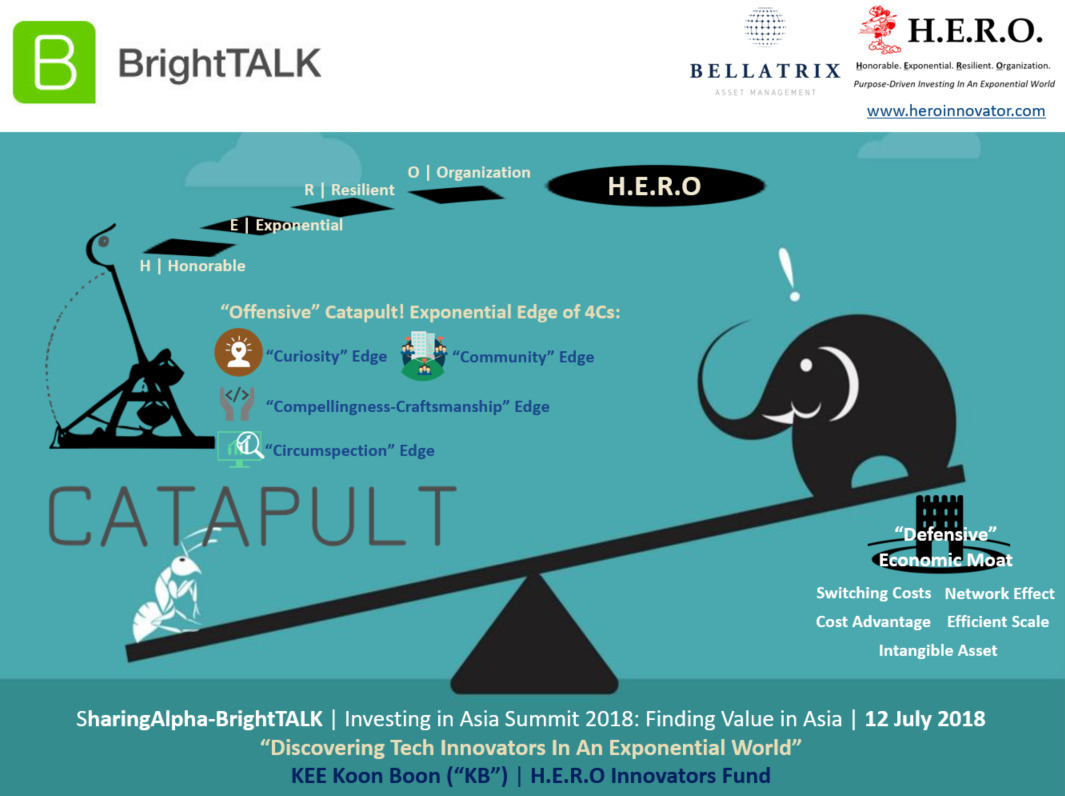
We like to invite lifelong learners in value investing and business model innovations to the BrightTALK webinar Investing in Asia Summit 2018 | Finding Value in Asia: Discovering Tech Innovators in an Exponential World on 12 July 2018 (Thursday) at 9am UK time (10am Swiss time or 4pm Singapore time). There will be a live Q&A session at the end of the webinar, please feel free to ask any tough questions which we will do our best to address them. We look forward to learn from your great questions and to open up a meaningful conversation with you to explore the journey together. We hope to build a warm community of resilience, learning and exponential growth where entrepreneurs and investors support and encourage one another to navigate and thrive in this challenging world and we are grateful to have your support. Thank you so much!

Abstract:
Can the megacap tech elephants still dance? Or is this the better question: Is there an alternative and better way to capture long-term investment returns created by disruptive forces and innovation without chasing the highly popular megacap tech stocks, or fall for the “Next-Big-Thing” trap in overpaying for “growth”, or invest in the fads, me-too imitators, or even in seemingly cutting-edge technologies without the ability to monetize and generate recurring revenue with a sustainable and scalable business model? How can we distinguish between the true innovators and the swarming imitators?

We see a distinct value opportunity in an exclusive group of under-the-radar Asian SMID-cap tech stocks who are exceptional market leaders in their respective fields with unique scalable business models run by high-integrity, honorable and far-sighted entrepreneurs with a higher purpose in solving high-value problems for their customers and society whom we call H.E.R.O. – “Honorable. Exponential. Resilient. Organization.”.

  • Investing in exponential innovators = The most relevant language in value investing?
  • Why are these exponential & exceptional innovators overlooked and mispriced winners and the most relevant multi-year investment trend and opportunity?
  • The analytical framework to identify under-the-radar winners, including rejuvenating the defensive economic “moat” analysis by complementing with the more offensive “catapult” analysis, using this new lens to view the value creation process afresh and continually discover innovators creating, enabling and capturing new demand with exponential non-linear growth potential.
  • Remaining skeptical and grounded in the Asian capital jungles and avoiding the investing pitfalls and traps of Asian-style accounting fraud and misgovernance which western-based fraud detection tools and techniques have not been adequately adapted to the Asian context.
  • Selected case studies.

Warm regards,
KB | kb@heroinnovator.com | WhatsApp +65 9695 1860
www.heroinnovator.com

Mini Workshop | 100X: Be Exponential, Be Exceptional Like a H.E.R.O.! Business Model Innovation & Investment Insights to Transform SMEs Into Exponential Enterprises from $10 Million to $1 Billion

Mini Workshop | 100X: Be Exponential, Be Exceptional Like a H.E.R.O.! Business Model Innovation & Investment Insights to Transform SMEs Into Exponential Enterprises from $10 Million to $1 Billion

We are planning mini-workshops in partnership with a quality audit & consultancy firm for their clientele base of SME business owners to share about H.E.R.O. – below is a brief synopsis. If there is available space, we will open up the workshop to interested qualified investors who are lifelong learners. More details on the dates and venue to be shared at a later date. If you are interested to find out more or reserve a seat, please contact KB, thank you.

Synopsis:

Disruptive innovation is accelerating exponentially across many industries, upending passive companies and benefiting selective innovators whom we call H.E.R.O., which stands for “Honorable. Exponential. Resilient. Organization.”

Always feel that the insights from the usual case studies of big giants from Apple to Alibaba may not be relevant and applicable to your SME? H.E.R.O. Innovators are not your usual SMEs – they are exceptional market leaders in their respective fields and are 10X exponential compounders in profits and market value. What does it take to be exponential and exceptional like a H.E.R.O. and scale a SME 10 times or even 100X from $10 million to $1 billion in market value?

What are the business model innovation and investment insights that business owners, CEOs, managers and investors can learn and discover from the real-world case studies of H.E.R.O. Innovators that can be transformed into growth and positive change for yourselves?

Are we willing to commit ourselves and our companies to a process of mobilization, learning and discovery that progressively unlocked more of the company’s and personal full potential?

Part 1: Be Exponential! 天时

  • Stay ahead of the curve and keep your head when all others are losing theirs in an exponential world by acquiring the ability to tap on the technological insights of H.E.R.O. Innovators as a source of endless innovation for you and your team.

Part 2: Be Exceptional! Business Model Innovation Insights 地利

  • Discover why Asian H.E.R.O. Innovators outperform to create value regardless of macroeconomic potholes and bumps and the innovations they introduce to make the bumps work for them – and how you can acquire the ability to adapt them to work for you and your team.
  • Learn why do two companies in similar industry with each earning the same absolute profit size differ vastly in their market value in the stock market.
  • Understand the surprising insight why sales, profit and tangible asset growth may not translate to market cap growth and the secrets to unlocking business valuation.

Part 3: Be a H.E.R.O.! CEO 2.0 人和

  • Master lessons in overcoming challenges, hardships and adversities from the leaders helming Asian H.E.R.O. Innovators who propelled some of today’s innovative next-generation companies to success. Avoid business mistakes of the decisions of H.E.R.O. Innovators.

Participants Profile:

JOIN US in this thriving community of serious entrepreneurs and value investors where we come together and profit from sharing ideas.

  • Business Owners, CEOsCFOs and company executives aspiring to scale new heights for their businesses and last the distance to lead a meaningful and successful life;
  • Finance professionalsaccountants, and non-financial professionals who are keen to enhance their understanding of business building and value investing principles for professional and personal use;
  • Scions of business owners who desire to sharpen their business and investment acumen, manage challenges in family business, wealth preservation and creation, and network with other entrepreneurs and senior managers.

Are You a “First-Class Noticer” of Wide-Moat Compounders? Business Model Innovation & Investment Insights from Japan’s M3 Inc (Archive April 2015)

“Are you free now?” N asked me in a pensive mood when our paths crossed in a chance encounter in the underground basement of the Singapore Management University (SMU).

“Sure, what’s on your mind?”

“I have read your email on ‘To what can I devote my life’ last night and I have been thinking. I like to show you something. It’s an app business that I am doing up with my friend Chris.”

A SMU accounting student taking my course Accounting Fraud in Asia, N and his friend Chris have started a mobile app company which had developed an Uber-like mobile app to assist us to beat the long queues in healthcare clinics.

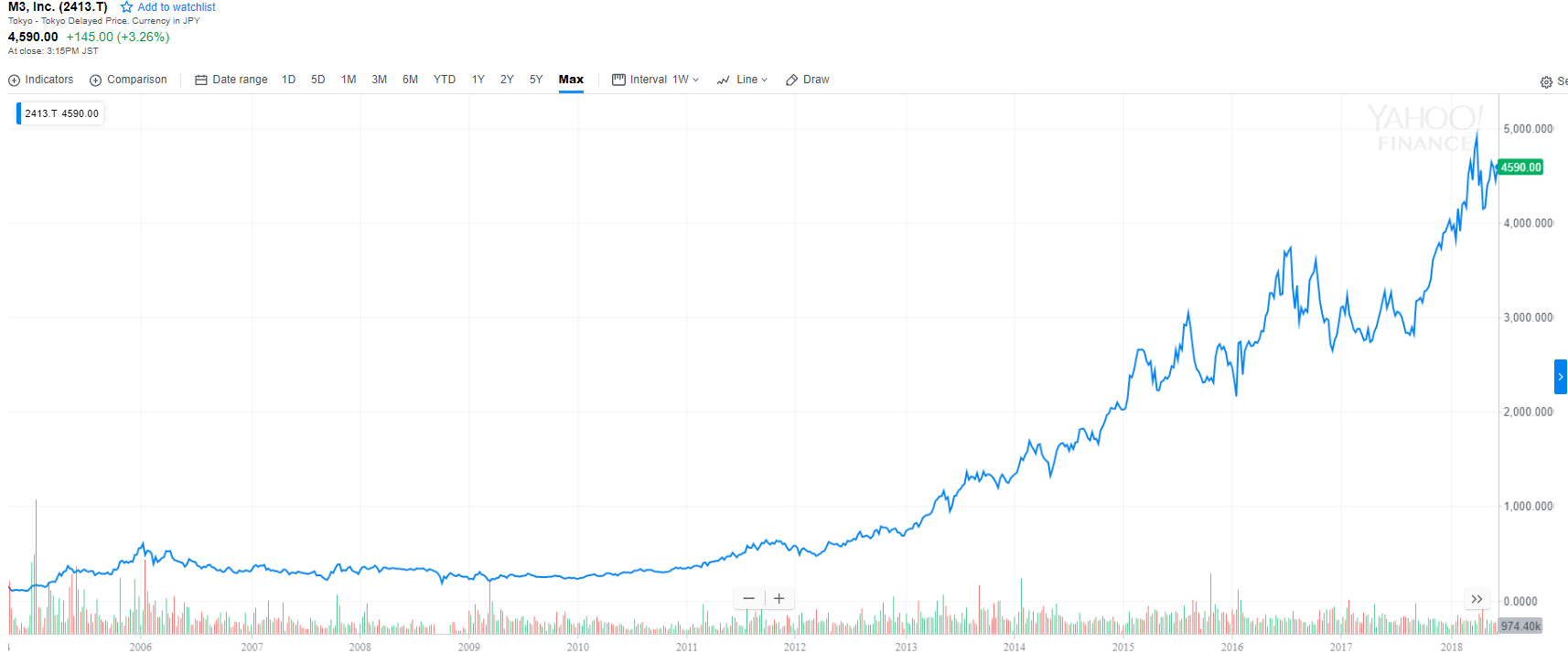
When I listened to N explaining his app, i immediately shared with him the Japanese innovator M3 Inc (2413 JP, MV $6.6bn). M3 is an overlooked wide-moat innovator I wrote about in 2012 and shared with the CEO and top management team of a listed tech company in a series of workshop “Uprising! Business Model Innovations and TMT Industry Trends” conducted in Singapore, HK and Beijing in 2012/13. M3 has since tripled to $6.6 billion. M3’s popular iTicket (www.iticket.co.jp) internet and mobile service used by more than 500,000 members to make reservations at clinics and beat the long queues might have some relevance for N to articulate the business model to seek funding – and clarity in their own execution and scalability. Both Chris and N have never heard of M3.

I explained briefly to them that M3 started out like a Google for medical professionals, with its core MR-kun service used as a marketing tool by pharmaceutical companies to provide consistent, repeated delivery of information on products and diseases. MR-kun also provides a channel for companies to receive questions and feedback from doctors, strengthening company/doctor relations.

With support by Sony Corp subsidiary So-Net which retains a 49.8% stake in M3, Itaru Tanimura established M3 in 2000 when he was 35. Essentially, M3 recognized that the demand for eDetails is quite high for busy physicians who require timely information at their convenience, without the limitations imposed by their off-line MRs. Doctors spend the most time collecting information via the Internet. Conversely, pharmaceutical firms spend the majority of their budget on MR related costs – and Japanese pharmaceutical firms’ huge marketing cost of ¥1.2-1.5tr ($10-12.5bn) is not sustainable.

Pharmaceutical companies signed up for MR-kun pay a basic annual fee of ¥70 to ¥100 million ($0.58 to 0.83 million) per electronic “e-detailing message,” which is the online equivalent of a sales visit by a MR (medical representative) to a physician’s clinic. In the pharmaceutical industry a sales visit by an MR to a doctor’s clinic is called a detail. M3 also charges fees for the production of promotional content and receives fees for other services such as facilitating the exchange of messages between pharma company MRs and their physician clients. The average of M3’s top five clients pays ¥860m ($7.2m) every year.

A dominant platform used by 80% of Japan’s physicians, MR-kun is rated by over 92% of its users who said its usage “deepened their knowledge of diseases”. With this intangible trust built up amongst the community of users, M3 is able to leverage this relationship with its members to develop new online tools. These include online tools in clinical trials to determine the feasibility of trials and help with patient recruitment, market research and survey panels, and online job search and career information site for member doctors and pharmacists. In China, M3’s membership for the healthcare professional portal site Medilive.cn topped one million members in August 2014 after just five years, covering roughly half of the physicians in China. M3 leveraged upon the media capacity of Medilive.cn to expand into “Messenger”, the Chinese version of MR-kun.

M3 even expanded from B2B to B2C by providing a range of services for consumers including AskDoctors.jp, a subscription service that gives patients a chance to ask doctors questions about their ailments, and iTicket.

M3’s Tanimura-san is what literary giant Saul Bellow would call a “first-class noticer”. Two entrepreneurs or value investors can study the same business model, watch the same video, or even take the same advice from a mentor, but the intensively-attentive and committed first-class noticer pick up critical details, opportunities and talents among noise that the other misses.

Building on Bellow’s term, Harvard’s business psychology expert Max Bazerman studied why some people notice and act on threats and opportunities while others do not. Bazerman identified three core challenges to being a first-class noticer: (1) Ambiguity, (2) Motivated blindness due to ego or vested self-interest, and (3) Conflict of interest with our desires influencing the way we interpret information, even when we are trying to be objective, and others that include the slippery slope and efforts of others to mislead us.

We develop noticing skills by acknowledging responsibility when things go wrong rather than blaming external forces beyond your control. Some character moves we can make to become first-class noticers:

·       Develop the introspection and capacity for observation to discover just how you learn and then to get out and do it.

·       Build in a process and attract people around you to challenge ambiguity, motivated blindness, and any conflict of interest to change you might have. Do it with intention. Intentionally establish a system to test your biases and comfortable assumptions.

·       Have a growth mindset that makes reinvention of yourself a regular way of life. Notice the signs. Find a way to embrace them rather than avoid them. Be self-accountable. Do it now.

Above all, the first-class noticer notices better because he or she cared more about their long-term journey than the shot-term paycheck. The intensive attentiveness is applied to a Purpose with an authentic Voice and the ability to engage others in shared meaning and to be truly aware of what’s going on in the world from wide-ranging and diverse sources of information. In the immortal words of leadership guru Warren Bennis, “the first-class noticer integrates a purpose with noble aims”. The first-class noticer devotes himself or herself to the Purpose and idea larger than themselves, being watchful and thankful. The word “watchful” is a legacy from the Old Testament – or a proactive sitting on a city wall and keeping watch. Watchmen were the first ones to see attacking armies or traveling traders. They saw things before others saw them.

One of the world’s greatest and most inspiring first-class noticer is Kazuo Inamori. Born into poverty, Kazuo Inamori lost his family home at age 13 and almost died that same year after contracting tuberculosis. A religious neighbour handed him several Buddhist religious tracts, urging him to meditate on the meaning of life. As he meditated, his TB subsided. His reprieve left Inamori with the idea that he should strive for the betterment of humanity.

Carrying this value in his heart, Dr. Inamori built two world-class companies from scratch in the course of a generation – global advanced ceramics company Kyocera (6971 JP, MV $20.6bn) (founded in 1959) and Japan’s second largest telecommunications firm KDDI(9433 JP, MV $62.8bn) (established in 1984), with a combined market capitalization of over $80 billion and employing over 80,000 kindred spirits. Through his commitment to society, which include the creation of the Nobel-class Kyoto Prize which honors contributors in technology, science, arts and philosophy by his Inamori Foundation, Inamori-san, 83, carries the voice of entrepreneurship on a global scale as the “Entrepreneur for the World”, an award he was presented with during the World Entrepreneurship Forum in 2009.

As president of Seiwajyuku, a business leadership association dedicated to nurturing business owners and entrepreneurs, Inamori-san, ordained as a Buddhist monk at 65, offered this advice to entrepreneurs:

“If your goal is to be a rich and beautiful celebrity, or if you are not willing to sacrifice yourself for the world and other people, do not try to be an entrepreneur. Entrepreneurs have heavy responsibilities and must share the fruits of their labor with employees and shareholders. We must always have criteria in our hearts that can help us answer the question, ‘What is the right thing to do as a human being?’ and guide us to do what is good for society and humanity in our daily work.”

After our chance encounter, N sent me an email that he aspires to build the “M3 of Southeast Asia”: “Uber became the one of the largest transport service company with no taxis. Alibaba became the world’s largest e-commerce company with no inventories. We hope our company can have a firm foothold in the medical industry without clinics”.

The medical industry needs high reliability because of its mission to care for the life of human beings. This is the reason why M3 succeeded with the trusted platform, the “emptiness” of the trust and support from the community of pharmaceutical firms, physicians, and patients to generate stable and continued income with the option value and potential to expand their business based on the trusted platform.

We wish N all the best in the pursuit of his aspiration – and to become a first-class noticer of business model innovations beyond the mere technical aspects of what makes a wide-moat compounder.

Warm regards,
KB

Self-Regulation: A Star Leader’s Secret Weapon; Want a Loyal Team? Choose Kindness Over Toughness

Bamboo Innovator Daily Insight: 9 Jan (Fri) – The Power of Asking Pivotal Questions; Mahatma Gandhi and the Art of Travel

Life

The Power of Asking Pivotal Questions: MIT Sloan

Mahatma Gandhi and the Art of Travel: Bloomberg

Can’t get satisfaction? Be entrepreneurial: FT

Why Our Brains Don’t Respond To Our Attempts At Habit Change; We often try to change our behavior by reinforcing negative actions. Here’s how to reframe your motivation and finally follow through: FastCo

How Lego Became The Apple Of Toys; After a decade-long slump, Lego has rebuilt itself into a global juggernaut. An exclusive look inside the company’s top-secret Future Lab: FastCo

In divvying up assets in bankruptcies, Hong Kong liquidators need sensitive touch; Mat Ng is the liquidator currently handling fallen chief secretary Hui’s bankruptcy, selling his music record collection and other assets to repay his creditors. SCMP

Liquidator runs after mistress of bankrupt former HK chief secretary: “I have the duty to chase all assets of Mr. Hui to return to his creditors”: SCMP

The Type of Innovation That Builds Nations: HBR

Family-run jeweller K.M. Oli Mohamed stands the test of a century: TheStar

Grandson’s quest to revive faded Tibor brand’ Sam Reich’s challenge is to restore the famous designer textile name: FT

The lessons learnt by early high flyers: What is it like to achieve extraordinary success at a tender age?Life – The lessons learnt by early high flyers: FT

Integrity Is Free: Strategy&

The Impact of Anand Mahindra’s Nanhi Kali project; These schools focus on skill development of students out of colleges and polytechnic institutes and prepare them for jobs; Forbes

Santander chairman casts aside late father’s strategy: FT

Yuan-dynasty landscapes: Even better than the real thing: Economist

From $1000 to $10 million in a decade; Bashiry’s company, Broadband Solutions, was a one-man start-up in 2005; a broadband voice and data company catering specifically for small businesses: TheAge

17 Tips For Writing An Excellent Email Subject Line: BI

What you need to know about success: Success is messy. DWS

Marking the New Year through history: KoreaTimes

Bill Gates says ‘poop water’ is safe: KoreaTimes

Top Ranked Leaders Know This Secret: Ask For Feedback: Forbes

The frustrating hunt for Genghis Khan’s long-lost tomb just got a whole lot easier: WaPo

Mastering the ‘Name Your Product Category’ Game: MIT

Press Enter for Ecstasy: Chemists all over the planet send their recipes to Chinese factories that make the drugs and ship them by airfreight to avoid detection.: WSJ

Colleges Turn to Personality Assessments to Find Successful Students; Some School Are Looking Past SAT or ACT Admission Tests: WSJ

Why Digital-Movie Effects Still Can’t Do a Human Face; Even today, computer animation can’t begin to reproduce the subtle facial expressions that are the key to human communication: WSJ

The Type of Innovation That Builds Nations: HBR

Books

Understanding Context: Environment, Language, and Information Architecture: Amazon

Everyone Communicates, Few Connect: What the Most Effective People Do Differently: Amazon

Five Of The Best Books On Communication: ValueWalk

Investing Process

Tocqueville’s François Sicart: A Devoted Contrarian Needs Patience: Tocqueville

Greater China

Chinese Property Developer Kaisa Group Appears to Default on offshore bonds, in a development that is raising concerns among global investors; Chinese Developer Kaisa On Verge Of $5Bn Default; Who’s Next?: WSJ, ZeroHedge

Li Ka-shing Is Hong Kong’s Richest Man For 17th Consecutive Year: Forbes1, Forbes2

China’s Anticorruption Campaign Drives Out M.B.A. Students: WSJ

China’s courtship of Latin America tested; China’s decelerating economy and crumbling commodity prices are testing its courtship of Latin America and underscores Beijing’s reluctance to commit cash blindly : FT

Far Eastern Air Transport (FAT, 遠東航空) refuted a Chinese-language magazine’s claim that the airline’s president hollowed out about NT$500 million of company assets: ChinaPost

Taiwan prosecutors conducted a search on the residence of Lin Rong-jin (林榮錦), the former chairman of pharmaceutical company TTY Biopharm (東洋製藥), on suspicion of hollowing out company assets. ChinaPost

Taiwan’s high speed train company is reportedly set to go bankrupt in March 2015, but Taiwan’s government is likely to take over the company’s management in January,: ChinaPost

Li Ning issued a profit warning, saying it expects to suffer a net loss of up to 820 million yuan (HK$1.04 billion) in 2014, more than double its net loss of 391.54 million yuan in 2013.: SCMP

Casino Bad Bets Hit Hong Kong Rich Hard: Forbes

Occupy Central Bodes Well For Hong Kong’s Future, Billionaire Lui Che Woo Says: Forbes

For One Hong Kong Billionaire Optimist, Occupy Central Signaled “Buy”: Forbes

Vast Wealth and a So-so Business; Heiress Pansy Ho Weighs In, Again. MGM Macau made Pansy Ho a billionaire many times over, thanks to a deal she capitalized on more than ten years ago when U.S. casino operators were maneuvering for a foothold : Forbes

Will Taiwan Gain From Embracing China Traders? Making it easier for Chinese retail investors to access local shares is a boon for an already buoyant market.: Barron’s

India

The Gujarat model: How Modi-nomics was forged in one of India’s most business-friendly states: Economist

India’s Stagnant Courts Resist Reform: BW

Modi throws open doors to people of Indian origin around the globe: Reuters

Modi’s Chauvinism Problem: ProjectSyndicate

Modi Struggles to Unlock $200 Billion in Stalled Projects: Bloomberg

Japan & Korea

Korean Air ‘Nut-Rage’ Executive Could Be Headed To Prison For 15 Years: BI

Line, a Korea-Japanese messaging app with more than 500 million registered users, is launching a service called Line Taxi, TechInAsia reports.: BI

Korean investors shifting investments from stocks to bonds en masses: Maeil

Lotte’s endangered dream: If Lotte wants to build the world’s most fun building, there’s no reason it can’t make it the safest as well. JA

SK Innovation, Korea’s largest oil refiner, will most likely post an operating loss in 2014, hit by plunging oil prices.: KoreaTimes

GungHo, Nintendo to combine ‘Super Mario Bros.’ and ‘Puzzle and Dragons’: JapanTimes

Japan’s Fight to Change Suicide Culture Hurt by Latest Recession: Bloomberg

ASEAN

Universal Robina wants to satisfy ASEAN tastes: Nikkei

Widodo Plans Land Bank to Quicken Indonesia Infrastructure: Bloomberg

Indonesia may yet steal a march on India in reforming its economy: SCMP

Marina Bay Sands sues chairman of China Packaging Group for S$3.9 million over debts in Hong Kong; The company’s share price plunged 27.4%: SCMP

Fighting dirty: Muhammad Yusuf, the chief of Indonesia’s financial intelligence unit Financial Transaction Report and Analysis Centre (PPATK), is understandably frustrated because law enforcement agencies have not properly followed up: JPost

The movement of the Siamese capital to the area in the late 18th century led to an increase in population and investment in building canals for irrigation and transport. This led to the first great transformation of Bangkok: Nation

SGX panned as a place to raise funds in 2015; Association which says it represents nearly 30 listed firms urges Singapore businesses to consider markets abroad: BT1, BT2

Macro

Move to liquidate student property fund; The offshore fund is one of a string of student property vehicles marketed to retail investors that have fallen foul of liquidity problems over the past two years.: FT

Pivotal Insider Ruling Is Put to Test: At Issue Is Gesture of Friendship Cited by SEC: WSJ

Missing From Most Pimco Stock Funds: Individual Stocks: WSJ

Scammers Target Brokerage Accounts; The Morgan Stanley Data Breach Is a Reminder of the Big Dollars at Risk: WSJ

Capitalism begins at home: Providing better and more affordable housing could be the next “capitalist achievement”: Economist

The magic of mining: Minting the digital currency has become a big, ruthlessly competitive business: Economist

A crack in the vault: Chatter about breaking up large banks goes public: Economist

Lost a fortune, seeking a role; The seven German Landesbanken that survived the financial crisis are still a mess: Economist

Return of the hired gun: How private armies will remake modern warfare: Economist

US still the dominant superpower in derivatives trade: FT

Risks lurk in failure to simplify finance: FT

Deutsche Bank reveals 7 reasons why ‘Canada is in serious trouble,’ starting with a 63% overvalued housing market: FP

DuPont Finds Itself a Target of an Activist: NYT

Beware the Currency Wars of 2015; More aggressive currency devaluations in Asia and Europe could create great systemic risks world-wide.: WSJ

Europe’s Largest Bank Stock Suspended, Admits Need For $8.9 Billion Capital Raise: ZeroHedge

The BRICs Will Be Cut to the ICs if Brazil and Russia Don’t Shape Up, Warns Phrasemaker O’Neill : Bloomberg

TMT

In China, Shirtmaker TAL Uses Data Analysis for Efficiency Boost: BW

Samsung Gets Mugged in Androidland: Bloomberg

Five Rules for Strategic Partnerships in a Digital World: Strategy&

Advanced Micro Devices CEO Lisa Su, Fortune 500’s newest woman CEO, talks about her first 90 days on the job and details her plans for the tech giant. Fortune

Xero Wants All Small Businesses To Do Accounting In The Cloud: Forbes

Meet the market shapers: A new breed of high-tech economist is helping firms crack new markets: Economist

Hidden in the long tail: Consumers reap the benefits of e-commerce in surprising ways: Economist

A Chinese Company Is Already Making Fake Apple Watches And Proudly Displaying Them In Las Vegas; Apple Watch faces attack of the clones at CES: BI, FT

Google Is Losing Its Grip On Search: BI

GoPro expansion to focus on China; GoPro’s Need for Speed; Camera Maker’s Stock Valuation May Be Too Pricey: FT, WSJ

Tech world feels its way through the dark in internet of things: FT

Memo to activist investors: Unless you understand tech, you’ll do more harm than good: Pando

How Flipboard Is The Epitome Of Web 3.0; Every year, Flipboard looks more and more like the future of magazines.: Medium

Online retail share crash heralds bursting of tech bubble: Telegraph

What is Xiaomi?: Stratechery

Amazon Bought This Man’s Company. Now He’s Coming for Them: BW

12 million driverless cars to be on the road by 2035: Reuters

If Mark Zuckerberg is the next Oprah, Facebook is in trouble: WaPo

The Dark Side of Information Technology: MIT

Energy & Commodities

Energy bondholders could lose out in refinance deals; Risk heightened by weaker investor protection written into bonds: FT

Barrick Gold Corp comes under fire, cut to underperform in extensive analyst report: FP

‘No white knight coming’: Distressed natural gas producers hunker down amid new energy reality: FP

Wall Street isn’t feeling so ‘super’ about the oil trade: Fortune

Oil-Price Drop Takes Shine Off Steel Town; Ohio Workers Who Benefited From Energy Boom Now Face Layoffs: WSJ

Cargill Energy-Trading Earnings Rise While Crude Plunges: Bloomberg

Oil Plunge Leaves $27 Billion of Energy Bonds Junk Priced: Bloomberg

Why OPEC Is Talking Oil Down, Not Up, After 48% Selloff: Bloomberg

Oil Slump Giving Asian M&A Predators One-Year Window for Deals: Bloomberg

Healthcare

The Drugs That Companies Promote to Doctors Are Rarely Breakthroughs: NYT

The $3 billion startup that wants to help you to make medicines in your own body: Fortune

Consumer & Others

McDonald’s: When the chips are down; After a long run of success, the world’s largest fast-food chain is floundering-and activist investors are circling; Why slightly more upmarket outlets are eating fast food’s lunch: Economist (Part 1, Part 2)

Soylent’s Magical Milkshake Is Now Worth $100 Million: BI

GameStop Has A Brilliant Plan To Avoid Becoming The Next Blockbuster: BI

LVMH head Ravi Thakran looking to invest in Australia’s ‘hidden gems’: BRW

Fiat has already benefited from spinning off its most valuable brand Ferrari, but can the legendary Italian sports car company find a new gear on its own?: Forbes

Under Armour Overtakes Adidas in U.S. Sportswear Market; Baltimore-Based Company Boosts Sales in Apparel and Footwear at German Rival’s Expense: WSJ

Daily Bamboo Innovator Insight: Tues 25 Nov 2014 – Why You Can’t Invest Like Warren Buffett – And Shouldn’t Try; A non-cheesy guide to gratefulness: What to read and watch

Investing Process

Why You Can’t Invest Like Warren Buffett – And Shouldn’t Try: Forbes

Beware initial euphoria over headline-grabbing deals: BT

Citi Analysts Thought Everyone Knew ‘Hold’ Meant ‘Sell’: Bloomberg

Once Lucky, Always Lucky? Institutional Trading in a Connected World: SSRN

Life

A non-cheesy guide to gratefulness: What to read and watch: TED

How Innovators Think, And What They Do About It; 88% of award-winning projects began with an employee asking, “What difference would people love?” Forbes

Winning teams are tough to find-and even tougher to build. The former captain of New Zealand’s mighty All Blacks rugby team, David Kirk, explains how to develop superlative   McKinaey

Behind the Talent of Artistic Child Prodigies; Why Can Some Children Draw Realistic Pictures at a Young Age Without Any Training? WSJ

The Secret to Resisting Temptation; People who excel at resisting temptation might have a secret strategy: They deliberately avoid situations in which their self-control might fail, says a study.: WSJ

The Unifying Leader; The collaborative leader is willing to step back from the war posture of politics and be vulnerable. The collaborative leader understands the paradox; you have to take off the armor to build strong bonds. NYTimes

Innovation that succeeds by exploiting the past creatively; Gambling that a rare flash of genius will generate a new, viable idea is expensive: FT

Here’s Why ADHD May Have Been An Evolutionary Advantage: BusinessInsider

How Steve Jobs Fouled Up Presentations For The Rest of Us: Forbes

9 Tips To Drive Down The Price Of Just About Anything: BusinessInsider

11 Tricks Steve Jobs, Jeff Bezos, And Other Famous Execs Use To Run Meetings: BusinessInsider

After 96 Loan Rejections, This Guy Built A $750 Million Marketplace For Business Loans: BusinessInsider

IKEA has created a desk that converts from sitting to standing via a simple button: Quartz

Companions in Misery: What can Schopenhauer, philosophy’s best known pessimist, tell us about New Yorkers? NYTimes

Climbing a Glass Building? Try a Gecko’s Sticky Pads: NYTimes

Brains of People with Chronic Fatigue Syndrome Offer Clues About Disorder: NYTimes

Daum Kakao chairman stresses role of startups; Kim suggested the idea of “social impact” as the most important factor to be successful for a start-up. KoreaTimes

Strategist uses Harry Potter magic to lift fortunes of Osaka theme park: JapanTimes

Four conversations to build your team leadership: Nation

Research: Insecure Managers Don’t Want Your Suggestions: HBR

Interpreter of Maladies; For 30 years, Fouad Ajami took Westerners into the heart of Arab civilization, unafraid to show his readers its afflictions and dreams. WSJ

The Beauty of ‘Infrastructure’; Brian Hayes, author of the updated ‘Infrastructure: A Guide to the Industrial Landscape,’ discusses his book documenting the buildings, systems and networks that make everything in our world work: WSJ

Greater China

China rate cut unlikely to halt slowdown, say analysts: FT

Outside Forces Drive China’s Big Flip-Flop: Bloomberg

China Stock Surge Before Rate Cut Raises Investors’ Worries: WSJ

One reminbi to one US dollar in 25 years: Jim Rogers: WantChinaTimes

The Future of Chinese Arts and Creative Industries: Forbes

When You Give Your Team a Goal, Make It a Range: HBR

China Considers Tobacco Advertising Limits, Public-Smoking Ban: WSJ

Currency Wars Reignite As Yuan Tumbles Most In 2 Months And Chinese Bond Market Freezes: ZeroHedge

India

Burger King eyes a big slice of the Indian market: Forbes

Buyers Balk as Stressed Assets Pile Up on Rule: Corporate India: Bloomberg

Japan & Korea

Kuroda Tells Japan Inc. to Stop Hoarding Cash as Costs to Rise: Bloomberg

S. Korean companies squeezed in ‘new nut cracker’ between China and Japan: Maeil

IKEA under probe for overcharging consumers in Korea: KoreaTimes

Park pitches ‘creative economy’ in North Jeolla: KoreaTimes

Korean conglomerates to face tougher regulations in appointing financial CEOs: KoreaTimes

Japan’s young fret as unexpected recession kicks in: JapanTimes

Abe Sales Tax Backfiring With More Debt Not Less: Bloomberg

ASEAN

Indonesia Corruption Watch Gives Attorney General a Long To-Do List: JakartaGlobe

Holding of properties from all over the world by Singapore property trusts means that the market has been able to grow beyond expectations. BT

Should Pemandu scale down and close shop; is it duplicating civil service role? Star

Rural Philippine Call Center Shows Promise of New Business Model: WSJ

World’s Longest Stock Gain Has Top Malaysia Fund Piling Cash: Bloomberg

S’pore must exploit IT advantage to stay ahead: PM: TODAY

Macro

Companies Still Sorting Through Revenue Recognition Rule, Survey Shows: ComplianceWeek

Fears Australian banks ill-prepared for housing-induced crisis: TheAge

BlackRock: Beware of Dividend Stocks; If interest rates rise even modestly in 2015, these defensive plays are likely to perform poorly. Barron’s

The World According to Goldman: Barron’s

The Unsettling Mystery of Productivity; Since 2010 U.S. productivity has grown at a miserable rate. And no one, not even the Fed, seems to understand why. WSJ

New Abnormal Means Relying on Central Banks for Growth: Bloomberg

Hedge Funds Lose Money for Everyone, Not Just the Rich: Bloomberg

Global ‘QE glut’ to brim through 2015 as funds swim with the tide: Reuters

TMT

How Google Glass Helped This Blind 13-Year-Old Dancer Get His Vision Back: BusinessInsider

How to make a fortune without ‘doing’ anything: The Uber, Airbnb story: Fortune

Is Spotify the music industry’s friend or its foe? NewYorker

Huawei aims to turbocharge design of self-driving vehicles: FT

Melbourne, Becoming A World Class Tech Hub: Forbes

A startup planned on the kitchen table is among America’s top 20 web properties: Forbes

Facebook ‘Newspaper’ Spells Trouble for Media: JakartaGlobe

It Won’t Be Easy Making Money Off of Cherry-Picking Shoppers; Successful Retailers Must Create a Better, Memorable Customer Experience: WSJ

Wake Up, Brick-and-Mortar Retailers: The Web Has Opened Shoppers’ Eyes to Selection, Ease, Transparency: WSJ

The End of the Impulse Shopper: The Web Has Made Consumers More Intentional, Smarter: WSJ

Amazon Offers Help Finding Local Handymen; Listing Service in 3 Cities Aims to Connect Customers With Service Providers: WSJ

Uber and a Fraught New Era for Tech; Consumer-Privacy Troubles Are Likely to Transform Silicon Valley: WSJ

Healthcare

Radiologists Are Reducing the Pain of Uncertainty: NYTimes

I Asked 20,000 Doctors About Fitbit And Apple’s HealthKit, And Here’s The Answer: Forbes

Bringing the Customer’s Voice into Medicine: HBR

U.S. Buys Up Ebola Gear, Leaving Little for Africa; Manufacturers Strain to Meet Demand Amid Rising Anxiety: WSJ

More Patients Opt to Replace Ankle Joints Instead of Fusion; Increased Range of Motion; Expect Repeat Surgery a Decade Later: WSJ

Surgical Tool Gets Strongest Warning; Morcellator Used in Hysterectomies Can Spread Undetected Cancer, FDA Says: WSJ

RealView Imaging’s 3D holographic display enables doctors to view a real-time 3D hologram of a patient’s anatomy “floating in the air” and interact with it either by stylus or with their hands: WSJ

Commodities & Energy

Global metals markets are becoming more difficult to regulate as manipulation takes more subtle forms and new trading platforms spring up: FT

Petrobras scam allegations weigh on Brazil as blacklist fears rise: FT

Black hole in mining sector profits leads to ‘vanishing’ returns; FTSE 100 miners are feeling the pain from a collapse in commodity prices as the Chinese economy hits the skids: Telegraph

OPEC Fault Lines Spur Hedge Funds to Trim Bullish Oil Bets: Bloomberg

BHP Billiton digs deep as tough times get tougher: TheAge

Consumer & Others

4 Reasons Nike’s Business Will Explode: BusinessInsider

The boss of Domino’s Pizza Enterprises says his company has “far from peaked”, after he capitalised on the company’s skyrocketing share price to sell $2.2 million worth of shares. TheAge

Bud Crowded Out by Craft Beer Craze: Faded Beer Brand Unhitches Clydesdales in Favor of Fresher Pitches to Young People: WSJ

Supermarket price war now claiming food producers as victims; Cost-cutting by the UK’s largest grocers has squeezed the margins of its suppliers, driving up corporate failure in the sector while it has declined elsewhere: Telegraph

Coca-Cola to release expensive low-sugar milk that will ‘rain money’: Telegraph

Pay per puff? Caffeine stick? E-cigarette boom sparks race for new patents: Reuters

My role model is Fuzukawa Yukichi, the Benjamin Franklin of Japan

http://www.moatreport.com/wp-content/uploads/2013/04/moatreportasia-460x156.png

Bamboo Innovators bend, not break, even in the most terrifying storm that wouldsnap the mighty resisting oak tree. It survives, therefore it conquers.”

BAMBOO LETTER UPDATE | November 3, 2014

Bamboo Innovator Insight (Issue 57)

§  The weekly insight is a teaser into the opportunities – and pitfalls! – in the Asian capital jungles.

§  Get The Moat Report Asia – a monthly in-depth presentation report of around 30-40 pages covering the business model of the company, why it has a wide moat and why the moat may continue to widen, a special section on “Inside the Leader’s Mind” to understand their thinking process in building up the business, the context – why now (certain corporate or industry events or groundbreaking news), valuations (why it can compound 2-3x in the next 5 years), potential risks and how it is part of the systematic process in the Bamboo Innovator Index of 200+ companies out of 15,000+ in the Asia ex-Japan universe.

§  Our paid Members from North America, Europe, the Oceania and Asia include professional value investors with over $20 billion in asset under management in equities, some of the world’s biggest secretive global hedge fund giants, and savvy private individual investors who are lifelong learners in the art of value investing.


Can You Guess This Asian Wide-Moat Company?

“My role model is Fuzukawa Yukichi, the Benjamin Franklin of Japan.”

Q: “Who has influenced you the most? Any role model(s) that you have?”

Mr. H: “There are many people who have influenced me. My role model is … Fuzukawa Yukichi. Yukichi-san is regarded as one of the founders of modern Japan and is called the Voltaire and Benjamin Franklin of Japan. His ideas about government and social institutions made a lasting impression on a rapidly changing Japan during the Meiji Era. He is an author, writer, teacher, translator, journalist, and entrepreneur who also founded the newspaper Jiji-Shinpo and the Institute for Study of Infectious Diseases. He is also a civil rights activist and liberal ideologist, believing that whether one is a child of a samurai or farmer, male or female, they should have the right to be educated. An interesting story about his creativity to overcoming resistance. During his era, Japanese don’t eat beef. Besides religious belief and cultural influences, an aversion to beef is because of its taste. So Fuzukawa added soya sauce, spring onion, sugar into what we now know as the hugely popular Sukiyaki, the Japanese beef hot pot. From this small story, you can see that without Yukichi-san, there is no modern Japan! In those conservative and stifling times, he is able to see Japan a hundred years ahead with incredible foresight. Hence the Japanese commemorate his contributions by putting him on the highest-denomination (¥10,000) of the Japanese yen currency note.”

http://3.bp.blogspot.com/-Zp7NE9Ywsw4/UMha7amXEJI/AAAAAAAADl0/SPSHrN90afk/s1600/scan0001.jpghttp://images.rapgenius.com/a7v9dhs4ei4z6q7kmjlianie7.512x212x1.jpghttps://encrypted-tbn3.gstatic.com/images?q=tbn:ANd9GcS-oEsHiEsSdtGs5jK3QWKtmfNmPid4VuxYPi7w7YbVyJgBdZcAhttp://upload.wikimedia.org/wikipedia/commons/4/4d/Usdollar100front.jpg

Can you guess who is this Asian entrepreneur? Our latest monthly Moat Report Asia for November investigates an Asian-listed company who is the global #3 leader in a product with multiple applications from shale gas to submarines, overtaking General Electric (GE). For a world-class company possessing deep intangible know-how, the company has an undemanding valuation at EV/EBITDA 10.2x and Price-to-book value 1.45x. Its P/B is even lower at 1.2x after taking in account the property revaluation gains from unlocking the value of its land bank near the MRT earmarked for urban renewal and development that would drive up its book value by 21%. The firm’s short-term downside is also protected by its healthy balance sheet with net cash of $230m and a decent dividend yield of 3.23%.


From Mr. H’s role model, we get to perhaps examine Kuroda’s massive monetary stimulus from a different perspective by traveling back in time. Japan’s postwar economic miracle was driven especially by companies that exported materials, parts and industrial products – not by consumer-goods companies. Hitachi, Toshiba and NEC have grew after the war by exporting industrial products like locomotives, gas turbines. Now, quietly, some Japanese giants have returned back to their industrial and robotics roots. In recent years, the three – Hitachi, Toshiba, NEC – have shed many consumer operations and doubled down on businesses like heavy machinery, industrial electronics. Take the case of Hitachi. After posting cumulative losses of ¥985bn for four fiscal years ended Mar 2010, Hitachi swung back to a cumulative net income of ¥1.03tr in the four years since then. Panasonic has quit the consumer smartphone market, stopped making plasma screen TV sets and sharply reduced its camera output.


Besides Japan, America is also experiencing a manufacturing-industrial renaissance and re-shoring driven by the decline in energy costs, the increase in American labor productivity and the rising wages in China and Asia. American factories are producing more expensive and complicated goods – medical equipment, computer chips, commercial and military jets and oil and gas equipment.

And Mr. H’s products are part of these structural trends that will take place in the years ahead.

Who is Mr. H and his company?

His personification is Fuzukawa Yukichi and Benjamin Franklin – Mr. H is also you.

Warm regards,

KB

Managing Editor

The Moat Report Asia

www.moatreport.com

SMU: http://accountancy.smu.edu.sg/faculty/profile/108141/Kee%20Koon%20Boon

A new monthly issue of The Moat Report Asia is now available!

Access the in-depth idea presentation:

http://www.moatreport.com/members/

PS: We have also posted the presentation slides to a talk given by Mr Wai Phyo Kyaw (the technopreneur behind Rebbiz: MyanmarCarsDB, MyanmarJobsDB, MyanmarHouseDB) and Ms Chua Mei Mei (executive director of Beauty Palace) to the students in the Singapore Management University (SMU) for the official course Accounting Study Mission to Myanmar (Dec 2014) upon the invitation of KB Kee, managing editor of The Moat Report Asia and adjunct faculty (accounting) in SMU. Wai Phyo is akin to the early days of Greg Roebuck who founded the highly successful carsales.com.au (CRZ, MV $2.2bn). Beauty Palace, a former distribution partner of Unilever, demonstrates how emerging companies stay relevant and competitive to the extent that they become the targets of MNCs/Unilever who send people to learn from them. Beauty Palace also sheds insights into the dynamics of the listed Asian operations of Unilever –Unilever Indonesia (UNVR IJ, MV $18.9bn), Hindustan Unilever (HUVR IN, MV $25.4bn). KB wrote the following thank-you note to Wai Phyo and Mei Mei on behalf of SMU:

Dear Mei Mei (and Kenneth), Wai Phyo and Ye Lin,


Many thanks for coming down to SMU to share with the students your hands-on experience in building up businesses in the rapidly-evolving Myanmar with its distinctive challenges and opportunities.

One thing that all of us felt very strongly from all three of you is the sense of national pride that you have in being involved in the transformational changes gripping the country as both an entrepreneur and a citizen!

Indeed, from urban Yangon/Mandalay to the rural towns/villages, every Burmese desire an improvement in their lot in life, whether they be shampoo-toothpaste or trustworthy information about cars-houses-jobs.


Mei Mei: You remind all of us of Hyflux’s Olivia Lum who was the first woman to win the Ernst & Young World Entrepreneur of the Year. Both of you are willing to brave uncertainties and hardship in traveling to far-flung, dangerous places to sell products and forge relationships – Olivia had shared with the world the tale of her trip to Maldives where she was the lone passenger in a boat manned by two men; a storm broke during the four-hour trip to an island and sea water gushed through a crack that had opened up in the bottom of her boat. You have shared with us your inspiring story of courage and grit in traveling to different parts of Myanmar to do business with integrity and values.

·        One question that all of us would like to learn from you in an ongoing conversation is this: Your unique background has shaped your outstanding character, values and success – from having the sense of responsibility as the eldest in the family of five siblings to the heightened sense of business awareness in the family business relationship with Unilever over the years that the foreign partner could go independent one day and hence a need to stay hungry and capable. So how can someone “ordinary” have the drive and grit that you have?

Wai Phyo: Startups are all-consuming and we are thankful for your sharing on the tech startup scene in Myanmar and your inspiring leap of faith (long working hours, commitment, and responsibility) that resulted in your business success in Rebbiz (MyanmarCarsDB, MyanmarJobsDB, MyanmarHouseDB)! Your success remind us of what Facebook co-founder Dustin Moskovitz shared in the photos “What It’s Actually Like” below: “This is an actual scene from Palo Alto, [Mark Zuckerberg] spent a lot of time at this desk, head down and focused…this is just him signaling his intention to be focused and keep working, not be social.”

https://static-ssl.businessinsider.com/image/5422bf37ecad0456680c1bf3-960-720/so-a-scene-from-the-social-network-this-is-us-partying-and-working-at-the-same-timesomebodys-spraying-champagne-everywhere.jpgdustin moskovitz startup entrepreneurship launch advice deck

·        One question that all of us would like to learn from you in an ongoing conversation is this: In building up a Minimum Viable Product (MVP) in a startup to improve from the interaction and feedback from the actual users, how does one overcome the anxiety and fear when bigger, more resourceful rivals (eg Rocket Internet) actually emerge with a seemingly better product, especially since everyday the entrepreneur and his team are fighting fire with limited time and resources?

“In what you burn, you ignite in others.” – We are inspired by your authentic sharing today and all of us look forward to continuing our conversation with you in Yangon in the Alumni Event on 7 Dec! Thank you once again for your valuable time in sharing with all of us your knowledge and wisdom!


Warm regards,

KB

Harley-Davidson trades leather and beards for green and clean; premiers prototype of an electric bike, in keeping with the times

Harley-Davidson trades leather and beards for green and clean

Ben Geier

JUNE 23, 2014, 5:31 PM EDT

When you think Harley-Davidson, you probably think about leather, beards, and loud engines. Now, though, you can picture a fully electric bike with a digital display.

The iconic American motorcycle manufacturer held an event in New York City Monday afternoon showing off Project LiveWire, a prototype of the company’s first electric motorcycle. Read more of this post

Retailer Target Lost Its Way Under Ousted CEO Gregg Steinhafel; Long before a massive data breach and a money-losing expansion into Canada, there were problems at the top of the retail chain

19 MINS AGOBUSINESS

Retailer Target Lost Its Way Under Ousted CEO Gregg Steinhafel

Chain Had Problems Long Before Data Breach and Money-Losing Expansion in Canada

Long before a massive data breach and a money-losing expansion into Canada, there were problems at the top of the retail chain.

By Paul Ziobro, Serena Ng

Just days before Chief Executive Gregg Steinhafel resigned from Target Corp., a small group of senior executives huddled together to discuss ways to improve the flagging retailer’s fortunes. Shortly after their gathering on May 2, executives delivered a message to the board: If Mr. Steinhafel didn’t leave immediately, others would.

The following Monday, the CEO was out. Several top managers are now leading the Minneapolis company until a permanent replacement is found. Read more of this post

Food Makers’ Secret Ingredient: Less Salt, Fat; McDonald’s, Boston Market, Kraft Are Under Pressure to Change Recipes, but Consumers Don’t Always Like Them

Food Makers’ Secret Ingredient: Less Salt, Fat

McDonald’s, Boston Market, Kraft Are Under Pressure to Change Recipes, but Consumers Don’t Always Like Them

JULIE JARGON

image001

June 23, 2014 7:33 p.m. ET

Food and restaurant companies are under increasing pressure to make products healthier, but sometimes they don’t want customers to know when they have cut the salt or fat. Read more of this post

Nestle takes step toward customizable vitamins

Nestle takes step toward customizable vitamins

11:15am EDT

LONDON (Reuters) – Nestle said on Monday it was working on a new research project that could one day lead to the development of made-to-measure vitamin combinations tailored to an individual’s needs.

Nestle, the world’s largest food group, said its Institute of Health Sciences was working with Waters Corp to develop tests that would efficiently measure the amount of vitamins in body fluids such as blood or urine.

Such tests would then be used to build a picture of a person’s nutrient status and to offer supplements tailored to certain needs.

According to a report by Bloomberg, the company could eventually offer such supplements through a device similar to its Nespresso coffee machine, though that could take years to develop.

Aside from the popular Nespresso, Nestle has smaller dispensing systems — Special T is for individual cups of tea, while BabyNes is for baby formula.

Nestle has recently been putting more focus on its health sciences business, which is growing faster and has higher margins than its traditional food businesses.


CEO Victor Luis talks Coach’s turnaround strategy

CEO Victor Luis talks Coach’s turnaround strategy

Phil Wahba

JUNE 20, 2014, 12:05 PM EDT

Fortune’s exclusive interview with the Coach CEO discusses the company’s 5-year plan.

Coach  COH -2.69%  laid out on Thursday the strategy it hopes will help it win back the market share it has lost in North America to the likes of Michael Kors  KORS -0.85% and kate spade  KATE 2.59% , and accelerate its growth overseas. Read more of this post

The secret of Generation C; What tweens really love about Starbucks’ secret menu is not just that it feels a little subversive – but that it offers ‘customisation’

June 20, 2014 1:09 pm

The secret of Generation C

By Gillian TettAuthor alerts

What tweens really love about Starbucks’ secret menu is not just that it feels a little subversive – but that it offers ‘customisation’

Last weekend I was strolling through central Manhattan with my daughters when they spotted a Starbucks. “We have to go there – please, please!” one declared. “I have to tell all my friends at school!” Read more of this post

The remarkable rise of reverse-engineered private-label coffee pods

The remarkable rise of reverse-engineered private-label coffee pods

By Max Nisen @MaxNisen June 20, 2014

The coffee roaster and single-serve coffee machine maker Keurig Green Mountain has been extremely successful over the last few years, becoming one of America’sdominant coffee brands. But it has been challenged by a rising number of K-Cup pirates—private label companies making much cheaper Keurig-compatible single-serving pods, without paying a dime to Keurig for licenses.

image001-14

To be clear, this “piracy” is not illegal, and in fact private labels are by far the fastest growing segment of the single-serve market, dramatically outstripping Keurig’s own brands and high-profile partner companies such as Starbucks. Private-label market share has grown to 9.3% of the total, according to a Credit Suisse research report. And private-label sales growth has been absolutely spectacular over the last year: Read more of this post

How Golf Got Stuck in the Rough; As young people seek faster-moving fun, only 14 new golf courses opened in the U.S. last year, while almost 160 shut down

How Golf Got Stuck in the Rough

By Lindsey Rupp and Lauren Coleman-Lochner June 19, 2014

Not that long ago, golf was considered the activity of choice for corporate bonding and the upwardly mobile aiming to look successful. Today companies are relying less on glad-handing on the links, and many young people are cool to a pursuit viewed as time-intensive and elitist. The result: Golf is suffering from an exodus of players, and courses are closing. The number of U.S. golfers has dropped 24 percent from its peak in 2002, to about 23 million players last year, according to Pellucid, a consulting company that specializes in the business of golf. It found that in 2013 alone, the game lost 1.1 million players. Read more of this post

Who will be the new kings of UK’s retail sector? Retailers are synonymous with their founders and leaders, who have an ability to shape a business in their image perhaps like no other

Who will be the new kings of the retail sector?

There is a changing of the guard, and the incoming generation appears to be finding life hard going

On July 9, Justin King will end a decade as Sainsbury’s chief executive Photo: Rex Features

By Graham Ruddick

7:18PM BST 19 Jun 2014

The retail industry has produced some of the best-known business leaders and entrepreneurs in Britain. Ask any member of the public to name a British businessmen, and personalities such as Sir Philip Green, Sir Terry Leahy, Sir Stuart Rose and Justin King are likely to be on the list.

Over the past decade and more, they have shaped the high street; and, before Sir Philip, Sir Terry, Sir Stuart and King, it was no different. Read more of this post

Harley-Davidson Wheels Out an Electric Bike; Hog Maker Aims for Younger Riders With Electric-Motorcycle Test

Harley-Davidson Wheels Out an Electric Bike

Hog Maker Aims for Younger Riders With Electric-Motorcycle Test

JAMES R. HAGERTY and BOB TITA

Updated June 19, 2014 5:01 p.m. ET

image001-6

Motorcycle maker debuts a battery-powered bike that won’t be available for at least two years. Associated Press

Harley-Davidson Inc., HOG +0.33% known for gasoline-powered motorcycles thundering with machismo, is testing a battery-powered model that it hopes will appeal to younger people concerned about the environment.

“We’d like to get customer feedback,” Matt Levatich, Harley’s president and chief operating officer, said in an interview, adding that the product is at least two years away from being offered for sale. For now, he said, the lithium-ion batteries in prototype models have a range of roughly 100 miles between recharges under typical riding conditions. They can go from zero to 60 miles an hour in “just under four seconds,” he said. Read more of this post

Investors Lose Appetite for Darden; Activist Investors Are Furious Over Decision to Sell Red Lobster for $2.1 Billion

Investors Lose Appetite for Darden

Activist Investors Are Furious Over Decision to Sell Red Lobster for $2.1 Billion

SPENCER JAKAB

June 19, 2014 3:35 p.m. ET

Darden Restaurants Inc. DRI -0.40% has had a lot on its plate lately, but it may regret skipping the seafood course.

Activist investors are furious with Darden for agreeing last month to sell Red Lobster, its second-largest chain, for $2.1 billion. Some are calling for the entire board to be replaced. Fiscal fourth-quarter results, due on Friday, almost seem like an afterthought given the larger debate on strategy. Read more of this post

Boom or hype? The truth about menswear; The fashion industry says menswear sales are soaring but the real picture is more complicated

June 13, 2014 7:17 pm

Boom or hype? The truth about menswear

By Charlie Porter

The fashion industry loves to talk about a menswear boom but how much do the big brands actually sell?

It’s a simple question: how important is menswear to the main fashion labels? It seems timely, too, since this weekend sees the beginning of the menswear collections for spring/summer 2015. Ideally, the show experience is supposed to be intoxicating, creating a happy stupor that luxury conglomerates hope will make male consumers buy yet more stuff. But how much menswear are the brands actually selling? Read more of this post

Iron Ore Prices Hit Fresh 21-Month Lows As Commodity Ponzi Probe Escalates

Iron Ore Prices Hit Fresh 21-Month Lows As Commodity Ponzi Probe Escalates

Tyler Durden on 06/13/2014 11:24 -0400

Anxiety over the Qingdao port and warehouse probe is slowly but surely creeping through all the commodities that were used in China’s commoditty-financing-deals (as we noted here). With Copper hurting (and gold picking up), Iron Ore prices have tumbled to 21-month lows (near the lowest since 2009) as ‘real’ demand slows as the economy slows and ‘financial’ demand is crushed as “banks are more vigilant about iron ore financing.” As Bloomberg reports, investigators are trying to determine if individual batches of commodities were used multiple times to secure loans. This is making banks nervous (shadow and non-shadow) and while iron ore inventory is falling, prices are adjusting lower rapidly as traders anticipate “financing problems forcing traders to dump ore.” Read more of this post

Energy subsidies: Price squeeze; Popular and harmful, energy subsidies are hard-but not impossible-to kill; Jokowi’s team says it is “considering” phasing out $24.5bn subsidies over four years or so

Energy subsidies: Price squeeze; Popular and harmful, energy subsidies are hard—but not impossible—to kill

image001-11

Jun 14th 2014 | From the print edition

CUTTING energy subsidies is difficult. Their drawbacks are huge: they distort the economy, fuel corruption, bust budgets and, perversely, benefit the rich, as big users of energy, far more than the poor. They suck money from health care and education. Yet ending them can turn poverty to destitution—and rage. Rulers in Egypt, Indonesia, Nigeria and many other places know that to their cost. Read more of this post

The Primary of Governance Pitfalls in Value Investing in Asia

image001

“Bamboo Innovators bend, not break, even in the most terrifying storm that would snap the mighty resisting oak tree. It survives, therefore it conquers.”

BAMBOO LETTER UPDATE | June 16, 2014
Bamboo Innovator Insight (Issue 38)
 

Dalang-mite: The Primacy of Governance Pitfall in Value Investing in Asia


“Habis manis sepah dibuang.”

– Local Indonesian proverb, translated as “When the sweetness is gone, the pulp is thrown out”, referring to the chewing of sugarcane. It means that when something is no use anymore, it is disposed of.


Why are the faces and clothes of puppets in the wayang performance – a traditional Javanese show – painted with bright colors when the audience sitting behind the screen can only see their shadows? More importantly, why is the philosophy underlying the wayang performance critical for value investing in Asia?


The answer will be revealed shortly but first, let’s join the over 200 million locals who were reached out in the first televised presidential debate last Monday night in Indonesia, the world’s third-largest democracy, ahead of the July 9 presidential elections in the battle between ex-general Prabowo Subianto and the highly-popular Jakarta governor Joko Widodo (“Jokowi”) of the PDI-P party. Indonesia’s 11 privately-owned national TV stations reach 95% of the country’s 240 million people; newspapers reach only 12%. Two media tycoons, Hary Tanoesoedibjo and Aburizal Bakrie, who control nearly half of Indonesia’s TV audience, are backing Prabowo of the Gerindo coalition that controls a combined 292 seats, or 52% of the House.

image002-1

Top left: Presidential candidate Prabowo, second to left, greets his opponent Jokowi, center, next to vice presidential candidates Hatta, left, and Jusuf, right, before their TV debate. Bottom left: The dalang or puppet master in the wayang kulit show. Right: Prevalence of nominee and trust accounts by primary ownership category for 1,386 publicly traded corporations in 2008 (Source: Carney and Child (2013), Changes to the ownership and control of East Asian corporations between 1996 and 2008: The primacy of politics, Journal of Financial Economics 107: 494-513)


A missing argument in the presidential TV debate stands out. Prabowo and his running partner Hatta Rajasa surprisingly did not probe Jowoki-Kalla on the unspeakable problem: that Jowoki will always be suspected of being merely a puppet for Megawati Soekarnoputri, the former president, daughter of Indonesia’s first president Soekarno and current PDI-P chairwoman. As long-time head of the party, Megawati has the final say on major political decisions and the kingmaker has publicly described Jokowi as being only a party official appointed as presidential candidate and assigned to fulfil the party’s programme.


Thus, the answer to the opening question is revealed: Colors of the puppets are not meant to be seen by the common masses; only the audience behind the stage, those who are closer to the puppet master, the dalang, have the privilege of seeing the true colors of the faces and costumes of the puppets. When a warrior like Arjuna or Bima is about to appear, the dalang places on that puppet a golden mask. The privileged few behind the screen close to the dalang know in advance that a war is about to begin before the front audience sees it over the screen and they have a deeper understanding of the feelings and behavior of the manipulator.


The primacy of dalangs can be seen both at the politics and corporate risk level. Current president Susilo Bambang Yudhoyono (SBY) has familial ties with Prabowo’s running mate, Hatta, through their children’s marriage, even though SBY’s Democratic Party has taken a “neutral stance”. While the powerful Golkar party, the oldest and most established of all the political entities in Indonesia and the election machine behind long-time strongman Soeharto, is unable to put up its unpopular chairman Bakrie as the presidential candidate, it continues to play a pivotal role after making the unexpected announcement on May 19 that it would back Prabowo. Jusuf Kalla, the former Golkar’s chairman and still a card-carrying member, is Jokowi’s running mate as vice-president. Thus, Golkar has its feet in both doors for the country’s top job to maintain influence. It has been said whatever the outcome, the already entrenched corrupt practices will be business-as-usual with Golkar behind the scene.


At the corporate level, shares of most companies in Asia are not as widely held as those in the West. From the above table summarizing the prevalence of nominee and trust accounts by primary ownership category for 1,386 publicly traded corporations in Asia, Indonesia has one of the highest percentages of firms with nominee accounts or trust holdings that hide the ultimate identity of the shareholders at 21% for widely-held corporations and 7.9% for family-firms. When corporate transparency and governance is measured this way, the Philippines and Singapore clearly ranked at the bottom, while Taiwan is ranked at the top. The controlling owner with the ultimate beneficial ownership is like the dalang behind the screen, sitting at the apex of the complex pyramidal or cross-holding or dual-class structure controlling the puppet firm(s) with dexterity through layers of intermediate companies, opportunistically misrepresenting economic prospects given weak enforceable legal rules of investor protection in emerging markets. Insiders closest to the dalang would have advance knowledge of the dalang’s short-term plans, such as major contract wins that can trigger a jump in the share price, or issuance of shares that are dilutive to existing shareholders, or transferring of resources within the group of companies and affiliates via related-party transactions, positioning themselves ahead of the minority investors.


Thus, it would appear that avoiding pitfalls in value investing in Asia is about having “knowledge” about painted puppets and thedalang. Financial numbers are mere shadows and quantitative analysis, however sophisticated, cannot capture the intricate plans of the dalang, rendering clever short-term tactical gains irrelevant – often reversing in dramatic fashion without time for the investor to react and take portfolio action – once the dalang alters his or her plans, as evident from how high-profile western investors have stumbled when applying their once-successful investment methods in Asia without any adaptation. Hernando de Soto, the influential economist and author of the book “The Mystery of Capital: Why Capitalism Triumphs in the West and Fails Everywhere Else”, sums up why such an opaque dalang system is not effective in the long-run for sustainable value-creation: “Knowledge lies at the heart of western capitalism; Knowing who owned – and owed – what allowed long-term investors to take risks and allocate capital productively.”


Although Indonesia is an investor favourite, corporate governance is a longstanding concern. The case of PT Davomas Abadi, supposedly Indonesia’s second-biggest cocoa processing and chocolate firm, is instructive on the ills of the dalang.


PT Davomas Abadi – Stock Price Performance, 1994-2014

image003-1

<Article snipped>


We often wondered aloud and lament at the low valuations in Asia as compared to the West. Why is it that Asian entrepreneurs do not see the need to build “moats”, preferring to be the dalang? Asian entrepreneurs whom we spoke to over the past decade are often perplexed and exasperated why sales and earnings growth at their companies do not necessarily translate into corresponding market capitalization growth. Over time, some of these entrepreneurs….


<Article snipped>


Value investing in Asia has to progress beyond painted puppets and the dalang. Short-term clever tactical trades from “insider knowledge” about short-term plans of the controlling shareholders cannot be robust and sustainable. As the sagely Warren Buffett puts it aptly: “But in the end, the only wealth creation comes about through what the business creates. If a company that’s not worth anything sells for $20 billion and 5% of it changes hands, somebody takes $1 billion from somebody else, but investors as a whole gain nothing. They are all fee richer. It’s a very interesting phenomenon. But they can’t be richer as a group unless the company makes them richer.” Asking the penetrating long-range fundamental questions, identifying the business model gaps of the emerging companies, assessing the possibilities whether they can cross the chasm to become Bamboo Innovators, and adherence to good governance principles – these are what diligent long-horizon value investors should possess to stay ahead of the curve when investing in the tricky minefields of Asia with all the dalang-mite.


To make headway in understanding Indonesia and Asia, one must first understand the profound philosophy of the wayang. Apart from excitement, the people went to the wayang to gain wisdom, insight, and peace of mind. The true spirit of thewayang is in alignment with the values of the Bamboo Innovator. Like the clown god Semar, who in the wayang plays often steps in to save the situation when more refined characters have failed, Semar’s role is also to expose the evil in the human character. He looks ugly but is kind-hearted, powerful but humble, brave but faithful. He appears stupid but is often brilliant and wise. Endowed with supernatural powers, Semar never once misuses them, but always comes to the rescue of the helpless. When Arjuna was groomed to be a good leader, the dalang said:


“To be a knight or a good leader, one must have a strong mind and character to bear troubles and sorrows, just as the earth has to bear everything which exists on the surface of the planet. A good leader must be like the sun, giving warmth and life to all creatures without expecting anything in return; like the moon, giving peace and joy to all; and like the stars twinkling in the sky, maintaining high ideals to serve mankind. He must also be like the ocean, vast and broad-minded; like the fire, fierce and just; like the wind, intelligently knowing the aspirations of the people; and like water, giving knowledge to all who thirst for it.”


To read the exclusive article in full to find out more about the story of PT Davomas Abadi, APP, Golden Key, Astra, including the impact of hidden controlling ownership on governance risks and business valuation, please visit:


Some updates:


1)      We will be away from July 1 to July 11 for our mandatory military camp training in Singapore, following which we will be on a business trip in Italy from July 13-20.


2)      Value Unplugged 2014 and Value Investing Seminar in July in Italy


Value Unplugged 2014 (www.valueunplugged.com) in Naples, Italy is now full. We’ll gather in a small, relaxed setting to learn and make friends. We’ll also attend Ciccio Azzollini’s sold-out Value Investing Seminar in July in Trani, Italy — the definitive summer conference for value investors – as one of the keynote speakers.

http://www.valueinvestingseminar.it/content_/relatori.asp?lan=eng&anno=2014


The Moat Report Asia
 

“In business, I look for economic castles protected by unbreachable ‘moats’.”

– Warren Buffett


The Moat Report Asia is a research service focused exclusively on competitively advantaged, attractively priced public companies in Asia. Together with our European partners BeyondProxy and The Manual of Ideas, the idea-oriented acclaimed monthly research publication for institutional and private investors, we scour Asia to produce The Moat Report Asia, a monthly in-depth presentation report highlighting an undervalued wide-moat business in Asia with an innovative and resilient business model to compound value in uncertain times. Our Members from North America, the Nordic, Europe, the Oceania and Asia include professional value investors with over $20 billion in asset under management in equities, secretive global hedge fund giants, and savvy private individual investors who are lifelong learners in the art of value investing.


Learn more about membership benefits here: http://www.moatreport.com/subscription/


  • Individual subscription at $1,994 per year:

https://www.moatreport.com/individual-subscription/?s2-ssl=yes


Our latest monthly issue for the month of June investigates the world’s #1 ODM (Original Design Manufacturer) and global #5 manufacturer of a consumer healthcare device product that is used frequently, even daily, thus providing the foundation for stable recurring cashflow. This company is also a hidden champion in a niche product segment (50-55% of group’s sales) that has become a high-growth fashion product currently accounting for less than 10% of the overall industry. The company is able to mass-manufacture this niche product, but not the giants, because of its unique process IP in flexible manufacturing system and know-how to handle large-scale complex orders. The manufacture of this product itself is difficult to replicate and requires FDA/CE licenses because of its medical device nature and the entry barrier is not capital but the know-how and R&D expertise. In particular, the manufacturing integrates different fields of science including polymer chemistry, physics, optics, engineering, materials control, process control, microbiology, and, injection molding. The firm has also developed a proprietary system of tracking the manufacturing process of different sets of product so that if a quality issue arose, when and where the problem set of products was being produced could be swiftly identified, thus diminishing the scale and cost of product recall. This system has helped the firm win the long-term trust of its ODM customers to place stable large orders. The Big Four giants do not have such a system and have to incur substantial losses from product recalls. The company also possess its own brand which has many loyal followers and support in its home market where it enjoys a 30% market share and contributes to 25% of group’s sales while sticky ODM customers account for 75% of group’s sales, mainly from the Japan market. As a result of its wide-moat advantages, the firm enjoys a consistently high ROE of 41%, double or triple that of the giants. From FY07 onwards, even during the depths of the Global Financial Crisis in 2007/09, the firm has not raised equity. Since listing in Mar 2004, the company has only done one rights issue in May 2005. Also, it is able to sustain a strong stable cash dividend payout (>70% with 3% yield) with its healthy net-cash balance sheet (net cash $30m; net cash-to-equity ratio 23%) and proven management execution in prudent capex expansion to support sustainable quality earnings growth. M&A deals in the healthcare and medical device sector has been growing due to their strong defensive nature and giants seeking growth to overcome their own patent cliff. The firm will always be an attractive takeover target by giants who wish to swallow it up to possess its valuable flexible manufacturing system and know-how to fill their own missing competency gap and hence will enjoy long-term downside protection in its terminal value. In the battle between “ODM vs Brand”, we find the story of the company to be quite similar to that of TSMC (2330 TT, MV $103bn), now the largest ODM foundry in the world. “Skate to where the puck is going to be, not where it has been,” as hockey legend Wayne Gretzky advised. In our view, the profit and valuation premium in the value chain will start to skate to the “Inno-facturers” who are the hidden ODM innovators (the brand behind brands) consolidating the industry, such as TSMC and this company. While its valuation is not cheap with EV/EBIT (FY13) at 20.6x, when we compare EV/EBIT relative to ROE, the company is relatively cheap, by as much as 130-220% when compared to giants and other comparables. When we compare EV/EBITDA relative to ROE, the valuation gap is 90-160%. This long-term valuation gap implies that the company, with its far superior and sustainable ROE, could potentially double to $2.4bn, as it continues to consolidate its niche product segment and enter into a new product cycle of an innovative product whose patents are expiring in 2014/15 (US/worldwide) to make ASP/margin improvements in sustaining quality profits and cashflow.Its share price has dropped 18% from its recent high and underperformed the index by 26% in the last six months. This will present a buying opportunity for long-term value investors who can penetrate beyond conventional valuation metrics because of a deep understanding of its business model and underlying source of its wide-moat advantages. In Asia, many firms break apart or become value traps due to shareholder conflict, envy and differences in opinion on the business direction of the company. The stable long-term corporate culture infused by the late founder, who established the company in 1986 with the current executive chairman and 2 other key shareholders, to combine the energy and ideas of everyone to work hard to keep the business running forever is underappreciated.


Our past monthly issues examine:


  • The Home Depot of Asia which has the largest market share in its home country and now seeks to expand regionally. It isone of the few home improvement retailers in the world which is able to achieve a structural negative cash conversion cycle (CCC) at -39 days for resilient, recurring and sustainable operating cashflow to enable the expansion of its store network while keeping a healthy balance sheet. It is hard to achieve negative cash conversion cycle (CCC) as a home retailer as compared to a supermarket retailer as the product nature is more durable. Even Home Depot, Lowe’s and Bed Bath & Beyond (BBBY) are not able to achieve a negative CCC. Led by the capable owner-operators since 1995, the company is a pioneer in proactively creating awareness and demand in the minds of consumers that upgrading your home can be fun and in incremental affordable steps. Its creative branding has resulted in the firm to become the “first on customers’ mind”, or what Charlie Munger elucidated as the “psychological wide-moat” advantage. 80% of sales are generated customers looking for home improvement and renovation ideas and solutions.  Growth is supported by the management’s proven ability to identify and cater to dynamic changes in customer preferences. The firm’s comprehensive pre and aftersales service creates brand loyalty and sustains long-term sales. The merchandizing management is tailored to the peculiarities of customer preferences in each area to drive same store sales growth with creative customization by store, location, season and events. Its key strategy to expand its profit margin is to increase its higher-margin house brands and product-mix management. Its EBITDA/sqm of $400/sqm was higher than Home Depot until Home Depot experienced a rebound last year to $500/sqm. The firm’s resilient sales are supported by its unrivalled network of diverse locations throughout the country. Its bold vision and successful “Blue Ocean” execution in the highly fragmented second-tier markets has created a powerful wide-moat advantage that will last for many years to come. In short, the management have proven their ability to execute in difficult market and industry conditions especially in the past 5 to 7 years during the 2007/09 global financial crisis with the firm emerging much stronger. The Illinois Institute of Technology engineering graduate and quiet billionaire owner behind the home retailer is one of the few Asian business tycoons who has the thirst to scale up the business in a sustainable way, as opposed to opportunistic ventures, having been largely influenced by his early years experience observing the success of American wide-moat firms. If we can adjust the EV/EBITDA valuation metric to reflect the CCC, the company’s EV/EBITDA of 18.5x will be lower at 10-11x, while Home Depot’s EV/EBITDA 11x will be higher at 13x. Noteworthy is that Home Depot has a negative free cashflow throughout FY1989-2001 (13 consecutive years!) and yet market cap has climbed from $1.5bn to $103bn. Home Depot compounded despite the ugly valuations during the capex ramp-up. This once again highlights that the power of wide-moat is often underappreciated, misunderstood and overlooked. When Home Depot generated $180m in operating cashflow in FY1992, quite similar to this Asian firm now, Home Depot is valued at $5bn (vs $3bn). Store network is expected to double in the next 4-5 years, representing a potential doubling in market value.
  • The Northeast Asian-listed company who is the world’s largest maker of an essential component with applications in apparel, shoes, diapers, car seats etc. All top 20 global athletic shoe brands, including Nike, Adidas, Reebok, Sketchers, UnderArmor are customers and this Asian innovator with R&D capabilities has forged long-term “spec-in” partnerships with them. Its broad product offering is protected by over 110 patents. By locating its Pan-Asian production plant network in China, Taiwan, Vietnam and Indonesia close to its major clients, including sales/customer service centers and warehouses in US and Europe, the firm is better positioned to understand their requirements, deliver fast and meet their needs. While top 10 athletic shoe brands account 40% of its revenue, the firm has a diversified clientele base of over 10,000 customers, giving it resilience and growth with both the established and emerging brands as clients. The company is trading at PE14e 12x, EV/EBITDA 7.1x and EV/EBIT 10.6x with a dividend yield of 3.9%. Interestingly, its EBITDA margin is double that of Adidas and its 8.7% net margin is higher than Adidas’ 5.4%, though below Nike’s 9.8%. Given the tipping point of its Pan-Asian production network and contributions from its new products and as capex tapers off in the next few years, free cashflow could be around $50-60m and applying a P/FCF of 15x would yield a market value of $750-900m,, representing a potential upside of 100-150%. Thus, the firm offers a similar quality growth trajectory to Nike/Adidas with its unique knowledge-based business model and yet trades at a more attractive valuation and higher dividend yield as downside protection.
  • The Middleby of Asia commanding a dominant market share of over 80% in hypermarkets, 50% in chain outlets, 30% in 4- to 5-star hotels in China and an overall 30% in its home market. Yet, no single customer accounts for more than 5% of its revenue. Just to recall for value investors, NYSE-listed Middleby, with its sleepy and boring business, has compounded 100-fold from around $50m to $5.7bn since its tipping point in 1999. The founders of this Asian family business demonstrated clear dedication in building up the company with its wide-moat business model backed by a strong and unique distribution/marketing network in finding, winning and binding new customers to build massive brand equity and long-lasting relationships with clients over time. Their devotion to its core product for nearly 20 years results in maximum problem-solving skills, innovative strength and product leadership and hence, to ever greater customer benefit that will protect the company to consolidate the fragmented market and provide ample opportunities to continue its profitable growth. The company is currently trading at PE13e 15.8x and an undemanding EV/EBIT 10.1x and EV/EBITDA 9.5x and its growth potential based on its unique business model is not priced in. There is a structural re-rerating of niche business models with (1) diversified client base, (2) steady revenue streams, (3) lean capex requirements that creates ample free cashflow and defensive growth. Based on PE, P/CFO and EV/EBIT, the company is trading at a 40-50% discount to the foreign listed comparables despite more efficient use of assets in generating profits and cashflow. It has an attractive 7% earnings yield growing at 20% over the next 3-5 years and a 3.8% dividend yield that is supported by its strong cashflow generation ability, steady revenue stream and lean capex requirements to limit downside risks in valuation. Based on the growth plans to penetrate new product and customer segments; build its third plant in India in addition to the ones in its home market and in China; and potential bolt-on acquisition opportunities with its healthy balance sheet in net-cash position, it has the potential to double its operating cashflow in the next 3-5 years and market value could double, representing an upside potential of 100-140%.
  • An emerging Asian Walgreens which is a top 3 community pharmacy operator in its home market. Walgreens is a classic neglected American compounder up over 272-fold to $54 billion from under $200m as it quietly consolidates the market. Over the decade, we observed that it is difficult to scale services-based businesses without an entrepreneurial mindset, committment and execution and the bold and unique management system of the company since 2000 allowed the pharmacists to be part-owner of the business which will lead to increased level of commitment and an owner’s mindset in growing the business for the long-term in the community. The firm has strong cash generation ability due to its negative cash conversion cycle (CCC) in the business model to help the business stay resilient during difficult times and to fund capex needs internally without straining the business model scalability as the network expands. The centralized logistics system provide regular deliveries to all of its community pharmacies enables the outlets to maximize retail space without the need to have space to keep stocks. This also enables the community pharmacies to optimize retail space to carry a wide range of products which is important as consumers increasingly have top-of-mind recall for the company as the destination to go to for their healthcare needs. Like Walgreens, the company believed in the power of embedding technology into the business model to better compete and its financial and warehousing/inventory management systems are integrated with its in-house POS (point-of-sale) system which is linked among all its community pharmacies and head office via virtual private network. The company is founded by five college friends who were somewhat frustrated that their pharmacy degrees were underappreciated and under-rewarded as compared to their medical degree counterparts even though they had studied hard for 4-5 years and had in-depth medical knowledge. They were eager to prove themselves that they are as capable, if not more so. This restless spirit to prove their capabilities resulted in them coming together to be entrepreneurs and they wish to provide the platform for similar restless pharmacists to apply their hard-earned knowledge acquired in the university. We find that this common purpose and camaraderie spirit is rare in Asian companies and makes the company unique to scale up sustainably. The company is currently trading at a EV/EBIT of 13.9x and EB/EBITDA 12.6%. In the next two to three years as the company expands its network of outlets, operating cashflow (CFO) could increase 50-60% and a re-rerating could result in a doubling in market value.
  • An Asian-listed pharmaceutical company which has a dominant franchise in a neglected but growing disease and is a leader with a domestic market share of 49% in this niche segment and is the only fully-integrated player amongst the few pre-qualified WHO firms, giving it >30% EBITDA margin, better pricing power compared to the competition, and significant advantage over other players in ramping up the global business from the current 30% market share in the most-common treatment drug (vs Novartis 50%). Furthermore, the pharma company has the second-highest GP/TA (gross profit/ total asset) ratio in the industry at 56.3% and the most conservative accounting practice in the industry which “depresses” earnings relative to its peers i.e. it is the only domestic firm which expenses, and does not capitalize, all R&D. With the new plant for formulations export to US, the deepening of the niche drug franchise, growing wins in chronic pain and other niche areas and the commercialization of the potential blockbuster product of blood thinner by FY16/17, EBITDA could potentially double to $200m in the next 4-5 years, triggering a valuation re-rating to a market value of $3.4bn, a 130% upside.
  • An Australian-listed company with market value $405m, EV/EBITDA 7.5x, EV/EBIT 10x, div 3%, 70% domestic market share whose management made the controversial bold decision to stop overseas exports in order to focus on cultivating the higher-margin domestic market with innovative marketing strategy and new products and is potentially doubling its supply in the next 3-5 years. It is in its 10th year of listing after piling the foundation in consolidation, investment, rationalization for its next stage. It has an all-time low debt-equity position 18.6% with healthy balance sheet. “Buffett of Nordic” recently increased position between Apr-Sep this year in the peer comparable of the company and the billionaire investor announced in Nov an acquisition of a rival in a wave of global consolidation and with the view on a sustained recovery in product prices.
  • Northeast Asia-listed company with global #1 market share leadership in 4 different products, including making the components for an innovative consumer product whose sales have climbed from $90 million to $526 million in the recent three years. The company is a hidden global consolidator with underappreciated growth. The stock is trading at PE 11.5x, EV/EBITDA 9x and generates a sustainable dividend yield 5.75%.
  • Taiwan and Southeast-Asian-listed entrepreneurial company, both with a dominant 80% domestic market share and have innovative business models to generate substantial cashflow to support both expansion and a 4-5% dividend yield.
  • There is also a behind-the-scene conversation with the CEOs of the companies to understand their thinking process in building up the business.


The Moat Report Asia Members’ Forum has been getting penetrating quality dialogues from our subscribers. Questions range from:


  • The nuances of internal dealings in Asia, including the case discussion of the recent deal in which HK billionaire’s Lee Shau-kee Henderson Land acquiring Towngas or Hong Kong & China Gas (3 HK) from his family holdings, seemingly déjà vu from the early Oct 2007 transaction when the market peak.
  • The case of F&N Singapore spinning out its property unit FCL Trust and getting “free” special dividend-in-specie and the potential risk in asset swap restructuring to deleverage the hidden debt in the entire Group balance sheet.
  • The dilemma of whether to invest in a Southeast Asian-listed company and hidden champion with a domestic market share of 60% due to family squabbles and a legal suit over the company’s ownership.
  • Discussion of the wise and thoughtful 107-year-old Irving Kahn’s investment into a US-listed but Hong Kong-based electronics company with development property project in Shenzhen’s Qianhai zone and the possible corporate governance risks that could be underestimated or overlooked, as well as their history of listing some assets in HK in 2004.. This is also a case study of “buy one get one free” in John’s highly-acclaimed book The Manual of Ideas in which the “free” property is lumped together with the (eroding) core business to make the combined entity look cheap and undervalued. What are the potential areas that value investors need to watch out for when adapting the SOTP (sum-of-the-parts) valuation method in Asia?
  • And many more intriguing questions.


Do find out more in how you can benefit from authentic and candid on-the-ground insights that sell-side analysts and brokers, with their inherent conflict-of-interests, inevitable focus on conventional stock coverage and different clientele priorities, are unwilling or unable to share. Think of this as pressing the Bloomberg “Help Help” button to navigate the Asian capital jungle. Institutional subscribers also get access to the Bamboo Innovator Index of 200+ companies and Watchlist of 500+ companies in Asia and the Database has eliminated companies with a higher probability of accounting frauds and  misgovernance as well as the alluring value traps.


Professional Development Workshops for Executives and Lifelong Learners
 

Our 8th run of the series of workshop From the Fund Management Jungles: Value Investing Exposed and Explored – (Part 1) Moat Analysis, (Part 2) Tipping Point Analysis and (Part 3) Detecting Accounting Fraud – on 14 June 2014 has been well-received with serious value investors, professionals, and serious lifelong learners attending, with some who flew in from Jakarta and KL!..


Our 9th workshop will be on Detecting Accounting Fraud Ahead of the Curve sometime later in the year.


Thank you for your support all this while!


Thank you so much for reading as always.


Warm regards,

KB Kee

image004

Managing Editor

The Moat Report Asia

Singapore

Mobile: +65 9695 1860


A Service of BeyondProxy LLC

1608 S. Ashland Avenue #27878

Chicago, Illinois 60608-2013

Other offices: London, Singapore, Zurich


P.S.1 Here is a little more about my background:

KB Kee has been rooted in the principles of value investing for over a decade as an analyst in Asian capital markets. He was head of research and fund manager at Aegis Portfolio Managers, a Singapore-based value investment firm. As a member of Aegis’ investment committee, he helped the firm’s Asia-focused equity funds significantly outperform the benchmark index. He was previously the portfolio manager for Asia-Pacific equities at Mirae Asset Global Investments, Korea’s largest mutual fund company. He holds a Masters in Finance and degrees in Accountancy and Business Management, summa cum laude, from Singapore Management University (SMU). KB had taught accounting at his alma mater in Singapore Management University and had also published an empirical research paper Why ‘Democracy’ and ‘Drifter’ Firms Can Have Abnormal Returns: The Joint Importance of Corporate Governance and Abnormal Accruals in Separating Winners from Losers in the Special Issue of Istanbul Stock Exchange 25thYear Anniversary Best Paper Competition, Boğaziçi JournalReview of Social, Economic and Administrative Studies, Vol. 25(1): 3-55. KB has trained CEOs, entrepreneurs, CFOs, management executives in business strategy, macroeconomic and industry trends in Singapore, HK and China.


P.S.2  Why do I care so much about doing The Moat Report Asia for you?

My personal motivation in embarking on this lifelong journey has been driven by disappointment from observing up close and personal the hard-earned assets of many investors, including friends and their families, burnt badly by the popular mantra: “Ride the Asian Growth Story!” I witnessed firsthand the emotional upheavals that they go through when they invest their hard-earned money – and their family’s – in these “Ride The Asian Growth Story” stocks either by themselves or through money managers, and these stocks turned out to be the subject of some exciting “theme” but which are inherently sick and prey to economic vicissitudes. They may seem to grow faster initially but the sustainable harvest of their returns is far too uncertain to be the focus of a wise program in investment. Worse still, the companies turned out to be involved in accounting frauds. Their financial numbers were “propped up” artificially to lure in funds from investors and the studiously-assessed asset value has already been “tunnelled out” or expropriated. And western-based fraud detection tools and techniques have not been adapted to the Asian context to avoid these traps.


After a decade-plus journey in the Asian capital jungles, it has been somewhat disheartening as I observe many fraud perpetrators go away scot-free and live a life of super luxury on minority investors’ hard-earned money. And these perpetrators make tempting offers to various parties in the financial community to go along with their schemes. When investors have knowledge in their hands, we have a choice to stay away from these people and away from temptations and do the things that we think are right. With knowledge, we have a choice to invest in the hardworking Asian entrepreneurs and capital allocators who are serious in building a wide-moat business.


CONNECT WITH US

image005image006image007image008image009

MOAT REPORT ASIA    OUR TEAM    SUBSCRIBE    MEMBERS    CONTACT US

The Moat Report Asia
A Service of BeyondProxy LLC
1608 S. Ashland Avenue #27878
Chicago, Illinois 60608-2013

Other offices: London, Singapore, Zurich


Anheuser-Busch reveals Budweiser ingredients for first time

Anheuser-Busch reveals Budweiser ingredients for first time

Maker of Beck’s, Busch and Michelob said it will list the ingredients for all of its other brands online “in the coming days”

By agencies

10:09PM BST 12 Jun 2014

The King of Beers is bowing down to a food blogger.

Anheuser-Busch has unveiled the ingredients of Budweiser and Bud Light for the first time, a day after a popular food blogger started an online petition to get major brewers to list what’s in their beverages. Read more of this post

Why a Family Dollar-Dollar General merger is like a McDonald’s-Burger King tie-up

Why a Family Dollar-Dollar General merger is like a McDonald’s-Burger King tie-up

Jonathan Ratner | June 12, 2014 | Last Updated: Jun 12 9:30 AM ET
Carl Icahn wants a merger between Family Dollar Stores Inc. and Dollar General Corp., but a tie-up may be like asking McDonald’s Corp. and Burger King Worldwide Inc. to join forces.

Mr. Icahn’s disclosure that he has acquired a 9.4% stake in Family Dollar sent the stock soaring this week. Investors anticipate that since another activist investor, Nelson Peltz, holds a significant stake, the discount retailer could be in play. Read more of this post