Muddy Waters’ Carson Block Shreds American Tower, Warns Of Misstatements, And Explains Why Its Stock Will Collapse

Carson Block Shreds American Tower, Warns Of Misstatements, And Explains Why Its Stock Will Collapse

STEVEN PERLBERG JUL. 18, 2013, 11:49 AM 7,548

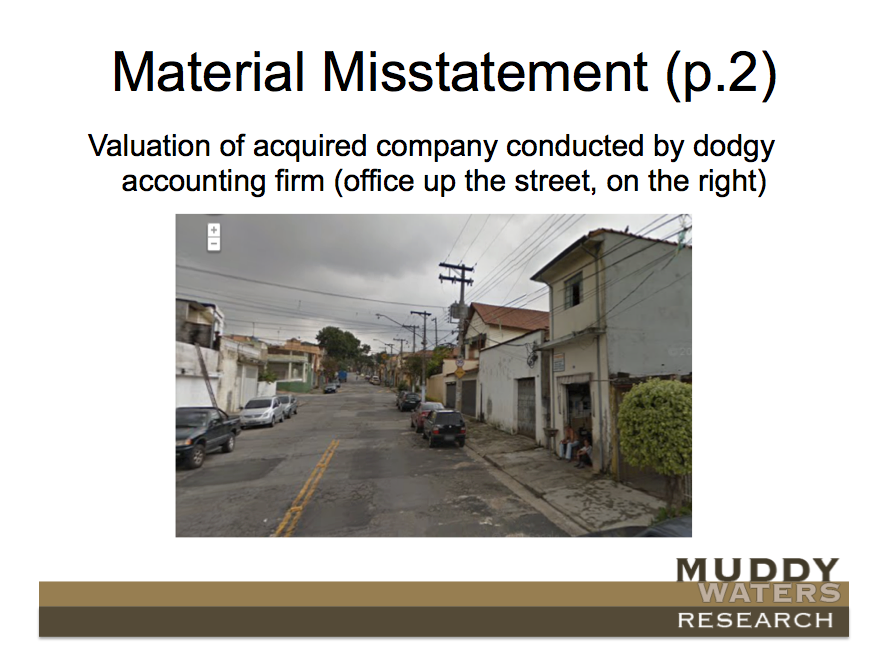
Muddy Waters founder Carson Block took communications powerhouse American Tower Corp to task on Bloomberg Market Makers yesterday. Block’s research firm is out with a new report that casts doubt over AMT’s work in emerging markets, hinting that the company has been misleading, if not outright fraudulent. “We rate AMT a Strong Sell and value it at $44.57 per share, representing downside of 40%,” Muddy Waters writes in the report. “It has engaged in a value destroying investment binge overseas, and we have identified a significant material misstatement in the Company’s accounts that could amount to fraud.” Muddy Waters flagged one transaction in particular, a $585 million purchase of towers in Brazil. “There is an approximately US$250 million discrepancy between what AMT claims to have paid for the acquisition of towers in Brazil, and the actual selling price,” according to the report. Muddy Waters provided the research to the SEC.jpg (25) jpg (26) jpg (27) jpg (28) jpg (29)

Distinguishing Alpha from Noise: Resurrecting the Role of Investment Philosophy in Evaluating Investment Managers; “In the long run X always wins”, where X could be dividend yield, earnings growth, quality of management, yet managers are unable cite a reason why X should be systematically under-priced by the market.

17 Jul

Distinguishing Alpha from Noise

David J. Merkel

I read a paper today that I thought was pretty interesting — A Consultant’s Perspective on Distinguishing Alpha from Noise. [8 pages PDF]  I have been on both sides of the table in my life.  I have hired managers, and I have tried to sell my equity management services. In general, managers that thought would offer value would venture off the beaten path.  They might own some well-known names, but they would own far more that would make me say, “Who is that?”  The companies would be less known because they are smaller, foreign, have a control investor, etc. Those portfolios would look a lot different than an index fund.  They would be more concentrated by sector, industry and company.  They would have a process that analyzes what the market is misvaluing, whether by sector, industry, or company.  They would stick to their discipline through thick and thin, realizing that all anomalies in the market go in and out of favor. Read more of this post

South Korea tycoon and CJ chairman Lee Jae-Hyun charged with embezzlement, tax evasion; stashed away undeclared assets worth about 96 billion won (S$108.5 million) and evading taxes worth 54.6 billion won since 2004

South Korea tycoon charged with embezzlement, tax evasion

Published on Jul 18, 2013
SEOUL (AFP) – The head of South Korean food and entertainment giant CJ Group was charged on Thursday with embezzlement and tax evasion, as Seoul seeks to rein in family-controlled business groups. Lee Jae-Hyun, 53, allegedly stashed away undeclared assets worth about 96 billion won (S$108.5 million) and evading taxes worth 54.6 billion won since 2004. “This is a case where a business tycoon illicitly pocketed funds diverted from listed companies and evaded tax,” Prosecutor Park Jeong-Shik told journalists. Lee created some 10 shell companies in foreign countries, including Singapore and Hong Kong, to avoid tax, he said. Three other former and current executives of the group were also charged as accomplices.

Future of STX remains in doubt; W3 tril. liquidity injection plan fails to restore confidence

2013-07-17 16:55

Future of STX remains in doubt

W3 tril. liquidity injection plan fails to restore confidence
By Kim Rahn

Concerns are growing over a plan by creditors to inject 3 trillion won into cash-strapped STX Offshore & Shipbuilding because it is uncertain whether the shipbuilder will recover, even with the fresh liquidity.
Experts say the company’s full recovery depends on unforeseeable economic factors. Even creditors have raised concerns over whether the shipbuilding firm will recover and become profitable again because the sluggish shipbuilding and shipping industry are unlikely to improve soon. Read more of this post

China Resources Power fell the most in more than four years after Xinhua media said the power generator and the chairman of its state-owned parent intentionally overpaid for a 2010 acquisition

China Resources Power Falls After Report of Deal Overpayment

China Resources Power Holdings Co. (836) fell the most in more than four years after the official Xinhua News Agency posted a letter on its website by one its reporters that said the power generator and the chairman of its state-owned parent intentionally overpaid for a 2010 acquisition.

The company’s shares fell as much as 11.8 percent, the biggest drop since Nov. 6, 2008, and were trading down 10.4 percent as of 2:20 p.m. in Hong Kong. The city’s benchmark Hang Seng Index was little changed. Read more of this post

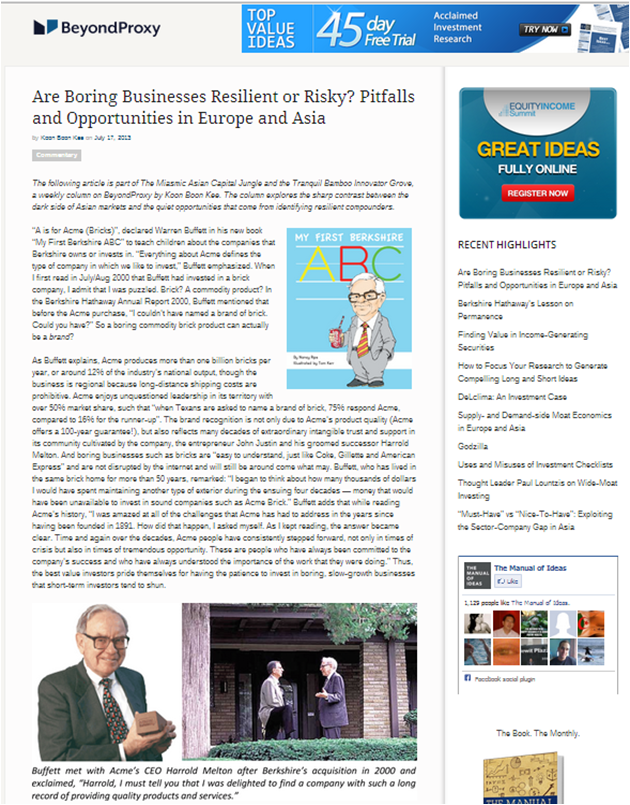
Are Boring Businesses Resilient or Risky? Pitfalls and Opportunities in Europe and Asia. Bamboo Innovator is featured in BeyondProxy.com, where value investing lives

Bamboo Innovator is featured in BeyondProxy.com, where value investing lives:

  • Are Boring Businesses Resilient or Risky? Pitfalls and Opportunities in Europe and Asia, July 17, 2013 (BeyondProxy)

BoringBusiness

Diving Into Economic Moats

Diving Into Economic Moats

By Jeremy Glaser and Heather Brilliant, CFA | 07-10-2013 02:00 PM

Jeremy Glaser: For Morningstar, I’m Jeremy Glaser. We’ve recently launched a dedicated economic moat section in our Premium Stock Analyst Reports. I’m here with Heather Brilliant, the global director of equity research, to talk about the importance of economic moats and the best way to use this new section. Heather, thanks for joining me.

Heather Brilliant: Thanks for having me, Jeremy.

Glaser: So let’s talk a little bit about what an economic moat is. I know it’s a term we talk about a lot. But what exactly does it mean? How should investors be thinking about it?

Brilliant: So, we use the term “economic moat” to connote a sustainable competitive advantage. And importantly, an economic moat rating has been available as part of the Premium service for a long time, and what we’re really doing now is trying to give investors a little bit more insight into how we arrive at that economic moat rating, or why we think a company has a moat or not. And so, when you read the section, you can really get a deeper sense of, well, why is this company a wide moat or a narrow moat, or even, why doesn’t it have a moat? And so, I think that will really enhance the direct applicability of some of the research to the ratings that we’ve been putting out for some time. Read more of this post

The woeful admission by Treasury Wine Estates that inventory levels had been grossly mismanaged and overstated is going to lead to a major rethink by the market about what this company has been doing for the past couple of years

US wine stocks stain market darling

July 16, 2013

Elizabeth Knight

MK-CE757_AUSWIN_NS_20130715183604

The woeful admission by Treasury Wine Estates that inventory levels had been grossly mismanaged and overstated is going to lead to a major rethink by the market about what this company has been doing for the past couple of years.

Under chief executive David Dearie, Treasury Wine has been telling a positive story about remaking the company, focusing on the high-end brands and installing proper management disciplines – a goal made possible thanks to winning independence from Foster’s in 2011. Read more of this post

Accounting Scandal Hooks Spanish Frozen Fish Giant; “It’s Enron, Spanish style. There was a tangle of subsidiaries set up solely and uniquely to hide the debt.”

Accounting Scandal Hooks Spanish Frozen Fish Giant

By Katell Abiven on 2:45 pm July 14, 2013.

A Pescanova’s store is pictured in Vigo, northwestern Spain, on June 26, 2013. The head of Spanish frozen fish giant Pescanova admitted on July 11, 2013 he may have made bad decisions after an auditor’s report said the group deliberately fabricated deals and financial results to disguise a 3.28-billion-euro ($4.3 billion) debt. (AFP Photo/Miguel Riopa)

Madrid. It boasts a fleet of 100 ships and 10,000 employees worldwide but suspected fraud at frozen seafood giant Pescanova is causing an embarrassing stink in export-hungry Spain. After years of posting growing sales, amounting to 1.7 billion euros ($2.2 billion) in 2011, the group that was among the world industry’s leaders and the pride of the northern region of Galicia has plunged into scandal. One evening in February, Pescanova was forced to reveal that it could not publish its 2012 accounts. Two months later, on April 25, it filed for bankruptcy. “That was a surprise,” said Francisco Vilar, regional secretary of the food-processing federation of the main union at Pescanova, the Workers’ Commissions (CCOO).  People who work here have been here for 30, 40 years, with good management. So it was an enormous surprise.” Pescanova is accused of false billing, hiding a debt of 3.3 billion euros that was more than double the declared figure, and its top managers of selling shares just before the scandal broke. “It’s Enron, Spanish style,” said one banking source, referring to the giant US energy group that collapsed in the 2000s in one of the biggest financial scandals in US corporate history. Read more of this post

From $177 Million to $2.6 Billion: Once teetering on the edge of bankruptcy, Restoration Hardware is turning into a bonanza for its private-equity owners.

Updated July 14, 2013, 7:58 p.m. ET

Restoration Hardware’s Renovation Is Private-Equity Boon

Restoration Hardware Holdings Inc. is turning into a bonanza for its private-equity owners.

By RYAN DEZEMBER and MATT JARZEMSKY

MI-BX181_HARDWA_NS_20130714184203 MI-BX185_HARDWA_G_20130714184208

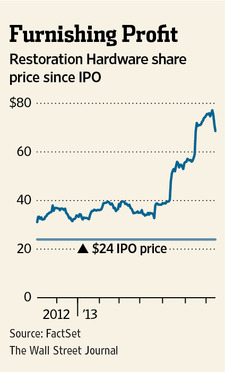
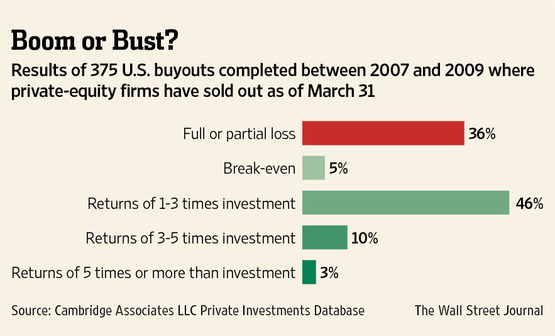
RH +1.01% Once teetering on the edge of bankruptcy and subject of a buyout bidding war during which offers shrank, Restoration Hardware Holdings Inc. RH +1.01% is turning into a bonanza for its private-equity owners. The firms that bought the luxury-home-furnishings retailer in 2008 are on track to make about eight times their initial investment, when including their remaining stock holdings in the company, according to a Wall Street Journal analysis of securities filings. This is a huge return among deals struck in the years leading up to and during the financial crisis. Five years ago, as the housing crash crimped the company’s profits, a group led by Connecticut private-equity firms Catterton Partners and Tower Three Partners LLC and the retailer’s chief executive took the company private for about $177 million. Restoration still doesn’t turn out consistent profits. But today the retailer, which returned to public ownership in a November initial public offering, has a stock-market value of about $2.7 billion. Read more of this post

Stella International Takes on LVMH to Expand in Paris

Stella International Takes on LVMH to Expand in Paris

Stella International Holdings Ltd. (1836), the Asian shoemaker that manufactures for companies such as Prada SpA (1913), plans to expand its own brands in Paris, turning into a lower priced competitor to luxury clients there.

The contract manufacturer plans to add two shops in Paris by end of this year and expand into other locations in Europe, Stephen Chi, chief executive officer of the company’s women’s footwear and retail business division, said in a July 10 phone interview. The company, which was founded in Taiwan and trades on the Hong Kong stock exchange, already has one Paris store. Read more of this post

The hidden costs of investing

July 12, 2013 5:43 pm

The hidden costs of investing

By Lucy Warwick-Ching

Hidden Costs

Picture the scene. You’ve splashed out on the latest Aston Martin. But as you climb into the driver’s seat you’re asked to pay a fee for the key to the car and another charge for its manual. Then, just as you’re about to drive off the dealer’s forecourt you’re hit with yet more charges – an exit fee for leaving the garage, followed by separate charges for the leather seats and passenger door. Most of us wouldn’t keep silent if this scenario happened in real life, so why do so few investors complain about the percentage of their money that goes on charges? “Confusion about charges on investment funds and pensions has left most investors in the dark about how much they are paying,” says Gina Miller of SCM Private, a wealth manager, who is spearheading a“True & Fair Campaign” to encourage better disclosure of investing costs. Read more of this post

Momentum investing is bad for your wealth; Managers should focus on companies, not prices

July 12, 2013 5:46 pm

Momentum investing is bad for your wealth

By Paul Woolley

Managers should focus on companies, not prices, says Paul Woolley

The role of the finance sector is to channel savings into productive investment. Those of us who invest directly in shares can form their own views on how best to do that. Everyone else is reliant on the industry to do it for them. Institutions such as pension funds fulfil this role, acting as the collection point for savers’ capital and setting the terms for how it is allocated. We innocently assume that our capital is directed to those sectors and companies with the best earnings potential. That way we receive the highest returns and the economy flourishes. The sad truth is that isn’t how it works in reality. The bulk of investment is now conducted without reference to economic value. There are only two basic strategies for managing equity portfolios in particular: fundamental investing – based on expected future cash flows – and momentum investing, or trend following, which considers only short-run price changes and disregards value. Fundamental investing calls for patience. Investors must wait either for prices to reflect the full value of the underlying business, or earnings to crystallise as dividends. Momentum investing delivers quick gratification – or not, depending on how long trends last. Read more of this post

Hong Kong regulators are reportedly investigating allegations of fraud against Zoomlion Heavy, China’s second-largest construction machinery maker

Probe into Zoomlion 
Thursday, July 11, 2013
Hong Kong regulators are reportedly investigating allegations of fraud against Zoomlion Heavy Industry Science and Technology (1157). Guangzhou-based Southern Metropolis Daily and Yangcheng Evening News received two documents showing Hong Kong Exchanges and Clearing (0388) and the Securities and Futures Commission accepted complaints against the Changsha-based machinery maker on June 7. They allege the firm is involved in manipulating profit and misleading investors by making false statements. The anonymous complaints also noted similar allegations against Zoomlion were presented to the China Securities Regulatory Commission on Tuesday.Both the HKEx and SFC declined to comment on the issue. Zoomlion shares fell 1.78 percent yesterday to HK$4.98. Since allegations first surfaced in January, the stock has declined 57 percent. NATALIE NGAN

Financial fraud investigation into Chinese wind energy giant Sinovel after a few years of explosive growth

07.11.2013 18:48

Post-Boom Blowdown for Wind Energy’s Sinovel

A wind energy giant is in trouble with regulators, customers and investors after a few years of explosive growth

Pu Jun and Yu Ning

(Beijing) — Wei Wenyuan’s sudden resignation stunned his colleagues at Sinovel Wind Group but started making sense two weeks later when securities regulators announced a financial fraud investigation targeting the company. Wei’s departure May 13 after just two months as chairman and eight months as acting president also mirrored the turbulent atmosphere at Sinovel, one of China’s largest wind turbine manufacturers as well as a developer of wind farms locally and overseas. Read more of this post

Corporate Insiders Shift From ‘Buy’ to ‘Sell’ as Bankruptcy Nears

July 10, 2013, 11:02 p.m. ET

Corporate Insiders Shift From ‘Buy’ to ‘Sell’ as Bankruptcy Nears

SUSAN PULLIAM and ROB BARRY

P1-BM252B_Tradi_G_20130710184829

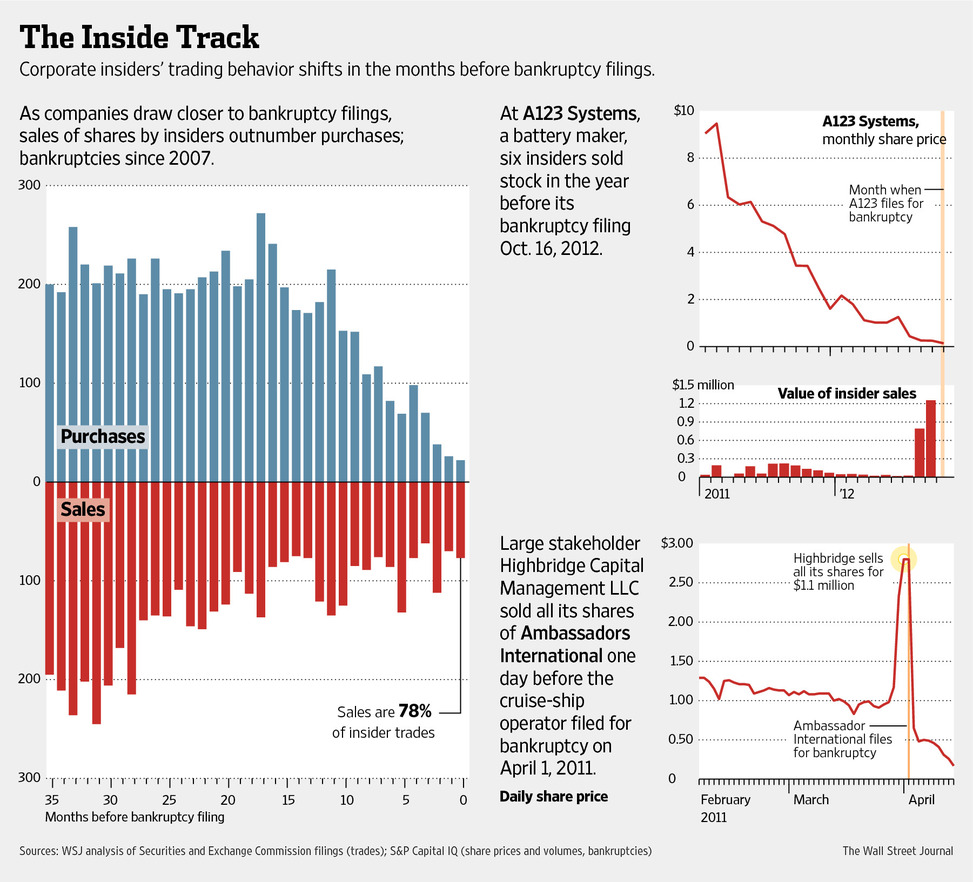
One day in September 2011, Wall Street analysts trundled into the spacious lobby at the Livonia, Mich., plant of a company called A123 Systems Inc. to view a slide presentation describing a rosy outlook for the maker of lithium batteries. “They stood up in front of investors and painted a very bullish picture,” said Andrea James, an analyst at Dougherty & Co., who took pictures of the lobby’s two-story floor-to-ceiling window. “It looked like the lobby of a company that was making money hand over fist.” Thirteen months later, it filed for bankruptcy protection. But not before insiders unloaded a total of $2.5 million of its stock. The company said the sales conformed to its policy for insider transactions. The episode suggests how corporate insiders’ trading can shift in the months before their companies file for bankruptcy. A Wall Street Journal review of thousands of trades by insiders in their own company’s stock found the trades veering heavily toward selling rather than buying as bankruptcy filings drew nearer. Read more of this post

Supply- and Demand-side Moat Economics in Europe and Asia. Bamboo Innovator is featured in BeyondProxy.com, where value investing lives

Bamboo Innovator is featured in BeyondProxy.com, where value investing lives:

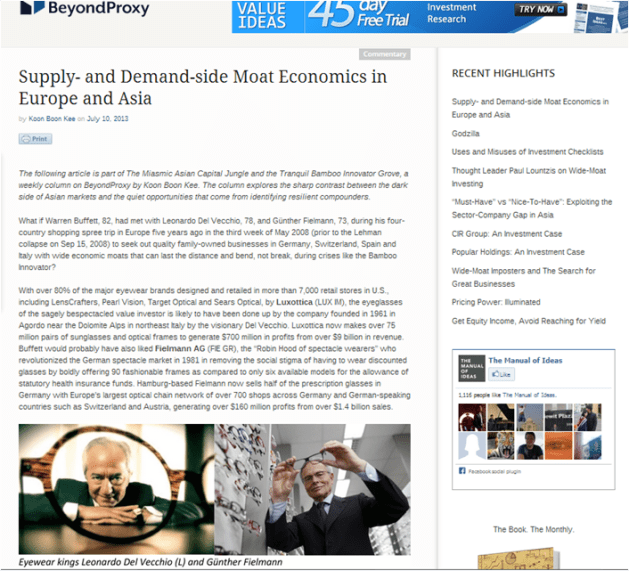
  • Supply- and Demand-side Moat Economics in Europe and Asia, July 10, 2013 (BeyondProxy)

Moat Economics

Wide Moat Investing Summit 2013 (July 9-10): Bamboo Innovator presents “Wouldn’t it be nice if we can invest BEFORE the economic moat is obvious?”

Warren Buffett, the Human Big Data Engine

Warren Buffett, the Human Big Data Engine

Posted May 3, 2013 by Chanu Darmarla in Big DataThought Leadership

Warren Buffett is one of the world’s most successful investors. By combining a sound investment philosophy with a bullet-proof decision-making process, Buffet has been able to outperform the stock market by roughly 13% over a 35-year period. Buffett spends countless hours researching each of his equities. Before making a decision, he reads annual reports, news publications and any other information he can get his hands on. His decisions are informed by research, and based on the strict fundamentals that work best for his style of investing. The way Buffett operates is not unlike the best use cases for big data. Among other things, his success lies in his ability to make good decisions in accordance with quality benchmarks. This is the key to using big data well, and to business success in general. Big data users can learn from Warren Buffett. His brain, in effect, is a kind of big data engine. Here are three lessons that Buffett provides for big data users:

1. Know What You’re Looking For

By analyzing large amounts of data from diverse sources, we can gain context and correlations that wouldn’t have otherwise occurred to us. Buffett pulls from actuary reports and bond publications; big data can suck information out of nearly everything, from social media to expense reports. But it is all for nothing if you don’t know what you’re looking for. You need structure around your queries. Buffett has a few rules of thumb. He looks for low-volatility stocks with a low price-to-book ratio. They should be profitable and growing, among other considerations. Similarly, if you ask your data analytics platform the right questions, you’ll know the best answers when you see them. Perhaps you’re looking for a Scotch-drinking customer base that prefers premium product and prioritizes convenience over shopping around. If you know that before you ask your data engine to generate their social media preferences, you’ll get a much better result than if you asked the same question about Scotch drinkers in general. Read more of this post

Best performing Russell 3000 stocks YTD

2013’s Top Stocks…So Far

FRIDAY, JULY 5, 2013 AT 02:05PM

bestray705

We’re now a few trading days into the second half of the year, and with not much going on this Friday after July 4th, we thought now was as good of a time as any to highlight some year-to-date performance numbers. Below is a chart showing the YTD performance of the S&P 500 and its ten sectors (purple bars) along with the average YTD performance of stocks in the Russell 3,000 by sector (green bars).  As you’ll see in the chart, while 2013 has been a great year for the largecap S&P 500, it has been an even better year when you include all of the midcap and smallcap stocks that make up the US equity market.  (The Russell 3,000 is made up of all Russell 1,000 — large and midcaps — and Russell 2,000 — smallcaps — stocks and represents 98% of the US stock market.) As shown below, the cap-weighted S&P 500 is currently up 13.9% year to date, but the average stock in the Russell 3,000 is up 22.3%!  The S&P 500 Consumer Discretionary sector is up 21.4% YTD, but the average Consumer Discretionary stock in the Russell 3,000 is up significantly more than that at 32.5%.  Technology stocks have done much better in 2013 than the S&P 500 Technology sector suggests as well.  Due to Apple’s struggles, the S&P 500 Tech sector is up just 7.4% YTD, but the average Technology stock in the Russell 3,000 is up 21.9%.  The only sector where largecaps are doing better than midcaps and smallcaps is the Financials.  As shown, the S&P 500 Financial sector is up 20.1% YTD, while the average Financial stock in the Russell 3,000 is up 16.9%.  These results within the Financial sector coincide with a post we did a couple of weeks ago on the impact that Dodd-Frank might be having on smaller financial firms. As mentioned above, the average Russell 3,000 stock is up 22.3% year to date.  Of the stocks that make up the Russell 3,000, 81.8% are in the green so far this year, while 86 stocks in the index are up more than 100%.  Below is a list of the 50 best performing Russell 3,000 stocks so far in 2013.  As shown, Revolution Lighting Technologies (RVLT) is up the most with a gain of 479.92%, followed by Clovis Oncology (CLVS) and YRC Worldwide (YRCW).  Some other notables on the list include Tesla (TSLA), Best Buy (BBY) and Netflix (NFLX).  Outside of these names, however, you’ve probably never heard of most of the stocks.  If you’re looking for new ideas, why not take some time to become familiarized with this year’s big winners.  It can’t hurt!
Global Yellow Pages CEO Stanley Tan loses $25.4m in 2 days in financial products, sues UBS

Yellow Pages CEO loses $25.4m in 2 days, sues UBS

Saturday, Jul 06, 2013, AsiaOne

acc430

SINGAPORE – Global Yellow Pages CEO Chen Bao Neng (Stanley Tan) is taking UBS to court after he suffered losses amounting to $25.4 million in just two days. According to Lianhe Zaobao, the 55-year-old executive director had invested in 16 financial products through UBS from October 2007 to August the following year. He then lost $25.4 million in the 2008 financial crisis.  Read more of this post

How Wal-Mart Became the World’s Biggest Retailer

How Wal-Mart Became the World’s Biggest Retailer

By Alex Planes
July 2, 2013 | Comments (1)

On this day in economic and business history…

The first Wal-Mart (NYSE: WMT  ) opened its doors in Rogers, Arkansas on July 2, 1962. At this point in his life, Wal-Mart founder Sam Walton had already racked up over two decades of experience as a retailer. He got his start in the industry as a management traineein one of J.C. Penney‘s (NYSE: JCP  ) Iowa stores in 1940. Penney’s focus on maximizing the value of a customer’s visit goes a long way toward explaining Walton’s lifelong obsession with making his own store experiences better through research and observation. Five years later, Walton purchased his first store, a Ben Franklin five-and-dime in Newport, Arkansas with a $20,000 from his father-in-law. Walton took the unprofitable Ben Franklin and turned it into that company’s biggest success in Arkansas, learning along the way that lower prices and proper in-store marketing techniques can make a world of difference in the brutally competitive retail industry. Read more of this post

Unique Characteristics in Dental and Veterinary Distributor Markets Support Wide Economic Moats

Unique Characteristics in Dental and Veterinary Distributor Markets Support Wide Economic Moats

By Michael Waterhouse | 07-05-13 | 06:00 AM | Email Article

We have upgraded  Henry Schein (HSIC) and  Patterson Companies (PDCO) to wide-moat companies thanks to their strong competitive advantages in the dental and veterinary distribution markets. As critical intermediaries between a highly fragmented base of customers and suppliers that depend on their scale and customer services, Schein and Patterson possess competitive advantages that support a long time frame of attractive returns on capital, in our view. We also think the high out-of-pocket dental and vet markets will sustain consistent midsingle-digit growth over the long term. Both stocks are trading close to our fair value estimates of $99 and $39 for Schein and Patterson, respectively, and while valuations don’t currently suggest attractive entry points for either firm, we think investors should keep these names on their watch lists. Read more of this post

Ferrari-Beating Great Wall Motor Shows Wei Jianjun Forging Next Hyundai

Ferrari-Beating Great Wall Shows Wei Forging Next Hyundai

Wang Jiangwei recalls spending last summer sweating through a month of military drills conducted by Chinese People’s Liberation Army instructors. Wang isn’t a soldier; he’s a researcher at Great Wall Motor Co. His Baoding, China-based employer is so profitable, it generates a fatter margin than any listed carmaker in the world. Behind the success is Chairman Wei Jianjun, who has built China’s biggest SUV maker with a leadership style that stands out for its emphasis on discipline and frugality. “The military training is pretty serious and tough,” said Wang. “Not only new hires but people who get promoted, even those becoming department heads, need to redo training.” Great Wall represents a rare breed of Chinese automakers independent of foreign partners and government, sparing it from having to split profits and endure extra bureaucracy. With the stock surging 60-fold (2333) in Hong Kong since its 2008 low, Wei has become Asia’s wealthiest car executive, with an estimated fortune of $6.5 billion as he strives to create China’s first global automotive brand. “Wei is a real professional, a real entrepreneur,” said Bill Russo, formerly vice president of Chrysler Northeast Asia and now president of automotive consultant Synergistics Ltd. in Beijing. “If there’s one or two automakers able to survive all the competition with foreign rivals in the next decades or so, Great Wall will definitely be one of them.” Read more of this post

William Heinecke, an Early Entrepreneur in Asia, Is Still Finding Success; The billionaire chairman of Minor International has maintained the spirit of American entrepreneurship: find a gap and fill it

JULY 4, 2013, 1:48 PM

William Heinecke, an Early Entrepreneur in Asia, Is Still Finding Success

By RON GLUCKMAN

dbpix-heinecke-tmagArticle

From his Asian base, William Heinecke is expanding into Africa, the Middle East and Australia. “It’s a more complex world,” he says. “But the skills of being an entrepreneur haven’t changed, and probably won’t change.”

BANGKOK — William Ellwood Heinecke has always followed his instincts. He started his first businesses, cleaning offices and selling advertising, as an expatriate high school student in Bangkok. He was a millionaire before he reached voting age. Defying conventional wisdom at the time about overseas appetites, he introduced pizza to Asians in the early 1980s, the start of an empire of retailers, restaurants and resorts built around classic brands like Pizza Hut, Sizzler, Marriott and Esprit. It encompasses more than 10,000 rooms and 1,400 restaurants across 22 countries. He has moved up the value chain, developing his own successful brands. Now Mr. Heinecke, the billionaire chairman of Minor International, has aggressively steered expansion into the Middle East, Africa, Australia and emerging markets across Asia, flying around the region in corporate jets, swooping in on huge deals. Maintaining the spirit of American entrepreneurship, Mr. Heinecke has kept his mantra the same: find a gap and fill it. Read more of this post

Performance of China’s Hong Kong Shares Has Been a Long-Term Letdown

July 4, 2013, 5:34 p.m. ET

Performance of China’s Hong Kong Shares Has Been a Long-Term Letdown

DANIEL INMAN

MI-BW991_CHISTO_NS_20130704175705

When Tsingtao Brewery Co. 600600.SH +0.48% went public in Hong Kong in July 1993, runaway investor demand for the beer maker’s new shares lifted them 29% on their first trading day. Since then, nearly 600 other big Chinese companies have raised a total of about $250 billion through initial public offerings in Hong Kong, according to Dealogic. IPOs by banks, real-estate developers and other firms opened the door for foreign investors eager to bet on China’s booming economy—and vaulted Hong Kong into a big-time rival to New York and London in the global battle for new stock listings. But the performance of so-called H-shares, as Hong Kong listings of companies incorporated in China are known, has been a letdown. The Hang Seng China Enterprises Index is up 43% since its birth in 1994. Economic growth in China has averaged 10% over the past two decades. In comparison, Japan’s Nikkei Stock Average lost 30% in a prolonged period of economic stagnation, and the U.K.’s FTSE 100 index gained 101%. Read more of this post

Novo’s Scale Advantages and Drug Lineup Broaden Its Wide Moat

Novo’s Scale Advantages and Drug Lineup Broaden Its Wide Moat

By Lauren Migliore, CFA | 07-03-13 | 06:00 AM | Email Article

 Novo Nordisk (NVO) has been consistently at the forefront of diabetes care, and we expect favorable industry dynamics and the firm’s formidable research and development and diabetes-focused commercialization infrastructure to continue to drive strong returns on shareholder capital.

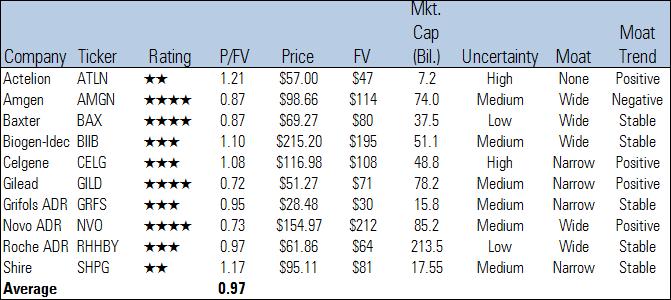
We expect growth to come from increased market penetration in diabetes care and stable growth in biopharmaceuticals. Once-daily Victoza continues to outperform once-weekly Bydureon in the GLP-1 market thanks to the competing drug’s inability to prove noninferiority in trials, and we expect Victoza to break the $2 billion mark in annual sales this year. Novo’s next-generation products, Tresiba and Ryzodeg, will help the company defend its leading insulin franchise, though we expect that a complete response letter will delay U.S. launch by two to three years. This regulatory setback, along with recent safety concerns for the incretin class–of which Victoza is a member–has caused shares to underperform, and Novo is now trading at one of the steepest discounts to fair value (over 20%) in the large-cap biotech space (see the following table). However, we think these issues have little long-term impact on the company’s value, and instead present investors with the rare opportunity to own this high-quality name at an attractive price.

Comparables Within the Biotechnology Industry
1678

Source: Morningstar Read more of this post

“Must-Have” vs “Nice-To-Have”: Exploiting the Sector-Company Gap in Asia. Bamboo Innovator is featured in BeyondProxy.com, where value investing lives

Bamboo Innovator is featured in BeyondProxy.com, where value investing lives:

  • “Must-Have” vs “Nice-To-Have”: Exploiting the Sector-Company Gap in Asia, July 3, 2013 (BeyondProxy)

SectorCoGap

CJ Group has gone into emergency mode after Chairman Lee Jay-hyun was arrested Monday on charges of creating secret funds and evading taxes

2013-07-02 17:24

CJ put on emergency footing

By Kim Tae-jon

CJ Group has gone into emergency mode after Chairman Lee Jay-hyun was arrested Monday on charges of creating secret funds and evading taxes.  Read more of this post

China’s Lady Buffett and HK-listed white spirits company Silver Base wrote off more than HK$600 million worth of sales that it could not recoup

Drink firm has little to cheer as ban hits
Victor Cheung
Tuesday, July 02, 2013

SilverBase Dukang

Economic slowdown and a ban on liquor consumption at official banquets sparked losses of more than HK$1 billion for the year to March 31 at Silver Base (0886). The distributor of several famous brands of white spirits, or baijiu, also wrote off more than HK$600 million worth of sales that it could not recoup. For the 2012-13 fiscal year, losses hit HK$1.13 billion, compared with a profit of HK$926 million in the previous fiscal year. Revenue slumped 87percent to HK$390.19 million. The losses include HK$650 million impairment and write-off loss for trade receivables, and some HK$100 million for inventory provision. In addition, inventories doubled to HK$1.22 billion. Liquor bans on government departments have “brought a direct and severe hit to the sales of high-end baijiu” brands such as Wuliangye, the company said. But Wuliangye Yibin, the maker of upmarket baiju, still saw 50percent in bottom line growth in the same period. Since 2009, chairman Liang Guoxing has been reducing his stake from 67percent to less than 50percent. New World (0017) group founder Cheng Yu-tung has also downsized his stake in Silver Base from the second half of last year, from more than 8percent to less than 5percent. But Liu Yang, chairwoman of Atlantis Investment Management, spent some HK$258 million to buy the firm’s shares from September and now holds a 14percent stake. Read more of this post