Entrepreneurs shine through in gloomy times; winners of the Queen’s Awards for Enterprise are a showcase for the country’s ability to create innovative products and services and sell them around the world.

April 22, 2013 12:43 am

Entrepreneurs shine through in gloomy times

By Brian Groom

Five years into the most prolonged economic downturn of modern times, British business could do with cheering itself up. A glance through this year’s winners of the Queen’s Awards for Enterprise should help.

From a maker of mass spectrometers to a nail bar chain, from a maker of milking equipment to a supplier of food supplements to improve fertility, the winners of the awards – first handed out in 1966 – are a showcase for the country’s ability to create innovative products and services and sell them around the world.

The 2013 list, published to mark the Queen’s birthday on April 21, contains 152 business awards, mixing FTSE companies with subsidiaries of foreign-owned groups and private businesses. Read more of this post

One Way to Time the Market; VLMAP, Value Line’s Median Appreciation Potential, is used to project where the market will be in four years

April 19, 2013, 4:59 p.m. ET

One Way to Time the Market

By MARK HULBERT

The stock market in four years’ time is unlikely to be much higher than it is now. That sobering forecast comes from a simple stock-market timing model that has an impressive track record over the past five decades. Among the more than 100 market timing strategies tracked by the Hulbert Financial Digest, in fact, this model has turned in the best performance of any in forecasting the market’s four-year return. The clear investment implication is to begin reducing risk in your stock portfolio—either by building up cash or shifting your holdings toward more conservative stocks such as those with strong balance sheets and which pay high dividends.

This market timing system is based on a single number that appears each week in the Value Line VALU -1.20% Investment Survey, the flagship publication of Value Line, a New York-based research firm. The number represents the median of the percentage gains that Value Line’s analysts estimate the 1,700 widely followed stocks they monitor will produce over the next three to five years. Over the past five years, for example, this number—known as the VLMAP, for Value Line’s Median Appreciation Potential—has been as low as 45% and as high as 185%. It currently stands at 50%. Value Line itself doesn’t endorse using the VLMAP for market-timing purposes. Though the firm doesn’t actively discourage investors from relying on this number or any of the other data that it produces, Value Line instead showcases a market-timing model that has a shorter-term focus.

Read more of this post

Tech’s Rust Belt Takes Shape: Technology has long distributed its riches unequally. But the sector has seldom seemed so sharply divided between disrupters and the disrupted

Updated April 18, 2013, 8:03 p.m. ET

Tech’s Rust Belt Takes Shape

By DON CLARK and SHIRA OVIDE

MK-CC544A_TECHE_NS_20130418183603MK-CC543_MSOFT__NS_20130418182704

Technology has long distributed its riches unequally. But the sector has seldom seemed so sharply divided between disrupters and the disrupted. Computing pioneer International Business Machines Corp. IBM -1.20% on Thursday reported its revenue dropped 5% after failing to close big software and hardware deals. IBM is also in advanced talks to sell part of its server system business to Lenovo Group Ltd., 0992.HK +4.81% according to people familiar with the matter, the same company that bought IBM’s personal-computer business in 2005. Software giant Microsoft Corp.,MSFT -0.12% once known for rapid sales of PC software, reported that the business that includes its Windows operating system turned in essentially zero growth after one-time effects of software revenue deferrals. By contrast, Internet innovator Google Inc. GOOG -2.13% said Thursday revenue grew 31% in the first quarter, while profit rose 16%.

The growth disparities are just the latest repercussions of technology shifts—including the rise of mobile devices and slowing growth in personal computers, the replacement of conventional software with online versions and outsourcing corporate internal computing operations to facilities run by other companies. Tech’s turmoil bears similarities to the way old-line industrial companies in America’s Rust Belt lost sales to rivals in Asia and other regions. But the disrupters this time are mainly domestic and born since the Internet revolution took hold in the mid-1990s, often offering free or low-cost alternatives to widely used products. Read more of this post

East Coast’s Q1 Letter: How an Idea Goes Through Their Investment Process

Thursday, April 18, 2013

East Coast’s Q1 Letter: How an Idea Goes Through Their Investment Process

Christopher Begg’s East Coast Asset Management is out with their first quarter letter for 2012.  Entitled “The Art of Fugue,” the letter details how an opportunity goes through their investment process and they also provide an update on their portfolio. Investment process is always a work in progress, so it’s interesting to hear how other investors refine this and what they incorporate into their approach.  On East Coast’s process, Begg writes, “Once an investment idea is sourced, the idea is put through an initial checklist and if it has merit it will ultimately be categorized as a compounder, a transformation, or a workout. Next, the investment idea will go through two stages of due diligence – two individual fugues, both in six parts. In each six-part stage we always begin and resolve with our subject, or royal theme, which is a perspective on compounding.” We’ve highlighted East Coast’s investment process before, but their latest letter breaks down the six things they look at (in search of quality of the business):
– Competitive advantage
– Pricing power
– Market opportunity
– Capital itensity
– Economics
– Management
Then eventually they look to answer 4 questions:
1. Does the investment have an attractive expected rate of return? (IRR)
2. Does the investment have a sufficient margin of safety?
3. Do we understand the critical data points that will drive the success and intrinsic value of the business?
4. Do we understand first cause, or why the investment may be mispriced?
Begg then applies the above to a new holding they initiated in the quarter so you can follow along with their investment process to see how they think about everything.  It’s certainly a useful exercise and some of you may be able to guess the position.

http://www.docstoc.com/docs/document-preview.aspx?doc_id=153075680

A Story of Value Investing by Loews: The Adventures of Lotta Value, Investment Hunter

The Adventures of Lotta Value, Investment Hunter

At Loews, we seek to combine dynamic creativity and a willingness to embrace constant change with a deep and abiding commitment to long-established principles of prudent business and investment management.
Our presentation of the Loews value story in graphic form may surprise some of you. We chose this method of communication because it has become increasingly difficult, in today’s “pure-play” business environment, for conglomerates like Loews to be heard.
We know we have a good story to tell, and we want to find a new way to tell it — this time in a unique and engaging way.
Since we never do anything halfway at Loews, we asked Lotta Value to be our guide.
We hope you enjoy The Adventures of Lotta Value, Investment Hunter ! We certainly had a lot of fun creating her and sending her on her value quest.

value-hunter

Berkshire Gains as Buffett’s Coca-Cola Stake Rallies

Berkshire Gains as Buffett’s Coca-Cola Stake Rallies

Warren Buffett’s Berkshire Hathaway Inc., the largest investor in Coca-Cola Co. (KO), jumped the most since January in New York trading on gains in the value of its stake in the soft-drink maker. Berkshire Class A shares rallied $4,000, or 2.6 percent, to $161,000, a record closing price. Atlanta-based Coca-Cola surged 5.7 percent after posting first-quarter profit that beat analysts’ estimates and announcing a deal to sell some bottling distribution rights in North America. Buffett’s firm has 400 million Coca-Cola shares, making it one of the four largest holdings at Omaha, Nebraska-based Berkshire, along with investments in Wells Fargo & Co., American Express Co., and International Business Machines Corp. Berkshire’s stakes in the companies may increase in the future as the firms buy back shares, Buffett said in a letter to investors last month. “The four companies possess marvelous businesses and are run by managers who are both talented and shareholder- oriented,” Buffett said in the letter. “Too much of good thing can be wonderful.”

To contact the reporter on this story: Noah Buhayar in New York at nbuhayar@bloomberg.net

Updated April 16, 2013, 7:59 p.m. ET

New Coke: Bottlers Are Back

Beverage Company Expanding Delivery Territories for Five of Its Independent Bottling Companies

By MIKE ESTERL And PAUL ZIOBRO

Coca-Cola Co. KO +5.69% likes to have its cake and eat it too.

That is why it sold its bottlers and then bought them back again. That is why it is now going back to the franchise model for distribution. Read more of this post

Amazon’s Letter To Shareholders Should Inspire Every Company In America

Amazon’s Letter To Shareholders Should Inspire Every Company In America

Henry Blodget | Apr. 14, 2013, 10:06 AM | 19,692 | 23

Late last week, Amazon CEO Jeff Bezos published his latest letter to shareholders.

This year’s letter, like most of Bezos’ letters, should inspire most companies to change the way they do business.

Specifically, it should inspire companies to do business the way Amazon does business — sacrificing this year’s profits to invest in long-term customer loyalty and product opportunities that will create bigger profits next year and for years thereafter.

The way most companies do business is to focus primarily on today’s bottom line: The prevailing ethos in corporate America, after all, is that companies exist to make money for their owners — and the more and the sooner the better — so every decision should be made in the context of that.

The result of this is that many (most?) companies scrimp on things like long-term investments, customer service, product quality, and employee compensation, in the interest of delivering a few more pennies to this quarter’s bottom line.

This obsession with short-term profits has helped produce the unhealthy and destabilizing situation that now afflicts the U.S. economy: Read more of this post

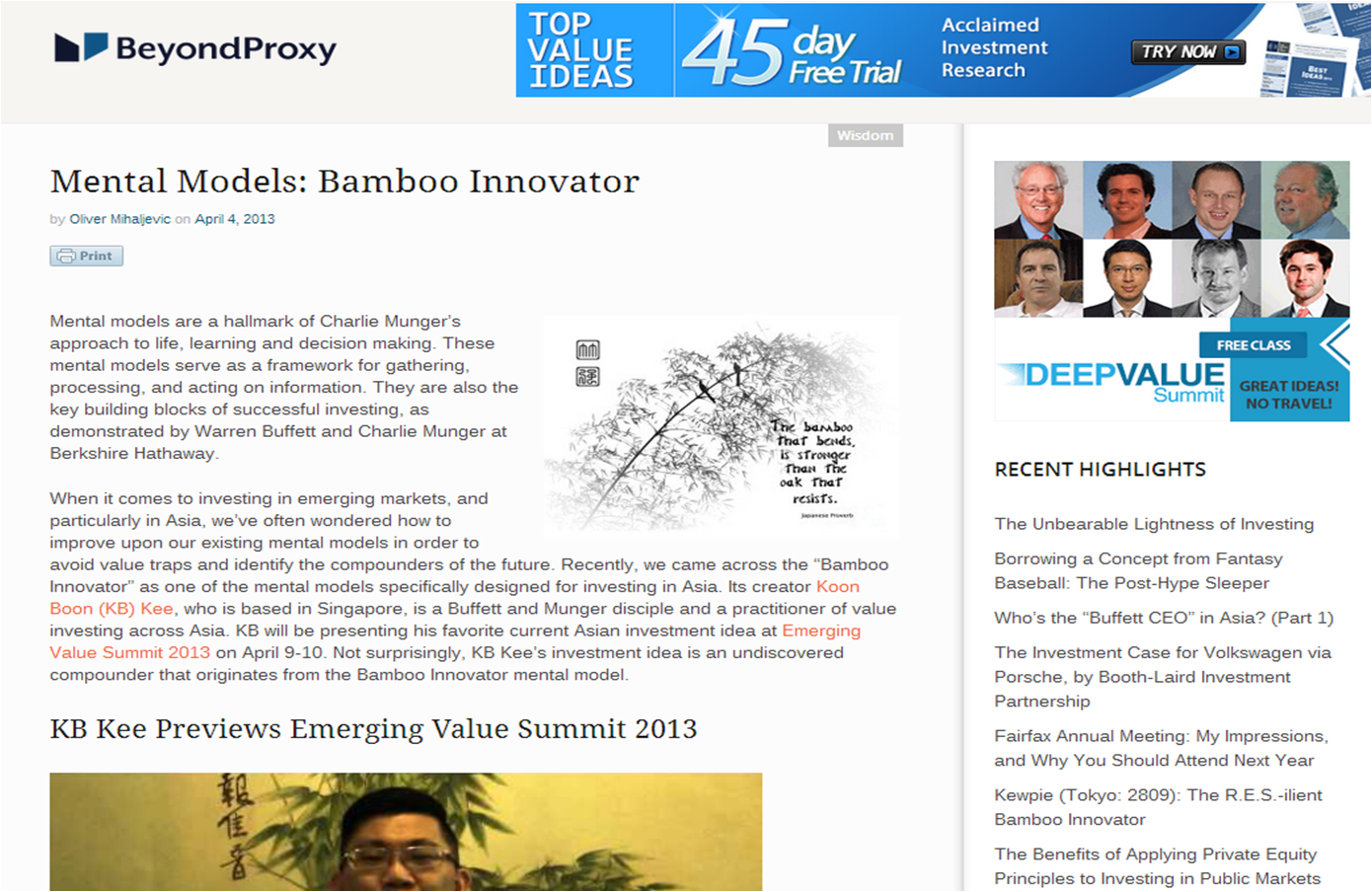
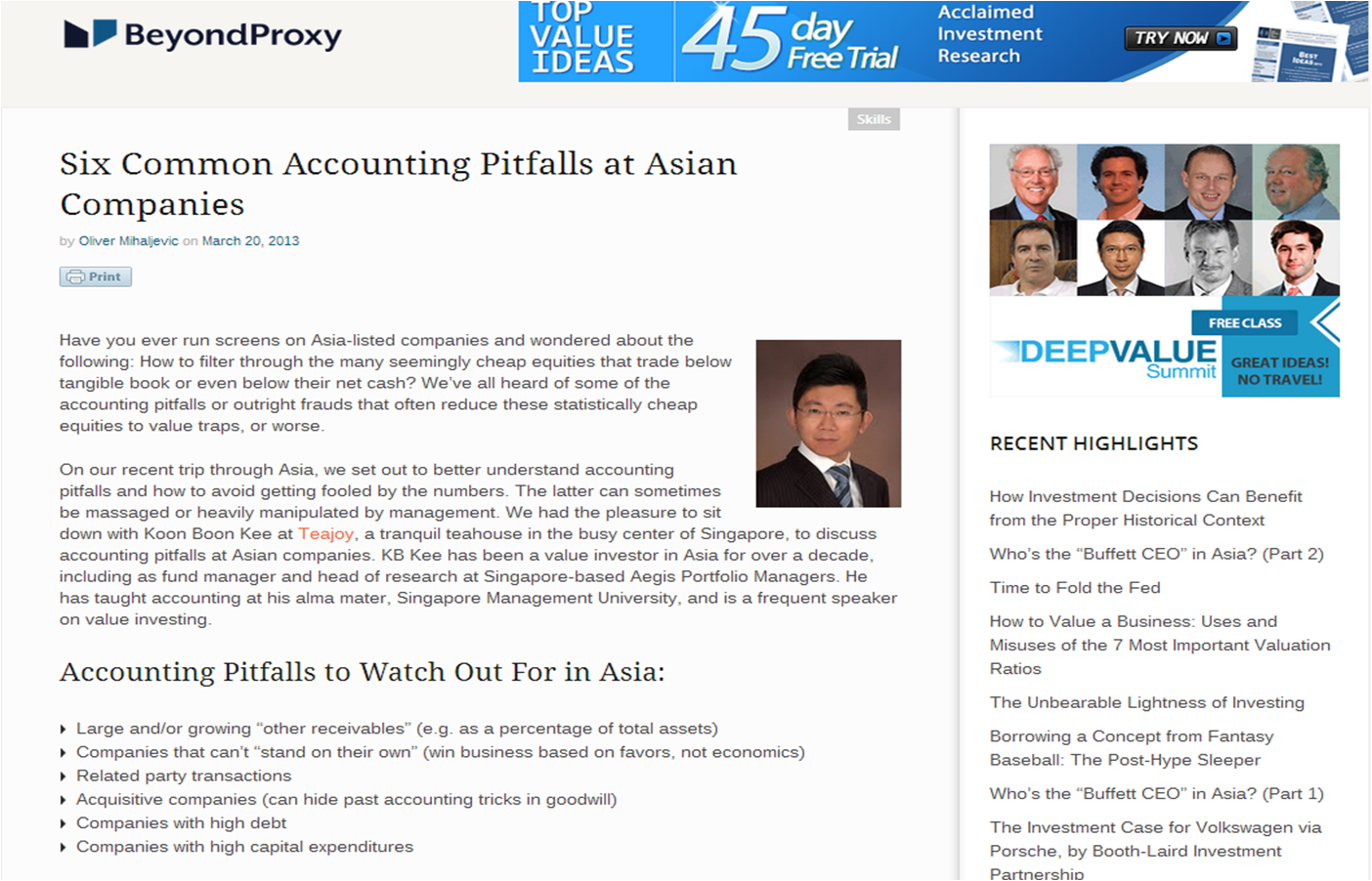
Mental Models: The Bamboo Innovator Approach to Investing in Asia, with Singapore-Based Value Investor KB Kee (BeyondProxy.com, GreatInvestors.TV, Youtube, Frequency.com)

http://www.beyondproxy.com/mental-models/

http://www.beyondproxy.com/detecting-fraud/

http://www.beyondproxy.com/accounting-pitfalls-at-asian-companies/

http://greatinvestors.tv/video/insights-into-accounting-pitfalls-at-asian-companies-with-si.html

http://greatinvestors.tv/video/beware-of-other-receivables-accounting-at-asian-companies-wi.html

http://www.frequency.com/video/insights-into-accounting-pitfalls-at/85354333/-/5-1707

MentalModelDetectFraudPitfalls

Heinz: Buffett buyout gets even less Buffett-y; Heinz’s new CEO Bernardo Hees comes from Burger King and, before that, Buffett’s buyout partner 3G. It’s another move that’s outside of Buffett’s playbook

Heinz: Buffett buyout gets even less Buffett-y

By Stephen Gandel, senior editor April 12, 2013: 11:54 AM ET

Heinz’s new CEO Bernardo Hees comes from Burger King and, before that, Buffett’s buyout partner 3G. It’s another move that’s outside of Buffett’s playbook.

FORTUNE — In mid-February, when the deal to buy Heinz was announced, Warren Buffett gave Heinz’s CEO a vote of confidence. “I think Bill Johnson has done a very good job of running the company,” Buffett told CNBC.

Two months later, Johnson is out of a job. Read more of this post

Finding Alpha In Short Interest Data

Algorithmic Finance Meetup: Starmine Short Interest Talk

by Quantopian on Apr 04, 2013

With the commoditization of such basic quant factors as value and momentum, in recent years systematic investors have turned more and more to sentiment based alpha signals. Aggregated open short interest level provides a profitable, low turnover signal rooted in buy-side sentiment, aka “the smart money.” Dr. Stauth will cover the basics of short selling and data availability and will review the research and proprietary formulation of the StarMine short interest model as well as covering a range of sample trading strategies.

How the CSIRO cheated a global drugs giant into buying anti-counterfeit technology which could be easily compromised – passing off cheap chemicals it had bought from China as a ”trade secret” formula

How the CSIRO cheated a global drugs giant

April 11, 2013, Linton Besser and Nicky Phillips

csiro-wide-620x349

The CSIRO has duped one of the world’s biggest pharmaceutical companies into buying anti-counterfeit technology which could be easily compromised – passing off cheap chemicals it had bought from China as a ”trade secret” formula.

The Swiss-based multinational Novartis signed up two years ago to use a CSIRO invention it was told would protect its vials of injectible Voltaren from being copied, filled with a placebo and sold by crime syndicates.

Police and drug companies are battling counterfeiters who are selling fake medicines that have killed hundreds of people. Last year Interpol seized 3.75 million units of fake drugs and arrested 80 people. Read more of this post

The Hazards of Betting on M&A in Asia

Updated April 9, 2013, 2:14 p.m. ET

The Hazards of Betting on M&A in Asia

By ISABELLA STEGER And CYNTHIA KOONS

AI-CA227_ASIADE_G_20130409222403

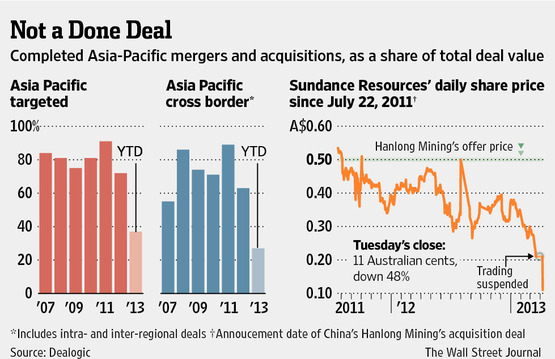
The collapse of Sichuan Hanlong Group’s acquisition of Australia’s Sundance Resources SDL.AU -2.73% —news that sent the iron-ore miner’s share price tumbling—has highlighted the challenges faced by hedge funds seeking to bet on such deals in Asia.

“The market has been saying for some time that the deal is probably off,” said Tom Elliot, chief investment officer at Beulah Capital. On Monday, Sundance said it terminated an agreement to be acquired by Sichuan Hanlong.

The collapse of the deal has burned hedge funds that have bought into Sundance, people with knowledge of the funds’ positions said, without identifying them. Hedge funds use merger-arbitrage strategies such as buying shares in a company that is being taken over at below the offer price, in hopes that the deal will be completed, yielding a profit.

“As far as I can tell, the hedge funds have not been able to fully exit the stock,” Mr. Elliot said. Read more of this post

Be like the bamboo, not the oak (Today, 8 April, 2013); “Singapore is too small and its talent pool is too small to produce a world-class manufacturing giant of the Fortune 500 class,” Singapore’s founding Prime Minister Lee Kuan Yew once said. A cryptic remark, indeed, because it does not imply that he thinks Singapore cannot produce knowledge-based giants, or resilient “bamboo innovators”

Be like the bamboo, not the oak
“Singapore is too small and its talent pool is too small to produce a world-class manufacturing giant of the Fortune 500 class,” Singapore’s founding Prime Minister Lee Kuan Yew once said. A cryptic remark, indeed, because it does not imply that he thinks Singapore cannot produce knowledge-based giants, or resilient “bamboo innovators”.
BY KEE KOON BOON –
6 HOURS 19 MIN AGO

“Singapore is too small and its talent pool is too small to produce a world-class manufacturing giant of the Fortune 500 class,” Singapore’s founding Prime Minister Lee Kuan Yew once said. A cryptic remark, indeed, because it does not imply that he thinks Singapore cannot produce knowledge-based giants, or resilient “bamboo innovators”.

Why bamboo innovators? Bamboos bend, not break, even in the most terrifying storm or devastating earthquake that would snap the mighty oak tree. It survives, therefore it conquers.

Disruptive industry trends and black-swan crises have become a permanent fixture in today’s marketplace. How wonderful it would be if countries, companies and individuals can stay resilient amid such upheavals and unorthodox challenges.

The study of bamboo innovators could inspire companies to be productive innovators in order to surpass stall-points in their business models during tumultuous periods, particularly for small and medium enterprises aspiring to scale up to become global champions.

But why is it that Asian companies are predominantly product manufacturers in the first place? This could ironically be a result of the Asian values of hard work and sacrifice.

It is far easier for the Asian entrepreneur to be the middleman taking orders from a few important anchor multinational corporation customers with access to the end-customers, take capital risk investing in tangible assets and work hard to produce the required products with quality and efficiency — than to attempt to build business models that have direct ownership of the hundreds and thousands of end-customers.

As a result, these entrepreneurs are unwilling to share the rewards with their “undeserving” staff who took neither risk nor sacrifice. They treat employees as expenses and not intangible assets, make most or all of the decisions and hoard most resources and information, running the firm as a “one-man show”. Eventually, they may face the challenge of business continuity arising from succession woes.

NEW IDEAS

Keyence is an example of the unconventional Asian firm. Founder Takemitsu Takizaki liberated the firm from manufacturing conventions and built a knowledge-based enterprise in laser sensors for factory automation, serving more than 100,000 customers in 70 countries.

Despite having less than 1 per cent global market share in a commodity-like product and only around 3,000 employees, Keyence commands a US$17-billion (S$21.1 billion) market value — approximately similar to Singapore’s Keppel Corp, a global leader in offshore oil rig design and building.

Mr Takizaki understood keenly that Keyence cannot improve on Japan’s legendary manufacturing efficiency. So, unlike its manufacturing-based competitors who leave sales to distributors, wholesalers and agents, it deliberately avoids making products, except for manufacturing steps that involve trade secrets kept in-house.

Most of its employees are either “sales” or “research” staff. In their direct contact with the customers, Keyence’s in-house “sales” team picks up new product ideas on frequent factory visits. For instance, its front-liners observed from the production lines at instant noodle factories that the noodle quality was compromised because the noodles were manufactured at variable thicknesses. Laser sensors that could measure noodles to 1/100th of a millimetre were developed to ensure consistency.

A quarter of sales at Keyence is generated from such new products every year, more than what 3M achieves. To excel in these areas, Keyence had to cultivate a meritocratic culture, and it is known for having some of the highest-paid employees in corporate Japan.

Bright young people from rival firms are attracted to Keyence by the performance-based pay. The average salary there is US$100,000. Engineers also get to do their own research, rather than labouring for years under grey-haired supervisors.

THE EMPTY CORE

Keeping the front line or the “periphery” resilient and innovative, and the centre or the “core” diffused, and enforcing meritocratic values at all levels have compounded immense value at Keyence. This “core-periphery” growth pattern is also that of the bamboo: The vitality of its growth revolves around its “empty” centre.

Instead of constructing itself inch by solid inch, like a tree, the nutrients and moisture that would have been exhausted making and maintaining its empty centre can be utilised for growth of its periphery in the stem. From a builder’s viewpoint, the architecture of the bamboo presents a powerful configuration: Fibres of greatest strength occur in increasing concentration towards the periphery.

Manufacturing and project-based companies often tout the size of their order book and their idea of “team” is about having high-profile dealmakers who can bring in the sales orders; the job of “everyone else” is to execute efficiently and “productively”.

The well-connected dealmakers may be able to pull in high-dollar projects, but because of the difficulties in coordinating and executing large-scale complex projects, these deals cannot be repeated and the hype associated with a big order book starts to fade, particularly when cost overruns and delivery delays rear their ugly heads. Bigger becomes riskier.

Even in manufacturing, the only way to perform and execute large-scale complex projects repeatedly is to create a culture of excellence where the interests of emotionally engaged front-liners matter in the innovation and value creation process.

Customers are attracted to this contagious performance culture rather than to the dealmakers on a relationship basis, resulting in a valuation breakthrough beyond the billion-dollar market value barrier that many Asian companies find difficult to break.

“Fortune 500”? With “emptiness” in business model design, Singapore can instead aim for its own resilient “Bamboo Innovator 500” powerhouse with a US$10-trillion value.

ABOUT THE AUTHOR:

Kee Koon Boon, a former lecturer of accounting at the Singapore Management University, has been an investment professional for the past decade. He is a presenter at the Emerging Value Summit 2013 on April 9-10.

Resilient Growth In Crisis? Bamboo Innovators CSL and Keppel Show How

Resilient Growth In Crisis? Bamboo Innovators CSL and Keppel Show How

By KEE Koon Boon

8 April 2013

“Sometimes to be reborn, you must first die,” Dr. Victor Fung, group chairman of the multi-billion Li & Fung group of companies, cites pensively this old Chinese proverb in order to ask an open-ended question, “In a world that’s speeding up, how will companies change enough without crisis?”

We cannot avoid, or even choose, a crisis in order to engender the change that is required to overcome stall points in growth and to stay relevant in today’s marketplace where disruptive industry trends and black-swan crises have become a permanent fixture. When the inevitable traumatic upheavals and unorthodox challenges do come, innovators craft their business models to stay resilient like the bamboo, which bend, not break, even in the most terrifying storm that would snap the might resisting oak tree.

Australia’s CSL and Singapore’s Keppel are two such companies who have experienced near-deaths in daring greatly to scale and globalize their once domestic SME operations right under the noses of powerful incumbent global giant rivals – and they were renewed and reborned to be resilient Bamboo Innovators.

In its remarkable transformation from a sleepy government outfit providing snakebite antivenin since its privatization and listing in 1994 with a market value of A$500 million to a A$29 billion global biotech champion, CSL had experienced a near-death crisis in 2002. Similarly, Keppel, the global leader in offshore oil rig design and building, had hit a crisis in 1973, 1983 and 1990. Both were able to bounce back higher to scale greater heights. Why? Both companies have dedicated leaders cultivating a culture rooted in trust, cooperation and empowerment to contend with and heal creative dissent to handle large-scale complex projects repeatedly with excellence.

Brian McNamee was plucked from relative obscurity at the age of 33 to head CSL at the recommendation of then Industry Minister John Button. Similarly, the late Hon Sui Sen, founding Chairman of Singapore’s Economic Development Board (EDB), picked Chua Chor Teck to be Keppel’s first managing director in May 1972 and to take over and “Singaporeanize” Keppel from the hands of British managers of the Swan Hunter Group, then one of the best known shipbuilding companies in the world that has now disappeared.

During the era when America was dubbed the OPEC (Organization of Plasma Exporting Companies) of the global plasma industry, CSL broke the dominance of America’s grip by buying Swiss plasma fractionation pioneer ZLB for A$1 billion in 2000 and Germany’s Aventis Behring for US$925 million in 2004. Today, domestic earnings account for 10 percent of the group earnings at CSL with the bulk provided by its global businesses. Similarly, Keppel got its design and technology in oil rig from acquiring rig builder Far East Livingstone Shipbuilding (FELS), which Keppel took majority control in 1973 during the oil crisis. Subsequently, the late Sim Kee Boon, Chairman of Keppel Corp from 1984 to 1999, continued to lead the globalization push of Keppel, subsequently continued by the capable leaders Mr. Lim Chee Oon, Mr. Choo Chiau Beng, Mr. Tong Chong Heong, Mr. Loh Wing Siew and so on. Mr. Sim outlined the basic strategy of avoiding “green-field” or start-from-scratch projects and to invest in yards that are already there. For instance, Keppel acquired Allison-McDermid in America, AHI in Middle East, PEM Setal in Brazil, and Verolme Botlek in Europe. Mr. Sim’s dream was to see Keppel become like a Nestle with a very significant global presence.

The big-picture “plan” to globalize is seen obvious but managing the unseen risks and creating adaptive advantages along the way are more important. For the first two years, ZLB lived up to its promise, resulting in solid earnings growth for CSL, and its market value more than doubled. But the wheels came off in 2002 when the industry went into oversupply and a combination of sharply falling product prices and disadvantageous currency mismatch nearly crippled CSL. Back in 1983, Keppel’s cash purchase of Straits Steamship saddled it with a debt of S$845 million. Furthermore, the shipbuilding industry during that period was pronounced a sunset industry by the pundits as the industry went into oversupply with more than 80 shipyards capable of building rigs. Keppel survived the crisis and was the only surviving rig-builder in the world in 1986 then. Subsequently, another crisis hit shortly after Keppel’s acquisition of Texas-based jackup yard Allison-McDermid in 1990 when an American firm brought a US$565 million litigation case against Keppel for alleged breach of contract and damages involving the building of jackup offshore drilling rigs. CSL turned risk into opportunity by acquiring Aventis Behring to consolidate its position as the industry recovers. Keppel eventually won the suit. Keppel saw the need for control and bought out its partner, renaming the entity AmFELS which became a wholly-owned subsidiary of Keppel. It grew to become one of the best-equipped offshore yards in the Gulf of Mexico.

Growth through acquisitions has proven to be the graveyard for many companies in general. Warren Buffett, the world’s greatest investor, likened growing via acquisitions to kissing unresponsive corporate toads who croaked and the tempting but value-destroying toy that executives must have because their peers have one too. Post-acquisition efforts in integrating the companies into the parent company to compete as a coherent whole prove crucial to successfully scale to greater heights and not blow up. Both CSL and Keppel are able to do so because of the foundation laid down in the culture carefully nurtured by Mr. McNamee and Mr. Chua.

“We respected them greatly for their skills and their capabilities, so we weren’t cultural imperialists. We greatly respect our Swiss and German colleagues and so there was no notion that they were being taken over and that they were going to work to our method,” McNamee articulated how their culture of trust and respect provided both parties a common ground to work together towards a global vision for the group. The culture of empowerment at CSL is embedded into its business model to foster open innovation and extensive collaboration with its acquired companies and a network of high-quality academics, scientists and physicians across the world. CSL minimises a silo formation by giving people personal responsibility and by running R&D using a matrix structure. This intangible culture has delivered powerful tangible results, including how CSL beat competitors to be the first to market with an effective vaccine against the global swine flu epidemic and in developing the anti-cervical cancer drug Gardasil. The dedication of McNamee is also touching. He was diagnosed to have cancer and kidney problems when he was planning to buy ZLB. Swiss giant Novartis also offered more money and fanned the patriotism flame that ZLB should remain in Swiss hands. Due to the persistence of McNamee who flew to Switzerland against medical advice to personally negotiate the deal, CSL acquired ZLB despite paying 20 percent less than its rival bidder.

In his touching eulogy for Mr. Chua, “the much-loved leader among his men” who passed away from cancer in 1986 when he was 47, Keppel’s influential long-time US representative Mr. John Bajor commented, “Yes there’s complete dedication expected but the return in caring for each employee is the spirit he so carefully nurtured and left behind. It has become the Keppel way.” Mr. Sim also paid tributes to Mr. Chua who “tried exceedingly hard to inculcate in the organisation the ‘Keppel culture’ of loyalty, thrift and hard work.” Mr. Chua’s dedication and his “genuine interest in helping junior officers overcome difficulties in order to advance their career” has laid the foundation to the “Can Do” spirit of excellence at all levels in Keppel for many years to come.

The story at Bamboo Innovators CSL and Keppel highlighted the intangible culture of kindness, caring and empowerment is akin to the invisible intricate underground root structure that makes the ground around a bamboo grove very stable – and make possible the adaptability of the bamboo to bend, not break, with storms and crisis, and to remain relevant and evergreen no matter how the world around us speeds up and changes.

It’s harder than ever to run a truly actively managed fund. Here’s how four firms execute unique – and successful – strategies. “We want to know that there’s intellectual thought, that there’s a process for buying companies, as well as for selling them”

SATURDAY, APRIL 6, 2013

Earning Their Keep

By SARAH MAX | MORE ARTICLES BY AUTHOR

It’s harder than ever to run a truly actively managed fund. Here’s how four firms execute unique — and successful — strategies.

It’s not easy being an active fund manager these days. Market information that was once available to a privileged few now flows freely and quickly. Index funds and exchange-traded funds, meanwhile, make it possible to implement simple or sophisticated strategies cheaply and effectively.

And then there’s performance.

Last year, 66% of domestic equity managers underperformed relative to the Standard & Poor’s 1500 index, according to the S&P Dow Jones Indices SPIVA Scorecard. That’s a considerable improvement over 2011, when 84% of active managers lagged the benchmark, but it’s hardly vindication for stock-picking. Even managers dealing in the supposedly inefficient international markets have struggled to get an edge. Last year, just 56% of international funds and 54% of emerging-market funds managed to deliver that elusive, market-beating “alpha” they’re paid for. There have been consequences: Over the past five years, nearly 27% of actively managed domestic equity funds and 23% of international equity funds have merged or liquidated.

So what’s an active manager to do? Some end up as “closet indexers,” who charge too much for hugging the index. In 2011, only 11% of assets invested in actively managed large-company funds were in portfolios that deviated from their benchmark by more than 80%, according to Martijn Cremers, a Notre Dame professor who helped pioneer “active share,” a measure of how truly active an active manager is. However, “skilled managers are out there,” says Charlie Ruffel, managing partner at Kudu Advisors, a strategic advisory firm for asset managers. “The challenge is in identifying them.”

The standout managers tend to have standout firms behind them, equipping them with the research teams, technology, financial backing, and supportive culture needed to go above and beyond. Some favor more concentrated approaches, investing in a small number of their very best ideas. Others take pains to investigate or even involve themselves with the management of the companies they invest in. Some take creative approaches to data-crunching, creating new perspectives on the market, while others simply thrive in a culture of constantly questioning and defending their stock-picking and portfolio moves. “Up until five years ago, managers didn’t need to try so hard to stand out,” adds Ruffel. “We’re in a different place.” Experts, such as financial advisors and consultants who help institutions choose funds, are constantly evaluating managers, looking for a process that brings consistent outperformance. They’re also looking for lights and mirrors — actions that appear to be in the name of research but don’t add value. Too much activity, they say, can be a warning sign. For instance, a manager who spends a disproportionate amount of time or travel on a position that represents less than 5% of the portfolio “might be cause for concern,” says Jonathan Bergman, a managing director at TAG Associates in New York. In general, however, Bergman and his peers are reassured when they hear that management has gone to great lengths to gain extra insight into a holding. “We want to know that there’s intellectual thought, that there’s a process for buying companies, as well as for selling them,” he says. Read more of this post

Billabong perilously close to a wipeout; In 25 years, the company has lost most of its street cred and its value has shrunk from billions to whatever is on offer

Billabong perilously close to a wipeout

April 6, 2013, Elizabeth Knight

In 25 years, the company has lost most of its street cred and its value has shrunk from billions to whatever is on offer, writes Elizabeth Knight.

art_n_tide_0604-300x0

Twenty-five years ago, Billabong basked in street cred. Today, as one fashion industry insider quipped, the brand has become the barbecue short for the sausage sizzle. If the 45-year-old dads are wearing boardies with elasticised or Velcro adjustable waists to accommodate a middle-aged muffin top, their 15-year-old sons are not in the market.

On Friday, the future ownership of this Australian iconic brand hung in the balance. Two American corporate sharks have been circling the bleeding Billabong carcass for a couple of months and intense talks are continuing over the weekend.

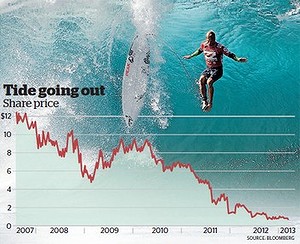
The decision by the Billabong board and its largest shareholder and founder, Gordon Merchant, to hang out the for sale sign, is the ultimate recognition the company has lost its way. Five years ago Billabong was a $5 billion company and its stock traded for $14. The prices being offered by these financial syndicates today are less than 70¢ a share – the financial equivalent of the bin out the front of the store housing the end-of-season/couldn’t-sell stock that customers rifle through. At this price the whole company is worth closer to $300 million. It is the final ignominy for the company whose financial performance has been in such steep decline that it has lost the support of many of its major investors and has been playing a dangerous game of dodgeball with its bankers. Read more of this post

U.S. Company on How to Go Broke Despite Dominating Vodka Sales in Russia; The company’s unlikely troubles show how timing and local knowledge are crucial

U.S. Company on How to Go Broke Selling Vodka in Russia

Going broke while dominating vodka sales in Russia and Poland may seem tough to do. A company founded by a Florida golfer, listed on Nasdaq Stock Market and until recently based in New Jersey, is almost there.

Unable to repay $258 million in bonds due last month, Central European Distribution Corp. (CEDC), which owns vodka brands including Bols, Zubrowka and Parliament and once imported Dom Perignon to Russia, is preparing to file for bankruptcy. Creditors will vote by April 4 on a restructuring plan that would hand CEDC to Russian billionaire Roustam Tariko, solidifying his control of the distiller and distributor he’s toyed with for years.

The company’s unlikely troubles show how timing and local knowledge are crucial. After almost two decades of success in Poland, CEDC expanded into Russia via acquisitions just as Poles began drinking less vodka and the Russian government raised taxes and costs to discourage alcohol consumption. The global financial crisis, a 37 percent collapse in Russia’s currency, and accounting errors that followed didn’t help either.

“If we had to do it over, we probably should have bought one company to see how it went, rather than buying three within six months,” CEDC co-founder William V. Carey, who resigned in July as chief executive officer, said in a phone interview from Warsaw, where he still lives. Russia’s “new regulations weren’t there when we invested, making it much more difficult to manage growth and profitability over the last three years.” Read more of this post

Isaac Newton’s Nightmare During the South Sea Stock Bubble (Dec 1718 – Dec 1721)

Isaac Newton’s Nightmare — Charted By Marc Faber

Sam Ro | Apr. 2, 2013, 4:43 PM | 6,414 | 3

The parabolic move in Bitcoin prices has us thinking about some of the most notorious asset bubbles in history. We were thumbing through some of Jeremy Grantham‘s old research and saw this great chart from Marc Faber. “I can calculate the movement of stars, but not the madness of men,” Newton apparently said after he lost his fortune.

screen shot 2013-04-02 at 4.29.11 pm

Why Grocers Like Tesco Find Trouble in the U.S. Market; The American grocery market has tempted foreigners for almost a century. Many foreign companies have also arrived with a superiority complex, seeing hundreds of small, unsophisticated enterprise that seemed to be easy prey for international entrants with deep pockets and industry know-how

Why Grocers Like Tesco Find Trouble in the U.S. Market

Any day now, Tesco (TSCO) Plc, the U.K. grocery giant, may announce the closure of the 200 or so Fresh & Easy food stores it has opened in California, Arizona and Nevada since 2007.

When it does, Tesco will join a long list of international grocers that have met their match in the U.S. In every case, these companies wrongly assumed that strategies honed abroad would succeed in America, and they underestimated the resources and management attention required to make headway in a vast and fast-changing market.

The American grocery market has tempted foreigners for almost a century. One reason is the obvious potential: For a grocer that had exhausted the possibilities in its home market, expansion in the U.S. offered a means to boost profits. Many foreign companies have also arrived with a superiority complex, seeing hundreds of small, unsophisticated enterprises that seemed to be easy prey for international entrants with deep pockets and industry know-how. Read more of this post

Creating ‘bamboo innovators’ in S’pore now on AsiaOne

Now on AsiaOne: http://www.asiaone.com/News/Latest%2BNews/Singapore/Story/A1Story20130402-413040.html

Creating ‘bamboo innovators’ in S’pore

20130402.152437_bt_gilv7

Uncertain conditions can breed innovative businesses, where risk-taking educators nurture flexible students. -ST
Kee Koon Boon

Wed, Apr 03, 2013
The Straits Times

Gil Shwed, CEO & Founder of Check Point Sofware.

SINGAPORE – “Can my kid watch how you milk cows?”

“Can my kid see how you print the newspaper?”

These were questions asked by Israeli inventor and entrepreneur Gil Shwed’s mother when she took him on educational “adventure trips” when he was young, exposing him to a dairy farm, a printing house, and his father’s office in 1972, where at age five he saw a computer for the first time.

He soon signed up for computer classes at age nine, a summer coding job at 12, and took computer science classes at the Hebrew University while still in high school.

Unlike his career-minded peers, Mr Shwed persisted with an idea first cooked up during his military conscription: building a type of computer security software that links up computer networks in a way that would allow some users access to confidential materials while denying access to others. He embarked upon the project with two friends after army conscription and without the security of “proper” jobs.

By 1994, the trio’s Firewall product won the best software award at a computer show, vindicating a venture capital firm’s faith in Mr Shwed’s vision. Check Point Software Technologies listed on Nasdaq in 1996. Its market value today has jumped 12-fold to US$10 billion (S$12.4 billion).

Binding the trio together was a pioneering ethos where “education” with a “bitzu’ism” quality was at its heart. A bitzu’ist is a Hebrew word that loosely translates to “pragmatist” with a resilient quality, like bamboo that bends but does not break in the wildest storms when even oak trees snap. The bitzu’ist is the “builder, the irrigator, the pilot, the gun-runner, the settler all rolled into one”.

Mr Shwed thinks of his home country Israel as a “start-up nation”. “We managed to create a country from zero. We’ve had an entrepreneurial spirit for over 100 years. One thing that really helps us here is that we don’t have a local market.”

Surrounded by hostile neighbours and with few natural resources, Israel has the highest density of start-ups in the world, with one for every 1,800 Israelis. With a population of 7.7 million with 70 different nationalities, Israelis think globally when creating products and innovative firms.

Developing human capital is the key to growing the Israeli economy. Its education system is not about chasing after instrumental achievements such as “grades” or a “checklist-based holistic curriculum vitae” or “high graduation salary”.

The education system in Israel is made market-relevant when plugged into an unique ecosystem that constantly searches for and supports innovative ideas and new products to help build “bamboo innovator” companies such as Check Point.

In “Singapore version 1.0’s” growth since independence, the education system is meritocratic, highly competitive and “standardised”, lifting the technical competence and social mobility of Singaporeans to fit multinational companies (MNCs) with their export-oriented strategies.

This is augmented by higher valued-added services from logistics, shipping and maritime support to legal, finance and accounting, generating high wages to beat inflationary pressures. “Education 1.0” is about meeting the needs of capable MNCs which connect Singapore’s small, open economy to the real marketplace.

Yet the highly skilled workforce is not able to translate its “intangibles” in know-how into building and even owning “bamboo innovators”. The “earnings” accrued from this know-how remain with the MNCs.

In investing lingo, a high-salaried MNC worker has a price earnings (PE) ratio of one while a MNC can have a PE value of 20 times. A productive “bamboo” worker is one who, when a wind blows away his MNC title and position, can still remain a resilient innovator to create value because he has that intangible quality that is indestructible.

MNCs are concerned about the Singapore workforce lacking the initiative and innovativeness desired by knowledge-based industries, thus creating a barrier to a breakthrough in wages and productivity. It is the hollow “emptiness” in its centre – the intangibles – that gives bamboo great strength and flexibility in a raging storm.

The Singapore workforce’s accumulation of wealth and tangible assets for their own sake has evolved into a sense of entitlement, a dangerous liability that erodes character, moral values and social cohesion.

Reform attempts through character education and creative thinking alone are not only difficult but also decidedly off-track. As economist David Landes puts it, nothing dilutes drive and ambition more than a sense of entitlement. This kind of distortion makes an economy inherently uncompetitive.

Instead of the diminishing marginal returns from repeating “Education 1.0”, where school results are instrumental, these complex uncertain times require an education system that enables students to grope and reach directly into the global marketplace, to be sensitive and alert to existing anomalies and paradigms, and to how things ought to function and behave.

Educators must connect and sensitise students to the chaotic global marketplace. It is this sensitivity and alertness that leads to creating “bamboo innovators”.

Reflecting former deputy prime minister Goh Keng Swee’s view about the spirit of education as both “a search for truth” and “the way to a better life”, Singapore’s “Education 2.0” system should centre on how and why resilient firms continue to create value in uncertain and difficult times.

The system should also educate students who dare to become “bamboo innovators” like Mr Shwed, and who will build enduring creations.

As former Israeli president Shimon Peres said, “the most careful thing is to dare”.

The Innovators: The Men Who Built America

http://en.wikipedia.org/wiki/The_Men_Who_Built_America

The Men Who Built America (also known as The Innovators: The Men Who Built America in some international markets) is a History eight-hour, four-part miniseries docudramabroadcast in Fall (autumn) 2012, and on the History Channel UK in Spring 2013. The series focuses on Cornelius VanderbiltJohn D. RockefellerAndrew CarnegieJ. P. Morgan and Henry Ford and how their industrial innovations and business empires revolutionized and, as alluded to in the title, “built” America. The series is directed by Patrick Reams and Ruán Magan and is narrated by Campbell Scott. It averaged 2.6 million total viewers, 1.2 million Adults 25-54 and 1 million Adults 18-49 across 4 nights.

418831_563132657043923_1061238913_n (1)

Silver Bears Pounce as Manufacturing Sputters

Updated April 2, 2013, 8:10 p.m. ET

Silver Bears Pounce as Manufacturing Sputters

By TATYANA SHUMSKY

MI-BV112_SILVER_NS_20130402194507

Silver prices plunged deeper into bear-market territory, as weak manufacturing data from the world’s major economies stoked investor fears that the metal’s gradual decline this year is turning into a rout.

Silver has shed over 20% of its value since October and its losses this year surpass most other commodities, including gold. Bets that silver will decline are on the verge of outnumbering bullish positions for the first time since September 2007, according to the U.S. Commodity Futures Trading Commission. On Tuesday, silver ended 2.5% lower at $27.217 a troy ounce on the New York Mercantile Exchange.

JMAT Read more of this post

Three Rules for Making a Company Truly Great

Three Rules for Making a Company Truly Great

by Michael E. Raynor and Mumtaz Ahmed

Much of the strategy and management advice that business leaders turn to is unreliable or impractical. That’s because those who would guide us underestimate the power of chance. Gurus draw pointed lessons from companies whose outstanding results may be nothing more than random fluctuations. Executives speak proudly of corporate achievements that may be only lucky coincidences. Unfortunately, almost no one provides scientifically credible answers to every business leader’s basic questions about superior performance: Which companies are worth studying? What sets them apart? How can we follow their examples?

Frustrated by the lack of rigorous research, we undertook a statistical study of thousands of companies, and eventually identified several hundred among them that have done well enough for a long enough period of time to qualify as truly exceptional. Then we discovered something startling: The many and diverse choices that made certain companies great were consistent with just three seemingly elementary rules:

1. Better before cheaper—in other words, compete on differentiators other than price.

2. Revenue before cost—that is, prioritize increasing revenue over reducing costs.

3. There are no other rules—so change anything you must to follow Rules 1 and 2.

R1304J_A_LG Read more of this post

10 things financial advisers won’t say

April 1, 2013, 7:38 p.m. EDT

10 things financial advisers won’t say

Pros will tell you where to put your money, but often at a steep price

By Ian Salisbury

MW-BA868_sm10th_20130328165556_MG
1. “We’re your biggest advocate, except when we’re not.” Read more of this post

Receivables of China’s Moutai, the world’s second largest distiller by market value, increased 7X; top five are distributors accounting for 88% of receivables; 茅台应收账款激增7倍 欠款前五均为经销商

茅台应收账款激增7倍 欠款前五均为经销商

http://www.nbd.com.cn 2013-04-02 01:09

核心提示: 记者翻阅贵州茅台2012年报发现,应收账款金额前五名单位均为经销商,占应收账款总额的87.98%。

每经记者 曹晟源 发自成都

尽管贵州茅台(600519,SH)日前公布的2012年年报成绩不错,净利润同比增速仍在50%以上,但其激增7倍的应收账款却引发关注。《每日经济新闻》记者注意到,应收账款前五名均为本应该早已打款的经销商。

在 “塑化剂事件”、“三公消费”瘦身、反垄断等冲击下,白酒行业已进入调整期。而此时经销商和酒企之间的关系变得异常敏感,出现应收账款的大幅增长,似乎预示着经销商和白酒企业之间此前的关系或将发生改变。 Read more of this post

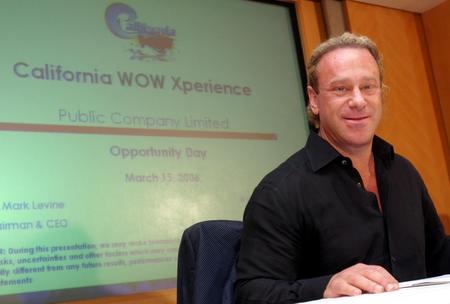
No progress in bankrupt Thai-listed California WOW fitness club case; “The proceedings have been slow and cannot catch up with fraud, deception and swindles of business operators.”

No progress in CAWOW case

Published: 1 Apr 2013 at 11.54

487484

A group of 639 members of the bankrupt California WOW (CAWOW) health club gathered on Sunday to decide on their next move, complaining that authorities have made no progress in helping settle their grievances. Read more of this post

A publication designed to be an authoritative guide to financial planning hit bookstore shelves Monday; Kevin Keller, CFP Board president and chief executive, drew a parallel between the book and medical volumes that describe diseases and treatments for doctors and consumers; “I like to think of this as the Merck Manual of financial planning.”

CFP Board publishes ‘Merck manual’ of planning

735-page book targeted at students, profs and practitioners

By Mark Schoeff Jr.   |  April 1, 2013 – 4:28 pm EST

A publication designed to be an authoritative guide to financial planning hit bookstore shelves Monday.

The 735-page “Financial Planning Competency Handbook” is the first book published by the Certified Financial Planner Board of Standards Inc. Written for college students and professors, as well as financial planners, the book is the CFP Board’s attempt to build an academic foundation for financial planning and define the field’s body of knowledge.

Kevin Keller, CFP Board president and chief executive, drew a parallel between the book and medical volumes that describe diseases and treatments for doctors and consumers.

“We think it is a seminal work for the financial planning profession,” Mr. Keller said. “I like to think of this as the Merck Manual of financial planning.” Read more of this post

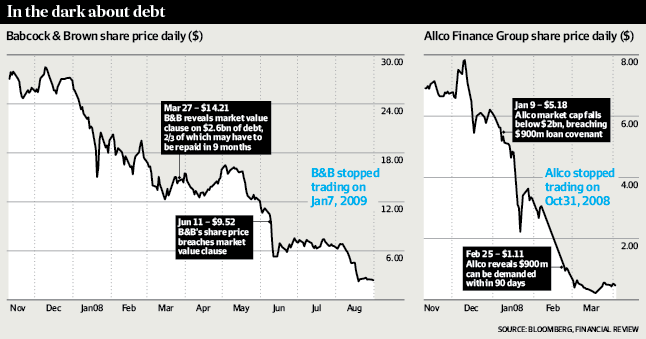
Keeping debt a dirty secret from investors

Keeping debt a dirty secret from investors

PUBLISHED: 28 MAR 2013 00:33:00 | UPDATED: 29 MAR 2013 00:31:10

CHRISTOPHER JOYE, The Australian Financial Review

4b98a466-969b-11e2-b272-865705c1a5bf_28p33joye

Ask yourself this question: is the amount of debt a company assumes, the rate of interest it pays, the events of default, the repayment date and all non-standard conditions (or “covenants”) vital to working out the value of that company’s equity? Any half-witted analyst or investor will emphatically answer “yes”.

Yet when I ask Damian Reichel, a partner at law firm Johnson, Winter & Slattery whether it is standard practice for companies listed on the Australian Stock Exchange to disclose all the terms and conditions of their debt arrangements, he responds: “No, it’s not standard at all. It is, however, normal to disclose the amount of debt outstanding in the company’s accounts and maturity dates so that people know when facilities expire.”

This is a problem that weighs heavily on the minds of sophisticated investors, analysts and even some regulators. While market convention is to disclose little information about a company’s leverage, it is vital to determining its equity value, even if lay retail investors tend to ignore it.

If a company’s capital structure is comprised of debt and equity, it is impossible to price one in isolation from the other. Debt directly subordinates equity in two ways: first, it has a prior-ranking entitlement to the company’s earnings for interest repayments; second, debt ranks ahead of equity if the business is wound up.

The introduction of debt into a capital structure exposes shareholders to new risks. And individuals and companies default on their obligations all the time. When they do, the lender has the right to force asset sales at prices often far below fair value, which inflicts losses on those standing last in the queue – shareholders. Read more of this post

A U.S. investor won an unusual remedy in his fight against a Chinese company under an accounting cloud; Court Official Given Power to Seize Assets to Buy Back Burned Investor’s Shares

March 31, 2013, 8:44 p.m. ET

Novel Relief for China Woes

Court Official Given Power to Seize Assets to Buy Back Burned Investor’s Shares

By MICHAEL RAPOPORT

MI-BV059_ZST_NS_20130331172703

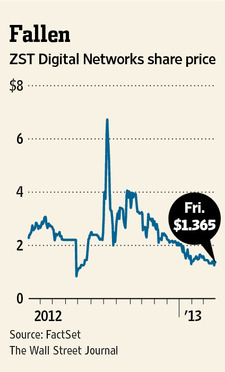
A U.S. investor won an unusual remedy in his fight against a Chinese company under an accounting cloud: A judge gave a court-appointed official the power to seize company assets needed to buy back the investor’s shares for far more than their current price. The ruling in Delaware Chancery Court by Vice Chancellor J. Travis Laster also offers a glimmer of hope to other investors who suffered steep losses on Chinese companies that listed their shares in the U.S., but have plummeted in value in the past two years. Such investors were pounded by billions of dollars in losses as short sellers targeted U.S.-listed Chinese companies, auditing firms backed away from previous work on financial statements and regulators questioned the accounting and disclosure practices of some companies.

The Delaware ruling came after ZST Digital Networks Inc. ZSTN +11.20% a network-equipment supplier, flouted an earlier court order to give the shareholder access to “certain books and records” of the company. Peter E. Deutsch, who runs a wine importer, began buying ZST shares in 2011 and eventually accumulated 3.9 million shares. But ZST ran into questions over its accounting in 2012, ultimately prompting Mr. Deutsch to sue.

Read more of this post

Creating ‘bamboo innovators’ in S’pore (Straits Times, April 1, 2013)

http://www.stasiareport.com/premium/opinion/story/creating-bamboo-innovators-spore-20130401

Creating ‘bamboo innovators’ in S’pore

Uncertain conditions can breed innovative businesses, where risk-taking educators nurture flexible students.

Published on Apr 01, 2013
Check Point Software Technologies CEO and founder Gil Shwed, an Israeli inventor and entrepreneur who started the Firewall security software. — PHOTO: CHECK POINT SOFTWARE TECHNOLOGIE
By Kee Koon Boon For The Straits Times
Read the published version below and the unedited longer version hereRead more of this post