1987 Berkshire Letter And Warren Buffett’s Thoughts on High ROE

1987 Berkshire Letter And Warren Buffett’s Thoughts on High ROE

by John HuberFebruary 20, 2014, 6:57 pm

I am in the midst of writing a few posts on the importance of Return on Invested Capital (ROIC). I wrote two posts last week discussing Greenblatt’s formula and some thoughts on the topic (Here and Here). I’ll have one or two more posts next week discussing a few brief examples of compounders (companies that exhibit unusually high returns on capital over extended periods of time, allowing them to grow–or “compound”–shareholder value over long periods of time).

There always seems to be a strong divide between “value and growth“, deep value (aka cigar butts) and quality value, etc… I too have mentioned these differences numerous times. And it’s true that many investors can do well simply buying great businesses at fair prices and holding them for long periods of time, while other investors prefer to slowly and steadily buy cheap stocks of average quality and sell them as they appreciate to fair value, repeating the process over time as they cycle through endless new opportunities.

The styles are different, but not as different as most people describe them to be. The tactics used are different, but the objective is exactly the same: trying to buy something for less than what its really worth. Both strategies rely on Graham’s famous “margin of safety” concept, which is probably the most important concept in the investing discipline.

Both Quality and Valuation Impact Margin of Safety

The margin of safety can be derived from the gap between price and value, and it can also be derived from the quality of the business. The latter point is really part of the former… For example, a business that can steadily grow intrinsic value at a rate of say 12% annually is worth much more than a business that is growing its value at say 4% annually–all other things being equal. And since the higher quality compounder is worth more than the lower quality business, the quality compounder offers a larger margin of safety.

Of course, in the real world, it’s not that easy. The lower quality business might offer an extremely attractive discount between current price and value, which is significant enough to make the investment opportunity preferable to the compounder. This is often the case in real life–compounders are rarely are offered cheaply.

But too often, value investors get enticed by cheap metrics and seemingly large discounts between price and value in businesses with shrinking intrinsic value. The problem in these types of cigar butts is that the margin of safety (gap between purchase price and value) is largest the day of the investment. Every day thereafter the business value slowly erodes further, making the investment a race against time.

Now, not all cheap stocks have eroding intrinsic value. On the contrary, many high quality, or average quality businesses are occasionally offered quite cheap. But in my opinion, it’s always much more reassuring to be invested in businesses that have intrinsic values that are growing over time, as it allows for larger margins of error in the event that you’re wrong, and better returns in the event that you’re right. A couple days ago I read a quote somewhere that I believe Allan Mecham said that I’ll paraphrase: If investors focused on reducing unforced errors as opposed to hitting the next home run, their returns would improve dramatically.

So it’s like the amateur tennis champion that wins because they had the fewest mistakes, not necessarily the most forehand winners.

Reducing Unforced Errors and Buffett’s 1987 Roster

One way to reduce unforced errors in investing is to carefully choose the businesses that you decide to own. The gap between price and value will ultimately determine your returns, but picking the right business is one important step in reducing errors.

One way to reduce errors is to focus on studying high quality businesses with high returns on capital. In the last post, I mentioned an article that Buffett referenced in the 1987 Berkshire shareholder letter. In this letter, Buffett mentions that Berkshire’s seven largest non-financial subsidiary companies made $180 million of operating earnings and $100 million after tax earnings. But, he says “by itself, this figure says nothing about economic performance. To evaluate that, we must know how much total capital – debt and equity – was needed to produce these earnings.

So Buffett was interested in return on invested capital. However, he goes on to state that these seven business units used virtually no debt, incurring just $2 million of total combined interest charges in 1987, so virtually all capital employed to produce those earnings was equity capital. And these 7 businesses had a combined equity of only $175 million.

So Berkshire had seven businesses that combined to produce the following numbers:

$178 million pretax earnings

$100 million after tax earnings

$175 equity capital

57% ROE

102% Pretax ROE

So Buffett’s top 7 non-financial businesses produced fabulously high returns on equity with very little use of debt. In short, they were outstanding businesses. Buffett proudly goes on to say that “You’ll seldom see such a percentage anywhere, let alone at large, diversified companies with nominal leverage.”Of course, investor returns depend on price paid in relation to value received, and we are only discussing the value received part of the equation here.

Buffett then voices his opinion on the importance of predictability and stability in business models:
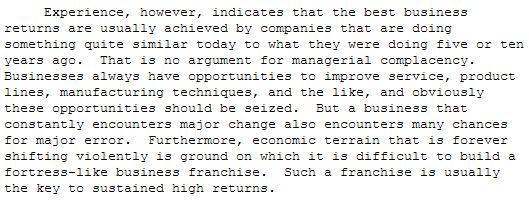
image001-24

1987 Berkshire Letter

He then references an interesting study by Fortune that backs up his empirical observation. In this study, Fortune looked at 1000 of the largest stocks in the US. Here are some interesting facts:

Only 6 of the 1000 companies averaged over 30% ROE over the previous decade (1977-1986)

Only 25 of the 1000 companies averaged over 20% ROE and had no single year lower than 15% ROE

These 25 “business superstars were also stock market superstars” as 24 out of 25 outperformed the S&P 500 during the 1977-1986 period.

The last statistic is remarkable. Even in the really high performing value baskets such as low P/B or low P/E groups, you’ll typically see a ratio of around one-half to two-thirds of the stocks that outperform the market. Sometimes you’ll even have a majority of underperformers that are paid for by a few large winners in these basket situations. But in this case, even with a small sample space, it’s pretty telling that 96% of the group outperformed over a period of meaningful length (10 years).

Of course, this begs a question along the following lines: “Great, by looking in the rear view mirror, it’s easy to determine great businesses… how do we know what the next 10 years will look like?”.

Buffett again provides some ideas:

image002-9

1987 Berkshire Letter

The idea is to locate quality businesses in an effort to reduce unforced errors. Again, one way to do this is to focus on valuation alone. I think Schloss implemented this method the best. Another way is to study compounders and be disciplined to only invest when the valuation aligns with your hurdle rate.

And in terms of percentages, there will likely be fewer errors made (fewer permanent capital losses) in the compounder category than there will be in the cigar butt category. It doesn’t mean one will do better than the other, as higher winning percentage doesn’t necessarily mean higher returns. But if you want to reduce unforced errors (reduce losing investments), it helps to get familiar with stable, predictable businesses with long histories of producing above average returns on invested capital. 

So circling back to the compounders… and the question of: “Yeah the last 10 years are great, but how do we find the winners for the next 10 years?” One possible place to look would be to glance at the same list that Fortune put together. I attempted to recreat the Fortune list in Morningstar based on the last 10 years (2004-2013). As I’ve mentioned before, I keep a few quality lists at Morningstar including:

Non-financial stocks that have grown revenues and maintained positive earnings for 10 consecutive years (81 stocks, less than 1% of the database)

Non-financial stocks that have produced positive free cash flow in each of the last 10 years(596 stocks, 6% of the database)

Stocks that have produced returns on equity of 15% or more in each of the last 10 years (143 stocks, or just over 1% of the database)

My attempt to recreate Fortune’s list will fall short, because I can’t easily determine the average ROE of these 143 businesses, but this list would be a good place to start looking. Many of these stocks have performed very well in the past 10 years, just from glancing at the list.

And it’s worth noting that this list is the previous 10 years, it doesn’t mean that these stocks will maintain their strong returns on equity over the next 10, although research shows that most strong businesses tend to remain strong over time (mean reversion plays much less a role than is commonly assumed).

So it might be worth checking out this list, and keeping it as a watchlist for quality companies that might become available at low prices at some time or another. Or use it as a list to go through one by one, learning about successful business models in the process.

Here is a look at the list of consistent ROE stocks sorted by lowest 25 P/E ratios:
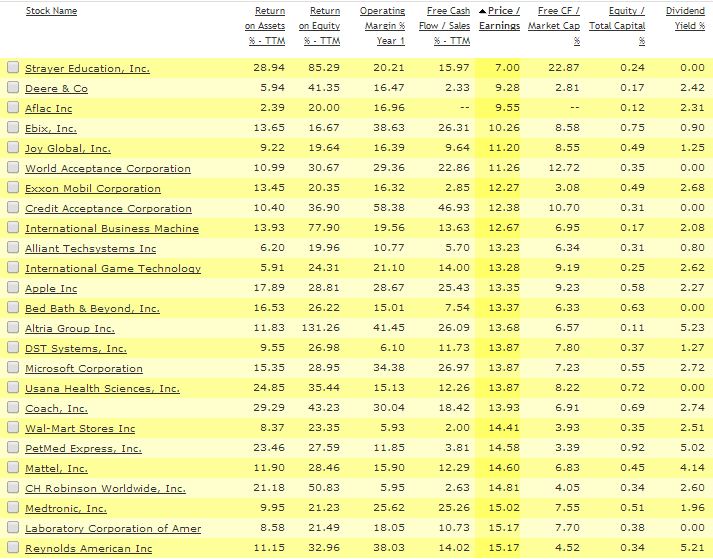
image003-14

Here is a look at the same list of 143 stocks that have produced 15% ROE in each of the past 10 years, this time sorted by highest Returns on Assets:

image003-14

1987 Berkshire Letter

Remember, all of these firms have achieved at least 15% ROE in each of the past 10 years, something 99% of public companies failed to do. This list certainly contains stocks that aren’t undervalued (many are quite expensive), but it’s probably a good list to keep an eye on from time to time, as it certainly contains a healthy amount of businesses with compounding intrinsic values.

Investing’s Biggest Irony: Everyone Thinks They’re a Contrarian

Investing’s Biggest Irony: Everyone Thinks They’re a Contrarian

By Morgan Housel | More Articles | Save For Later
February 14, 2014 | Comments (15)

Robert Shiller won the Nobel Prize in economics last year for his research on spotting market bubbles. He’s also a pioneer of behavioral finance, developing brilliant explanations for how psychology causes us to do dumb things with our money.  Read more of this post

Disclosing Adverse Earnings News and Litigation: The Importance of Large Market Declines

Disclosing Adverse Earnings News and Litigation: The Importance of Large Market Declines

Dain C. Donelson 

University of Texas at Austin – McCombs School of Business

Justin Hopkins 

University of Virginia – Darden Graduate School of Business Administration
January 27, 2014
Darden Business School Working Paper No. 2386099

Abstract: 
This study examines the legal consequences of disclosing adverse news after hours or disclosing during large market declines. The probability of litigation rises to 0.28% (from 0.16%), and settlements increase 50% over the median (by $1.7 million) when disclosure occurs during a large market decline. Disclosures issued after hours are also more likely to trigger litigation (0.36% versus 0.17%), but this is because managers disclose more adverse news during this period. In supplemental tests, we find no evidence that the timing of firm disclosures affects dismissals, or that managers delay disclosures to avoid days with large market declines. The latter result could be attributable to managers not recognizing the legal consequences to disclosing adverse news on a day where the market declines significantly because legal standards suggest that broader market forces should have no bearing on the outcome of securities litigation.

Managerial Ability and Earnings Quality

THE ACCOUNTING REVIEW American Accounting Association

Vol. 88, No. 2 DOI: 10.2308/accr-50318 2013 pp. 463–498

Managerial Ability and Earnings Quality

ABSTRACT: We examine the relation between managerial ability and earnings quality.

We find that earnings quality is positively associated with managerial ability. Specifically,

more able managers are associated with fewer subsequent restatements, higher

earnings and accruals persistence, lower errors in the bad debt provision, and higher

quality accrual estimations. The results are consistent with the premise that managers

can and do impact the quality of the judgments and estimates used to form earnings.


The Audit Committee: Management Watchdog or Personal Friend of the CEO?

THE ACCOUNTING REVIEW American Accounting Association

Vol. 89, No. 1 DOI: 10.2308/accr-50601 2014 pp. 113–145

The Audit Committee: Management Watchdog or Personal Friend of the CEO?

ABSTRACT: To ensure that audit committees provide sufficient oversight over the

auditing process and quality of financial reporting, legislators have imposed stricter

requirements on the independence of audit committee members. Although many audit

committees appear to be ‘‘fully’’ independent, anecdotal evidence suggests that CEOs

often appoint directors from their social networks. Based on a 2004 to 2008 sample of

U.S.-listed companies after the Sarbanes-Oxley Act, we find that these social ties have a

negative effect on variables that proxy for oversight quality. In particular, we find that

firms whose audit committees have ‘‘friendship’’ ties to the CEO purchase fewer audit

services and engage more in earnings management. Auditors are also less likely to issue

going-concern opinions or to report internal control weaknesses when friendship ties are

present. On the other hand, social ties formed through ‘‘advice networks’’ do not seem to

hamper the quality of audit committee oversight.


Revisiting the Make-or-Buy Decision: Conveying Information by Outsourcing to Rivals

THE ACCOUNTING REVIEW American Accounting Association

Vol. 89, No. 1 DOI: 10.2308/accr-50579 2014 pp. 61–78

Revisiting the Make-or-Buy Decision: Conveying Information by Outsourcing to Rivals

ABSTRACT: The textbook make-or-buy decision is typically described as choosing the

cheaper of the two sourcing options. However, research in accounting has consistently

demonstrated that strategic and informational considerations often complicate such

seemingly straightforward criteria. In a similar vein, this paper shows that when a firm

becomes privy to accounting information pertaining to its profitability, its sourcing choice

has powerful informational reverberations. This is because input procurement from an

outsider serves to convey both profitability information and strategic positioning.

Conveying profitability information refers to the fact that the size of the input order

provides the supplier a credible signal of the firm’s internal accounting information and,

thus, its relative ability to compete in the marketplace. Conveying strategic positioning

refers to the fact that the upfront placement of the input order also informs the supplier

about the firm’s chosen strategic choices in the marketplace. We demonstrate that both

sources of information conveyance together can point to a firm preferring to buy inputs

from a retail rival even when it can make them internally at a lower cost. This penchant

for outsourcing to a rival is more pronounced the more accurate the firm’s accounting

system.


Don’t fall in love with your stocks; Investors spend far more time searching for stocks to buy than thinking about when to sell. That is a potentially costly shortcoming, especially in a bull market

Feb. 14, 2014, 5:19 p.m. EST

Don’t fall in love with your stocks

Opinion: How to know when it’s time to sell

By Mark Hulbert, MarketWatch

Investors spend far more time searching for stocks to buy than thinking about when to sell. That is a potentially costly shortcoming, especially in a bull market that is approaching its fifth birthday, which is how old its predecessor was when it ended in 2007. Read more of this post

Seth Klarman – How Much Research and Analysis Are Sufficient?

Seth Klarman – How Much Research and Analysis Are Sufficient?

by VW StaffFebruary 15, 2014, 7:35 pm

Your Saturday night treat from From Seth Klarman’s Margin of Safety: Risk-Averse Value Investing Strategies for the Thoughtful Investor

See Seth Klarman: Investing Versus Speculation here

How Much Research and Analysis Are Sufficient?

Some investors insist on trying to obtain perfect knowledge about their impending investments, researching companies until they think they know everything there is to know about them. They study the industry and the competition, contact former employees, industry consultants, and analysts, and become personally acquainted with top management. They analyze financial statements for the past decade and stock price trends for even longer. This diligence is admirable, but it has two shortcomings. First, no matter how much research is performed, some information always remains elusive; investors have to learn to live with less than complete information. Second, even if an investor could know all the facts about an investment, he or she would not necessarily profit. Read more of this post

Knowing When It’s Time to Sell Your Favorite Stock: It can be as important as deciding to buy.

Knowing When It’s Time to Sell Your Favorite Stock

It can be as important as deciding to buy.

MARK HULBERT

Updated Feb. 14, 2014 7:19 p.m. ET

Investors spend far more time searching for stocks to buy than thinking about when to sell. That is a potentially costly shortcoming, especially in a bull market that is approaching its fifth birthday, which is how old its predecessor was when it ended in 2007. Read more of this post

Seth Klarman On Selling “The Hardest Decision of All”

Seth Klarman On Selling “The Hardest Decision of All”

by VW StaffFebruary 14, 2014, 1:47 pm

Seth Klarman On Selling ”The Hardest Decision of All”  From Seth Klarman’s Margin of Safety: Risk-Averse Value Investing Strategies for the Thoughtful Investor Read more of this post

CSIMA (Columbia Student Investment Management) Conference Notes

AGENDA

A Conversation with Bill Ackman, Pershing Square Capital Management

Moderator: Bruce Greenwald, Columbia Business School


Panel 1: Activism as a Catalyst for Unlocking Value

Jesse Cohn, Elliott Management Corporation

Scott Osfeld, JANA Partners

Tom Sandell, Sandell Asset Management

Moderator: Ken Squire, 13D Monitor and the 13D Activist Fund

Read more of this post

Lessons Learned Over Forty Years: Investing in Companies with Significant Hidden Assets (Particularly Real Estate)

Lessons Learned Over Forty Years: Investing in Companies with Significant Hidden Assets (Particularly Real Estate)

Lessons Learned: Hidden Assets

We are approaching our 40th year of publishing Asset Analysis Focus. As far as we know, we are the oldest subscription based institutionally oriented research publication on Wall Street. Read more of this post

Management Forecasts in Japan: Do Managers Accurately Estimate Costs When They Issue Management Forecasts?

Management Forecasts in Japan: Do Managers Accurately Estimate Costs When They Issue Management Forecasts?

Kenji Yasukata 

Kinki University
August 19, 2013
AAA 2014 Management Accounting Section (MAS) Meeting Paper

Abstract: 
Virtually all firms listed on Japanese stock exchanges report point forecasts of sales and earnings in their annual press releases. The availability of management forecasts in Japan provides a unique research opportunity to investigate managers’ prediction of cost behavior of their company. Forecasted costs are available by subtracting forecasted earnings from forecasted sales. Using recent “sticky cost” research methods, the forecasted rate of change in costs can be compared with the actual rate of change in costs. Specifically, I describe the forecasted rate of change in costs as a function of the forecasted rate of change in sales, and comparing the forecasted rate of change in costs with the actual rate of change in costs. The rationale for this approach is, in theory, that costs are resources sacrificed to generate sales; hence, it is generally expected that costs increase (decrease) as sales increase (decrease). Basically, focusing on the relationship between forecasted sales and costs provide deeper insights into management earnings forecasts than focusing on the forecasted earnings because earnings are the aggregated measure of sales and costs. The major findings of this paper are that managers underestimate the rate of increase in costs when sales are expected to increase; however, they tend to overestimate the rate of decrease in costs when sales are expected to decrease, indicating that costs are underestimated regardless of the forecasted direction of change in sales. These findings imply that optimistic bias in management earnings forecasts can partly be attributed to the forecast error of rate of change in costs.

From Micro-Caps to Mid-Caps, a Comprehensive Approach to Smaller Companies

From Micro-Caps to Mid-Caps, a Comprehensive Approach to Smaller Companies

by Royce FundsFebruary 12, 2014, 4:40 pm

As the small-cap asset class has grown in size, those companies just beyond the periphery of small-cap have become somewhat orphaned.

By moving up to the smid-cap space and looking down to the micro-cap space, we not only give ourselves access to an underappreciated—and inefficient—zone of the equity market, we also potentially enable some of our long-held, favored investment ideas to continue to benefit our clients as they grow beyond the smaller-company universe. Read more of this post

Entrepreneurial Ideation and Organizational Performance: Imprinting Effects

Entrepreneurial Ideation and Organizational Performance: Imprinting Effects

Charles E. Eesley 

Stanford University

David H. Hsu 

University of Pennsylvania – Management Department

Edward B. Roberts 

Massachusetts Institute of Technology (MIT) – Entrepreneurship Center
January 6, 2014

Abstract: 
How does the relationship between the organizational context for venture idea formation and venture performance depend on the venture’s founding team and business environment? Using data from a survey of 2,067 firms, we show that venture ideas emerging from research lab contexts are imprinted in a way that is better aligned with a cooperative commercialization environment. Ideas from industry contexts are aligned with a competitive commercialization environment. We contribute to prior work by showing that imprinting can come both from how a venture idea interacts with the business environment and how those ideas interact with the type of founder.


Thin Capitalization Rules and Multinational Firm Capital Structure

Thin Capitalization Rules and Multinational Firm Capital Structure

Jennifer L. Blouin 

University of Pennsylvania – Accounting Department

Harry Huizinga 

Tilburg University – Center for Economic Research (CentER); Centre for Economic Policy Research (CEPR)

Luc Laeven 

International Monetary Fund (IMF); Centre for Economic Policy Research (CEPR)

Gaetan Nicodeme 

Université Libre de Bruxelles (ULB) – Solvay Brussels School of Economics and Management
January 15, 2014
CentER Discussion Paper Series No. 2014-007

Abstract: 
This paper examines the impact of thin capitalization rules that limit the tax deductibility of interest on the capital structure of the foreign affiliates of US multinationals. We construct a new data set on thin capitalization rules in 54 countries for the period 1982-2004. Using confidential data on the internal and total leverage of foreign affiliates of US multinationals, we find that thin capitalization rules affect multinational firm capital structure in a significant way. Specifically, restrictions on an affiliate’s debt-to-assets ratio reduce this ratio on average by 1.9%, while restrictions on an affiliate’s borrowing from the parent-to-equity ratio reduce this ratio by 6.3%. Also, restrictions on borrowing from the parent reduce the affiliate’s debt to assets ratio by 0.8%, which shows that rules targeting internal leverage have an indirect effect on the overall indebtedness of affiliate firms. The impact of capitalization rules on affiliate leverage is higher if their application is automatic rather than discretionary. Furthermore, we show that thin capitalization regimes have aggregate firm effects: they reduce the firm’s aggregate interest expense bill but lower firm valuation. Overall, our results show than thin capitalization rules, which thus far have been understudied, have a substantial effect on the capital structure within multinational firms, with implications for the firm’s market valuation.


Investor Sentiment Aligned: A Powerful Predictor of Stock Returns

Investor Sentiment Aligned: A Powerful Predictor of Stock Returns

Dashan Huang 

Singapore Management University – Lee Kong Chian School of Business

Fuwei Jiang 

Singapore Management University – Lee Kong Chian School of Business

Jun Tu 

Singapore Management University – Lee Kong Chian School of Business

Guofu Zhou 

Washington University in St. Louis – Olin School of Business
September 15, 2013

Abstract: 
The widely used Baker and Wurgler (2006) sentiment index is likely to understate the predictive power of investor sentiment because their index is based on the first principal component of six sentiment proxies that may have a common noise component. In this paper, we propose a new sentiment index that is aligned for explaining stock expected returns by eliminating the noise component. We find that the aligned sentiment index has much greater power in predicting the aggregate stock market than the Baker and Wurgler (2006) index: it increases the R-squares by more than five times both in-sample and out-of-sample, and outperforms any of the well recognized macroeconomic variables. Its predictability is both statistically and economically significant. Moreover, the new index improves substantially the forecasting power for the cross-section of stock returns formed on industry, size, value, and momentum. Economically, the driving force of the predictive power of investor sentiment appears stemming from market underreaction to cash flow information.


Financial Statement Impact of IFRS Adoption: The Case of Korea and Implication for IFRS Adoption in the U.S.

Financial Statement Impact of IFRS Adoption: The Case of Korea and Implication for IFRS Adoption in the U.S.

Yoon Ho Kim 

Samsung Life Insurance

Jaywon Lee 

Korea Advanced Institute of Science and Technology (KAIST)

Sang Hyun Park 

Georgia Regents University
October 1, 2013
KAIST College of Business Working Paper Series No. 2013-033 

Abstract:      
This study investigates the financial statement impact of adopting International Financial Reporting Standards (IFRS) using a unique set of manually collected sample of Korean firms who have early-adopted IFRS. We collect approximately 90 reconciliation items and document their respective influence on asset, liability, equity and net income. Applying IFRS, asset, liability, equity and net income values all decrease. In terms of value relevance, IFRS equity values are not more value relevant than Korean GAAP (K-GAAP) values while IFRS net income values are less value relevant than K-GAAP values. In regards to earnings management, we are unable to find any significant differences between IFRS and K-GAAP. Considering that K-GAAP resembles the U.S. GAAP in many aspects, we offer some implications for IFRS adoption in the U.S.

Chief Financial Officer Power, Pay Duration, and Earnings Quality

Chief Financial Officer Power, Pay Duration, and Earnings Quality

Stacey Kaden 

University of Arkansas

Juan Manuel Sanchez 

Texas Tech University
August 16, 2013
AAA 2014 Management Accounting Section (MAS) Meeting Paper

Abstract: 
While numerous studies have examined the impact that powerful CEOs have on their compensation and overall firm decisions, relatively little is known about how powerful CFOs influence their compensation and important firm outcomes, such as earnings quality. This is somewhat surprising given the critical role CFOs play in the financial reporting process of a firm. We examine whether relatively more powerful CFOs influence the “duration” of their compensation. Our results suggest that powerful CFOs have shorter pay durations than less powerful CFOs, giving powerful CFOs faster unrestricted access to their compensation. Additionally, we examine whether powerful CFOs affect the earnings quality of the firms they manage, particularly when the incentives arising from “pay duration” are strong. We find higher levels of income-increasing accrual-based earnings management in firms with powerful CFOs who have short pay durations.


Rights Offerings, Trading, and Regulation: A Global Perspective

Rights Offerings, Trading, and Regulation: A Global Perspective

Massimo Massa 

INSEAD – Finance

Theo Vermaelen 

INSEAD – Finance

Moqi Xu 

London School of Economics & Political Science (LSE)
December 13, 2013
INSEAD Working Paper No. 2013/120/FIN

Abstract: 
We study right offerings around the world, using a sample of 8,238 rights offers announced during 1995-2008 in 69 countries. Although shareholders prefer having the option to trade rights, issuers deliberately restrict tradability in 38% of the offerings. We argue that firms restrict rights trading in order to avoid the execution risk associated with strict prospectus requirements, a prolonged and uncertain transaction process, and the potentially negative information signalled via the price of traded rights. In line with this argument, we find that issuers restricting tradability are those with more to lose from reduced participation or that are more likely to face execution risk.

Recovery from Financial Crises: Evidence from 100 Episodes

Recovery from Financial Crises: Evidence from 100 Episodes

Carmen Reinhart 

Harvard Kennedy School (HKS), Belfer Center for Science and International Affairs (BCSIA)

Kenneth Rogoff 

Harvard University – Department of Economics; National Bureau of Economic Research (NBER)
January 2014
NBER Working Paper No. w19823  Read more of this post

Restatements Sully Future Credibility: Study by SMU: Is the Decline in the Information Content of Earnings Following Restatements Short-Lived?

January 30, 2014, 4:40 PM ET

Restatements Sully Future Credibility: Study

MAXWELL MURPHY

Senior Editor

Companies that restate prior results due to accounting irregularities cause investors to tune out their future quarterly numbers, according to recently published academic research. How long they tune out, however, may be within the restating company’s control.

When companies have a material restatement, for example the result of fraud or other misconduct, their stocks tend to trade less volatilely after future earnings statements, an effect that can last nearly three years on average. But companies that take swift, decisive action can trim the investor shunning by more than half, a study in the current issue of the Accounting Review, an American Accounting Association publication, suggests.

The research, by academics at Singapore Management University and Boston College, finds that stock swings surrounding an earnings release, when the company takes little remedial action, are more muted for an average of 11 quarters after a material restatement. The researchers, who studied thousands of restating companies from the late 1990s through 2008, interpret that to mean investors are less trustworthy of the results reported by companies after accounting irregularities.

“When the company issues the earnings report, investors don’t react to the news,” says Alvis Lo, an assistant professor in the accounting department of Boston College’s Carroll School of Management who co-authored the study.

However, companies that move quickly to replace their chief executives and finance chiefs, rejigger the audit committees on their boards or outright fire their accountants, for example, can find their stocks responding more normally to earnings news within five quarters or fewer, Mr. Lo said.

More decisive action, Mr. Lo contends, “can limit the potential damage” to a company’s credibility with investors.


Is the Decline in the Information Content of Earnings Following Restatements Short-Lived?

Xia Chen 

Singapore Management University

Qiang Cheng 

Singapore Management University

Alvis K. Lo 

Boston College
June 3, 2013
The Accounting Review, January 2014, Forthcoming 

Abstract: 
Prior research finds that the decline in the information content of earnings after restatement announcements is short-lived and the earnings response coefficient (ERC) bounces back after three quarters. We re-examine this issue using a more recent and comprehensive sample of restatements. We find that material restatement firms experience a significant decrease in the ERC over a prolonged period – close to three years after restatement announcements. In contrast, other restatement firms experience a decline in the ERC for only one quarter. We further find that among material restatement firms, those that are subject to more credibility concerns and those that do not take prompt actions to improve reporting credibility experience a longer drop in the ERC. Lastly, reconciling with prior research, we find that using a more powerful proxy for material restatements and imposing less restrictive sampling requirements help increase the power of the tests to detect the long-run drop in the ERC.


How to read a 10-K like Warren Buffett

How to read a 10-K like Warren Buffett

By: Elizabeth MacBride, Special to CNBC.com

CNBC.com | Monday, 27 Jan 2014 | 10:31 AM ET

If you think you can be a great investor, you’d better enjoy working with one of the principal tools of the trade: the 10-K. Berkshire Hathaway’s Warren Buffett has said he loves to curl up with companies’ annual reports. When asked how to get smarter, Buffett once held up stacks of paper and said he “read 500 pages like this every day. That’s how knowledge builds up, like compound interest.” Read more of this post

Firms’ Strategic Disclosure of Bad News Around Debt Offerings

Firms’ Strategic Disclosure of Bad News Around Debt Offerings

Kooyul Jung 

Ulsan National Institute of Science and and Technology (UNIST)

Boyoung Kim 

Korea Advanced Institute of Science and Technology (KAIST)

Kyoungwon Mo 

Korea Advanced Institute of Science and Technology (KAIST) – College of Business
August 2013

Abstract: 
This study examines management disclosure behavior around debt offerings and its effect on the cost of debt offered. For the equity market, studies show that management disclosure of good news decreases the cost of equity. Studies also show that debt holders are more concerned with negative earnings and firm credibility. We examine this disclosure tendency of debt holders for debt offerings. We argue that firms use management forecasts of greater than zero earnings before debt offerings, and given this, they strategically tend to use bad news more than good news to increase firm credibility and reduce the cost of the debt issued. We find the results support our argument. We also find that the higher the default risk, the greater the increase in bad news forecasts (with profit) and its reduction effect in the cost of debt.

The Timing and Frequency of Corporate Disclosures

The Timing and Frequency of Corporate Disclosures

Ivan Marinovic 

Stanford Graduate School of Business

Felipe Varas 

Duke University
January 23, 2014
Rock Center for Corporate Governance at Stanford University Working Paper No. 169

Abstract: 
This paper studies dynamic disclosure in an environment with continuous flow of private and public information. In equilibrium, the manager may both preempt or withhold bad news, depending on the relative importance of litigation risk vs. disclosure costs. Consistent with the evidence, we show that the fear of setting a strong disclosure precedent, may discourage managers from disclosing their information altogether. Our paper sheds light on the puzzling relation between disclosure and litigation. We show that in the presence of litigation risk a higher intensity of public news may increase disclosure; whereas in its absence it would reduce it. Surprisingly, a higher litigation risk may make the manager better off by inducing savings on disclosure costs. Our analysis suggests that the persistence of cash flows is a key determinant of the likelihood of disclosure that has not been considered by extant empirical research.


The accuracy of equity research: Consistently wrong; Bear market or bull, analysts give bad advice

The accuracy of equity research: Consistently wrong; Bear market or bull, analysts give bad advice

Jan 18th 2014 | From the print edition

IT IS no secret that equity analysts at banks do not always give the best investment advice. In 2001 Eliot Spitzer, the attorney-general of New York state, exposed their habit of heaping praise on undeserving firms with which their colleagues hoped to do business. Some had advised clients to buy stocks they had referred to in private as “junk”, “crap” and “shit”.

But it is hard to talk up dud firms when markets are falling, and anyway, there is little business to be won at such times. So it might have been reasonable to assume that analysts’ recommendations are better in bearish markets than bullish ones. New research, alas, suggests this is not so: the advice analysts give in bad times seems to be even worse than the boosterism they peddle in good.*

Roger Loh of Singapore Management University and René Stulz of Ohio State University looked at analysts’ forecasts of profits and the buy or sell recommendations they issued for the period 1983-2011. Their predictions, it turned out, were less reliable in falling markets than in rising ones, even after making allowances for increased volatility in such times. Analysts’ forecasts of profits for the next quarter were out by 46% more during periods of financial crisis than at other times, for instance.

The drop in accuracy may be linked to cuts in research budgets. During downturns banks spend less on research. For instance, in the most recent crisis budgets were cut by around 40%, according to Neil Scarth at Frost Consulting, largely by replacing more experienced (and more expensive) analysts with younger, greener ones. The fear of being fired may also befuddle rather than focus minds.

Ironically enough, Messrs Loh and Stulz also found that investors pay more attention to analysts’ opinions when times are tough. Normally only one change in ten in analysts’ stock recommendations moves the price of the share in question. But the proportion increases to one in seven in falling markets, even though there are more changes during market routs. Just as drivers value maps more when it is foggy, investors pay more heed to research during periods of increased uncertainty, reckons Mr Stulz. Unfortunately for them, that is also when their maps are most likely to be wrong.

*Roger Loh and René Stulz, “Is sell-side research more valuable in bad times?”


How Wall Street can make a good investment bad

How Wall Street can make a good investment bad

John Waggoner, USA TODAY7 a.m. EST January 18, 2014

Can Wall Street make index funds, a good investment, into a bad one? Sure.

Index funds are a low-cost way to get exposure to stocks

Their main advantage: Low cost

Don’t buy high-cost, highly specialized, or ultra-risky index funds

If you try really hard, you can make any good thing bad, and that’s exactly what Wall Street has done to some index funds. How bad? Very bad. Let’s take a look at the worst index funds.

First: Index funds really are good things. They give you a slice of a diversified portfolio of stocks at an exceptionally low price — as little as $5 per $10,000 invested, in the case of the Admiral shares of the Vanguard 500 Index fund. The average stock fund, in contrast, will charge you $120 year, according to Lipper, which tracks the funds.

How do you make a good thing bad? Three ways:

Charge a lot for it. The overriding advantage of an index fund is its low cost. It’s hard enough for a fund manager to beat the Standard & Poor’s 500 stock index. Beating the S&P 500 by more than 1.2% year after year makes Sisyphus’ job look easy.

The most expensive S&P 500 index fund: Rydex S&P 500 H shares, which charges 1.57% in annual fees. Not surprisingly, it is also the worst-performing S&P 500 index fund the past five years. While the average S&P 500 index fund turned $10,000 into $22,494 the past five years, Rydex S&P 500 H shares turned $10,000 into $21,137 — a $1,357 difference.

Specialize it. When you invest in a broad-based index, you get the volatility of the stock market. But when you invest in a specialized index, you more volatility. In general, the specialization you get, the greater the volatility. For example, the worst 12 months for the S&P 500 the past two decades has been a 44.8% loss the 12 months ended February 2009. The financial sector clocked a 70.7% loss the same period.

The more specialized you get, the greater your chance of loss. It should be no wonder, then, that one of the worst-performing funds the past five years has been an index fund: The United States Natural Gas fund, down 88.94% the past five years.

Leverage it, specialize it, and charge a lot for it. Leverage, in the financial world, means using futures and options to supercharge returns — both up and down. Direxion Financial Bear 3X shares takes an index of financial services stocks and leverages it by 300%. Unfortunately, it bets against the index, which has risen smartly the past three years. The fund has lost 99.7% of its value the past five years. Put more graphically, it has turned $10,000 into $30. The charge for that service? About 0.95% a year.

Why do bad index funds happen to good people? Sometimes, as in the case of Rydex S&P 500 H shares, it’s because they’re sold the fund by an adviser. Other times, it’s because they are lured by the prospect of huge returns. Had you invested in the PowerShares NASDAQ Internet Portfolio five years ago, for example, you would have gained 408.6%.

But your best bet is to avoid temptation and look for the lowest-cost, most broadly diversified index fund you can find for a core holding. Three suggestions:

• Vanguard Total Stock Market, which tracks the performance of the entire stock market. The investor class shares charge 0.17% a year in expenses; the Admiral shares charge just 0.05% a year. The fund has gained 57% the past three years.

• Fidelity Spartan International Index Fund, which tracks the performance of large-company foreign stocks. The fund charges just 0.27% a year in expenses, and has gained 27% the past three years.

• Vanguard Total World Stock, which invests in an index that tracks both U.S. and foreign stock performance. The fund charges 0.35% a year and has gained 33% the past three years.


Big gains for natural gas fuel big losses for hedge funds

Big gains for natural gas fuel big losses for hedge funds

Fri, Jan 24 2014

By Barani Krishnan and Jeanine Prezioso

(Reuters) – Natural gas was the biggest gainer among commodities last year but the hedge fund that has historically led gains in the space had its first losing year, and many others were down double-digits after being on the wrong side of the market.

U.S. gas prices gained more than 26 percent in 2013, the largest rally in eight years as brutally cold weather boosted gas demand. Prices rose, and toward the end of the year, the market saw wild swings in the spread between the March and April gas contracts.

Investors suspect that natural gas hedge funds lost heavily on spread trades of the March and April contracts, after miscalculating winter and spring gas demand and price action.

Prominent funds, from the $1 billion Velite Benchmark Capital in Houston to the smaller Sasco Energy Partners in Connecticut, finished the year down about 20 percent or more, according to industry sources and performance data obtained by Reuters.

“It was a tough year without doubt for most of us. The losses were pretty broad-based,” said Kyle Cooper, managing director of research at Cypress Energy Capital Management in Houston, a small $20 million hedge fund that lost 17 percent.

Hedge funds typically do not reveal their book, so it was hard to ascertain the price bets or size of the positions laid out by the gas funds, and the trades where they lost money.

It is also unclear how funds have fared in the first weeks of this year as natural gas futures prices have surged 20 percent so far this month.

Velite ended down 25 percent, according to two sources familiar with its numbers. It was the fund’s first loss since its launch in 2006, and was also the most high-profile loss among gas funds. Velite was founded by natural gas trader David Coolidge, 49, who became the top natural gas fund manager after ex-Enron wunderkind John Arnold retired two years ago.

Velite declined comment.

Big price swings are not unusual in natural gas, but the fluctuating March-April spread caught even the most experienced traders by surprise. The spread, known as the “widowmaker” for sharp losses it has caused in the past, gyrated wildly in a 20-cent range in December as forecasters predicted milder temperatures and then arctic-like chills.

In December, the gap between March and April 2014 gas moved from 4 cents on December 4 to 19 cents on December 12, as funds expected inventories to drain by the end of the winter heating season as Arctic chills swept across the United States.

It then contracted to as low as 9 cents five days later only to blow out to 30 cents on December 23, leaving ample room for winners and losers.

INCREDIBLE VOLATILITY

This year, the market has continued to surge, with front-month gas futures hitting above $5 per million British thermal units on Friday, a peak since June 2011, after some of the coldest temperatures in two decades. Next-day gas prices in New York City rose to a record above $100 per mmBtu on Tuesday.

“We’re still having incredible volatility now,” Cooper said. “This means we could have more big losses in January, and possibly some big winners if they got it right.” He declined to say how Cypress had performed for the month so far.

Of last year’s losers, Fairfield, Connecticut-based Sasco reported a 20-percent slide on a capital of $244 million, performance data obtained by Reuters showed.

Houston-based Skylar Capital, which opened with about $100 million at the end of 2012 and is run by former Arnold protégé Bill Perkins, lost about 25 percent, industry sources said.

Copperwood, also in Houston and run by ex-Enron veteran Greg Whalley, declined about 27 percent on a capital of $800 million, two market sources said.

All the funds declined comment.

Compared to them and Velite, the average commodity-energy fund on Chicago’s Hedge Fund Research rose 1.2 percent in 2013.

WRATH OF THE WIDOWMAKER

While the widowmaker was the likely cause of pain for some funds, others prospered by avoiding it.

e360 Power, an energy fund in Austin, Texas, which also trades electrical power, profited on its gas positions by focusing on market fundamentals and “trading around the ranges and the opportunities that were presented,” said James Shrewsbury, principal at the firm. The fund, which manages $170 million, rose 47 percent on the year.

The widowmaker attracts mainly fund managers, said Julian Rundle, chief investment officer at Dorset Asset Management, which allocates money to commodity managers.

Once a fund began losing money on the trade, it was hard for it to unwind without further losses, Rundle said.

“The key point was you had to really pay up to get out of that thing.”


The Asian Superlative Horse for Value Investors: The Tale of Cosmax Vs L’Oreal

Dear Friends and All,

The Asian Superlative Horse for Value Investors: The Tale of Cosmax Vs L’Oreal

The Three Apples was on my mind in August 2007 when the Bamboo Innovator was in Seoul presenting to a group of about 50 Korean SME CEOs and the commerce minister at the KITIA-PwC conference. The first, “Eve’s apple,” the apple of morality. The second, the “Apple of Beauty,” the one which was given to Aphrodite by the Trojan prince. The third, “Newton’s apple of science”, the one that inspired Newton for the development of his theory of universal gravitation. The Three Apples is the corporate symbol of Korea’s Cosmax (Kospi: 044820 KS, MV $720 million), an ugly-duckling cosmetics company that the Bamboo Innovator decided to pay a visit amongst the over two thousand companies listed in Korea after the conference.

Cosmax was shunned by both foreign and local investors then because it doesn’t have its own brand – it does the contract manufacturing (ODM/OEM) for L’Oreal, Shu Uemura, Maybelline, J&J, Mary Kay, Amorepacific and so on. Companies with brands are the ones who command valuation premium, the veterans would sneer. The financial numbers of Cosmax was also ugly as it was undertaking a capex exercise to expand in China, depressing its profit margins while the plants are being constructed. KS (Kyung-soo) Lee (photo), founder and chairman of Cosmax, explained: “These three symbols hinged on the apple, explain the leaders, reflect exactly our industrial philosophy based on honesty, on our mission to contribute to a life more beautiful and finally on our goal for R&D.”

The Bamboo Innovator remembered the management sharing how Cosmax/KS were often advised by investors to go with the trend and venture downstream to building their own brand. Cosmax will not compete with its clients and adds value with new ODM products that are developed only after analyzing trends, KS Lee emphasized, stamping his integrity to stay independent to innovate with its own business model. The company highlighted its ability to create “formulas” and boasts that nearly all of its products are manufactured from them. One of the company’s most popular products is a gel eyeliner it devised for L’Oreal. KS had worked at Dong-A Pharmaceutical and Daewoong Pharmaceutical before starting Cosmax in 1992, then called Miroto Korea. President and CEO CH (Chul-hun) Song rose through the ranks of LG Household & Health Care’s cosmetics manufacturing division before joining Cosmax in 2004. At Cosmax’s R&D center, many heads of departments have joined Cosmax from Amorepacific, including company director Kim Joo-ho and directors Park Myeong-sam and Moon Seong-joon. Since August 2007 as the company expanded with a new factory in Shanghai (constructed in 2006 and the tipping point of commercialization in 2008) and Guangzhou, Cosmax has rose over 13-fold to a market value of $720 million from around W4,000 to W56,000, but not before enduring a gut-wrenching plunge to W1,410 in Oct 2008 during the Global Financial Crisis.

The recent exit of L’Oreal’s Garnier brand and Revlon from China and the continued success of Cosmax in China goes to highlight that beauty in Asia should not be judged skin-deep in chasing brands and pretty financial numbers. The porcelain beauty of Chinese women takes $35 billion to upkeep so exiting from such a seemingly attractive market speaks volume about the increasing difficulties faced by established western brands in China and emerging markets. L’Oreal made the surprising announcement less than two weeks ago that it is pulling its successful Garnier brand from the rapidly evolving Chinese market, which made up a little over 1% of L’Oreal’s $2 billion sales in China. The positioning of the Garnier line with relatively mass-market pricing has seen an initial promising start as the #1-selling brand in China since launching in 2006 with superstar Zhang Ziyi but it failed to gain traction as consumer grew wary of mass-market products and they no longer believe mass-market products are good for them. Revlon also said it was cutting its ailing operations in China, which account for about 2% of its total sales, and slashing more than 15% of its workforce, or 1,100 jobs, including those of 940 beauty advisers.

As hockey legend Waynes Gretzsky would say, skate to where the puck is going to be, not where it has been. The Bamboo Innovator was of the view that the profits and valuation premium in the value chain is possibly shifting to manufacturers with R&D/ODM capabilities to handle large batch orders as product lifecycle shortens and speed-to-market is crucial and there will only be a few of these companies, including Cosmax, who have the capability and capacity to handle these orders. Cosmax is capable of…

<Article snipped>

The story of Cosmax also reminded the Bamboo Innovator of an old Taoist tale of the Superlative Horse on how to find the neglected, the misunderstood opportunities, and its age-old wisdom is particularly apt as we approach the Chinese Lunar Year of the Horse at the month end of January:

Duke Mu of Chin said to Po Lo: ‘You are now advanced in years. Is there any member of your family whom I could employ to look for horses in your stead?’

Po Lo replied: ‘A good horse can be picked out by its general build and appearance. But the superlative horse – one that raises no dust and leaves no track – it is something evanescent and fleeting, elusive as thin air. The talents of my sons lie on a lower plane altogether; they can tell a good horse when they see one, but they cannot tell a Superlative Horse. I have a friend, however, one Chiu-fang Kao, a hawker of fuel and vegetables, who in things appertaining to horses is nowise my inferior. Pray see him.’

Duke Mu did so, and subsequently dispatched him on a quest for a steed. Three months later, he returned with the news that he had found one. ‘It is now in Shach’iu,’ he said.

‘What kind of a horse is it?’ asked the Duke.

‘Oh, it is a dun-coloured mare,’ was the reply.

However, the animal turned out to be a coal-black stallion. Much displeased, the Duke sent for Po Lo. ‘That friend of yours,’ he said, ‘whom I commissioned to look for a horse, has made a fine mess of it. Why, he cannot even distinguish a beast’s colour or sex. What on earth can he know about horses?’

Po Lo heaved a sigh of satisfaction. ‘Has he really got as far as that?’ he cried. ‘Ah, then he is worth ten thousand of me put together. There is no comparison between us. What Kao keeps in view is the spiritual mechanism. In making sure of the essential, he forgets the homely details; intent on the inward qualities, he loses sight of the external. ‘He sees what he wants to see, and not what he does not want to see. He looks at things he ought to look at, and neglects those that need not be looked at. So clever a judge of horses is Kao that he has it in him to judge something better than horses.’

And when the horse finally arrived, it turned out, indeed, to be a superlative animal.

his is a fabulous tale of Superlative Horses and of men who have the patience and the uncanny instinct to identify horses that raise no dust and leave no track. One cannot escape noticing the relationship among the three men – the underlying trust, the sense of self-worth, the respect for one another’s views and, of course, the obvious loyalty. In value investing, the payoff/returns might not be immediate, as in the case of Cosmax and Duke Mu’s judgment of Kao’s assessment of the Superlative Horse, and usually result in fray nerves, anxiety and unhappiness. Trust and support of one another is critical. At the Moat Report Asia and Bamboo Innovator community, which recently saw the addition of clients who raise no dust and leave no track – a secretive Singapore-based billionaire who’s a highly successful super value investor and a European-based multi-billion family office – we believe our value-add is in the authentic and independent sharing of investment opinions and views in order to get closer to the Truth – and this means that we need to take the social and business risk of being disagreeable at times. For value investing to be productive, there has to be a candid dialogue with a group of people who genuinely care for one another.

The more over-powering message, one that is relevant in our search for the resilient compounder, is that we should go beyond the external – the nice financial numbers, the certificates, the accolades, the family links and the PR – and seek out the intrinsic leadership qualities in individuals and the wide-moat of the companies.

To read the exclusive article in full to find out more about the story of Cosmax and Sa Sa (HKSE: 178 HK) and the value investing lessons from the old Taoist tale of the Superlative Horse, please visit:

Cosmax

Is Sherwin-Williams a speciality chemical maker or a vertically integrated building supplies company? The distinction makes a big difference to how the shares are valued

January 20, 2014 4:06 pm

Sherwin-Williams: rosy picture

If US paint company must give up acquisition plan, that looks like good news for shareholders

Painting by numbers is not child’s play in the case of Sherwin-Williams. The figures are equivocal for the US paint company. Is it a speciality chemical maker or a vertically integrated building supplies company? The distinction makes a big difference to how the shares are valued. Read more of this post